Category: Uncategorized

  • Investing in Your Ads

    I’ve long said that advertising is an investment, and should be treated like other investments.

    When you expect high return quickly, there is high risk. When you expect slow, consistent growth the risk is minimized.

    So I found this quote particularly interesting:

    Fact #1: From 1984 through 1995 the average stock mutual fund posted a yearly return of 12.3 percent, while the average bond mutual fund returned 9.7 percent a year.

    Fact #2: From 1984 through 1995 the average investor in a stock mutual fund earned 6.3 percent, while the average investor in a bond mutual fund earned 8 percent.

    Gary Belsky & Thomas Gilovich explain how funds can earn more than the people who own them in Why Smart People Make Big Money Mistakes and How to Correct Them:

    Rather than investing in a few well-researched mutual (ideally index) funds and holding on to them for a very long time through thick and thin – the classic “buy and hold” strategy – most people flit in and out of a whole passel of funds in an effort to maximize their returns.

    Of course, if they got into better performing funds this observation would be pointless. Apparently, the odds go down the more often the investor changes strategy.

    So, back to my comparison to advertising. Much like investors in stock funds get bored with the performance of their funds and believe changing will improve their returns, investors in advertising get bored with the performance of their advertising and believe changing strategies will improve their responses.

    In both cases, they’re usually wrong.

    Imagine how much better a good strategy could work were it given time to impact all of those people who haven’t yet been persuaded to do business with you.


  • A Marketing Lession with Jack and Magic Beans


    Jack was a poor boy who, since his father ran off with a search engine optimization specialist, only wanted to promote his family information business. Jack’s widowed mother sent him to market with their last remaining possession – an option on cattle futures. “Cash this in, Jack,” she instructed, “then we can buy another two million gross exposures for our infoproduct.

    But along the way jack met a stranger who convinced him to trade his cow futures for a new software product called “Magic Beans.”

    Its a brilliant product,” said the stranger. “Instead of paying for legitimate advertising, the Magic Beans product takes your sales letter, and cleverly replaces the verbs, then the adverbs, then the pronouns, and generates another sales letter that basically says the same thing. You embed the same keywords, link to your main site, and get fabulous search positioning.

    Thrilled at the prospect of something for nothing, or, in this case, something in exchange for his last remaining asset, Jack made the deal, and proudly went home to show his mother.

    Alas, his mother was less than thrilled. She stomped off into her room as Jack installed the Magic Beans program in his desktop.

    And I, your faithful storyteller, was able to watch Jack at work. His output magically appeared on my laptop’s screen. Would you like to see how the Magic Beans did?

    Here is part of the unedited output of the program:

    According to United States today article, Advertisers Forced to Think Manner Outside the Box, engineering is giving sellers a tally for their money. From radio devices to iPods to digital picture recording equipments (DVRs), time-pressed consumers have got many more than picks and control over what they melody up in or tune out. Even though advertizers increased disbursement 10% to $140 billion last twelvemonth as reported by Tennessees Media Intelligence, that onslaught may just be turning all selling messages into a clump of agitation that ranges no one.

    Jerry Dyas*, President of Trade Only Design Library, Inc., have been saying for old age that in today’s concern human race an enterpriser have to force the envelope with his selling message if he desires to stand up out from the competition. Dyas, a nationally recognized gross sales and selling strategian with an impressive history of drive grosses through “out-of-the-box” marketing schemes states people are hesitating to take chances.

    “Most people look to see how others marketplace and make the same,” said Dyas. “Most selling is deadening and acquires mediocre consequences so you have got to be different. Being different volition pique some people but your occupation is not to do others happy.” Throughout Dyas’ career, his empirical observation is that if selling doesn’t stand up out, only poor consequences ensue.

    But Dyas doesn’t intend to travel out of your manner to purposely antagonise people. So, what makes he intend by” pique people”? “Just make something that others wouldn’t do,” Dyas says.

    Take Measurable Solutions, a Florida-based physical therapy consulting house for illustration – one that made the Entrepreneur Hot 100 List in 2005 as one of the fastest-growing newest concerns in the nation. Their selling message that helped them hit the big-time was Get New Patients Out the Wazoo! ‘Wazoo’ may have got offended a few people, but it was one of their most successful direct mail postal cards to date.

    How do you feel about this company’s ability to deliver? Would you buy from them? Would anyone?

    Remember the words of my dear, sweet, saintly old Grandmother Fanny McKay, who once said “If it sounds too good to be true, it’s probably another case of magic beans.”


    Chuck McKay is a marketing consultant who focuses on professional practices and owner operated businesses. Questions about legitimate advertising strategies for small business may be directed to ChuckMcKay@ChuckMcKayOnLine.com.


  • Advertising Can’t Create Demand

    I don’t know which is sillier. The general public who believe that advertising can convince people to buy things they don’t need, or advertisers who endlessly search for the magic message to drive more demand for the things they’re selling.

    Each somehow believes that ads condition people to consume.

    They’re both wrong.

    Advertising doesn’t do that. Life does.

    What’s the single biggest reason that a shopper will buy barbecue sauce?

    Running out of barbecue sauce.

    Advertising will never convince someone who hates barbecue to love it. It can, however help someone in a grocery store to notice your bottle and say “Hey… I’ve been hearing about this. I think I’ll try it.

    Which means no matter how many gross ratings points you purchase this week, only a small percentage of barbecue lovers will also be purchasing this week. Your mission is to make ’em think of your brand the next time they go shopping.

    Side note: both groups of silly people (general public and uninformed advertisers) believe advertising works, but only on other people. Never on them.


  • Learning the Hard Way

    Over the years I’ve watched various clients experience hard drive failure complicated by lack of data backup. Its an ugly thing to watch as a business owner discovers that his most valuable assett, his client records, are gone.

    To make sure that doesn’t happen to me, I backup everything to an external drive that can plug into any USB port on any other computer. Unfortunately, I’ve also given in to the temptation to “do it tomorrow.”

    This afternoon, while reaching for the phone, I spilled half a cup of coffee into the keyboard of my laptop, which promptly stopped working. I’m embarrassed to admit that my most recent backup was two weeks ago.

    I spent the afternoon learning about data recovery, and thanks to my new friends at a local computer repair facility I have all of the files I’ve been working on this week restored to my external drive and accessible from older computer I keep for emergencies.

    I was lucky. This could have been ugly. I’m implementing a daily backup regimen.

    How about you? Are you backing up daily? Weekly? Whenever you think what you’re working on is important? Whenever you have the time?

    Got any hard drive failure horror stories to share?


  • The Golden Rule, as You Know, is Flawed.

    The Golden Rule instructs us to treat other people in the ways we’d like to be treated.

    But that assumes everyone else would have to want exactly what we want, doesn’t it?

    Personally, I love a good discussion. I enjoy the differences in perception that bring people to different conclusions. I have a friend who considers this arguing, and finds it offensive. She prefers for everyone to “get along” and say only positive, reaffirming statements, or to say nothing.

    So, if I treat her as I’d like to be treated, challenging her conclusions, she would likely consider that to be a most unfriendly thing to do.

    The Golden Rule has a variant in business called Exceed Customer Expectations.

    Unfortunately too many small businesses try to exceed expectations in ways that are easy for the business. Just because its convenient for the business owner, (or better yet, cheap) doesn’t mean your customer will think kindly of your effort.

    Exceeding Customer Expectations doesn’t count if its not something your customers want.

    When your customer picks up his order, will he really appreciate the laminated wallet sized 2007 calendar with your business name on it? Yes, you got a great price. Yes, people need calendars. No, this doesn’t count as Exceeding Customer Expectations.

    How could you treat customers in ways that are easy, meaningful, and convenient for them?

    Ask. Then listen to their answers.

    That’s why Enterprise Rent A Car brings the car to you. They understand that when you need a car you probably also need a ride to get to the rental place. Avis, Alamo, or Hertz could have just as easily come up with this benefit if they had been talking to their customers.

    Why do you suppose Washington Mutual doesn’t charge for WaMu checking accounts? Trust me, they’re more than making up for the loss of those small fees by using the float on all of the cash deposited in all of the new accounts opened by people who like no fee checking.

    So here’s my recommendation: ask one simple question to your customers. “What do you hate about (my business category)?” Not “What do you hate about ABC Printing,” but “What do you hate about printers?”

    When people tell you they hate that print shops are notoriously late delivering printing, you know exactly how to Exceed Customer Expectations in a way that’s easy, meaningful, and convenient for your customers.

    Imagine the reputation you’d create by always delivering your customers’ printing a day or two early. That’s exactly how companies like MyCreativeShop do it!

    Listen to your customers.

    Anticipate their desires. Provide personal, added value service. And watch them move more business to you as they grow to trust you with all of it.

    Your Guide,
    Chuck McKay

    Your Fishing for Customers guide, Chuck McKay, gets people to buy more of what you sell.

    Got questions about what people hate, or at least resent, about your business category? Drop Chuck a note at ChuckMcKay@ChuckMcKayOnLine.com. Or call him at 317-2073-0028.

  • Drive Ins, Car Dealerships, and Forces Beyond Our Control

    Two miles north of Willison, North Dakota is the intersection of U.S. Highway 2 and U.S. Highway 52. Like many communities over the years the downtown area with its small buildings and limited parking has stagnated as business has moved to that intersection north of town.

    But, at the time in question, circa 1968, the only business at that intersection was Keenan’s Restaurant. Keenan’s was an old fashioned drive in, with car hops who brought your order to your car on a tray that suspended from the driver’s window. The menu ranged from basic burgers and fries to “21 shrimp in a basket.”

    Remember, to get to Keenan’s it was necessary to drive two miles away from the city center and every other restaurant in town. People didn’t just drive by and pull in on a whim.

    At that time the hottest chain restaurant in the midwest was the Country Kitchen. One of their stores went in next door to Keenan’s. Comparatively it was huge, with seating for 90, which made it even bigger than the truck stop restaurant on the other side of town.

    People flocked to the new place. During peak periods the long line of waiting folks spilled from the lobby, through the front door, and wrapped partially around the building.

    The conventional wisdom spelled “doom” for Keenan’s. Who would want to stay in their own cars instead of being served as welcome guests in a brand new comfortable, restaurant with much broader menu choices?

    Still, there was that long line of people.

    As much as people are willing to stand in line for an unusual experience (think Disney), each repetition of that experience makes standing in line less appealing for most of us.

    It didn’t take long for hungry diners, having driven that far out of town, to see the line, look at Keenan’s half empty parking lot, and say “You know, Keenan’s food always was pretty good.

    Instead of losing business, Keenan’s thrived with the new competitor next door.

    So, a new competitor doesn’t mean loss of business?

    It certainly can. Much of that possibility depends on the way the legacy business responds to the newcomer.

    Its too easy to blame forces outside our control for any decline in business. And, to the extent that we, as business owners, assume we’re helpless against circumstances, we will be.

    Suppose you operate an office supply store, and another office supply store opens across the street. If you do nothing, it is likely that your revenues (and profits) will decline.

    But suppose you welcomed the new competition as an additional traffic source for your store? Would that change the way you operate?

    This is why car dealerships tend to locate next to one another. In the mind of the shopper, isn’t it easier to compete with two or three other dealerships next door and across the street, than with a dozen scattered all over town? And aren’t people more likely to comparison shop when you make it easy.

    Does any dealership actually sell a car to even half of the prospective buyers who visit their lot? Humm. So, just by being convenient, another dealership will benefit from all of the non-sales next door.

    How do your customers see you reacting?

    Knowing you’re being compared to a direct competitor should help you to focus on providing a better shopping experience for your existing customers. That will make your company more attractive to prospective customers as well.

    But a business owner who places the blame for changing conditions as outside his control is surrendering power. The very act of assuming he has no control reduces his ability to compete.

    He has total control over conditions inside his business. He has control over his staff and their efficiency. He has control over the level of care and attention his customers feel. He has control over his inventory. He even has control over his own marketing messages.

    Are you facing new competition? Your time and focus must be occupied by those things you can control. Do it well, and watch your business (and your bottom line) improve over the way things were when you “owned” your location.

    Your Guide,
    Chuck McKay

    Your Fishing for Customers guide, Chuck McKay, gets people to buy more of what you sell.

    Got questions about the conditions under your control? Drop Chuck a note at ChuckMcKay@ChuckMcKayOnLine.com. Or call him at 317-2073-0028.

  • Communications Theory

    Years ago, while I was conducting sales training classes, I noticed that the attendees eyes all glazed over at the same point in the training. There were two ways I could have reacted.

    I could have said “Why do I keep getting the stupid trainees?” Or, I could have said, “I need to re-write this material.

    I chose “B.”

    When I changed “This is a mutually beneficial marketing opportunity,” to “This deal is good for both of us,” I saw their heads nod in agreement.

    But, please notice I simplified the vocabulary, not the concepts. That’s an important point, because your prospects are smarter than you’ve been giving them credit for being.

    How many times have you heard it said that to be successful your ads, your brochures, your instructions should be written at an eighth grade level? Have you interpreted that as “write for dumb people?”

    You shouldn’t.

    Talk to people in the words they use.

    Its been demonstrated that the average adult in the U.S. Has a vocabulary in excess of 30,000 words, but uses fewer than 1,000 in daily conversation. My own experience with small children and adults who are learning English as a second language indicates that meaningful conversation can occur with approximately 300 words.

    So, which words should you choose for communication with you prospects and customers? The simple words. The short, unambiguous, commonly used and easily understandable words. The words they use everyday in other conversations.

    But don’t dumb down what you need to say. That makes for poor communication, too.

    Earlier this week I read (again) how important it is to keep communications to arbitrary lengths. A press release must be no more than 360 words. A blog post no more than 170. No article or essay to be posted on the web should exceed 800 words. Why? Because people won’t stay focused for more than three or four minutes. At least, that’s the theory.

    And yet, we still have bestsellers lists of novels, business books, technical instruction – how many of them run more than 300 words? No kidding? All of them (he asked, his virtual voice dripping with sarcasm)? Most have three hundred times that many. And people keep buying (and reading) them.

    These people who won’t stay focused for more than a few minutes are still purchasing movie tickets, watching televised sporting events, and attending lectures. They’re buying and reading magazines, and learning to speak other languages (with vocabularies in excess of 300 words, no doubt).

    Let me propose an alternate theory.

    People have short attention spans when you’re boring them.

    If you have to limit your blog posts to 170 words its because at an average reading rate that’s the limit of people’s attention spans to badly written communications. If you can’t hold the attention of a reader for more than 360 words, its probably because you have nothing to say, you’re saying it badly, or you’re not expressing yourself in the words that make for easy conversation.

    People’s attention spans aren’t limited to three or four minutes when what you have to say is meaningful. People are just not willing to be bored.

    So, how do you stay interesting? There’s no getting around that you have to write about things your audience wishes to read about. But, assuming your content might be meainingful, when you have the choice, choose Anglo-Saxon rather than Latin words.

    Choose “let,” rather than “permit.” Choose “make” instead of “manufacture.” They’re easier to spell and easier to understand. They are the words people naturally use in their own conversations. As Winston Churchill said “Short words are best and the old words when short are best of all.”

    Richard Lederer, in The Case for Short Words, said “Short words are bright like sparks that glow in the night, prompt like the dawn that greets the day, sharp like the blade of a knife, hot like salt tears that scald the cheek, quick like moths that flit from flame to flame, and terse like the dart and sting of a bee.”

    Emotionally powerful, isn’t it? And yet, these are words the average three-year-old understands.

    Did you notice that every one of those words was a single syllable long? Did you feel the writer had “dumbed it down?” Or could you actually feel that sharp blade and those salty tears?

    Effective Communications.

    If you have something to say, say it succinctly, say it emotionally, say it in ways that maximize understanding. Say it in simple, direct words. They are the shortest distance between two minds. And use as many words as it takes to make your point.

    If you have nothing to say, by all means limit yourself to 170 words.

    Your Guide,
    Chuck McKay

    Your Fishing for Customers guide, Chuck McKay, gets people to buy more of what you sell.

    Got questions about communicating in the way people wish to communicate? Drop Chuck a note at ChuckMcKay@ChuckMcKayOnLine.com. Or call him at 317-2073-0028.

  • How To Measure Anything

    For years I’ve toyed with the idea of writing a book on common sense market research and analysis. There’s no longer any need for me to do so, since Doug Hubbard has already written it.

    How to Measure Anything: Finding the Value of “Intangibles” in Business by Douglas W. Hubbard will change the way you look at what you don’t know, because of what you do know.

    According to Hubbard, it’s all about uncertainty reduction, which is the basis for all exact science. How much do you know now? Express it in terms that represent your uncertainty.

    Hubbard calls his studies Applied Information Economics. People who hire him are eager to understand exactly how to calculate the values of an intangible – customer satisfaction, the value of public health, or the financial risk in a new IT investment, for instance.

    Applied Information Economics is showing up in the most interesting places. The U.S. Marine Corps, for instance, hired Hubbard to create a way to forecast fuel requirements for battle, which is presently being used in the war in Iraq. Hubbard’s methodology reduced their previous forecasting error by more than half.

    I like this book for much the same reason that I enjoyed Freakonomics: the key to finding the answer you seek is in asking the right question. Chapter two – Eratosthenes, Enrico & Emily – is my favorite chapter, probably because he quotes from one of my own Wizard of Ads ® case studies.

    Who’d have thought that you can measure customer satisfaction, or the value of happiness?

    If you’ve ever wondered how much to charge for a product, or whether your branding campaign is generating a positive ROI, you’re going to enjoy How To Measure Anything.

    Your Guide,
    Chuck McKay

    Your Fishing for Customers guide, Chuck McKay, gets people to buy more of what you sell.

    Got questions about gathering information about your market and competitors? Drop Chuck a note at ChuckMcKay@ChuckMcKayOnLine.com. Or call him at 317-2073-0028.

  • A Blues Band, Elvis, and an Affiliate Program

    A number of years ago, I wrote a business plan for a blues band, of which I was the bass player. When I took a job in a community across the country, I re-wrote the plan, wrote some marketing materials which explained the music we played, and started working the plan and seeking bookings for my new band.

    I also started interviewing musicians.

    A guitarist that seemed to be a good choice told me that I was either trying to scam potential employers, or was an idiot. “You can’t book a band that doesn’t exist,” Jim insisted.

    I asked how many gigs he’d been paid for in the last year. “Well,” he said, “I’m still having trouble finding the right musicians.”

    But Jim, you’ve been trying to form your own band and rehearsing with various musicians for… how long,” I asked? “Two years? No kidding? Two years with no pay at all. Do you think that you could learn some classic blues songs if I give you the lead sheets? You already know those songs? Great. Then a couple of run throughs with the rest of the band should be enough to get you comfortable. We have six paying gigs lined up. They pay seventy bucks, each. Wanna play?

    I was reminded of this incident in a conversation with an Elvis fan.

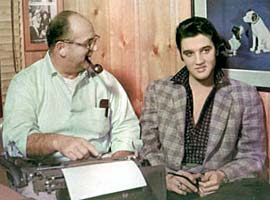
    The fan explained Colonel Tom Parker had been charging 50 percent of Elvis’ income for managing the star. The fan believed that the Colonel had taken advantage of Elvis. Apparently its a commonly held belief. “Where would he have been if he hadn’t been lucky enough to hook up with Elvis,” the fan wanted to know?

    I know exactly where he’d be.

    It helps to understand who Colonel Tom was. The Colonel was born Andreas Cornelius van Kuijk in June of 1909 in Breda, Netherlands, the fifth of eleven children. After graduating from high school, he relocated to the U.S. and volunteered for the U.S. Army. Following his discharge he changed his name to Tom Parker, lived as a hobo, and joined the circus as a carny for Royal Amusement Shows.

    In the early 1940s he worked as an ASPCA dog catcher, and pet cemetery proprietor in Tampa, Florida. As a dogcatcher, Parker put his circus training to use. He gathered the pups from several dogs, placed them all with one mother, and called a reporter from the Tribune to report a single dog had just given birth to 21 puppies. Apparently he did this more than once, and got press each time.

    His first job as a show business manager began in 1944 when he took over the career of country singer Eddie Arnold. By the end of 1947 Arnold had been number one on the country charts for 53 weeks. When Parker and Arnold separated he began booking country star Hank Snow, taking over as Snow’s manager in 1955. He began hiring a Memphis rocker named Elvis Presley as Snow’s opening act.

    Presley was unhappy with the direction of his career.

    Presley sought Parker’s advice. Parker told the young Presley he could be a star, if he’d hire the Colonel as his manager. Parker also told Presley it would cost him 50 percent of all future income. They couldn’t sign a contract because Elvis was still represented by a man named Bob Neal. They shook hands, and went without a written contract until Presley died in 1977.

    As Presley’s “special advisor” Parker negotiated Elvis’ recording contract with RCA Victor, insisting that Elvis would have final choice of all of the songs on the album. In 1956 Elvis ended his relationship with Neal, and Parker officially became Presley’s personal manager. By the end of their first year together the Wall Street Journal noted that Elvis had grossed $22 million in merchandise sales alone. (Another bit of circus influence, no doubt).

    It was Parker who landed Presley in all of those Hal Wallace movies in the 60s. It was Parker who came up with the idea of soundtrack albums from those films, which Elvis fans snapped up as fast as they were released.

    When popular music had changed, and the public had seemingly grown tired of Presley, Parker promoted Elvis’ sagging career through the first worldwide performance via satellite. That particular show was seen by one and a half BILLION people in 40 countries, returning Presley’s status as a top concert draw, and keeping him at the top until his death.

    So, to answer the fan’s question, where would Parker have been without Elvis? He’d have been taking some other performer to the top.

    The Colonel wasn’t lucky to have found Elvis. Elvis was lucky to have found the Colonel.

    Let’s change gears for a moment.

    Pretend that you’ve been selling your widget for $10 each. Along comes Sammy Salesweasel, who offers you $15 each for all you can supply him with.

    Do you care who he’s selling them to? Does it matter how much he sells them for? If he can sell them for $50 each in a new market that he’s developed, doesn’t he deserve the profit? Especially since you’re now even more profitable?

    One of my clients sells his service from his web site. He has an “affiliate program,” in which other sites sell his service and keep 65 percent of the revenue. Is this fair? Is it unfair? Are they sales he could have generated on his own?

    My client believes 35 percent of sales he’d never have had to be pure profit. By letting the affiliate keep twice as much money as he keeps himself, he gets a highly motivated affiliate selling his service.

    So here’s the lesson.

    The lesson from the affiliate program, from Elvis’ relationship with the Colonel, and even from Chuck’s blues band is simple: Don’t begrudge the marketer.

    The critical question isn’t “what’s my percentage? The question you should be asking is, “What’s my return on investment?

    When you find someone who can make you money, count the dollars deposited into your bank account, the dollars it cost you to produce, and do the math.

    Is 85 percent of “not much” better than 50 percent of “a lot?”

    Your Guide,
    Chuck McKay

    Your Fishing for Customers guide, Chuck McKay, gets people to buy more of what you sell.

    Got questions about finding new markets for what you sell? Drop Chuck a note at ChuckMcKay@ChuckMcKayOnLine.com. Or call him at 317-2073-0028.

  • Warren Buffet Digs a Well


    Warren Buffet is the world’s most successful investor. Probably because of two personal characteristics that come close to defining his investing philosophy.

    He doesn’t diversify.

    And he refuses to “hedge his bets.”

    You’ll note Berkshire Hathaway’s holdings are in fewer than three dozen companies, spread over a very few industries.

    Although I’ve never spoken to Mr. Buffet, I have read several analyses of his investment strategies. I’m told he doesn’t worry about diversification, because he heavily researches each investment. Hedging his bets by spreading the risk between additional companies would actually increase his risk, by forcing him to select companies less likely to succeed.

    Isn’t there an advertising investment parallel here?

    Why, yes. Yes, there is.

    Spreading the budget between as many opportunities as you can afford insures that the best you’ll ever get is average.

    The likelihood is you won’t even make it to average.

    I found a story to illustrate the concept in a book by Anthony Putman called Marketing Your Services. He tells of a farmer whose crops were drying out from lack of rain.

    The farmer started digging a well. He dug to 50 feet, gave up and covered up the hole. The next day he chose another location and dug again. By the end of the day he’d again hit the 50 foot mark, gave up, and filled in the hole.

    This continued for 17 days before he admitted defeat and sold the farm.

    The new buyer dug a well to 50 feet, and stopped for the day. The following day he returned to the same hole, and dug to 80 feet before stopping. On the third day, at 85 feet, he struck water. The water filled the well. That well provided all of the water the crops needed.

    The Parallel?

    Spending dollars on Google’s AdWords, a few banner ads, on search engine optimization, a small schedule in the newspaper, and a few bucks on a couple of radio stations, and the six o’clock TV news is rather similar to digging new wells, isn’t it?

    If any of the media you’re dabbling in might have actually delivered, you’ve already cut off the funding at 50 feet in order to finance a different attempt to reach people.

    You can’t afford to keep digging dry wells.

    You only need one good source of water, or customers, so long as it’s tapped into an unlimited supply.

    So, back to Warren Buffet, who consistently digs deep enough to find water each time he digs. But then, he does the required homework. Its his full-time job. He hires managers to run the companies he buys.

    You probably don’t have the resources to hire managers to run your company.

    Could you find someone to research and allocate your advertising investments, while you’re fishing for customers?

    Your Guide,
    Chuck McKay

    Your Fishing for Customers guide, Chuck McKay, gets people to buy more of what you sell.

    Got questions about allocating marketing budgets? Interestingly, Chuck is well informed on that topic. Drop him a note at ChuckMcKay@ChuckMcKayOnLine.com. Or call him at 317-2073-0028.