Category: Uncategorized

  • What’s Your Story?

    When we talk about building your brand we always project into the future, and what your brand will become.

    Customers need time to buy, and use, and make your product part of their lives. It takes time for one generation to introduce your product to the next generation. It takes time to develop your company’s heritage. That heritage will then become a major part of your brand.

    Heritage implies tradition, and a traditional way of life. Heritage includes history, but also status, class, and character. Heritage has value to this generation, and to future generations. Heritage grows in shared experiences and common history.

    Brands share their heritage in the form of meaningful, memorable, and relevant brand stories.

    People love good stories.

    Our cultural heritage is built around stories. Our great art involves stories. Our politics revolve around stories.

    Today, with more entertainment choices available than any time in history, people still choose to be entertained by great stories of other human beings. Side note: the huge impact of reality programming just goes to show that today’s taste in gossip – or should I say storytelling – tends to run toward unvarnished “truth.”

    Ah. Truth. Truth is subjective, isn’t it? During the last election which story got more traction? The story being told about John Kerry’s military service in Cambodia? Or the story being told about George Bush’s military service in Alabama? Which was the truth? Was either? Both?

    People love a good story.

    Do you need a story? If you’re determined to develop a brand, you do.

    Good brand stories involve the user, and do so on an emotional basis. Your brand story must not be about the product.

    A name by itself, although it may have recognition, isn’t a brand. Your brand must be more than a name. Your brand will become the sum of the values, the beliefs, and the actions of your company. Your brand story will be tempered by the experiences of customers in dealing with your company.

    Good brand stories capture both the essence of a brand, and its desires for the future. Your brand story will tell the truth about your company. Maybe it won’t be today’s truth. Maybe it will be a truth that your company aspires to.

    Disney’s brand story involves the past, present, and future. The past is portrayed as the ideal community with clean streets where no one is ever threatened. It’s present is safe, secure, and happy. In Disney’s future you’ll never grow old, get sick, or die.

    Oprah’s brand story is that of American women’s best friend. Her show is made up of the back-and-forth conversation with emphasis on self-revealing intimacies that is the basis of female friendship.

    McDonald’s brand story is one of families having fun together. A family outing to McDonald’s becomes a celebration. The food is secondary.

    Your brand story must be consistent with everything your company does. Terrible things happen when the story you tell is contradicted by your actions. For instance, here is a different version of a brand story. You’ve no doubt seen it in your e-mail.

    “When you forward this e-mail to friends, Microsoft can and will track it (if you are a Microsoft Windows user) for a two week time period. For every person that you forward this e-mail to, Microsoft will pay you $245.00, for every person that you sent it to that forwards it on, Microsoft will pay you $243.00 and for every third person that receives it, you will be paid $241.00 Within two weeks, Microsoft will contact you for your address and send you a cheque.”

    Putting aside for a moment the realization that there are always going to be people who WANT to believe in fairies, in getting rich quickly, and in outrageous claims, why does this particular fraud continue to show up in our in-boxes? Perhaps it’s because many of us resent Microsoft.

    Microsoft’s brand story is one of a rich company ruthlessly annihilating any and all competitors to maintain a monopoly.

    Which leads to one more critical part of the equation: you get to write your brand story, but it won’t spread without the enthusiastic help of the ultimate users of whatever it is you sell. Brand stories originate with your company, but they belong to your customers. Once you’ve put your story into the marketplace, its’ no longer under your control.

    We started this discussion by addressing folk heritage. The common stories of our heritage are what identify us as a people. The common stories of our heritage live in our minds, but even more deeply in our hearts. Brand stories become a major part of our common heritage.

    When a motion picture, or a vacation destination, or an automobile, or a celebrity, or even a cleaning product becomes successfully attached to a powerful brand story, it enters our minds through our hearts to become imbedded in our memories. That’s when it becomes a brand.

    Share This Page With A Friend

  • Media’s Dirty Little Secret

    I’m constantly amazed by all of the media reps from all of the different media outlets that can help your advertising to “reach the right people.”

    Why am I amazed?

    Because they all reach the same people.

    Don’t believe me? Start with radio – there’s more information available, and the radio reps are eager to share it.

    Ask ‘em for exclusive cume figures. (Cume is the cumulative total of different people who tune in to the station each week. Exclusive cumes are people who don’t listen to any other radio station).

    You’ll find, as I have, that the exclusive percentage is usually around 3% – 4%.

    Occasionally you’ll find a truly unique format, like Christian, or Classical, or Korean. In these situations you may find exclusive cumes as high as 15%. But as rare as those formats are, exclusivity is even more rare.

    Television? TV is harder to demonstrate, since people tend to watch programs instead of stations. However, that fact alone should make my case. No television station ever has an exclusive audience.

    Newspapers? Not them either.

    And not outdoor, or cable, or point of purchase, or “specialty” advertising (like calendars or pens or Rubic’s Cubes with your name on ‘em).

    Nope. Absolutely no medium, absolutely no media outlet, has an exclusive hold on the right people.

    With only minor variations, everyone is reaching the same audience. According to Wizard of Ads research, approximately 70% of all of the radio stations in America, for instance, are suitable for advertising whatever you offer.

    And yet, we keep listening to the “We’ve got the right people” pitch. We want to believe it. We want to believe that just a simple minor modification to what we’re already doing will make us incredibly successful. “We have a great offer. We just need to reach the right people.”

    So we let the media reps perpetuate this nonsense.

    We should hold them accountable for consultation on improving the impact of our messages.

    Instead, we let them convince us that folks who read their newspaper, or watch their TV station, or listen to their radio station, or view their outdoor ads are the right people.

    And they’re wrong.

    No need to fuss at ‘em. Most are just repeating what they’ve been told. But they are wrong, none the less.

    They don’t have a lock on the right people. They share the right people with every other media outlet in town.

    Please don’t misunderstand. I’m not saying that it doesn’t matter where you place your ads. It does matter.

    But not for the reason you’ve grown accustomed to hearing.

    It matters because one exposure to an ad almost never leads to a sale. Regardless of the medium you choose, your ad needs to be repeated a number of times each week to make acceptable impact.

    The correct media outlets are those that allow you enough exposures while staying within your budget. In other words: the less expensive choices.

    They may well be the smallest media outlets in the market.

    Can you reach enough people this way? You tell me.

    How many additional sales each week do you need to reach your goal? Ten? Fifty? If you get the same response as direct mail and most internet sites, about two percent of the audience will purchase.

    So for ten additional sales, you need to reach an audience of only 500. Is there a newspaper that doesn’t reach 500 people? A radio station? A billboard? A cable tv system?

    For fifty more sales you’ll need an audience of only 2,500 – assuming that your offer interests them. It pretty much always costs less to reach 2,500 potential customers twenty times, than to reach 50,000 once. And as we said, very few things will sell on the strength of a single exposure to your ad.

    Face it. Ninety-eight percent of the people in any audience have minimal interest in what you’re selling. How do you reach the two percent who are interested?

    You write better ads. Then you put those ads into an efficient media buy.

    You write ads that appeal to the right people.

    But that’s a subject for next time.


    Send This Page To A Friend

  • Reading Comprehension At 70 MPH

    Ben Franklin is reported to have once written “I apologize for the length of this letter. I didn’t have time to write a short one.”

    I chose Ben’s quote for our on-going discussion of advertising to draw attention to a basic truism: it takes more skill to craft a six word outdoor message than it does to write a 180 word radio commercial, or a quarter-page newspaper ad.

    Why six words? Because in order to see those words one usually glances at the “board” while doing 45 miles per hour down a city street (simultaneously watching for traffic) or while tooling down the highway at 70 mph. This requires the message to be short, simple, and easily comprehended.

    Perhaps six words are too restricting. Maybe eight words will work. Maybe eleven. But if you’re using eleven words, they’d better be short words. And short and simple, by themselves, aren’t enough. The key is to make those few words attention-getting, and memorable. This is where 99% of the outdoor advertising examples you and I see just don’t cut it. (Remind me sometime to rant about visual clichés).

    According to the Institute of Outdoor Advertising, outdoor has the ability to “generate awareness, create interest, and sell your product/service.” That was what IOA’s VP of Research, Cathy Hodges, told me in a letter 20 years ago. (Yes, I am an information pack rat. Yes, I really do still have the material she graciously sent May 2, 1985).

    In fact, the research indicates that with a 50 showing, over a four week schedule, you’ll reach nearly 80% of the adults in your market more than 13 times. There’s no doubt that outdoor advertising is the most cost-effective way to reach large numbers of people.

    Major national advertisers can use a short statement to reinforce the message they’re sending over other forms of mass media. We’ve all seen McDonalds, or Budweiser, or Ford extend the impact of their television with outdoor as a “reminder,” to build frequency.

    Other national advertisers market image, and don’t make a direct promise: Marlboro, Black Velvet, Chanel No. 5, or Coors Lite. Sometimes a strong outdoor showing is the only medium necessary to promote that image and build awareness.

    And on a local level, other media sometimes provide the best examples of how to effectively use outdoor. “Burt Smith, Accuweather, Channel Six at Ten,” for example.

    But for most local advertisers, outdoor isn’t a good choice.

    It’s that six-to-eleven-word practical limitation.

    More words mean less readership. Fewer words make it much harder to craft a strong message. Writing effective copy for billboards requires incredible skill.

    Today, however, we shall not dwell on the negative. Let me instead share with you of several gems that I saw as I drove North on I-35 from Wizard of Ads ® Headquarters South of Austin to my home West of Fort Worth.

    I saw hundreds of boards on this four and a half hour trip. Sadly, there are only six examples worth remembering.

    Those that I don’t remember? Several dozen real estate developments, all with pretty houses and such memorable messages as “Pinecrest, from the $180’s.” Car dealers bragging that they “will not be undersold.” Indistinguishable restaurant after indistinguishable restaurant after indistinguishable restaurant.

    But six that did stand out are excellent. Let’s look at them, shall we?

    First, my favorite use of outdoor – to give directions. Oh, you can add the promise of a benefit? So much the better.

    I appreciated this board for the touch of subtlety in it’s implied promise. Additionally, the Best Western logo was wrapped around the globe. Obviously, Best Western is everywhere. Excellent imagery:


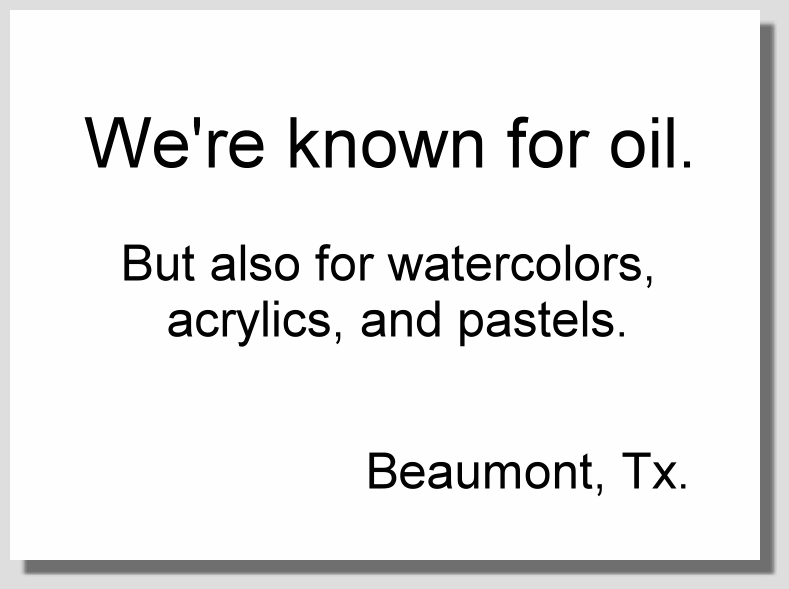
    Somewhere in Beaumont, Texas, a writer in the Visitor’s Bureau deserves a raise. Over a photo of the sun setting on the water:

    Some of the best radio and television ads are public service announcements. That’s not surprising. Effective advertising involves emotions. Most writers admit that the easiest ads involve issues about which people are already emotional.

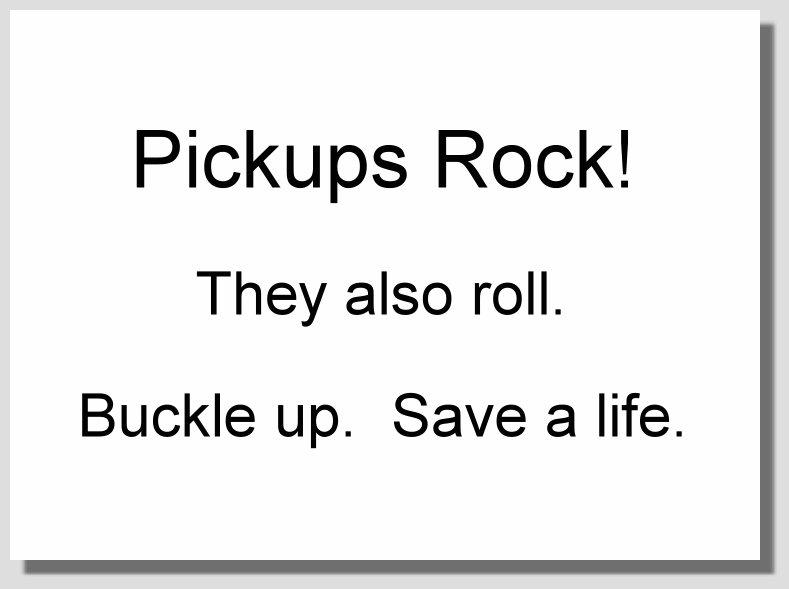
    Here’s the outdoor version of a public service announcement. Next to a graphic of an upside-down truck it said:

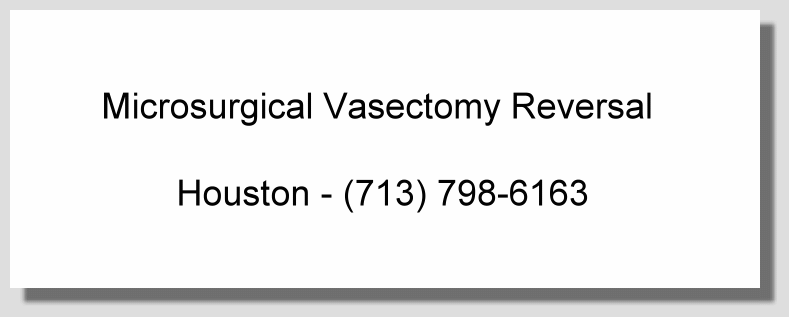
    Appreciate this next one for it’s simplicity. This board has been posted on major thoroughfares throughout the South for the last decade. Apparently gentlemen from Atlanta to El Paso have proven to be willing to travel to Houston for the procedure:

    This is too good an idea to not use locally. Chris Gloede, in his Rants On Modern Marketing blog suggests that with the proliferation of cell phones, a billboard is a great place to post a number to call for special offers or more information. It’s an idea worth stealing. Be sure to send Chris a “Thank you” note.

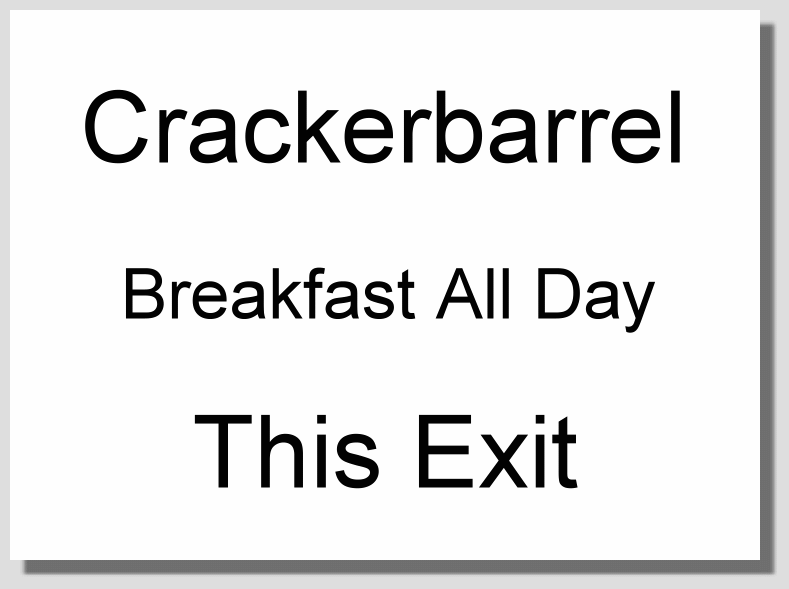
    And my final example, this board combines a strong implied benefit, with an excellent name, all wrapped up with a direction. As a bonus, the name (Bush’s Quick Chicken) and the implied benefit (three lane drive through) both promise the same thing… that I only have to pull off the road for a minute. Brilliant use of the medium. This board is my favorite of the whole trip:

    Considering outdoor? The cost of exposure isn’t the most important question. A much more important question is “Can I make an elegantly simple presentation of my business in only a few words?

    Well, can you?

    Send This Page To A Friend

  • Wishin’ Don’t Make It So

    Advertising can not fix a broken business. Oh, you might draw potential customers the first time through advertising, but from that point on it’s pretty much that customer’s Personal Experience Factor that determines whether she’ll be back, or not.

    Advertising can’t correct your company’s problems, either. As my dear, sweet, saintly old grandmother, Fanny McKay, used to say: “Wishin’ don’t make it so, and neither do massive amounts of gross ratings points.”

    Today brought to conclusion a 26 week test that further proves this point.

    Here are the facts:

    • The advertiser is a gentleman who came out of retirement to operate a small service business.
    • He truly is a craftsman.
    • He doesn’t intend to work many hours. He’s open from 9:30 am to 2:00 pm, and never open on weekends.
    • He didn’t spend much to buy the business, possibly because of its location.
    • He has a horrid location.
    • We wrote good ads, and explained that the odd hours were the price you paid for the excellent quality of his work at his price, which is much lower than anyone would expect.
    • The ads were voiced by a well-known and loved local personality.
    • The client received over 400 exposures per month on a local radio station, equally rotated through all of the station’s dayparts.

    And at the conclusion of six months, and well over 2,400 ads being played to this station’s audience, the advertiser had no improvement in business. None. Nada. Zilch.

    Should we be surprised? That a service business in a bad location with hours that most customers couldn’t keep, didn’t see those people changing their lives to do business on his terms?

    Send This Page To A Friend


    Ever been to one of Roy H. Williams free public seminars? People who have attended use such terms as “life-changing experience.” The next one takes place at Wizard Academy on August 4.

    I promise that you’ll never look at the world quite the same way again.

  • Would You Like Fries With That?

    I was having dinner alone, in a strange community, at a nationally-known restaurant chain. I watched the waitress deliver the checks at the five other tables in her section before flagging her over.

    “How many tables are in this section?” I asked. She told me six. Taking her through the math we determined that she averaged four table turns of two diners per table on each shift – approximately 48 customers per waitress per shift.

    I then asked the price of the average desert on her menu. She estimated $3.50 I said, “Do you realize that if you invited each of those people to have dessert, and one out of three did, you’d make an extra $8.40 in tips every shift?”

    She had that “no idea what you’re talking about” look, when she asked, “Are you telling me that you want dessert?” “No,” I said, “I’m telling you that people like to be asked.”

    Want to know the sad part? Restaurants aren’t the worst offenders. You spend all that money inviting folks to your store, then your staff doesn’t ask ’em to buy. Too many employees simply don’t think about up-selling. Waaay too many. This is a management problem. It has a management solution.

    Good managers know two basic facts:

    1) The easiest sale is an add-on sale to an existing customer.
    2) Anything that isn’t measured can’t be managed.

    Make up-selling a requirement. Start at the customer contact level. Tabulate the average number of items per purchase. The only number your staff needs to track, and to be accountable for, is the average number of items on each receipt.

    Do your employees think of this as (gasp!) SELLING? They’re right. If they have a problem with sales, shame on you for not making very clear at the first interview that everyone’s job was to sell. How do you describe the job? Clerk? Customer service person? No wonder your staff doesn’t have your focus.

    Maybe you need new staff people. Then again, maybe you could improve this staff. Start by changing their titles.

    Drop into any Waffle House. You’ll note that the waitress’ name tags all say “Salesperson.” The day they put on the uniform Waffle House employees know what the job entails.

    Done correctly, all customer service jobs are selling.

    Would you care to see the dessert menu?” will never produce the sales of “The chef just pulled some of his homemade apple pies out of the oven. Did you save room for a warm slice with a scoop of vanilla ice cream and maybe a sprinkle of cinnamon?”

    Yeah, selling.

    When was the last time you bought a bottle of wine and were offered an ice bucket, or a corkscrew? No, it doesn’t happen to me, either. Pity. Not only because the store could sell extra items, but also because I can never find a corkscrew. People appreciate it when you help them to save an extra trip. People are flattered by your concern.

    When the customer brings a can of paint to the check out, ask if she has drop cloths, masking tape, or paint rollers with handle extenders.

    When the customer asks for bedding plants, personally escort her to the plants, then ask if she has fertilizer, bug spray, a shovel.

    When the customer buys the new projection TV, will she need video cables? A video switcher? Audio cables? Matching transformers? A universal remote? A DVD player? A couple new movies?

    Never work up financing of the boat without reminding the buyer how much she needs life vests, depth finders, a trolling motor, a marine radio.

    Selling. Refer to it as improved customer service.

    What an incredible idea! Improving sales by providing genuine customer service. Put it in your ads.

    Here at Ajax Company we’ll:

    ease your frustrations; or
    save you time; or
    save you money; or
    help you impress your friends,

    by checking to see if you have everything you need before you leave the store.”

    Go through your business department by department. Make check lists. Figure out the your obvious offers, and make your staff very familiar with all of the appropriate add-on sales possibilities. Monitor them to make sure those possibilities are being offered.

    Pay attention to, and reward, improvement in add-on sales. See if your sales and your customer satisfaction levels don’t both go up.

    Send This Page To A Friend

  • The Definition of Marketing

    A couple of decades ago I found a good working definition of the difference between advertising and marketing: Advertising is an attempt to find someone to buy your stuff. Marketing is finding out what people want, and helping them to get it.

    By that definition, best-selling author Cindy Cashman understands marketing.

    Cashman’s first book, Everything Men Know About Women, has been perpetually popular, selling over a million copies since its first printing in 1988. She used the pseudonym “Dr. Alan Francis,” claiming a “landmark book on men’s understanding of that most complex of creatures: woman. Based on years of research and interviews with thousands of men from all walks of live, he presents the most complete picture ever revealed of mens’s knowledge of the opposite sex.”

    The book is 150 blank pages. It sells for $3.95.

    Cashman decided not to let Everything Men Know About Women get lost amid all of the titles in most bookstores, so she sold it at women’s clothings stores where it’s price made it an attractive impulse item.

    Since then, Cashman has written ten more books (with text) to become one of the most successful self-published authors in America. Her titles include, Bedtime Stories For Dogs, The Book Of Smiles, Mr. Eaves And His Magic Camera, and Life’s Lessons For Women, which has been translated into seven other languages, and is being sold in ten countries.

    I don’t consider myself a writer,” says Cashman. “I’m a marketer. And the more educated people are the harder it is for them to understand what I do. I have a concept. I write the press release. I write a three-page summary. I write the beginning, a bit of the middle, and the end. Then I hire a ghost writer and a graphic artist to write the text and design the cover.”

    Where does she get her ideas? From ordinary people.

    I used to go out in my boat and jot down title ideas. When I had a number of them, I’d gather ten women together. I’d mix ’em up: an attorney, a housewife. Then I’d give the ladies the list of titles and ask them which books they’d be willing to buy. I didn’t ask if they’d like to read them. I asked which ones they’d be willing to pay for. If I found a title that consistently got seven out of the ten to say they’d buy it, I knew I had a winner.”

    She also asks “Is this what I want to be known for?”

    More recently, Cashman has experimented with electronic publishing. She’s offering e-book titles such as The Million Dollar Question Handbook and As A Woman Thinketh from her web site.

    Always attuned to the fickle attention of the marketplace, she got the idea for two titles three weeks before the finale of Donald Trump’s The Apprentice. You’re Hired: Unofficial Lessons From The Apprentice, and You’re Fired: 17 Things You Can Do To Help Speed Up The Process.

    I got the idea Sunday afternoon, and pitched it to a publisher first thing Monday. They loved the concept but passed on the book. They said the book would take too long to bring to market, and there were only two episodes of the show left. I immediately wrote the press release, hired a ghost writer, hired a cover designer, and we all went to work. Within seven days of the first idea, the books were written, and my son had them up on the web site as e-books.”

    Find out what they want, and help them get it.

    Yeah. Cindy Cashman understands marketing.

    Send This Page To A Friend

  • Monday Night Blues

    Confession: I’m a blues fan.

    I like nearly all permutations of blues. In my office, when I need to decompress I’m fond of Muddy Waters, Lightnin’ Hopkins, and T Bone Walker. When I’m alone in the truck, it always cruises better to the heavily blues-influenced rock of Gary Moore, or Delbert McClinton’s steeped in blues honky tonk.

    Now, I’m well aware that blues is marked by the use of the lowered third and dominant seventh (so-called blue notes) of the associated major scale, but that’s an intellectual observation. That awareness isn’t part of the enjoyment. The enjoyment comes from feeling the music (right brain), rather than analyzing it (left brain).

    So, here I am, Monday evening, listening to Gov’t Mule’s live recording of Jesus Just Left Chicago, when I get the urge to see what Gov’t Mule has issued that isn’t already in my collection. (I’ve switched to present tense for the telling of this tale. Feel like you’re there, don’t’cha?)

    Google Gov’t Mule. Click on the link to the official site. Browse. Read some of the bio material. I’m emoting. I’m ready. I’m feeling a need for new songs.

    Click on “Mule Tracks.” Humm. Clever name.

    Welcome To Mule Tracks.
    If you haven’t downloaded shows before please check out the FAQ for info on the process. Or even if you have downloaded shows, there’s good info to be found in the FAQ
    .”

    You’re messing with my emotional willingness to purchase. You’re making me shift into intellectual mode. I don’t want to be in intellectual mode. I want the songs.

    I scan down the left side of the page, and I see dates of specific shows. Humm. These appear to be live recordings. And it seems that they’re available for download. Cool. Is there a charge? Click on “What Do I Get” from the FAQ and read:

    What do I get?
    After completing the purchase process you may download the entire product in the format you’ve chosen. Individual files are not available as separate purchases – you may only purchase products in their entirety. Certain products also have printable PDF files for CD labels, booklets and tray inlays. You will need the free Adobe Acrobat Reader 5.0 or later to access the files.”

    What the…? Product? I want songs. I don’t want “product.” Reading on, I come across:

    FLAC
    Using the appropriate software for your operating system, uncompress each of the FLAC files into WAV files. The WAV files are what you will need to burn an audio CD that can be played on most CD players. Keep in mind that not all CD burning software can burn WAV files. Be sure to check compatibility with your software. After the WAV files are extracted, burn them in your favorite CD burning application. For live performance products use the Disc-At-Once (DAO) option to avoid any two-second gaps between tracks on your CDs.”

    What’s an FLAC file? Does it have something to do with that duck? And now you expect me to check compatibility with my software? Where do I find that?

    I’m no longer jones’n for new Gov’t Mule songs. I’m frustrated and somewhat angry. Are you trying to keep the music from me? That’s how it feels. And just like I know about lowered thirds and dominant sevenths but don’t let it get in the way of the emotional enjoyment of the performance, I also know about file compatibility and digital rights management… but it’s getting in the way of my enjoyment of the performance.

    Didn’t the Grateful Dead encourage live recording of their shows, and even rope off a special taping section just for that purpose? If they could make it that easy, why are you guys making it so difficult?

    Screw it.

    Warren, Matt, Danny, Andy… your music’s great. Your web site is not.

    I’ve decided that I’ll wait to find the new album at Borders or Best Buy. I haven’t set foot in either place in months… but the next time I think of it, I may swing in. However, I’m sure as hell not blowing any more of my Monday evening by attempting to find out if my burner’s compatible with FLAC files.

    Oh, and I’m going to send you a copy of the Eisenboys Call To Action so you can see where you lost me… I can’t be the only one. Check the web metrics and consider your conversion rate. I’ll bet it’s low. And that’s a shame.

    How much money are you losing as people who are enthusiastic about your music get unenthused about the prospect of buying it?


    Send This Page To A Friend


  • Would You Like Fishing For Customers In Your E-Mail?

    A few times in the last couple of weeks I’ve received comments that it would be nice if people knew when there was to be a new post on Fishing For Customers.

    Unfortunately, I don’t write on that tight a schedule.

    So, here’s my solution: sign up in the new “subscribe” box, and get every new post e-mailed directly to your “in” box.

    It’s free… and I hope it’s something you can use.

    Sincerely,
    Chuck

  • Missing the Obvious

    Radio programmers have had an expression for decades: “You can’t bore people into longer time spent listening.”

    Know how to tell when a radio program is boring? You’ll recognize the unmistakable sound of radio receivers being switched off across the whole community. Likewise, you’ll recognize plummeting newspaper and magazine subscriptions as a sign that the writing is not particularly compelling.

    And yet, the major media owners all seem to think that the audience is spending more time with their competitors (satellite radio and the internet) because the audience is enamored of changes in technology. In typical neo-Luddite fashion, a recent CNN/Money article explains that magazine publishers are joining together to promote magazine reading; that newspapers are joining together to promote newspaper readership; radio groups are joining together to promote terrestrial radio listening.

    They’ve totally missed the point.

    People aren’t buying expensive satellite receivers and also paying monthly subscription fees because they percieve an improvement in audio quality. They didn’t go to the web because they were unhappy about getting printers ink on their hands.

    People went to satellite or to the internet to get content they specifically wanted to hear / view / read.

    And if content providers want an audience to continue using the more traditional delivery channels, they need to come up with better content.

    Offer radio programming that moves us, emotionally, and we’ll listen to it on shortwave if that’s where it’s found. Make the writing fascinating and we’ll pay for a subscription to read it.

    But give us the same recycled pablum as all of your competitors, and the technology doesn’t matter at all.

    Boring content is boring content no matter what the medium.


    Want to make your customers and potential customers find your communications with them to be fascinating? I can’t think of a better source of information you can immediately use than you’ll find at The Magical Worlds Communications Workshop.

    The workshop is based on the findings of America’s leading cognitive neuroscientists, and is personally taught by the Wizard of Ads®, Roy H. Williams. You’ll learn to do consciously what talented people do unconsciously.

    The workshop scheduled for July 20, as usually happens, this class, has been sold out weeks in advance. There are still a few seats available for the August 17 class.


    Send This Page To A Friend

  • The Big Lie

    The Big Lie. A simple concept. Make a statement. Repeat it. Repeat it until people accept it as true.

    Only one thing wrong with The Big Lie. It doesn’t work.

    Its been tried by governments, and advertisers, and employers, and spouses. The Big Lie doesn’t make people believers. The Big Lie is recognized as a lie when it contradicts their experiences.

    You see, statements are only accepted as true when they align with other statements that people have already accepted as true. If there’s an intellectual, or emotional conflict, people reject the new statement. They mentally catalog it as a lie.

    So, if you, Mr. or Ms. Advertiser, make any statement in your ads, prospective customers are going to weigh that statement against that which they already know to be true. Does your claim resonate with truth, or does it cause dissonance within their minds?

    If your ads do not reinforce what potential customers believe about your business, you’re wasting your ad budget.

    No one cares what you think about your business.

    Let me offer an example.

    When I was a much younger copywriter, working for a local radio station, one of our salespeople brought an assignment:

    My client, a local pool hall, wants to build more family business. Make us some ads showing families having fun playing pool on Friday nights.”

    I wrote a series of three ads, in which kids told stories about actually enjoying their parents company. We got some good child actors to play the parts, recorded the ads, and made sure that the schedule offered enough frequency to make some impact for the advertiser.

    The ads bombed.

    Of course, it might have helped had the salesperson, or even the client, thought to mention that a local motorcycle gang used this establishment as their meeting place. There were so many chopped hogs, chains, and tattoos in the parking lot that any family who packed up the kids and drove to the pool hall would never let them out of the car.

    The advertiser was well aware of his current clientele. He desperately hoped advertising would bring in people he wanted as his customers.

    If his business had been brand new, that might have worked. Unfortunately, he had an existing clientele and an existing image. And, not only does no one care what you think of your business, they don’t care what you want them to think about your business either.

    Does it matter that you believe you’re telling the truth, when your prospects don’t? Sorry. Their perception is your reality. Did those families who found a parking lot full of motorcycles care that the owner didn’t think of his place as a biker hangout? They didn’t. They recognized The Big Lie. NO ONE CARES what YOU think about your business.

    Now, if your ad sounds true, it has a chance. The more familiar that new statement sounds, the more comfortable people are accepting it. Jeffery and Brian Eisenberg put it this way in Call To Action – Secret Formulas To Improve Online Results:

    Words and phrases that look or feel familiar will have more of an impact on people than the unfamiliar … Too often, people talk or write the way that makes them feel comfortable and ignore what is necessary to make the audience … be open to the message.”

    Step back and take an objective look at your ads. From your prospective customer’s point of view, do your ads resonate with truth, or do they it cause dissonance and discomfort? Make them uncomfortable enough, they’ll assume you’re lying. And when prospects believe you lie, they don’t buy.

    From time to time an advertiser will assume that if he tells The Big Lie, the “sheeple” will do what they’re told and come buy from him. When they don’t flock to his door, he blames the advertising. He’s right. Those ads don’t work. People are not stupid. They don’t trust advertisers who lie to them.

    Still, when there’s enough money riding on new sales, it’s relatively easy to start believing what you want to believe.

    It’s a simple thing, isn’t it? You hire a new agency, buy a TV campaign, get your product featured in the popular magazines. If they can’t do it, hire someone who can. No more excuses. Tell The Big Lie.

    In the late sixties, GE, NCR, Zerox, and RCA all tried to challenge IBM for the computer mainframe business. They all thought of themselves as electronics manufacturers, and thought of computers as electronics devices.

    Unfortunately purchasing agents didn’t equate mass-produced television sets with digital computers.

    When “RCA, The Computer Company” was used as a slogan, the market responded “Don’t lie to me. RCA is not a computer company. RCA is a radio and TV company.” “NCR Means Computers” feels like The Big Lie. It must be a lie. We all know that NCR does not mean computers. NCR means cash registers. IBM means computers.

    By the mid 70s GE, NCR, Zerox, and RCA were out of the computer business.

    Their computer divisions weren’t killed by a competitor’s superior product. They were killed by bad advertising. The advertising was bad because it created an incompatibility with the truths already in the minds of the purchasers. “NCR means computers?” Sure. Sure, it does.

    All through the 50s, the 60s, the 70s, Cadillac was the symbol of success. We’ve all heard other things of quality being described as “The Cadillac of….”

    Unfortunately, it was the symbol of success for old people. The average age of a Cadillac owner was 61. When Baby Boomers went looking for an entry-level luxury car, they bought Saab, or BMW.

    GM’s solution? Slap a Cadillac nameplate on a Chevy Cavalier, and call it the Cimarron. But, wait a minute. Cadillacs are big, they’re quiet, they’re luxurious. Ask any Cadillac owner. Ask any non-owner. The Cimarron? Not big. Not quiet. Not luxurious. Obviously, not a Cadillac. It’s The Big Lie.

    It was an expensive lesson. You’d think GM would remember 1982. Nope. Gotta get the sales curve headed up. Gotta expand the market beyond old people. And when there’s enough money on the line, it’s easier to believe what you want to believe.

    In 1997 GM decided Cadillac should make another attempt to capture the younger market. They called this one the Catera, “The Cadillac That Zigs.” Humm. A non-luxury Cadillac, with a big price tag, marketed to a younger audience? Bad car, or bad advertising?

    Seen any Cateras lately?

    Advertising can’t help your company by making claims that can’t / don’t / won’t be accepted by the marketplace. Advertising can’t fix a broken business… or a broken business plan.

    How does Roxio intend to make Napster profitable as a paid download service, when the company’s identity is so closely tied to free file sharing? Can they overcome this major intellectual and emotional discord?

    Overstock Dot Com may see themselves as a high-end retailer. They can run ads forever claiming “It’s all about the O.” Bad, out-of-date sexual reference aside, will consumers buy into a luxury image from a company named OVERSTOCK?

    As my dear, sweet, saintly old Grandmother, Fanny McKay, used to say: “Wishin’ don’t make it so, and neither do massive amounts of gross ratings points.”

    So here’s what you can do… must do: Make sure your ads build upon what the public believes about your business. Never contradict what they already know.

    The only way to do that is to find your customers perceptions of you.

    You’re not going to like what you find. THIS is what people really think of my company? I promise, your fist look through their eyes will be painful. Most of what disappoints you, though, will be small stuff. Grit your teeth. Dig deeper.

    Find the nuggets… those reasons that your regular customers keep coming back. Find out what your existing customers believe they can’t find anywhere else. Ah. These are the truths you can use to build a long-term advertising campaign.

    They’re the truths that a competitor can never take from you.


    Send This Page To A Friend