Category: Uncategorized

  • The Second Biggest Mistake in Customer Acquisition – (the Strawberry Jam Theory)

    The Second Biggest Mistake in Customer Acquisition – (the Strawberry Jam Theory)

    [et_pb_section admin_label=”section”]
    [et_pb_row admin_label=”row”]
    [et_pb_column type=”4_4″][et_pb_text admin_label=”Text”]

    It Wasn’t Really a Question

    What my new acquaintance actually said was, “I know it takes money to make money, but promoting my business doesn’t feel like investing, and I can’t afford too many more bad rolls of the dice.”

    The implied question was, “What should I spend on marketing?”

    What Does it Cost to Acquire a Customer?

    The concept is simple, but the answer isn’t, mainly because it costs less to attract shoppers who are physically close to your business than those farther away.

    The easiest way to explain this may be with jam, and toast.

    Pretend Your Marketing Budget is One Tablespoon of Strawberry Jam

    toast and jamSpread over half a slice it covers the bread with a thick, generous coating of strawberry goodness that’s evident with every bite.

    On Two Slices of Toast it Starts Getting Thin

    And if you wanted to spread our delicious strawberry jam over seven and a half slices of toast, well, the result will be disappointing every time.

    There’s just not enough jam for a satisfying coverage of that much toast.

    Strawberry Jam in the Real World

    Whether you’re an esthetician, an attorney, or run a smoke shop; whether you weave custom rugs, or fit custom toupees, the concept works exactly the same way as jam on toast.

    Today, let’s consider an HVAC (heating and air) contractor in Rancho Cucamonga, California.

    • Half a slice of toast in this case would equal all of the homes within half a mile of the shop – 2,132 households.
    • One slice (one mile) includes 5,002 homes.
    • At a two mile radius from the shop that number of households jumps to 20,268.
    • At five miles the number of households has grown to 74,804.
    • And within a 7.5 mile radius the household total has reached 146,585.

    How Do We Reach All Those Homes?

    We’re going to rely on one of the oldest forms of traditional media: direct mail. We’ll send a postcard to all of the homes around our shop promising heat when it’s cold, cool when it’s hot, and lightning fast emergency service.

    What’s Our Budget?

    For illustration, let’s say our tablespoon of jam would let us deliver postcards to 150,000 homes.

    Hey, that’s great news! Everyone gets a postcard…

    …But No One Gets a Real Taste

    One tablespoon of jam spread across seven and a half slices of toast doesn’t provide any flavor. Worse yet, the jam arrived before the bread finished toasting.

    You see, most homeowners don’t think about hiring a heating and air contractor when their system is working. They don’t even think about heating or air until their system breaks down and, with a loud kerchunk, the toast pops up.

    If we send our mailing out in April we have to hope it arrives just as someone’s heating or air conditioning system fails. We also have to hope they become very uncomfortable very quickly. Because if they don’t have any issues until July they’ll never remember we offered jam when there was no toast.

    That tiny morsel of April sweetness was effectively gone before anyone bit into it.

    The Solution? Less Toast

    5,002 postcards, one sent to every home within a mile of our business, will leave enough budget to print and send 144,998 more cards.

    What do we do with them? Simple. We send them to the same 5,002 homes a couple of weeks later.

    And again ten days or so after that.

    In fact, our budget will permit us to reach those homes 30 times over the next 12 months.

    Why only 5,002 Homes?

    Those other households are simply too far away for cost-effective reach.

    We could try to reach 146,585 households once each. Mathematically, in a single contact, we’re likely to convince them only 3 percent of the way to picking up the phone and calling for help.

    But with 30 ongoing reminders we could instead reach 5,002 homes 100 percent of the way to becoming customers. (And when I show you how to get the Postal Service to deliver those cards for as little as 18 cents each? Oh, my. Life does get sweet!)

    When you understand how to send your marketing dollars out into the world, and have them bring several friends when they come back home, you get to decide your own growth rate.

    How high do you want your company to fly? How fast do you choose to get there?

    Assume the Variables

    It will become obvious that building a brand that customers think of when they need what you sell requires a different strategy than asking for that sale right now.

    You need to budget differently to build that brand, too. And regardless of which strategy you choose, you’ll need to “right size” your company’s marketing budget so that every dollar contributes to maximum impact.

    Can you afford anything less when you’re fishing for customers?

    Your Guide,
    Chuck McKay

    Your Fishing for Customers guide, Chuck McKay, gets people to buy more of what you sell.

    Wondering how often to make an offer to a potential customer? Drop Chuck a note at ChuckMcKay@ChuckMcKayOnLine.com. Or call him at 307-207-0028.

    [/et_pb_text][/et_pb_column]
    [/et_pb_row]
    [/et_pb_section]

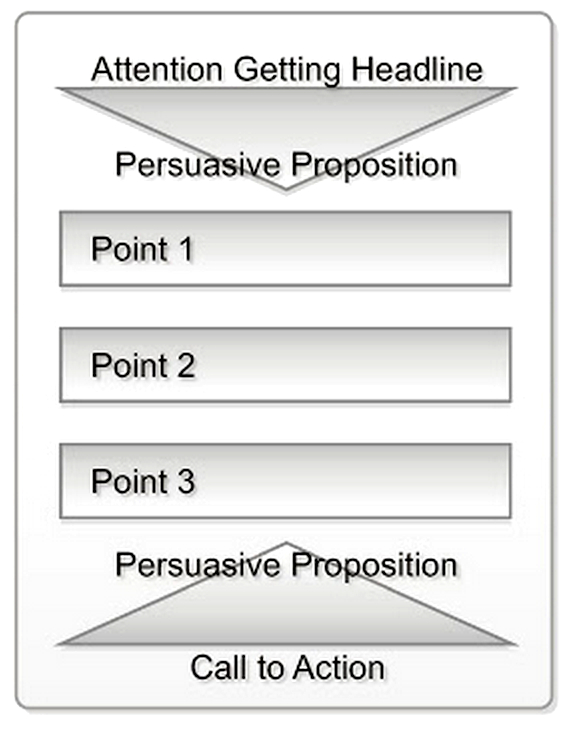
  • Applying The Persuasion Diagram To Newspaper Ads

    In the last post we used the persuasion diagram to organize advertiser information, which we then used to compose a radio ad.

    Let’s use the same exact information to build our newspaper ad. We fleshed out the rough points into this radio script:

    “Sometimes late at night you’ll hear their filthy little feet scuffling across the linoleum. You move a soap bottle from under the sink, and you think you see something ducking down the drain opening. And you’ll know that your home has been invaded. They’re filthy, disgusting, and once they establish a presence in your home they’re nearly impossible to get rid of. They’re roaches. You could try the powders… the sprays… and you’ll find that they just keep coming back. Until you finally call Elite Exterminating, the full service pest control and termite company. Elite Exterminating will kill the roaches you see, and the thousands of roaches you’ll never see. Call Elite Exterminating now at eight five three, eighty-three seventy. Eight five three, Eighty-three seventy. Eilte Exterminating, the full-service pest control and termite company proudly serving all of Texas and committed to complete customer satisfaction. One call… no more roaches. Elite Exterminating: eight five three, eighty-three seventy.”

    How much different will our content be for the newspaper? Surprisingly little.

    Using the sequence shown in the diagram, let’s put the pieces together.

    You’ll note that we’ve used the radio script, with a few additional touches, such as the additional local phone numbers, the internet address, and the MasterCard, Visa, and Amex logos.

    The use of some of the verbiage as headlines or subheads allows people to skim the ad to see if it has any interest to them. Just as we used radio sound effects, we injected photos of roaches in the newspaper ad to evoke emotion.

    So what is the difference between a radio ad and a newspaper ad?

    Very little, actually, and that’s a key point. With only minor modifications, this same message will work as a Yellow Pages ad or as a flyer.

    Try using the Persuasion Diagram for your next ads. I suspect you’ll be pleased with the results.

  • If Elected, I Will Not Serve

    How much are we willing to pay for a non-material experience?

    Among the super rich it’s no longer enough to give a loved one a new Maserati GranTourismo (MSRP $110,000). Now, the proper gift is a private concert by the Rolling Stones (MSRP $4,000,000).

    Or so I’m told.

    Even those of us who are not so rich seem to be more often choosing day spas or trips to Italy over the more traditional leisure activities. (When was the last time you went bowling?)

    Sociologist Melanie Howard suggests that, as people have more expendable income and more options, we are, as a society, hauling ourselves up Maslow’s hierarchy of needs toward the apex of self-actualization.

    She says, “There’s this emerging idea of ourselves as projects — we are no longer labelled by our education or gender, or born into a social situation that we then play out for the rest of our lives. We can do new things, pick up new skills, learn a new language. Because we’re living longer, we have more time to think about who we really want to be. We are all asking ourselves, ‘How can I get more out of my life?’

    What do we want to be?

    Involved, apparently.

    A couple of days ago I received this e-mail from Bill Drew, Jr, of New View Options blog:

    Hey Chuck,
    Just saw a news report that you were on. Cool! Here is the link: www.News3Online.com
    Best,
    Bill

    My first thought was that this was a co-incidence, one of several other Chuck McKays which includes a high school English teacher, a medical doctor, and the disc jockey from CKLW.

    Then the disclaimer popped up to explain the hoax, and offered to help me perpetuate it on my friends.

    But my second thought was, “Wow. They customized this experience for me eight times in slightly less than two minutes.

    It’s the Personal Experience Factor.

    It’s exactly the topic my colleague, Mike Dandridge, speaks and writes about.

    It was through Mike that I first learned of the 1999 book, The Experience Economy, by B. Joseph Pine II and James H. Gilmore. He drew my attention to Pine’s and Gilmore’s observation that the price of coffee depends largely upon the way it’s delivered to the consumer.

    Consider, however, a true commodity: the coffee bean. Companies that harvest coffee or trade it on the futures market receive — at the time of this writing — a little more than $1 a pound, which translates into one or two cents a cup. When a manufacturer grinds, packages, and sells those same beans in a grocery store, turning them into a good, the price to a consumer jumps to between 5 and 25 cents a cup (depending on brand and package size). Brew the ground beans in a run-of-the-mill diner, corner coffee shop, or bodega, and that service now sells for 50 cents to a dollar a cup.

    So depending on what a business does with it, coffee can be any of three economic offerings — commodity, good, or service — with three distinct ranges of value customers attach to the offering. But wait: Serve that same coffee in a five-star restaurant or expresso bar, where the ordering, creation, and consumption of the cup embodies a heightened ambience or sense of theatre, and consumers gladly pay anywhere from $2 to $5 for each cup. Businesses that ascend to this fourth level of value establish a distinctive experience that envelops the purchase of coffee, increasing its value (and therefore its price) by two orders of magnitude over the original commodity.

    Its time to stop selling simple “services.”

    Highly profitable companies are those which sell those services as individual experiences. Those which sell at retail assume their “guests” will want to purchase mementos which remind them of a specific experience.

  • Walt Disney Company has been the shining example of selling the experience since the opening of their first theme park in 1955.
  • Progressive Corporation makes both the purchase of vehicle insurance, and the settling of claims an experience. Check out their web site to get a feel for the purchase, then imagine the effect their claims adjusters have on accident victims when they show up with a van designed to calm them. Refreshments, mobile phones, and someone to arrange to have your vehicle towed and repaired, perhaps even to set up overnight accomodation for you if necessary.
  • Want to visit Apple’s stores in Great Britain? Use their “online concierge” to plan the trip. Apple sells much more than iPods and Macs. Apple now sells hospitality. In other words, an experience.
  • Pizza Hut offers to host your child’s birthday party. In addition to feeding the birthday party, they provide birthday cake and other amusements.
  • And this is perhaps the way to mass produce individual experiences. Treat the whole company as theatre. Treat the underlying goods and services as props.

    Can you do this with your customers?

    Can you stop focusing on delivering a less expensive widget, and instead deliver a memorable experience, of which the purchase of the widget is only one of the steps?

    Can you, like the practical joke nominating Chuck McKay for President, embed simple customizations into your presentation, and customize your experience for each shopper?

    __________

    Chuck McKay is a marketing consultant who helps customers discover you, and choose your business. Questions about creating individual customer experiences may be directed to ChuckMcKay@ChuckMcKayOnLine.com.

  • A Business Seminar For the 21st Century


    The formula used to be simple. You advertised. People responded. They called. They came. They bought what you sold.

    Today fewer are calling. Fewer are buying. And if you’re in business for yourself, you’re probably asking yourself “What happened?”

    I have the privilege of working with an exceptional group of marketers in the Wizard of Ads ® organization. Nearly five years ago the partners began talking to our clients about social changes that were beginning to effect the business landscape.

    Those changes are no longer predictions.

    They’re upon us. They’re a direct result of the Internet – but not for the reasons you may suspect. You see, value is created when there’s an information imbalance.

    Sometimes the inequity is obvious. If you had a medical doctor’s knowledge, for instance, you wouldn’t need to consult one.

    But sometimes the information spread is not as easily recognized. Successful retail merchants know where to buy at wholesale, how to ship, and how to competitively price in order to keep shoppers buying from them. Yes, their profit comes from buying low and selling higher, but it also comes from the retailer’s specialized knowledge – what to buy, how much to buy, how to price it.

    But the Internet places massive amounts of information just a few keystrokes away, and for free, which changes your entire relationship with your customers. They now dictate exactly how, and under what circumstances, they’re willing to do business with you.

    What can that retailer do?

    What’s the new strategy when the information that always delivered profit no longer provides a competitive advantage? Businesses that services rather than goods face the same issues. The consumer mindset has changed. Advertising which produced results since World War II isn’t working as it used to.

    Twice a year the Wizard of Ads ® partners from around the world * congregate to bring each other up to speed on our various areas of specialized knowledge.

    We’ve never before offered to share these insights with the general public.

    That’s about to change.

    The Boom Your Business Seminar in Nashville, August 1 & 2 will provide 200 owners access to the most powerful business seminar ever offered to small business.

  • Want to know How to Fight the Big Boys and Win? Mike Dandridge, author of the One Year Business Turnaround will tell you exactly how it’s done. Mike grew a small electrical supply company into a million dollar a month powerhouse in a small town while flanked by Lowe’s on one side and Home Depot on the other.
  • Do you suspect you’re not effectively marketing to women? You’re probably right. Michelle Miller, author of The Natural Advantages of Women, and co-author of the new The Soccer Mom Myth will tell you exactly what to do, and how in The Motherlode: Hitting the Vein of Gold in Marketing to Women.
  • If you instinctively know that customers need to discern a difference between your business and your competitors, Scott Fraser will show you how to apply the lessons of one of America’s strongest brands to the local level in Commodity Revolution; Differentiate Your Business at the Local Level.
  • Clay Campbell‘s Get Big Results From Small Ad Dollars presentation will let you in on simple marketing techniques that are invisible to your competitors. They work especially well when you have more time than money. Clay is the author of How to Get Big Results From Your Small Ad Budget, and Leading the Above Average Life.
  • Does your company have a web presence? International web expert Dave Young, author of Why We Blog, will show you how to make your site more persuasive, generate more leads, and increase your on-line revenue in Your Website: The Marketing Tool for the 21st Century.

    Then web strategist Paul Boomer will teach easily-implemented techniques to improve your customer’s on line experience in 10 Things You Can Do TODAY to Improve Your Website.

    Finally, web video producer extraordinaire, Rex Williams, will detail the keys to becoming personable, direct, and real to people you’ve never met in his Building Relationships On-Line presentation.

  • Many small businesses constantly struggle to create an appropriate marketing budget. How much is enough? How much is too much to spend in advertising your business? In How to Calculate Your Ad Budget, Ray Seggern will not only make the budgeting process simple, he’ll share a secret on-line tool which does all of the calculations for you. (Ray will also show you how to buy word-of-mouth, and how to budget for that).
  • Tom Waynek has spent years studying the signals radiated by both predators and their prey, and has distilled six key business truths in Signaling Theory: What Are You Really Saying to Your Customers? Tom will teach you how to make powerful marketing statements to increase store traffic, sales, and word-of-mouth.
  • Do you suspect your ads could be better, but you’re not sure where to start? Take Ad Writing 101 from one of America’s top copywriters and writing teachers, Chris Maddock. You’ll be able to apply Chris’ techniques to advertising copy and to brochures and web sites.
  • In Thinking Outside the Box, engineer-turned-poet Peter Nevland looks at those crazy little ideas that most of us dismiss as impossible, and shows how nearly every great businesses success starts as one. When you understand how to recognize and harness those ideas, you’ll also see the dangers of not implementing them.
  • Marketing (and all other social trends) will make more sense after you’ve seen Michael Keesee‘s The Pendulum: Marketing in 2008 and Beyond. You’ll recognize the driving and predictable forces shaping society and make better decisions on communicating with the public after this multi-media presentation.
  • As a regular reader of this blog, you’ve seen my P.A.I.N. series of posts. I’ll be explaining which messages work better on TV, which in newspaper, on radio, in outdoor, and in Yellow Pages in my presentation Marketing P.A.I.N. – Explode Your Advertising ROI Through More Effective Messaging.
  • Sound like information your company could put to good use? Yeah, I think so, too. I hope you’ll make plans to join us. There are only 200 seats available, though, and word-of-mouth on this event has already sold roughly half. Don’t put off this decision or you’ll miss out.

    __________

    * Wizard of Ads has offices in Australia, Great Britain, Central America, Canada, and the U.S.

    I have an extra pair of tickets to the Boom Your Business Seminar. If you’re a business owner ready to take your company to the next level, drop me a note, and briefly tell me the issues you’re facing. I’ll give the tickets to whomever I think might get the most benefit from attending.


    Chuck McKay is a marketing consultant who helps customers discover you, and choose your business. Questions about the Boom Your Business Seminar or about the Wizard of Ads ® partners may be directed to ChuckMcKay@ChuckMcKayOnLine.com.

  • Unattached Marketer Seeks Self-Employed Professional For Long Term Relationship

    I’m dating again. Oh, not because my marriage to the Lovely Mrs. McKay is in trouble, far from it. I’m “dating” in that I’m ready for a new consulting relationship. I’ll be taking my time to find the right fit for the long term.

    You see, marketing isn’t art. It’s not science. Its a series of decisions based on relevant case studies and historical examples. Those decisions may, or may not, predict results. So, truthfully, marketing is a gamble. A good relationship requires the client to understand, and accept, that the consultant’s function is risk management.

    A good consultant stacks the odds in the client’s favor by having a broad knowledge of proven marketing techniques. By knowing what has worked for other businesses. By seeing the parallels between the client’s issues and similar problems that other industries have solved. By recognizing not only the factors which can derail business, but also the opportunities that can help the client leapfrog over his competitors.

    Yeah, I’ve been called an “expert.” But don’t expect me, or any other consultant, to show up and give you the magic formula for endless wealth. Instead, expect me to be your business B.S. meter.

    You see, I love speaking and writing, but I have little respect for those speakers who have been talking for twenty years about the things they accomplished twenty-five years ago. I work with a select group of clients in order to stay current, and relevant, and focused on the real problems faced by businesspeople every day. As a speaker, it provides an edge that just can’t be faked.

    Some consultants look for opportunities to run the clock, and bill the client for more hours. Instead, I charge a flat fee, which changes each year at the same proportions as my client’s top-line revenue. This isn’t called a relationship by accident. When the client does well, so do I. When the client doesn’t, I don’t, either.

    And I don’t profit from the traditional 15 percent commission that the media pays to advertising agencies who place advertising for a client. Oh, the media still provides that commission, but my client pockets the cash. Some clients get back more in those commissions than the fees I charge, and thus actually make money by using my services.

    But, past the mechanics, the primary values any consultant provides are perspective, and advice, which brings us to the point of this writing.

    Sometimes the client doesn’t wish to follow that advice.

    I once heard this dilemma compared to a duffer on the golf course refusing to accept the help of the club pro. When the pro advises a three iron, and the duffer insists on using a wood, the pro’s choices are to tell the duffer he’s on his own, or to help him to get the best shot possible with his own choice of club. “Get a good stance, keep your left arm stiff, keep your head down, be sure to follow through.”

    A client I’ve been working with, however, will not use any club I recommend. As much as I’ve tried to help him get distance on his shots, he insists that I do things his way. It appears he’s hoping I can execute his marketing strategy better than he did. But, even a brilliant execution of a flawed strategy still leaves a flawed strategy.

    Since I don’t believe that our professional relationship is benefiting his business, I can’t in good conscience continue to charge him for my services. I hope we can stay friends, because I truly enjoy his company, but I have resigned the account.

    So now, I’m dating again. I’m looking for a new relationship. I’m meeting some new business owners for the first time, to see if there’s any chemistry, not for a quick project, but rather for the long-term. My most recent client and I have worked together for a year and a half, now. Others go back as much as eleven years. The best fit is likely to be a professional practice or owner-operated company, whose owner is ready to take that company to the next level.

    Do you know someone like this? Would you care to introduce us?


    Chuck McKay is a marketing consultant who helps customers discover you, and choose your business. Questions about marketing your business may be directed to ChuckMcKay@ChuckMcKayOnLine.com.

  • Blenders, Marbles, and i-Phones

    Its hard to believe that a dozen years have gone by since Jeffrey F. Rayport of Harvard Business School coined the term Viral Marketing.

    A viral message replicates itself through voluntary participation of the recipients, spreading an idea through preexisting social networks, much like a pathological virus spreads through a population.

    The self-replicating part is what excites marketers.

    A popular video clip which is shared through the Internet or camera phones is known as viral video. Popular examples include the Evolution of the Dance or the Star Wars Kid (which has been viewed more than 900 million times).

    Imagine the possibilities. People circulating your video, for free? But, wait a minute. These videos have high entertainment value. Not too many carry any company’s advertising message.

    Humm.

    How does a company use viral video to promote its products?

    You do something, or say something, that makes people want to share the video clip with their friends.

    Take Blendtec, for instance.

    Blendtec is an appliance manufacturer. They make a pretty good food blender. How does one convince people to talk about kitchen appliances, and more importantly, to promote the Blendtec brand?

    You show the power of the blender.

    Blendtec spent an average of $50 each on their “Will it blend?” series of videos. Anyone could have blended food. Blendtec got attention by demonstrating their blender’s ability to turn anything into dust.

    Tom Dickson, Blendtec’s CEO, stars in all of the company’s videos. Google “Blendtec” to watch Tom (and his blender) pulverize such items as marbles, hockey pucks, and even crowbars.

    If that wasn’t outrageous enough, Tom successfully pushed his company’s awareness levels in the public consciousness over the top, by turning a $600 i-Phone into powder?

    Some viral strategies work better than others.

    Blendtec’s strategy is brilliant on two levels.

    • First, the shear outrageousness of blending hockey pucks and crowbars is likely to get people to talk about the power of this blender – which focuses on the attributes the manufacturer wants you, the consumer, to remember.
    • Second, people don’t usually Google search “marbles,” but you can bet that with the highly publicized launch of the product they did search for “i-Phone.” Over six million visitors hit
      Blendtec‘s web site in the first ten days following this video’s release.

    Remember, getting noticed is only part of the equation. Being remembered for something which promotes attributes of what you’re selling is the other part.


    Chuck McKay is a marketing consultant who works with professional practices and owner operated businesses. Questions about producing viral video may be directed to ChuckMcKay@ChuckMcKayOnLine.com.

  • The Soccer Mom Myth

    Have you ever wondered what would happen if you put two experts on your favorite topic together and let them discuss the topic? Would you have Robert Allen and Carlton Sheets exploring nothing down techniques? Or would you prefer Milton Friedman and Steven D. Levitt hashing out the social repercussions of school vouchers?

    Me? I’d have Holly Buchanan and Michele Miller talk about marketing to women.

    Michele’s Wonderbranding and Holly’s Marketing to Women Online are required reading on the subject. They’ve been sharing the stage in speaking engagements for a couple of years. I’ve been looking forward to their co-authored book, The Soccer Mom Myth, for most of the last year. Its been worth the wait.

    Buchanan and Miller use examples we’ve all observed in real life to illustrate their points. They tell a story, for example, of a disagreement between their friend Heather and Heather’s financé. “From his perspective, the argument was not a big deal. In his male communication style, conflict is a normal part of how couples communicate. Heather, in her more female communication style, came away with a totally different interpretation of the argument. She looked at it as a breakup of the relationship.

    Then they apply this observation to business: “Believe it or not, this same scene plays out with companies and brands, not just fiancés. She has a bad experience with your company or product. You think, “It was just a customer service call, she couldn’t get her questions answered and had to wait ten minutes to get a live person, that’s just a blip.” But to her, it’s a relationship ender. What to you may seem like small things can be huge to her.

    Men and women communicate differently. No surprise there. But Buchanan and Miller note that there are times when one gender’s communication style is actually more effective with all customers. (Think men’s instructions and naming preferences with women’s categorization and navigation). By picking and choosing between gender specific tendencies, both genders will have a better shopping experience.

    And thats a critical point The Soccer Mom Myth makes: improving the purchasing experience for women automatically makes the experience better for men, as well.

    There are companies who are thinking they should market to women. This book will help them make giant strides in that direction.

    Other companies recognize that the phrase “marketing to women” is already redundant. They simply call what they do “marketing.” The Soccer Mom Myth will help them refine their technique and establish a major head start over their competitors.

    The Soccer Mom Myth, $19.95, 232 page hardcover, ships March 10. This book should be a part of every marketer’s library.


    Chuck McKay is a marketing consultant who works with professional practices and owner operated businesses. Questions about marketing to women may be directed to ChuckMcKay@ChuckMcKayOnLine.com.

  • If Stephen King Wrote Advertising Copy

    Last month a new Stephen King book was published by Charles Scribner’s Sons. It’s called Duma Key: A Novel.

    Duma Key: A Novel is the story of Edgar Freemantle and his recovery from the terrible nightmare-inducing accident that stole his arm and ended his marriage.

    Care to predict whether this will be a profitable book?

    But wait… it’s 592 pages long.

    Do Stephen King fans find hundreds of pages intimidating?

    It appears not. 50 of his novels have reached bestseller status. Enough fans buy his books to make his net worth over $200,000,000.

    And yet, its a safe bet that someone in his past said “This is too long. Nobody will read this many pages.

    Obviously, people who enjoy King aren’t concerned with the word count. And (critical point here) the opinions of non-fans DON’T MATTER.

    So, what’s the marketing parallel?

    People who aren’t in the market for what you sell don’t get an opinion in how long your advertising copy should be.

    ‘Nuff said.


    Chuck McKay is a marketing consultant who works with professional practices and owner operated businesses. Questions about optimal copy length may be directed to ChuckMcKay@ChuckMcKayOnLine.com.

  • Video Production Lessons From Ron Popeil

    Ron Popeil is the absolute master of selling on television. Can anyone else claim to have sold over two billion dollars worth of products? He recently sold over 7,900 Showtime RotesseriesTM in a single hour on QVC at $127 each.

    You do the math.

    Popeil did the basics better than anyone.

    Basics? Yes. There are only four.

    Popeil’s Basic Number One: The words you use are critical.

    Ron learned his craft pitching knives and kitchen gadgets on Maxwell Street’s open air markets in Chicago. The concept is simple. If he was persuasive, people bought. If not, they didn’t.

    Study his presentations and you’ll notice two things consistently. Popeil’s catch phrases (“Set it and forget it.” “But wait, there’s more!” “It slices. It dices.”) get said again, and again, and his use of rhetorical questions gets the audience involved. “Isn’t this amazing?

    By working in front of real people and dealing with their questions, he learned to anticipate common objections and build the answers to common questions into his presentation.

    As important as the pitch was, he never scripted his famous TV ads. “If I’ve been chopping away for 10 hours a day, giving the same pitch over and over again, refining it a little bit each time, why would I need a script?

    Popeil’s Basic Number Two: Noting is more important than the product.

    When Michael Jordan pitches Haines, Michael is the star. When Ron Popeil pitched the Showtime Rotisserie, the broadcast opened with a series of shots of meat and poultry roasted to perfection and rotating in the Showtime. The offstage announcer described a “mouthwatering pork-loin roast,” or a “delicious six-pound chicken.”

    Not until our interests and our appetites were whetted, does Popeil even enter the stage. Watch any of his infomercials. You don’t see much of Popeil, but you see the product solving problems and making life easier for consumers.

    Popeil’s Basic Number Three: Show, don’t just tell.

    Ron Popeil never simply told us what the Veg-O-Matic would do. He showed us.

    He showed how easily the product worked and how quickly it got results. There were no complicated settings, no buttons to press, no hidden gears, just a simple device that worked flawlessly each time.

    Through close ups we saw an onion sliced into uniform thicknesses with one motion, whole tomatoes sliced with every seed in place, a whole can of Spam sliced at once. He showed us how to turn the dial to make thin slices of cheese.

    Popeil also showed us the effect his products had on other people. He used to stand at the enterance and asked each member of the audience if they’d had a big breakfast. He wanted all of the hungry members in front when the food came out.

    Popeil’s Basic Number Four: You can’t fake passion.

    If you’re genuinely thrilled with the product you’re selling, selling it becomes the easy part. If you’re not excited about your offer, its time to find a new offer. Or a new career.

    Popeil’s autobiography, Salesman of the Century, has fallen out of favor, which is a good thing if you’ve never read it. Pick up a cheap copy and let the man tell you in his own words how to do what he does.


    Chuck McKay is a marketing consultant who works with professional practices and owner operated businesses. Questions about producing effective television advertisements may be directed to ChuckMcKay@ChuckMcKayOnLine.com.

  • Songwriters, Copywriters, and Income Taxes

    Kenny Rogers has said he sings songs that men wish they could sing to their women, and that women want to hear from their men.

    Songwriters understand that.

    A number of years ago I audited a UCLA Extension songwriting class from my friend, Grammy nominee Barry Kaye. Barry made a point during a song critique that I’ve never forgotten: people identify with songs and singers. No singer will ever sing a song that paints the protagonist as a wimp. Even more importantly, no listener will identify with such a character.

    His advice to aspiring songwriters? Never write a song that doesn’t make the singer an admirable character.

    An advertising lesson.

    As you may suspect, aspiring advertising copywriters can learn from Barry’s comment. Never write an ad that doesn’t make your purchaser an admirable character.

    In general, I like the H&R Block “I’ve got people” campaign (“I can deduct my gauplattlerhosen?”), but right now there is no way I’d buy that particular software package. I’ve been soured by the advertising.

    The ad opens with a man sitting in front of his computer as his wife enters the picture.

    She: “Hey, how’s taxes?

    He, quite sheepishly: “I’m stuck.

    She: “Stuck, huh? Humm. Maybe you should get some people to help us.

    She becomes sarcastic. “Oh, that’s right. We didn’t use people. We used a box.

    Then, like a mommy driving home a point to a naughty child, she holds the box in front of him and says, “Well, maybe you should tell the box you’re stuck.

    He, cowering: “I’m stuck.

    The announcer then ties the software to the “I’ve got people” campaign: “Tax cut from H&R Block is the only tax program that gives you direct access to H&R Block professionals.

    Before learning about the national tax experts bbb. I have in the past acquired tax software packages and calculated my own return. If I didn’t already have a relationship with an amazing accountant, I might consider purchasing H&R Block’s software.

    At least, I might have before I saw this ad.

    And as we get closer to tax time and it airs more frequently I’m finding that it’s grating on me. First, I’m annoyed by the wife. Second, I’m even more annoyed by the husband who allows himself to be scolded as if he were a 3 year old caught raiding the cookie jar. By extension, I’ve become negative on the product.

    Am I the target?

    Perhaps I’m not a member of the audience this ad is designed to persuade, and my opinion is not relevant. And, whether it is or not, you should never let one person’s reaction to any ad influence your decision to run it.

    But I suspect that my reaction to the characters in that ad may be a common one.

    Be careful how you portray the people who may buy what you’ve got for sale. As Barry Kaye pointed out, nobody identifies with a loser.


    Chuck McKay is a marketing consultant who works with professional practices and owner operated businesses. Questions about writing effective advertising copy may be directed to ChuckMcKay@ChuckMcKayOnLine.com.