Category: Advertising / Marketing Strategy

  • One Easily Remembered Point

    One Easily Remembered Point

    Dentist

    One of the things that too many small businesses do when they advertise is to try to pack the ad with everything that could possibly be of interest to any potential customer.

    After all, advertising is too expensive to waste any opportunity to sell everything to anyone.

    That’s logical, isn’t it?

    None the less, it’s guaranteed to be bad advertising.

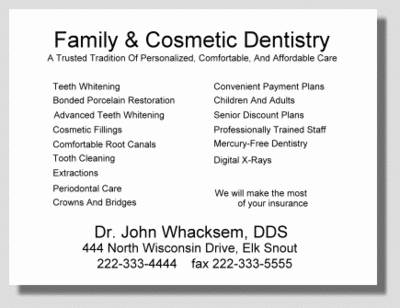
    Look at this Yellow Pages Ad

    It could easily be a radio ad, or television ad. The style isn’t at all different, merely the details of the execution.
    Dentistry Ad
    Dentistry Ad

    And as a Yellow Pages ad, listed with all competitors under “Dentists,” Dr. Whacksem is likely to get a few calls from this ad. He will, however, always suspect that his ad isn’t very efficient. It doesn’t draw enough business for what he’s paying. He’ll blame the medium. “My radio rep told me that Yellow Pages don’t work. She was right.”

    She’s wrong. So’s the doctor.

    The medium isn’t the problem, the message is the problem.

    What’s the message? Ah. There’s our problem.

    What is his message?  That he works on kids, and their parents, and older people, too? That he will accept insurance payments or make a payment plan? That he does fillings, and teeth whitening, and root canals, and extractions? That he does crowns and bridges and bonded porcelain? That he uses x-rays? That his staff is professionally trained? That he’s “mercury-free,” (whatever that means)?

    What is Dr. Whacksem’s message? I’ve counted at least fifteen, and that doesn’t even count him telling you how to get in touch.

    Without scrolling back up, how many can you remember? Humm. And that was only two paragraphs ago, after I drew your attention to it.

    Nobody will remember a list.

    Listing your services, or your products, is bad advertising.

    Instead of getting more information to more people, you’ll accomplish exactly the opposite. The message becomes part of a blur in the minds of the people who are already being clobbered by hundreds of other ads every day.

    This ad doesn’t say anything “salient,” anything a potential customer can relate to. Without that salience, it doesn’t stand out. It doesn’t get remembered. To maximize your impact, you need to give this ad salience.

    You need to make one simple, easily remembered point to one particular group of people.

    Some small business people get it right away. Many do not. Frankly, most do not.

    You’re telling me NOT to tell people that my dental office works on children, and adults, and old people. You want me not to tell people we do root canals, and teeth whitening, and x-rays, and takes most insurances? That’s crazy. What if someone needs a crown, and they don’t see that in my ad?”

    What if someone needs a crown, and you didn’t manage to get their attention in the first place? How many people do you believe actually read your list of services?

    Whatever the size of your business, your advertising will have a bigger impact if you limit your ads to one simple easy to remember message.

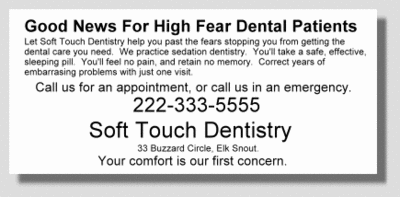
    Consider this ad from one of our first dentist’s competitors:
    Better Dentistry Ad
    Better Dentistry Ad

    First, notice the headline – “good news for high fear dental patients.” How many people are afraid to even be examined by a dentist? And even those who aren’t afraid will appreciate the promise of “Soft Touch.” Everyone will appreciate that their comfort is this dentist’s first concern.

    Notice, too, that the ad doesn’t list all of basic services. Truthfully, though, doesn’t every dentist do fillings? Root canals? Cleaning? Doesn’t every dentist use x-rays?

    Do we even notice that these things are missing? Do we care?

    No, we don’t.

    What do we remember?

    Instead, we remember that Soft Touch Dentistry doesn’t want us to hurt, or to be afraid.

    The second ad makes much more impact, doesn’t it?

    OK, but what happens when someone who’s not afraid of the dentist hits the Yellow Pages? Which ad is she drawn to?

    Care to speculate?

    Of course it’s the second one. Whether she needs a cleaning, a root canal, or a crown, our dental prospect is still not likely to even notice the first ad, and will react positively to the second. The second ad, the highly-focused single message ad, is the one our dental prospect will read. She’s also more likely to phone for an appointment.

    So, by narrowing the focus to a single point, we actually broaden the appeal of the ad. Wow.

    Then, there’s cost.

    And there’s something odd happening here. With all of its additional impact, the second ad takes only about 60% of the space that it’s competitor does. Soft Touch Dentistry makes a much bigger impact with a substantially smaller ad. Double wow. How much money will this save Soft Touch over the year? Better yet, how many more impressions can Soft Touch Dentistry purchase with the same budget?

    OK, one last thought: the Advertising Performance Equation (APE) represents the relationship between your message, the frequency of that message delivery to an audience, the customers’ experience with you, your market potential, and resultant sales.

    All other factors being equal, and without going into the math, making your ad twice as memorable will double the percentage of your advertising driven sales.

    And we like to double the catch when we’re fishing for customers.

    Your Guide,
    Chuck McKay

    Marketing consultant Chuck McKayYour Fishing for Customers guide, Chuck McKay, gets people to buy more of what you sell.

    Got questions about helping people to remember your advertising? Drop Chuck a note at ChuckMcKay@ChuckMcKayOnLine.com. Or call him at 304-208-7654.


  • Bad Seduction

    Bad Seduction

    I just read some advertising suggestions on an Internet marketing site that are beyond annoying. They are flat-out bad advice.

    They illustrate a complete lack of understanding of the whole persuasion process.

    First, small business owners are told that advertising often has a cumulative effect, so ad-driven sales may not be immediate. Then, they’re told how to measure and track the immediate response of their advertising.

    Reading past that little dichotomy, some of the suggestions included:

    · Use magazine response cards. Remember to code the cards if you use multiple publications.

    · Use a coupon in your newspaper ads. Code the coupons so that you can tell which publication generates the most sales.

    · Put a line in your radio scripts to “Mention this ad and get a 10% discount.”

    · Ask all new customers how they heard about your business.

    Make no mistake. These are all bad suggestions. Very bad. In addition to being very poor persuasion, each of these strategies assumes that your prospective customers are paying very close attention to your ads.

    Trust me, customers don’t.

    Good Advertising is Seduction

    Pretend with me for a minute that all advertising is an attempt to get a “date” with your prospect.

    How do these recommendations hold up under that scenario?

    Would you, for instance, send a response card to anyone you could possibly be interested in dating, which says “If you’d like to learn more about me, fill out your name, address, and your specific areas of interest in me, and apply your own postage to return it to me?

    No, I didn’t think you would.

    The advice contained in these recommendations also suffers from major misunderstandings in the motivations of customers.

    Coupons Assume That You Have Nothing to Offer but a Better Price

    Think about the implications of that for a moment. It suggests that after you’ve spent the money to advertise your discounted (and minimally profitable) price, that the customer has no reason to ever come back to do business with you again. Or at least, until you drop your price again.

    Mention this ad? In three decades of mass media experience, I’ve never heard of a single person saying “I heard your ad. Give me the discount.” Smart radio stations will never allow this on their air. Does that mean people don’t respond to advertising? No, it doesn’t mean that at all. It means that they won’t embarrass themselves by parroting your line. Not surprising, is it? Most people won’t admit that advertising affects them in any way.

    Ask new customers where they heard about you?

    Customers Don’t Know Where They Heard About You

    Oh, they’ll try to give you an answer. Really though, your advertising isn’t important enough for them to remember exactly what they learned about you, let alone the source of that information. But because they’ll want to be helpful, they will guess. They’ll usually guess wrong.

    There are two major problems with any of these “track your response” strategies.

    · They provide bad information. Bad information is worse than none at all. It gives you a distorted view of reality. Which leads to the second problem:

    · You’ll be tempted to make decisions based on this bad information. You will frequently make the wrong decisions.

    Consider this, instead. Send the object of your affection an “I love you” message.

    Does it matter whether your “I love you” comes in a telegram, an e-mail, a card, or over the phone? Or is the expression of love the most important consideration?

    Does it matter whether your ad message is delivered in the newspaper, over the radio, on cable TV, or by direct mail? Or is the message the critical part?

    Your advertising will improve by orders of magnitude when you spend less time attempting to find the most effective medium, and more time searching for the most effective message. Consider the message to be the bait you use when you’re fishing for customers.

    Your Guide,
    Chuck McKay

    Marketing consultant Chuck McKayYour Fishing for Customers guide, Chuck McKay, gets people to buy more of what you sell.

    Got questions about tracking your advertising? Drop Chuck a note at ChuckMcKay@ChuckMcKayOnLine.com. Or call him at 760-813-5474.

  • How Big Is Your Reputation?

    Here I sit in Victorville, California, on a working vacation. The lovely Mrs. McKay and I are taking some time to visit all three of our daughters (and play with the grandkids), and I’ve had the privilege of speaking before several Southern California service organizations this week.

    Yesterday I was the guest speaker at the weekly meeting of Victorville, California’s Victor Valley Marketing Group. I’ve known about half of these people for years. I used to be a member of this group. Of course, there were only 30 of us then. In the last three years the group membership has doubled.

    When I went through the steps of creating an advertising budget, my long-time friend Bob Sole, owner of Express Blinds, asked a pertinent question: “Once you’ve created a budget, how long do you have to advertise at that level before enough people know about you that you can cut back on your advertising?

    I don’t believe that you ever can. In fact, if your business is successful, you’ll probably be investing ever-larger sums in advertising. Here are two reasons why.

    The purpose of advertising is largely to expose your business to people who don’t pass by and see your sign on a daily basis. The best thing that you can do to promote your business is to locate in the busiest intersection in town, then hang out a “now open” sign. Find an area with enough traffic, and you may not need to advertise at all. Most of us though, don’t have prime locations. The farther we locate from where people naturally congregate, the more we need to use other means (ie: advertising) to remind those people to come and do business with us.

    One of the realities of any community is that it’s a continually changing entity. And no matter how great your location was ten years ago, the population and traffic patterns have probably shifted to some other prime location in the last decade. Perhaps you’ll find it makes sense to relocate every eight to ten years. A number of national grocery chains do that with their stores for this very reason. Then again, you may find that its more cost effective to simply keep inviting people to your current location.

    The second reason is that people move. According to the United States Postal Service, approximately 17% of the people in any given community relocate each year. Run the math and you’ll find (worst case) that after ten years only 19% of the people who “knew” you a decade ago still remember you. Add a small growth in population, and that figure can drop by a couple more percentage points.

    This brings out an odd contradiction, doesn’t it? The faster your community’s population grows, the more money there is in circulation. That usually means more business happens by default. Long term, though, it also means that you’re becoming lost in the crowd.

    Look around town. Are some of your old customers disappearing? Are new people moving to town? Have the traffic patterns changed in the last decade?

    Can you afford to assume that enough people have heard about you to quit inviting them into your business? That’s roughly like dropping your hook into the water without bait. Not an efficient strategy when you’re when you’re fishing for customers.

    Your Guide,
    Chuck McKay

    Your Fishing for Customers guide, Chuck McKay, gets people to buy more of what you sell.

    How do you advertise your business? Do you have an annual plan? Should you? Start a conversation with Chuck by email at ChuckMcKay@ChuckMcKayOnLine.com. Or call him at 317-207-0028.