Category: Market Segmentation, Targeted Marketing, Database Marketing

  • Free Coffee and the Incremental Discount Coupon Tactic

    Free Coffee and the Incremental Discount Coupon Tactic

    Cup of Coffee
    Cup of Coffee

    As I headed out the door the Lovely Mrs. McKay handed me a coupon from the new C store in our neighborhood, saying “You’ve got to stop for gas anyway. Here’s a coffee for the road.

    The coupon offered a “free coffee beverage” from, oh, let’s call ’em “Comfort Brothers Gas Station and Convenience Store.” I thanked her and slipped it in my pocket.

    Does a lower price boost sales?

    Will the availability of a discount, or a membership card, or a “get one free after purchasing ten” punched card appeal to everyone? Of course not. Some shoppers enjoy clipping, collecting, and organizing coupons to take advantage of reduced prices on household goods. Others see the time required by that process to be part of the price they pay for your service (or product), and will happily agree to full rate not to be bothered with it.

    If you offer a discount to shoppers who would have paid full price, you lower profitability. On the other hand, not discounting for the undecided leaves some inventory unsold. That reduces potential gross sales.

    How can you tell which is which?

    The answer is to let them select themselves.

    Make multiple offers at different price points to maximize sales. Those who wish to pay full price may do so, and those who won’t will find a subsequent price/value ratio which works for them.

    Here’s how to make it work:

    Let’s imagine you have purchased a mailing list of high probability prospects for your new service. Send a letter, or post card, or other mailing piece to the entire list. Offer to sell them your service. Explain why you offer a good value. Some will purchase. Move their names from your “general” list to the “paid full price” list. Guard this new list. The names are golden.

    A couple of weeks after your first mailing, send a twenty percent off coupon to everyone who remains on your “general” list. Segregate the names of those who respond to your second mailing into a “twenty percent discount” list.

    In ten more days send the remaining names on your “general” list a thirty percent off coupon. See how this works?

    You’re accomplishing two things through this process

    First, you’re maximizing sales at every price point. Second, you’re segmenting your general list into groups of people who have now revealed the price at which they’re likely to find your future offerings appealing.

    The percentage who bought from your very first mailing, divided by the total number of pieces mailed, is your base conversion rate. Over the next few months you might get as much as ten percent more than your base conversion rate, by offering these incremental increases in discounts. Expect the biggest response to be to your first coupon mailing. Each successive offer will produce a smaller number of buyers who will decide the price is finally right.

    Of course, the biggest factor which determines your base conversion rate is the offer itself.

    Specific dollars (cents) off tend to be more appealing than do percentages, although that can be affected by the market and the range of prices. Another proven appeal is to offer a reward such as free shipping or gift wrapping, or a free upgrade to anyone who spends a minimum amount.

    And you’ll always want to print expiration dates as part of your call-to-action to force a decision. “This offer good this weekend only,” or “Offer limited to the first 100 customers or close of business Friday, whichever comes first.”

    But, I digress from my personal coupon story

    After gassing up the car, I went inside to pay and to pick up a cup for the road.

    The coffee menu offered “a full-line of latte and mocha beverages served hot, iced and frozen, with gourmet flavored syrups and chocolates.” Every conceivable latte, espresso, and cappuccino. Full caffeine, half caf, caffeine free. With and without sweeteners, cinnamon, or chocolate. Iced lattes and mochas. Frozen lattes and mochas.

    Thinking of my blood sugar, I finally decided on a simple cup of house blend. Strangely enough, I could tell right from the redolence of the coffee that it was akin to the one described in this article.

    I presented my coupon and was told that they couldn’t honor it as payment for plain coffee. The offer, as I could plainly see, was for one of their prepared coffee beverages. Not for a simple cup of coffee.

    Are you serious,” I asked? “You’re willing to make a generous gift of a $4.50 banana caramel iced mocha, but you won’t let me have a simple sixty-nine cent cup of coffee?” Again, the attendant pointed out that the coupon clearly offered a “free coffee beverage,” and not a free cup of coffee. I handed the woman a dollar, took my change, and headed down the road.

    Years ago I watched an older lady present a coupon for a Big Mac at a Burger King restaurant. The young man behind the counter said, “Ma’am, this is a coupon for a McDonald’s sandwich. We have a very similar sandwich called the Whopper. May I get one for you at this same price?” This young man gracefully helped his customer avoid embarrassment. Care to bet she became a loyal customer?

    I hope my experience was not typical. I hope that the tens of thousands of coupons the Comfort Brothers spent on their grand opening paid off handsomely. In truth they have a beautiful store. It’s spotless, modern, and well laid out. The staff is friendly, well trained, well dressed. Shopping in their store should be a pleasure. I’m sure for most people it is.

    But I only remember that when I presented my coupon, they told me “No.” And that’s a tough first experience for any new customer to overcome when you’re fishing for customers.

    Your Guide,
    Chuck McKay

    Marketing consultant Chuck McKayYour Fishing for Customers guide, Chuck McKay, gets people to buy more of what you sell.

    Got questions about couponing, multiple price points, or direct mail marketing? Drop Chuck a note at ChuckMcKay@ChuckMcKayOnLine.com. Or call him at 304-523-0163.

  • Military Positioning as Marketing Strategy

    Military Positioning as Marketing Strategy

    Your company is the newcomer. You’re the young upstart that has innovated, and is generating significant buzz. How can you expect the leader in your business category to react?

    The expression “level playing field” implies a fair contest. In battle, as in marketing, a level field is the last thing we want. Military strategists from Genghis Kahn to Douglas MacArthur have all understood the advantages of taking the high ground. We’re not referring to any moral superiority, but rather to the literal highest point in the physical terrain of the battlefield.

    The first army on the field claims the high ground. And field position makes up the bulk of military strategy.

    Look at the high ground advantage geometrically. There is only a narrow angle at which shots fired uphill can hit their intended target. But shooting downhill opens the enemy to exposure from three or four times as big an area. The easier target will suffer greater casualties.

    In the 80s marketers studied the writings of Carl von Clausewitz and Sun Tzu and tried to apply battlefield strategies to marketing “warfare.” The parallels work on a superficial level, and the illustrations can make key marketing concepts come to life.

    I offer one such illustration.

    Imagine two military sections (small squads of 12 soldiers), each under the command of a sergeant. One firmly entrenched at the top of the hill. The other trying to take that hill.

    They each take aim and fire. The attacking section, shooting through the narrow aperture provided by the terrain, hit about 20 percent of the targets they shoot at. The defenders, without such limitation, manage to hit 60 percent of the time.

    After the first volley, seven of the twelve attackers are shot (60 percent of twelve bullets), leaving five standing. Only four of the defenders were wounded (20 percent of twelve, rounded), leaving eight.

    The second volley takes out three more attackers, leaving only two standing. One additional defender is wounded, leaving seven.

    The third volley wipes out the attackers with no additional injury to the defenders.

    It works this way nearly every time.

    Like the military parallel, marketing field position is largely determined by the first army in the field.

    Uh, lemme rephrase that.

    Marketing position is created by the first product in the consumer’s mind. This is why it’s critical that your company be first in the minds of your prospective customers. Its the reason the incumbent nearly always gets re-elected. Its the reason Coke still outsells Pepsi. Its the reason nobody sells more prepared chicken than the Colonel.

    How is marketing dominance achieved?

    The easiest way is to actually be first.

    That’s a rough requirement when your company is second, or third, or even farther down the list of competitors. Someone else already owns the high ground.

    The second way to claim a winning position is to create a whole new mental battlefield and be first to occupy it.

    If you can’t be the first lawn and garden equipment store in your community, be the first which doubles the manufacturer’s warranty. If you can’t be the first pawn shop, be the first that only deals in jewelry.

    Astute readers will recognize this strategy as specialization.

    One more point. The market leader also gets the benefit of the halo effect. Because the leader is so well known, it’s usually assumed that the leading company is “better.” Which means when people hear good news about your industry, they figure it’s news about the better known company.

    If you think about the ramifications of this for just a minute, you’ll have the answer to the original question.

    Copying for fun and profit.

    How does the established competitor defend his hill against you, the innovative new upstart company?

    By doing exactly what you’re doing.

    As long as the innovation is peripheral to the core business, the market leader can squash the upstart by simply offering the same innovation.

    Sadly, (for you) by duplicating, they’re also likely to get credit for the innovation, and you’re likely to be seen as a small copycat.

    But when your innovation IS the core business?

    Then you own the high ground on a brand new marketing battlefield, which places you first in the minds of customers who see value in your innovation.

    The best thing that can happen to you in this case is your competitor, the market leader, changes the way he does business to remain competitive. If his customers perceive that he’s abandoning his core business, he’ll lose a significant number of those customers.

  • If the established radio station with strong personalities shuts them up to take on the new “more music” radio station, the established competitor loses listeners who tuned in to hear those personalities talk.
  • When the established Chinese restaurant replaces moo goo gai pan or sweet and sour pork with spaghetti, tater tots, and cheeseburgers on the buffet, the established competitor’s image is diluted and less appealing to those customers prefer Chinese cooking.
  • As soon as the established overnight courier service, in an attempt to combat the new inexpensive courier, limits the cities to which the “overnight, or else” guarantee no longer applies, this established competitor will start losing market share among customers who’s jobs depend on guaranteed delivery.
  • Defending against innovation.

    If the new competitor’s innovation is only tangential to the core business, he should copy the upstart. If it’s critical to the core business, a savvy market leader shouldn’t overreact to the new competitor’s innovation. He won’t be able to stop it, either.

    Where’s the new high ground?  Which kind of innovation will your company offer your market?

    Innovation is critical when you’re fishing for customers.

    Your Guide,
    Chuck McKay

    Marketing consultant Chuck McKayYour Fishing for Customers guide, Chuck McKay, gets people to buy more of what you sell.

    Got questions about innovating or defending against innovation? Drop Chuck a note atChuckMcKay@ChuckMcKayOnLine.com. Or call him at 304-523-0163.
     

  • Marketing P.A.I.N. – Part 2, What Do People Want?

    Marketing P.A.I.N. – Part 2, What Do People Want?

    Originally published March 8, 2008

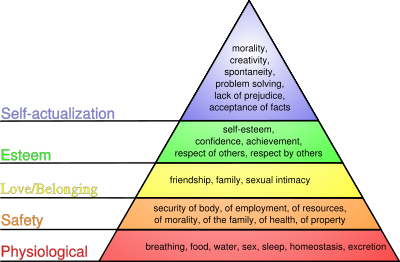
    Maslow's hierarchy
    Illustration of Abraham Maslow's hierarchy of human needs.

    They want you to make it stop hurting.


    Remember Abraham Maslow’s Hierarchy of Human Needs? Maslow described “deficiencies” that cause an individual discomfort when her needs are not being met.

    In other words, deprivation causes some degree of pain.

    Making that pain stop is the motivation for nearly all purchasing decisions. People buy to lessen the physical or emotional pain; pain of loss, of disappointment, of longing.

    The decision to purchase isn’t instant. People naturally hope the pain is temporary. They will continue to do things as they’ve always done them, at least at first, because change is painful, too. The second level of Maslow’s pyramid is Safety Needs, which include orderliness and predictability.

    But when the growing pain of postponing action becomes greater than the pain of change, people will make a purchase decision.

    Usually an event brings the new pain to greater focus and finally prompts the sufferer to act. We call this event a trigger.

    Triggers occur at every stage of pain.

    At each stage some prospective customers actively seek relief. At deeper stages, the triggers become both more predictable and more frequent. And, regardless of the business you’re in, there are only four stages of pain your customer can feel.

    Stage 1: No Interest, No Need. – The vast majority of the public has no interest in what you sell. (A good reminder that no message can possibly reach “everyone.”)

    Stage 2: Initial Awareness. – At this stage, your message should help early stage buyers to understand you can help them, even if they don’t have the vocabulary to ask the critical questions.

    Stage 3: Sorting Options. – Stage three shoppers are dealing with constant pain, and considering the perceived value of options to make the pain stop hurting. At stage 3, your customer will listen carefully to testimonials of people who have eliminated her exact problem.

    Stage 4: Ready to Purchase a Solution. – Stage four shoppers are no longer willing to suffer. They will make a purchase. They’ll do it within hours.

    These four stages can be used to describe every retailer, every not-for-profit, every service business.

    Let’s look at a few.

    The Stages of Pain for Plumbing.

    Stage 1: “Wash your hands.

    Stage 2: “Be sure to turn the knob tightly. It tends to drip.

    Stage 3: “I could buy the washer kit at Wal-Mart. I hope I don’t have to replace the whole faucet. Do I have any friends who know anything about plumbing? I wonder what a plumber will charge?

    Stage 4: “You grab the Yellow Pages. I’ll get the mop.

    The Stages of Pain for Accounting.

    Stage 1: “Put it in the payables pile. I’ll get to it.

    Stage 2: “I really need to get organized.

    Stage 3: “Why can’t I get the checkbook to balance?

    Stage 4: “The IRS wants me to bring my records.

    The Stages of Pain for Appliance Sales.

    Stage 1: “Its in the ‘fridge. Help yourself.

    Stage 2: “The milk doesn’t seem to stay cold enough anymore.

    Stage 3: “Who’s got a good selection of refrigerators?

    Stage 4: “Can you deliver this afternoon?

    The key to effective marketing (critical point).

    Most models of effective advertising list getting attention as the first step. Doesn’t it stand to reason that your communications will become powerful when your prospect recognizes that you’re talking to her?

    Match your marketing message to the pain your prospective customer already feels.

    But, if people experience a triggering event and are ready to buy at every level of pain, which pain level do your prospective customers feel?

    Your customers will go through all four stages, just like everyone else. You choose to address them at the stage which brings you the most profit. It’s a value judgment.

    Targeting people in the early stages of pain will help them to know of you weeks, months, or even years before they recognize a need for what you sell. The largest number of people will be exposed to your message. This is the concept behind Top-Of-Mind-Awareness and building your “brand.”

    But since you’re advertising your goods or services for so long before they’re needed, you’ll have to continue advertising for a longer period of time. That makes it more expensive. Choose early stages if you have the resources to stay the course, and the ultimate ability to handle huge numbers of customers.

    Marketing to later stages pays off much more quickly, since the triggers to purchase occur more frequently, but the pool of available prospects is much smaller. Effective marketing at later pain stages must be much more specific.

    In other words, when there are fewer fish biting, make very sure you’re using the right bait as you fish for customers.

    Your Guide,

    Chuck McKay

    Marketing consultant Chuck McKayYour Fishing for Customers guide, Chuck McKay, gets people to buy more of what you sell.

    Questions about determining the most effective pain remedy to offer your customers may be directed to ChuckMcKay@ChuckMcKayOnLine.com. Or call Chuck at 304-208-7654.

    If you know someone who would find this article useful, please share it.


    Marketing P.A.I.N. Series

    Part 1, Relationships
    Part 2, What Do People Want?
    Part 3, Advertising the First Stage of Pain
    Part 4, When People Realize They’re Hurting
    Part 5, Testimonials and Comparisons
    Part 6, Make It Stop!
    Part 7, Tie It All Together
    Part 8, Message Frequency, Media Choices, and Tracking

  • Marketing P.A.I.N. – Part 1, Relationships

    Marketing P.A.I.N. – Part 1, Relationships

    Vacuum Cleaner
    Vacuum Cleaner

    Assume John sells vacuums. He feels he needs to advertise.

    Does he…

    1) Explain to people why clean floors are important?

    2) Explain how vacuums remove dust, allergens, and pollens to keep your family healthier?

    3) Announce that his store has vacuums with HEPA filters in stock?

    4) Announce a big sale on vacuums this weekend?

    At one time or another John will be advised to do each of these things. Is any of them a valid strategy? Truthfully, each can be, but not to the same potential markets, and not at the same time.

    As you might imagine, those people looking for a vacuum today would probably respond better to appeal #3 – vacuums with HEPA filters in stock; or perhaps appeal #4 – big sale this weekend announcement.

    On the other hand, people who wonder about the effect of pollen on their family’s health are probably not yet ready to commit to any purchase.

    And no matter which appeal he selects, it will work better against some segments of the potential vacuum cleaner market than against other segments. It logically follows that some appeals will lead to greater profits.

    In a series of posts we’re going to discuss how to determine which segment of the potential market is most profitable, how to attract their attention, and how to craft a message which appeals to them. Finally, we’ll discuss how to choose a medium to deliver your message.


    Before we start, let’s look at John and Marsha.

    Consider John. John has just spent $200 taking Marsha to a very nice restaurant for dinner. Its their first date. John tries to impress Marsha. His shirt is unbuttoned down to the fourth button, so as to better show off the collection of gold chains he wears. Through dinner John tells Marsha all about himself: that he owns his own company, which he expects to take public in a couple of years; that his other car, the Porche, is in the garage again, at his vacation home, in Boca Raton. That a local political party has approached him about running for his state’s House of Representatives.

    Show of hands, who believes Marsha will accept a second date with John?

    Now, let’s consider John’s company. They just spent $2,000 on an ad which runs in American Idol on the local Fox affiliate. John’s Vaccuum ad states, “We’re an end-to-end solution for the wholesale purchase, shipping, warehousing, display, retail advertising, and financing of residential vacuum cleaners.

    Show your hands again. Who believes that Marsha will drop buy John’s Vacuums to shop for a vacuum cleaner?


    What’s the problem with the ad for John’s Vacuums?

    There are two, actually.

    The first problem is that the ad talks about the company. Frankly, customers don’t care about your company. They care about what you can do for them. If its so obvious that bragging about yourself is a terrible strategy to build an interpersonal relationship, why do business people insist on doing it to try for a professional relationship with a customer?

    Why would you want a relationship with a customer?

    Primarily because you don’t want to sell one item to one customer one time, and then start all over. You’ll make a lot more money with referrals and repeat sales.

    The second problem with the John’s Vacuum ad is it describes what the company does, from the company’s viewpoint. “An end-to-end solution for the wholesale purchase, shipping, warehousing, display, retail advertising, and financing of residential vacuum cleaners,” may be how those people who work for John’s Vacuums view their duties, but it’s not the way customers describe what they want.

    Next time we’ll discuss what people want, and why, for successful fishing for customers, your advertising should address those wants.

    Your Guide,
    Chuck McKay

    Marketing consultant Chuck McKayYour Fishing for Customers guide, Chuck McKay, gets people to buy more of what you sell.

    Questions about focusing on the issues your customers care about may be directed to ChuckMcKay@ChuckMcKayOnLine.com. Or call Chuck at 304-208-7654.

    If you know someone who would find this article useful, please share it.


    Marketing P.A.I.N. Series

    Part 1, Relationships
    Part 2, What Do People Want?
    Part 3, Advertising the First Stage of Pain
    Part 4, When People Realize They’re Hurting
    Part 5, Testimonials and Comparisons
    Part 6, Make It Stop!
    Part 7, Tie It All Together
    Part 8, Message Frequency, Media Choices, and Tracking

  • Media’s Dirty Little Secret

    I’m constantly amazed by all of the media reps from all of the different media outlets that can help your advertising to “reach the right people.”

    Why am I amazed?

    Because they all reach the same people.

    Don’t believe me? Start with radio – there’s more information available, and the radio reps are eager to share it.

    Ask ‘em for exclusive cume figures. (Cume is the cumulative total of different people who tune in to the station each week. Exclusive cumes are people who don’t listen to any other radio station).

    You’ll find, as I have, that the exclusive percentage is usually around 3% – 4%.

    Occasionally you’ll find a truly unique format, like Christian, or Classical, or Korean. In these situations you may find exclusive cumes as high as 15%. But as rare as those formats are, exclusivity is even more rare.

    Television? TV is harder to demonstrate, since people tend to watch programs instead of stations. However, that fact alone should make my case. No television station ever has an exclusive audience.

    Newspapers? Not them either.

    And not outdoor, or cable, or point of purchase, or “specialty” advertising (like calendars or pens or Rubic’s Cubes with your name on ‘em).

    Nope. Absolutely no medium, absolutely no media outlet, has an exclusive hold on the right people.

    With only minor variations, everyone is reaching the same audience. According to Wizard of Ads research, approximately 70% of all of the radio stations in America, for instance, are suitable for advertising whatever you offer.

    And yet, we keep listening to the “We’ve got the right people” pitch. We want to believe it. We want to believe that just a simple minor modification to what we’re already doing will make us incredibly successful. “We have a great offer. We just need to reach the right people.”

    So we let the media reps perpetuate this nonsense.

    We should hold them accountable for consultation on improving the impact of our messages.

    Instead, we let them convince us that folks who read their newspaper, or watch their TV station, or listen to their radio station, or view their outdoor ads are the right people.

    And they’re wrong.

    No need to fuss at ‘em. Most are just repeating what they’ve been told. But they are wrong, none the less.

    They don’t have a lock on the right people. They share the right people with every other media outlet in town.

    Please don’t misunderstand. I’m not saying that it doesn’t matter where you place your ads. It does matter.

    But not for the reason you’ve grown accustomed to hearing.

    It matters because one exposure to an ad almost never leads to a sale. Regardless of the medium you choose, your ad needs to be repeated a number of times each week to make acceptable impact.

    The correct media outlets are those that allow you enough exposures while staying within your budget. In other words: the less expensive choices.

    They may well be the smallest media outlets in the market.

    Can you reach enough people this way? You tell me.

    How many additional sales each week do you need to reach your goal? Ten? Fifty? If you get the same response as direct mail and most internet sites, about two percent of the audience will purchase.

    So for ten additional sales, you need to reach an audience of only 500. Is there a newspaper that doesn’t reach 500 people? A radio station? A billboard? A cable tv system?

    For fifty more sales you’ll need an audience of only 2,500 – assuming that your offer interests them. It pretty much always costs less to reach 2,500 potential customers twenty times, than to reach 50,000 once. And as we said, very few things will sell on the strength of a single exposure to your ad.

    Face it. Ninety-eight percent of the people in any audience have minimal interest in what you’re selling. How do you reach the two percent who are interested?

    You write better ads. Then you put those ads into an efficient media buy.

    You write ads that appeal to the right people.

    But that’s a subject for next time.


    Send This Page To A Friend