Category: Ad Writing / Copywriting

  • You Can’t Bore People Into Paying Attention

    You Can’t Bore People Into Paying Attention

    Yellow Pages
    Yellow Pages

    I’m uncomfortable with most clever or creative advertising. Clever and/or creative is dangerous, because it’s too easy to get sucked into the creativity, and forget that our purpose is communication and persuasion.


    If your attention is drawn to the cleverness of the ad, rather than to the product, it’s a bad ad.

    Today, however, that same warning applies to dull ads. Our purpose is communication and persuasion. You’ll do neither by boring people.

    About a week ago I received a phone call from a representative of a nationwide yellow pages publisher, who said “Hi, Chuck. I’ve been handling Abraham’s yellow pages advertising since he first opened his business fifteen years ago. When I called him today he gave me your number and said I should deal with you. His ad is ready to go.”

    I asked him to fax me a copy. When he did, I rejected the ad, and told him I’d submit a different one later that day.

    Chuck,” he said, “this ad’s ready to go. You don’t understand yellow pages. What’s important in yellow pages is size and position. The bigger the ad and the closer to the front of the category the more likely it is to be read.”

    A Larger Ad Will Be Noticed

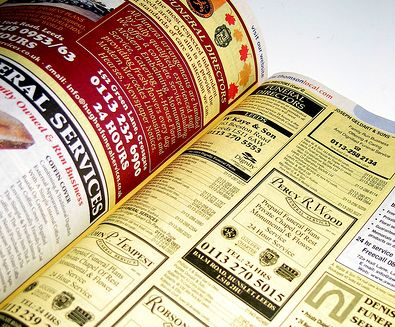
    Is he wrong? No, not completely. When all other factors are equal (as they never are in real life) a larger ad will be noticed more easily than a smaller ad. And there is some evidence that being listed earlier in the category improves the odds of being noticed, too.

    However, a bad ad won’t be read regardless of size or postion. Adding color won’t ad to your persuasive ability, and getting noticed does not directly lead to persuading anyone to buy. Size, position, or color don’t communicate a message.

    You’ll recognize a bad ad by it’s focus.

    Bad ads are about the advertiser. Good ads are about the customer. A bad ad says “This three stone diamond pendant is only $299 just in time for Mother’s Day.” A good ad says “She’ll kiss you like you’ve never been kissed before.”

    What’s the most important part of any ad? The headline. It draws attention and naturally leads the reader into the rest of the ad. At least, that’s how it’s supposed to work.

    The ad which had been faxed to me used my client’s logo as the headline. Can’t you just see a potential customer’s eyes glazing over as she sees page after page of yellow pages ads with business name after business name as the focal points of those ads? Unfortunately this kind of design is all too common in the yellow pages.

    Think about this: people go to listing media when they have a problem to solve. They go to the business category that seems most likely to address their problem. Page after page of business names makes the customer do all of the work. And make no mistake, trying to figure out whether your business can help IS work.

    The name of your business doesn’t say anything of interest to a customer searching for a solution to her problem.

    Make it easy for a prospective customer.

    Make your headline promise a big benefit, which will naturally pull the reader’s eyes to the rest of the ad. Once the customer is confidant that you understand her immediate need, include your name, address, and phone number – at the bottom, where they belong.

    How does this story end? I re-wrote the ad.

    The headline now promises a benefit to the reader. The information that the client had been “serving the community for fifteen years” was replaced with body copy and an illustration which expands on that promise. Finally the client’s logo was reduced to a reasonable size, and his address and phone number were placed at the bottom of the ad, where they become the last thing a potential customer reads.

    If she’s been persuaded, she’ll now pick up the phone and call.  Is there a better outcome when you’re fishing for customers?

    Your Guide,
    Chuck McKay

    Marketing consultant Chuck McKayYour Fishing for Customers guide, Chuck McKay, gets people to buy more of what you sell.

    Got questions about making Yellow Pages advertising more effective? Drop Chuck a note at ChuckMcKay@ChuckMcKayOnLine.com. Or call him at 304-523-0163.


  • One Easily Remembered Point

    One Easily Remembered Point

    Dentist

    One of the things that too many small businesses do when they advertise is to try to pack the ad with everything that could possibly be of interest to any potential customer.

    After all, advertising is too expensive to waste any opportunity to sell everything to anyone.

    That’s logical, isn’t it?

    None the less, it’s guaranteed to be bad advertising.

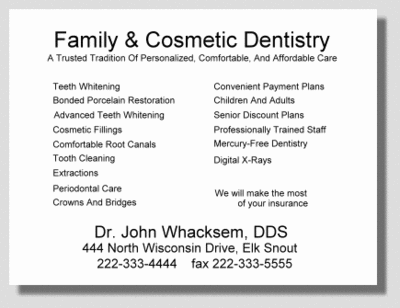
    Look at this Yellow Pages Ad

    It could easily be a radio ad, or television ad. The style isn’t at all different, merely the details of the execution.

    Dentistry Ad
    Dentistry Ad

    And as a Yellow Pages ad, listed with all competitors under “Dentists,” Dr. Whacksem is likely to get a few calls from this ad. He will, however, always suspect that his ad isn’t very efficient. It doesn’t draw enough business for what he’s paying. He’ll blame the medium. “My radio rep told me that Yellow Pages don’t work. She was right.”

    She’s wrong. So’s the doctor.

    The medium isn’t the problem, the message is the problem.

    What’s the message? Ah. There’s our problem.

    What is his message?  That he works on kids, and their parents, and older people, too? That he will accept insurance payments or make a payment plan? That he does fillings, and teeth whitening, and root canals, and extractions? That he does crowns and bridges and bonded porcelain? That he uses x-rays? That his staff is professionally trained? That he’s “mercury-free,” (whatever that means)?

    What is Dr. Whacksem’s message? I’ve counted at least fifteen, and that doesn’t even count him telling you how to get in touch.

    Without scrolling back up, how many can you remember? Humm. And that was only two paragraphs ago, after I drew your attention to it.

    Nobody will remember a list.

    Listing your services, or your products, is bad advertising.

    Instead of getting more information to more people, you’ll accomplish exactly the opposite. The message becomes part of a blur in the minds of the people who are already being clobbered by hundreds of other ads every day.

    This ad doesn’t say anything “salient,” anything a potential customer can relate to. Without that salience, it doesn’t stand out. It doesn’t get remembered. To maximize your impact, you need to give this ad salience.

    You need to make one simple, easily remembered point to one particular group of people.

    Some small business people get it right away. Many do not. Frankly, most do not.

    You’re telling me NOT to tell people that my dental office works on children, and adults, and old people. You want me not to tell people we do root canals, and teeth whitening, and x-rays, and takes most insurances? That’s crazy. What if someone needs a crown, and they don’t see that in my ad?”

    What if someone needs a crown, and you didn’t manage to get their attention in the first place? How many people do you believe actually read your list of services?

    Whatever the size of your business, your advertising will have a bigger impact if you limit your ads to one simple easy to remember message.

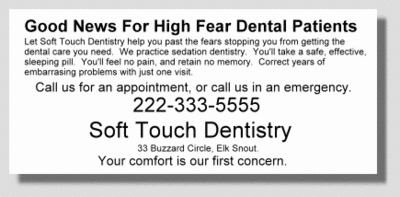
    Consider this ad from one of our first dentist’s competitors:

    Better Dentistry Ad
    Better Dentistry Ad

    First, notice the headline – “good news for high fear dental patients.” How many people are afraid to even be examined by a dentist? And even those who aren’t afraid will appreciate the promise of “Soft Touch.” Everyone will appreciate that their comfort is this dentist’s first concern.

    Notice, too, that the ad doesn’t list all of basic services. Truthfully, though, doesn’t every dentist do fillings? Root canals? Cleaning? Doesn’t every dentist use x-rays?

    Do we even notice that these things are missing? Do we care?

    No, we don’t.

    What do we remember?

    Instead, we remember that Soft Touch Dentistry doesn’t want us to hurt, or to be afraid.

    The second ad makes much more impact, doesn’t it?

    OK, but what happens when someone who’s not afraid of the dentist hits the Yellow Pages? Which ad is she drawn to?

    Care to speculate?

    Of course it’s the second one. Whether she needs a cleaning, a root canal, or a crown, our dental prospect is still not likely to even notice the first ad, and will react positively to the second. The second ad, the highly-focused single message ad, is the one our dental prospect will read. She’s also more likely to phone for an appointment.

    So, by narrowing the focus to a single point, we actually broaden the appeal of the ad. Wow.

    Then, there’s cost.

    And there’s something odd happening here. With all of its additional impact, the second ad takes only about 60% of the space that it’s competitor does. Soft Touch Dentistry makes a much bigger impact with a substantially smaller ad. Double wow. How much money will this save Soft Touch over the year? Better yet, how many more impressions can Soft Touch Dentistry purchase with the same budget?

    OK, one last thought: the Advertising Performance Equation (APE) represents the relationship between your message, the frequency of that message delivery to an audience, the customers’ experience with you, your market potential, and resultant sales.

    All other factors being equal, and without going into the math, making your ad twice as memorable will double the percentage of your advertising driven sales.

    And we like to double the catch when we’re fishing for customers.

    Your Guide,
    Chuck McKay

    Marketing consultant Chuck McKayYour Fishing for Customers guide, Chuck McKay, gets people to buy more of what you sell.

    Got questions about helping people to remember your advertising? Drop Chuck a note at ChuckMcKay@ChuckMcKayOnLine.com. Or call him at 304-208-7654.