What happens when a person gets parched? The obvious answer is that they will automatically search for the nearest store, POS (POS stands for point of sale) or refrigerator to look for a nice beverage to quench their thirst. This is of course basic human nature as just about every person on this planet will feel this way at frequent times during the day.
Now the question here is; what happens when a business gets parched?
Thirsty For Leads
A business cannot literally get thirsty. However, it can crave for an extra number of sales leads. The main reason behind this is because these sales leads are the key to the business’ survival and its eventful growth in their industry. There are times when a business can run dry of business leads. When this happens, their growth is stunted and the flow of income will be capped.
When the business is thirsty for leads, they turn to reliable sources like a credible business sales leads provider. These sales leads providers can offer them a dependable business contact database so that their thirst can be quenched.
What Does a Database Offer?
A business database holds a list of contacts of potential clients or business prospects in a specific market. For instance, business owners can get a business database that holds sales leads that are in a particular industry, profession, or even country. Therefore, they can acquire a number of sales leads just with a drop of a hat.
Aside from this, there are a number of other benefits that the business can get from acquiring this business contact database and mailing list from a reliable provider.
Let’s Look At These Advantages
Enhancing the range of the business’ target market – For many businesses, the expansion of their market range is put into top priority. The database allows their market to be expanded as it enables the business to contact potential clients that may have escaped them in some way or another. When they achieve this great benefit, they are not in the first step into increasing their return of capital.
Acquisition of fresh sales leads – Businesses, in most industries, always needs sales leads that are fresh and targeted. These are the leads where other companies within a related industry have not yet made any kind of deal with these potential clients. Now imagine when these business contact these prospects first, the chances for procuring a closed transaction out of them will be very high.
Lower down the completion time for the marketing campaign – With the sales leads in hand; the business no longer has to search for them thus negating the first few phases of their marketing campaign. Therefore, they can immediately focus on a more important matter at hand with these leads; namely qualifying them to become respected clients of the business.
Training costs will be minimized significantly – Business owners no longer have to worry about training their staff in trying to search for the sales leads as the contact database already holds them. The business owner can then train a lesser amount of tasks for their sales representatives. As an example, they can then train their representatives to qualify more leads and turn them into quality clients for their business.
Obtain a more stress free environment – This last benefit can be seen as an added bonus to the whole package. Since these other benefits are attained with the acquisition of the business database, then business owners and their staff will eventually notice that their assigned tasks has become less of a hassle to deliver. The end result will be that the business achieves a more relaxed workspace which helps a lot in keeping the peace within the establishment.
With this business database at the business owner’s fingertips, their organization will always be full of leads and enable them to acquire these benefits and more. Outsourcing to business database providers will help your business keep going and surely your ROI will be more than what you expect.
About the Author
Alice Clark is a sales and marketing consultant specializing in business contact database management. Alice invites you to visit http://www.contactdb.com/ to learn more about business contact lists and databases.
Martha was THE media queen at a large, St. Louis based advertising agency in the late 70s. She personally placed several millions of dollars with local media.
The St. Louis radio stations, television stations, newspapers, outdoor companies all came to kneel before her throne and pay homage.
For, you see, the ad budgets she tossed to local media reps as if she was feeding scraps to her pets, could make, or break, a media rep’s sales goal.
And Larry couldn’t get in to see her.
He’d called. Left messages. Sent flowers on her birthday. Arranged madrigal singers to serenade her office during the end-of-year holidays. But, no matter what could not get Martha on the phone, or to pencil him into her appointment book.
Until October of 1972, when Larry had a 15 foot banner made that said: “C’mon, Martha. Give Larry an Appointment. Call 314-228-7xxx.” He hung the banner on the building across the street, so that each time Martha looked out her third floor office window, she saw it.
Martha is an Identified Prospect
When prospects are identified, we have their contact information available. Instead of sending a letter to “occupant” and hoping someone reads it, we address that offer to a specific person.
Instead of running a 30 second TV ad to reach the whole viewership in hopes enough of those viewers might be interested, we pick up the phone, dial a particular prospect, and ask.
Presumed Prospect:
The prospect goes to her mailbox, and retrieves an envelope from Smiling Ralph’s Auto Emporium addressed to “Occupant,” or maybe “Resident.” The letter says, “Dear Neighbor, its time for Smilin’ Ralph’s Legendary Upgrade Your Ride sale, this Saturday at Smilin’ Ralph’s.”
Identified Prospect:
The prospect goes to her mailbox, and retrieves an envelope from Smilin’ Ralph’s Auto Emporium addressed to her. The letter says, “Dear (prospect’s name), your 2006 Chevy Silverado is worth $15,575 toward the purchase of a new Toyota Tundra 11 Crewmax at Smilin’ Ralph’s.”
The General Public is Too Vast
If Ralph sends letters to the general public, he’s sending them to people who don’t drive; to people who just bought a car; people who will not buy a pickup; people who will not buy any foreign-made vehicle, and people who simply can’t afford one.
The more non-buyers Ralph can remove from the Presumed Prospect list, the greater the percentage of sales which result from offers he presents to those remaining. This has the effect of driving advertising down cost per sale. All of his advertising becomes more efficient.
So, instead of sending the Occupant letter to everyone in town, Ralph uses some combination of geography, demography, and psychography to eliminate as many non-qualified prospects as is practical. Its Ralph’s goal to to spend no money to reach people who won’t buy. Its his hope a significant number of the remaining Presumed Prospects will.
We prefer to know more about our prospects, than less. We like efficiency.
Like Ralph, we look for similarities in age, income, event attendance, radio listening, magazine subscriptions, and other purchasing habits among our current Core Customers. We systematically eliminate groups of people from our Presumed Prospect listswho don’t match the profile.
Of course, the ultimate in knowing “more” is to have their names, addresses, and previous purchase information. This moves them from the Presumed Prospect list to the Identified Prospect list. Getting those people to self identify is the primary function of two-step advertising.
So, Identified Prospects Are Better?
Not better. More efficient.
C'Mon Martha Banner
Larry was willing to pay to hang a banner in Martha’s view because he knew she was a buyer. A big buyer. His risk of spending to reach a non-buyer is zero.
The cost of the banner may make it questionable as a good investment, but the sheer size of the anticipated payoff made this one worth the gamble. Of course, banners aren’t the only medium. And they are costly.
Compare the cost of Larry’s banner with the much smaller cost of a local radio ad. Ah, but radio presents another problem. To schedule that ad, Larry would have to know which stations Martha listens to, and the time she listens. He needs to know whether she is paying attention, or if she’s chosen that exact minute to return a phone call.
Odds are high Larry won’t pick the right time to schedule his ad. He’ll hedge his bet by purchasing ads on more radio stations, over greater periods of time, and for several more days. Maybe Martha will hear one of them. And unless Martha picks up the phone and calls him, Larry won’t even know when she’s heard it and he can stop paying for additional ads. Yeah, radio’s an expensive way to reach one single person.
OK. Larry could rent a billboard and put his message on it. Oh, wait a minute. Which route does Martha take to work? Does she drive, or take the bus? Will she be more likely to notice the message going to work or coming home. Larry is right back in the unenviable position of needing to buy a lot of boards, too.
And television? Larry doesn’t know which television programs she likes or which of those she’ll choose to watch at the time he’s scheduled the ad to run. Even if he did, can Larry be sure she won’t choose that commercial break as the best time to raid the ‘fridge? Come to think of it, doesn’t Martha sing in her church choir? On which night do they rehearse? Is that the night Larry chose to run his ad?
Newspaper? Which paper? Which section? What size ad? How many days? Which days? Looks like a significant budget for newspaper, should Larry choose it.
Mass Media is a Terribly Inefficient Way to Reach a Single Buyer
But, odds are Martha isn’t the only radio listener / television viewer / outdoor or newspaper reader. She’s likely one of many. How many depends on the station (or location, or circulation), and the time of day (or placement).
How many of those other people may be prospects? Ah. Good question. That sort of brings us back to the basics, and back to the concept of Presumed Prospects, doesn’t it?
As a general observation, the more we know about a shopper / potential buyer, the more it costs to expose that shopper to our message.
This concept is important. I’m going to repeat it. It always costs more to reach a highly-qualified prospect than one who’s marginally qualified, or not qualified at all.1 But, the more qualified that prospect is, the more likely she is to buy.
So, like nearly everything in advertising, the way to determine the best advertising program for your business is to try a few and compare. The cost of each ad isn’t really relevant. Divide the number of dollars resulting from advertising driven sales by the total cost of the advertising.
The Exception
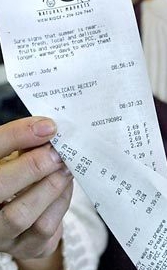
Cash Register Receipt
We know far more about existing customers than about any Presumed Prospects or Identified Prospects. Well, we should.
People who’ve already bought are most likely to do so again. Since you already know each customer’s name, her address (or e-mail address) and what she bought, you can craft an individualized offer and deliver it for the price of a stamp.2 (You do know this information, don’t you)?
There’s a grocery two blocks from my home. If 30 days goes by and they don’t record any purchases from me, coupons for the exact brands I prefer appear in my mailbox. They offer me 30 cents off six cans of Campbell’s® cream of chicken soup, and ring up a hundred dollars or so of other groceries on my next trip in.
And, our relationship is invisible to that grocery’s competitors. No one knows they sent the coupons but them, and me. And maybe my Postman, but he’s not telling.
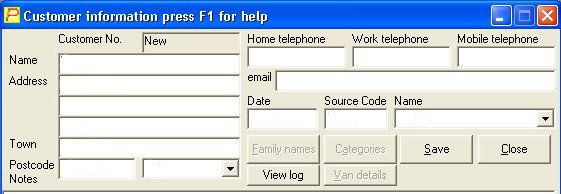
Customer Data Screen
Do you have a system to capture the pertinent customer information from each sale? You need one. You need to identify the characteristics of your Core Customers and apply those to the Presumed Prospect lists.
I promise, better database management leads to more predictable successes when you’re fishing for customers.
Your Guide, Chuck McKay
Your Fishing for Customers guide, Chuck McKay, gets people to buy more of what you sell.
Got questions about creating a customer database? Drop Chuck a note at ChuckMcKay@ChuckMcKayOnLine.com. Or call Chuck at 304-208-7654.
1. Martha and Larry are real people. I heard the story from Larry, years after he retired. After three days of her friends, colleagues, and other media reps calling to ask, “Well, are you going to give Larry the appointment?” she did. And, not surprisingly, she eventually placed a schedule.
2. When you send offers to your core customers, call it “Core Mail,” to distinguish it from Direct Mail.
In Shel Silverstein’s 1970 song I Got Stoned And I Missed It, he tells of “a nut down on the corner givin’ hunnert dollar bills away.” Being otherwise preoccupied, Silverstein wasn’t able to take advantage of the opportunity.
But untold numbers of websurfers essentially passed on the same opportunity when Mike Enlow tried to give away $100 bills on a web site he created for that purpose. (We can only hope that most were not operating their computers in Silverstein’s impaired state).
Enlow expressed it well when he said about shoppers on the web, “They Don’t Believe One Darned Word You Say! Literally. They’re sick of being lied to. Sick of being misled. Tired of outrageous offers, unsolicited email spam, products that don’t work as advertised, and people who hide behind fake names and fake email addresses.
“And Here’s The Problem: Even if you are selling the greatest, most effective, amazing product or service in the history of the world (even free $100 bills), I GUARANTEE you that whatever you are doing to establish your credibility right now isn’t enough.”
Does your website make it easy for people to snail mail you? Place a phone call? Do you show your name? Your photograph?
The more of these things you make easily accessible, the more trustworthy you appear.
Hancox adds, “The funny thing is, in so many aspects of our lives, we’re all trying to give away hundred dollar bills. Maybe not that specific dollar amount, but we may be trying to give away something we think is of value.”
He goes on to say “One of the simplest and yet most effective things you can do in life to improve your marketing and, quite frankly, just about everything you do to persuade and influence others, is to look at it from the other person’s perspective.”
And this, my friends, is the secret to all great advertising as well, when you’re fishing for customers.
Your Guide, Chuck McKay
Your Fishing for Customers guide, Chuck McKay, gets people to buy more of what you sell.
Questions about increasing your credibility through your advertising may be directed to ChuckMcKay@ChuckMcKayOnLine.com. Or call Chuck at 304-523-0163.
According to an old saying there are only two things people want to know about you: what you stand for, and what you won’t stand for. This is the basis of reputation.
We intuitively understand that people’s actions are nearly always in accordance with their values. Someone who embraces fairness and treats other people honorably is likely to treat us honorably. Someone known to be dishonest has a higher likelihood of cheating us, as well.
And like our personal reputations, our companies have professional reputations, built on the experience customers have in dealing with our companies, along with their willingness to talk about those experiences.
Call it Word-of-Mouth
Another name for professional reputation is word-of-mouth, which comes in three variants. From least to most influential, they are:
1. Market Awareness – Do I recognize any of these names in this directory?
2. Recognition – Have I heard of anyone who has the ability to help me with my problem?
3. Customer Experience – Do I have knowledge of, or experience with someone who can help me to solve this problem?
Each successive level takes priority over the previous.
Market Awareness
At the awareness level, customers recognizing your company’s name trumps them never having heard of you. This is the weakest level of word-of-mouth. If you stay in business long enough, you’ll achieve some level of awareness. You’ll then have a slight advantage over some newer company that has yet to achieve any awareness at all. Why? With no other information to go on, shoppers will usually buy from the company they’ve heard of.
Professional Awareness is largely a function of repetition. A customer notes your name on the outfield sign at the ball park. Hears your jingle each morning on the radio. Sees your banner ad on the Internet. Catches your sponsorship of the six o’clock news. Recognizes your logo on the a coffee cup. If you’re part of the community, eventually people will bump into your name in the course of living their lives. The longer they’re aware of you without hearing specific negatives about you, the more generally positive this awareness becomes.
Small businesses like to advertise how long they’ve been in business, as if years of “experience” automatically translates to a benefit in the minds of shoppers. Unfortunately, shoppers have proven not to care. (Kind of ironic, isn’t it? All those years of doing business in the community have lead to awareness of your company – but the benefit is to you, not to them).
Recognition
The next step up, recognition, beats out basic awareness because people now have attributes to attach to your name. “Here’s what people say” is the next best thing to first-hand knowledge – provided of course people aren’t saying uncomplimentary things.
The size of the community is a factor, too. The fewer people who make up the population, the more likely a shopper to run into someone with a story to tell about the business. Recognition is a bigger factor in small communities than in large ones.
According to Wikipedia, one study found that a good reputation added 7.6% to the price businesses received for their goods. Some companies are finding that improving their reputations can actually boost stock prices.
Side note: the Internet has changed the nature of “community.” It simultaneously offers the potential of world wide reach while providing individual gossip to anyone who seeks it. And just as bricks and mortar stores have public relations companies to put a positive spin on community perception, their web-based brethren are now hiring reputation managers to keep track of on-line credibility.
Personal Experience
And finally, those people who have had actual dealings with the companies in question will have the most convincing word-of-mouth of all.
Shoppers who get what they expect will not give interaction with that business much thought. Word-of-mouth commentary happens when the customer’s actual experience differs from the expected. Delighted, wowed, or amazed customers spread positive word-of-mouth. Disappointed, disgruntled, or dissatisfied customers will spread negative.
A real life example
The new guy on the staff has just relocated here to take the job. This morning he heard a strange grinding sound as he drove to work. New guy is worried. The disparity between his lack of knowledge about possible causes, and his pressing need for such knowledge makes him feel vulnerable.
He asks his co-workers for credible information to help him choose a solution, or at least his next step.
“Does anyone know anything about cars?” Note that he starts looking for information at the highest level of credibility – personal knowledge.
Not finding an expert among his co-workers, new guy begins to rely on word-of-mouth. Why? He’s trying to lower his risk level. A bad choice in a mechanic could have him paying for services he doesn’t need. Worse yet, he could choose someone who won’t be able to fix his problem (but will charge him for time invested anyway).
His next question: “Does anyone know a good mechanic?” addresses the most credible level of word-of-mouth – personal experience.
In the absence of such knowledge, he will quickly go down the probability scale, asking next what his co-workers have heard about mechanics in town.
Finally, he’ll go to his newspaper, or to the Yellow Pages and start studying the ads to see who appears to exhibit expertise in his specific grinding noise, or at least a company affiliated with a national chain.
Back to the beginning
There are three levels of word-of-mouth. Only two can be effected by your advertising. The third is strictly a function of the way you operate your business.
So what are your company’s values? What do you stand for? What won’t you stand for? Do you consistently project those values in each interaction with customers?
Is your business not growing because potential customers don’t know about you, or is it because they think they do?
Are you scaring the fish, as you fish for customers?
Your Guide, Chuck McKay
Chuck McKay
Your Fishing for Customers guide, Chuck McKay, gets people to buy more of what you sell.
Have questions about helping word-of-mouth to help build your professional reputation? Send them to ChuckMcKay@FishingforCustomers.com. Better yet, pick up the phone and call Chuck at 304-523-0163.
Q: I keep reading that narrower focused ads are more effective, but I don’t have a very big advertising budget. I can’t afford to pass up anyone who might be interested in what I sell. Shouldn’t my ads include everyone?
A: Short answer, “no.”
Here’s why: Unless you’re a recording engineer, or perhaps a recording musician, you’re probably not interested in advertising for a new Pro-Tools plug-in. If you’re exposed to such an ad, you probably won’t even notice it. You definitely won’t remember it.
You do the same thing with all of those other products and services in which you have no interest: sumo wrestling, cheeses of the world, the position of the guy running for school board in some other district, crosspoint stitching, 18th century English poetry, building a wind-powered electrical generator, tourism guides to Toronto, and the genealogical history of your brother-in-law’s family.
What happened when you were “exposed?”
Did you consciously consider, then choose to ignore these offerings as they competed for your attention? Nope. You didn’t recognize any value to you, and stopped further consideration. Gone. Poof. No longer exists in your universe. Maybe never did.
All of those people you’ve been attempting to “woo” to your business react in much the same way. Either they are interested in your advertisement, and will allow more information to enter their “What’s In It For Me” filter, or they aren’t, and relegate your ad to “ignore” status.
Now, when it comes time to compose an ad for your business, people will not see “office supply store” and immediately think, “Hey, they probably have flash drives, too. I could go there and compare prices with the computer store.” Instead, they’ll see “office supply store” and immediately think, “I don’t need office supplies.”
You’ve already been dismissed.
Its not that people are too lazy to figure out what you’ve got for them. They made the decision to ignore what you’re saying long before such a puzzle might even occur to them.
This is why you must create your advertising from the perspective of a potential buyer. Potential buyers, by the way, don’t think of what they want in terms of “all their (blank) needs.” And as long as your ads say that, or “fast, friendly, courteous service,” you can count on being ignored.
But, what if instead, you’d created an ad that said, “We’re a modern office supply store. We recognize that in addition to paper, toner, and desk calendars, today’s office may need blank DVDs, hub adapters, and hard drive upgrades. Come visit our computer supply department, and while you’re there, pick up a 16-gig USB flash drive for only $17.95?”
Would someone who needed a flash drive react to that ad? Highly likely.
But you have more things for sale than flash drives, don’t you? A whole store full of other things. Hummm. I guess you’ll need to create other ads for those items.
There is no universal bait. You must choose the fish you wish to catch when you’re fishing for customers.
Your Guide, Chuck McKay
Chuck McKay
Your Fishing for Customers guide, Chuck McKay, gets people to buy more of what you sell.
If you have more questions about copy strategies to sell more of what you offer, Chuck welcomes your email, or call him at 304-523-0163.
Bob’s is the only hardware store in Elk Snout. Bob’s buys a weekly quarter page in the Elk Snout Gazette for $230. Bob’s grosses $6,700 per week, year round (since there are no seasons in Elk Snout).
One day, the new Gazette salesperson convinces Bob’s manager to purchase an additional $200 ad in the Graduation Issue of the paper. That week, Bob’s revenue jumps to $7,100. “Well, I guess the new kid was right,” says Bob’s manager, “we just doubled our money.”
But, as the manager adds up all of Bob’s payables, he seems to have $64 dollars less to pay the bills than he expected. How could he be short? He even had the extra profit from the extra Graduation ad.
By some odd coincidence, you operate a small factory in Elk Snout making stone trivets. You sell them to hardware stores like Bob’s. That salesperson for the Gazette must have been pretty good. He got you to buy one of those $200 ads in the Graduation Issue.
Your gross increased by the same $400. At the end of the month, after you’ve paid the trivet factory bills, you find that you have an extra $15.
You and Bob’s weren’t alone in that Graduation Issue. The injection molding company and the nightclub also purchased $200 ads, and amazingly, they too each saw sales increases of $400 that week.
But when they reconcile their payables, the nightclub seems to have picked up an extra $170, but the injection molding company comes up short $332.
What’s going on??
It’s the effect of gross margin.
Gross margin is profit divided by selling price.
Let’s look at your trivet company financials. Every trivet costs $4.50 to produce. You sell them to Bob’s, and similar stores, for $9.75. Your gross margin is $5.25 divided by $9.75, or 53.8 percent. This means that for every dollar you take in, 53.8 cents falls to the bottom line, while 46.2 cents is consumed in the production of trivets.
The injection molding company operates with a gross margin of only 17 percent, using up 83 cents of every dollar manufacturing the plastic parts which they sell for that dollar.
But over at Bob’s Hardware, each dollar of gross sales produces 34.1 cents in net profit, which means that 65.9 cents of each of Bob’s dollars gets used to purchase and stock the hardware.
And at the nightclub, forty cents worth of rum and 5 cents worth of cola costs the customer $6.00, and provides an astonishing 92.5 percent gross margin.
So, what does gross margin have to do with advertising?
It isn’t simply dollars in minus dollars out.
In Hope is Not a Strategy for Greater Return on Advertising Investment, I said, “If advertising is an investment, you should expect to see a predictable profit from that investment. Invest a dollar in advertising, get back four, or five, or six. At the very least, shouldn’t you get back a dollar ten?”
Alas. A dollar ten returned on a dollar invested will have three of our four fictitious companies losing money. You see, each company’s revenue is in gross dollars, but each ad is purchased with net dollars. When a portion of each gross dollar is eaten up in the expense of generating sales, it takes more of the remaining net dollars to do the job.
You won’t know whether your advertising is profitable until you calculate Return on Advertising Investment (ROAI), wich is the reciprocal of gross margin. If you have a 50 percent margin, your advertising must return at least double your investment. At a 20 percent margin, you’ll need five times the investment. At 5 percent margin your ROAI needs to be 20 times.
Let’s look at this in chart form.
Gross
Breaks Even
Investment
Margin
at ROAI of:
Nightclub
$1.00
92.5%
$1.08
Trivet Company
$1.00
53.8%
$1.86
Bob’s Hardware
$1.00
34.1%
$2.93
Injection Molding
$1.00
17.0%
$5.88
The last column shows the sales increases each company needs to justify each dollar that company invests in advertising.
If the nightclub gets back anything in excess of $1.08, their advertising is profitable. But, if the injection molding company doesn’t see sales increases greater than $5.88 for each dollar invested , they’d be better off not advertising at all.
Your trivet company breaks even when each dollar spent returns $1.86. Bob’s breaks even when $2.93 returns. Compared to Bob’s Hardware, you get a $1.07 advantage in every dollar you invest in advertising. But compared to the injection molding company, each dollar your trivet company invests buys $4.02 more.
What about that $200 ad in the Gazette?
The nightclub did well. Your trivet company did, too.
Gross
Breaks Even
Effect of $400
Investment
Margin
at ROAI of:
Sales Increase
Nightclub
$200.00
92.5%
$1.08
$170.00
Trivet Company
$200.00
53.8%
$1.86
$15.20
Bob’s Hardware
$200.00
34.1%
$2.93
$-63.60
Injection Molding
$200.00
17.0%
$5.88
$-132.00
OUCH! Bob’s Hardware and the injection molding company not only didn’t make a profit on their $200 advertising investment, they actually lost operating capital.
And it all has to do with Gross Margin. If you don’t know your margin, how do you know whether your ads are “working?” How do you even know how much to budget?
Most companies don’t produce only one product. They need to calculate an average gross margin by dividing total operating profit by total gross sales.
What is your company’s average gross margin? What is the ROAI you need to stay profitable?
Fishing for Customers isn’t simply being ready to “hook ’em.” Sometimes it’s knowing how much you can afford to spend on “bait,” too.
Your Guide, Chuck McKay
Your Fishing for Customers guide, Chuck McKay, gets people to buy more of what you sell.
Got questions about expressing the specific values and advantages of what you sell? Drop Chuck a note at ChuckMcKay@FishingforCustomers.com. Or call him at 760-813-5474.
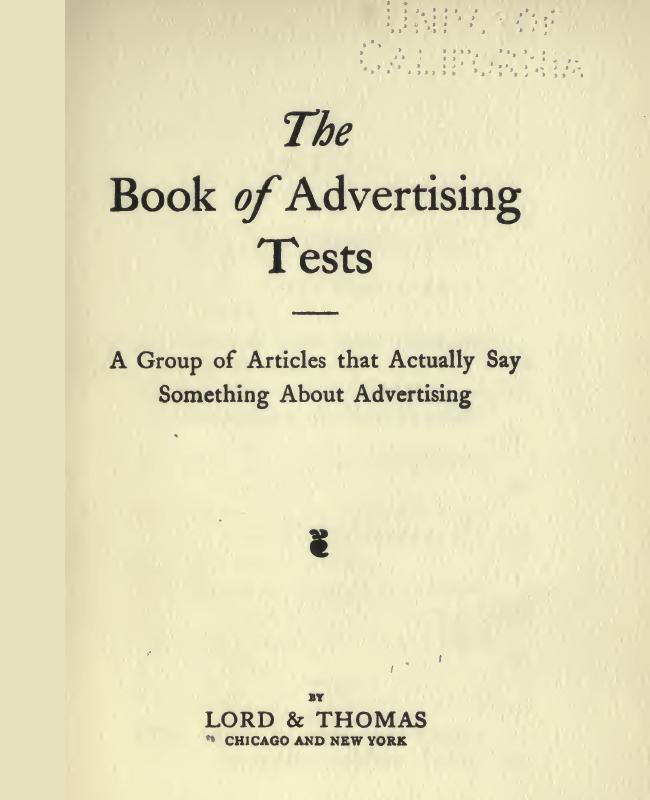
Former Canadian policeman John E. Kennedy not only created modern advertising (“salesmanship in print” and “reason why advertising”), he taught it to the copywriters of Chicago’s Lord & Thomas agency. At that time, he was the highest paid copywriter in all of advertising – a record he held until his pupil, Claude Hopkins, started earning more.
The Book of Advertising Tests is a collection of articles Kennedy wrote for the Lord & Thomas “house organ,” Judicious Advertising. Though it was published in 1926, the key points are timeless, and equally valid today.
Roger met me at a local family restaurant. With the ease of old friends not having seen each other for months, we slipped into a “catching up” conversation over breakfast.
I casually asked, “How’s your food, Rog?” Roger paused, considered, and told me, “It’s quite good.”
I pointed to the ceiling fan roughly ten feet to my left, and said, “Notice the dust build-up on the fan?” Roger confessed he hadn’t.
I directed his attention to the rear door, and asked, “Can you see the cobwebs on the Exit sign from here?” Roger admitted that he could.
I pointed out the filthy black build up on the air return vent next to the kitchen. Again I asked, “How’s the food taste now, Roger?” He replied, “Not as good.”
I wanted to know why. Roger looked at me, and disappointedly told me, “If the front of the house is this filthy, I can only imagine how disgusting the kitchen must be.”
Critical Non-Essentials
Dr. Paddi Lund
One wouldn’t think restaurants have much to do with dentistry, but there is a commonality.
People don’t have any specific knowledge as to whether their dental practitioner is any good at dentistry. They aren’t qualified to judge his education, experience, or even the quality of his fillings.
But, they do know how to recognize that the florescent lights in his hallway are flickering, and that he’s out of paper towels in the men’s room.
Australian Dentist, Paddi Lund, named these little signs that your business is properly attended to as “Critical Non-Essentials.” They are items which have no effect on the service one provides, but have tremendous influence on the opinions of customers about the quality of the work performed.
The florescent tubes and paper towels are non-essential to the practice of dentistry. They are critical to patient assessment of the dentist’s competence.
So the patients conclude a dentist who won’t keep his practice equipped and stocked with the basics can’t be a very good business person. By extension, he’s probably not a very good dentist, either.
Clean return air vents are non-essential to food service. They are critical to the customer’s assessment of food quality. Services like cosmetic dentist Colorado Springs have vacuumed carpets and tidy shelves are non-essential to fabric sales. They are critical to customer assessment of fabric quality.
Interestingly, it isn’t just the critical non-essentials that form people’s opinions of our businesses.
One Man’s “Untidy” is Another Man’s “Creative.”
We expect novelists to work in cluttered offices. Neat, tidy, everything-in-its-place organization would be out of character. But an attorney working in a disorganized, untidy office projects incompetence.
And florescent lights hanging by chains from the ceiling are perfectly appropriate for a warehouse shopping club, but woefully inadequate for a jewelery.
In general, softer surfaces, subdued colors, wall treatments, indirect lighting, and less noisy showrooms prepare shoppers for higher prices. They also help customers to “rank” us within our professions. And then they compare us to our competitors.
A carpeted store with wallpaper, indirect lights, and soft music will project better quality merchandise than a store with cement floors, painted cinderblock walls, and loud echoes of forklifts.
But, if that second store is impeccably clean, while the first store’s windows are grimy and restroom trash baskets are overflowing, you can predict where people will prefer to shop.
Consciously or not, people judge our competence both by their expectations of our profession, and by those critical non-essentials.
If those non-essentials are so important, why doesn’t everyone pay closer attention to them? Mostly because the change from excellent to unacceptable is so gradual.
And when businesses are running as lean as most are today, there simply isn’t anyone assigned the responsibility of checking the volume of the background music or the dates on the magazines in the waiting room.
We Need Systems
If each business had a list of assignments that was checked before they opened each day, and periodically throughout the day, it wouldn’t much matter who was on duty, would it? The work of the company would be done, and those non-essentials which contribute so much to each business’ image would be attended to as well.
If you don’t have a checklist, create one. Do it today.
When I’m evaluating a new client (and his competitors) I use a proprietary list of over 100 points at which customers come into contact with the company. Mine is organized by our five senses.
What contributes to imperfections customers could see, hear, or smell? What will they touch? What can they taste?
What will contribute to your customers first impressions? Their last? Does their experience end at check out? In the parking lot? Or when you follow-up after the sale?
Your checklist may resemble that of other businesses, but it won’t be identical. How could it?
What About Customer Referrals?
Even if you never “wow” a customer, over time, what do you think will happen if you never disappoint?
Does your company use such a system? Join the conversation, and tell us about it.
If not, why not start one today? Improving the bait makes your job much easier when you’re fishing for customers.
Your Guide, Chuck McKay
Your Fishing for Customers guide, Chuck McKay, gets people to buy more of what you sell.
Have you identified the critical non-essentials in your business? Maybe it’s time to start a conversation with Chuck about them. Call him at 317-207-0028. The man loves to talk about acquiring new customers and keeping current ones. Or, drop him a note at ChuckMcKay@ChuckMcKayOnLine.com.
A regional community college has just contacted the marketing rep for the local TV station.
They’ve spoken the words which strike fear into the hearts of salespeople everywhere: ““The advertising isn’t working.”
“Tell me more,” says the rep.
“Well, we’re getting a lot of calls – probably more than we’ve ever gotten before. We send our information kit to everyone who calls, but they don’t become students. We’re spending more on printing and postage than ever before, and aren’t getting much to show for it.
“Seems you’re wasting our money by bringing us the wrong people.”
The wrong people. Those would be people who don’t buy.
The advertising plan didn’t account for appealing to the “wrong people.” The plan assumed the right people would respond to the ads.
Radio stations are accused of bringing the wrong people when 200 listeners show up at Mr. Car Dealer’s remote broadcast but don’t buy cars.
The wrong people come to the grocery store and only buy the items featured in the coupon.
And now, you’re telling me the wrong people are picking up the phone and asking the college to send them information?
Why would they bother?
Who has so little to do today that he’s going to pick up the phone and call an institution of higher learning for information he doesn’t need or want?
The “wrong people” are common to nearly all businesses.
In the on-line world we refer to this as the “bounce rate” – the percentage of people who followed the link to your website and immediately changed their mind and went away. Its funny, but the conventional on-line wisdom doesn’t blame the advertising for bringing the wrong people, it INCREASES the advertising to get more people to the site.
Bricks and mortar stores? A recent study indicates that 81 percent of the people who enter such a store will leave without buying anything. What do they say when a salesperson approaches them? “No, thanks. I’m just looking.”
In both the real world and the virtual world, people are pressed for time. They don’t just go wandering around your store to alleviate boredom. They don’t enter your web store just to kill time. They don’t pick up the phone and call your 800 number out of indifference.
They’re never just looking.
They’re looking for something specific. They’re leaving because they didn’t find it – at least not the quality they demand or at a price they’re willing to pay. If they thought they’d found it, they’d have bought.
Stop blaming the advertising plan.
Your advertising isn’t bringing the wrong people. Your sales process is failing to convert them into buyers.
Its time to examine your sales process.
Begin by determining what your customers are seeking when they make contact. Then look for any impediment to prevent them from purchasing. Anticipate their questions and answer them in the way that makes them most comfortable buying from you.
There’s no use blaming your advertising if you have a long list of steady prospects and you’re not turning them into customers.
There’s very little point in trying to hook ’em when you can’t reel them in. It could be your brochures. Maybe it’s your salespeople. Either way, the flaw isn’t in your advertising. You’ll need to fix your sales process, before you can successfully fish for customers.
Your Guide, Chuck McKay
Your Fishing for Customers guide, Chuck McKay, gets people to buy more of what you sell.
Questions about reaching the right people with your advertising may be directed to ChuckMcKay@ChuckMcKayOnLine.com. Or call Chuck at 317-207-0028.

 When the business is thirsty for leads, they turn to reliable sources like a credible business sales leads provider. These sales leads providers can offer them a dependable business contact database so that their thirst can be quenched.

 Your Fishing for Customers guide,