Blog

  • What’s In A Name?

    What’s In A Name?

    Originally published August 14, 2005

    Name Tag
    “Hello, my name is” sticker

    Half a century ago a pair of researchers, Herbert Harari and John W. McDavid gave eighty experienced teachers papers to grade. Eight essays, all of comparable quality were supposedly by boys named David, Elmer, Hubert, and Michael, and by girls named Adelle, Bertha, Karen, and Lisa.

    The names were rotated through the eight essays, so that some teachers believed David wrote the essay on Tarzan, while others noted that David wrote the essay on kites.

    Result? When credited to names with positive stereotypes the papers got better grades than when credited to names with negative stereotypes. Michael always got a better grade than Elmer, for instance.

    Interesting.

    Names Make a Difference in People’s Expectations

    That would lead a curious person to wonder if George W. Bush could have been elected had his name been Pépé LePetomaine. Would John Kerry have been his party’s choice of candidate were he named Percy Arbuthnot? Would our fellow citizens be supportive of sending troops into combat if the initiative had been named something other than the “War On Terror?”

    Those who are very talented often make things look easy. When talented people are articulate, they make things sound easy, too. I think that’s the case with a post Chris Gloede authored on his Rants on Modern Marketing blog titled Product: Naming Isn’t Really That Important. It’s what started me thinking about names.

    I don’t disagree with Chris often. No matter how simple he makes it sound, I don’t believe that he would choose anything but a great name. Like I said, talented people just “do it,” while others are wondering what to do. And I certainly agree with him when he says “having a good product supported by good marketing” is more important than the name of the business.

    Still, I think names are important.

    Everything in our world has a name. Every sound, every color, everything you touch, and every business you deal with.

    Some Names Have Positive Connotations

    Others much less so.

    It’s not likely anyone today would name a baby Francis, Edgar, Agatha, or Mabel. And yet, we see companies deliberately choosing such names as Vapid Software. (I’ll save you the trouble of looking it up. Vapid is a Latin adjective meaning “flat tasting, lacking liveliness, dull”).

    There wasn’t much of a market for Chinese gooseberries. Say it out loud and listen to the sound of that name – gooseberries. It’s so much more attractive now that it’s been renamed “Kiwi fruit.”

    Crazy Eddie®, “with prices so low we must be insane,” sold massive amounts of stereo gear in New York in the 70s. It was a memorable name with a memorable advantage to consumers. But how likely are you to seek out an accountant doing business as Crazy Henry’s Income Tax Service? Would you make an appointment with a proctologist who calls himself Crazy Norman?

    Names are important. A businesses name is the foundation upon which it’s image is built. Are you more likely to purchase:

    DieHard®, or Gulf Star® batteries?
    Intensive Care®, or Cornhuskers® lotion?
    Craftsman®, or Imperial® hand tools?

    Care to guess which name in each pair sells more? Names are important.


    Overstock Dot Com has a problem in trying to market themselves as a high end retailer. The television image of opulance and the good life clashes with the name. Go to their web site and decide which of those images is a lie. Either way, their name becomes the limiting factor.
    Does The Body Shop® repair cars or sell scented bath products? This one sells bath products, and the name works. By association with the other image of a body shop, the implication is that you’ll find products to fix your body.

    My Great Names List

    My Great Names List is heavily populated by Sears® brands. In addition to Craftsman® and DieHard®, Sears names are such gems as Silvertone®, Coldspot®, Toughskins®, and the now defunct Roadtalker® CB radios. Sears understands naming

    Other names on my Great Names List include Right To Life Society®, Bank of America®, Sports Illustrated®, and Pay Less Drugs® (Yeah, I know. They’re Rite Aid®, now. Pity. I understand Pay Less Drugs. Wanna explain to me what a Rite Aid is? Or how to spell it?)

    A British energy company named Powergen? I like it. The Italian subsidiary of that company? Powergenitalia. That wouldn’t be such a good name.

    What do you think about Phartronics Engineering or Ascend Communications. (Try them out loud. It makes a difference).

    Also featured on my You’ve Gotta Be Kidding Me names list are such gems as Badcock Furniture, Boozer Shopping Center, Beaver Cleaners, Dick Cleaners & Drapery Service, and Bea’s Ho-Made Products.

    I want to see the workers on Bea’s assembly line.

    For the record, I didn’t invent these names to make my point. I’m not that clever. These are very real businesses. Well, except for Powergenitalia.

    Why Names Are Important

    Names establish the foundation of image. Names make a difference in people’s expectations. Your child’s name is important to his future success, and so is your business’ name important to its future success.


    In each case we use the name to affect public perception. Perception is reality.


    And what is marketing, if not an attempt to alter perception? The right perception can only help as you’re fishing for customers.

    Your Guide,
    Chuck McKay

    Marketing consultant Chuck McKayYour Fishing for Customers guide, Chuck McKay, gets people to buy more of what you sell.

    Need some help creating a great name for your company? Drop Chuck a note at ChuckMcKay@ChuckMcKayOnLine.com and start a conversation.  Or call him at 760-813-5474.

  • Ten Steps To Great Customer Service

    Ten Steps To Great Customer Service

    Originally Published July 12, 2006
    The scene is a national restaurant chain. I’m meeting a client for lunch. I notice that our hostess, who doesn’t appear to be much more than 19 or 20 is wearing a pin on her apron with the number “10” on it.

    I must have looked a bit puzzled when I asked “Have you worked here for ten years?

    She laughed and said, “No, this just means that I’ve been through our training course and know the ten steps to great customer service.”

    Really,” I asked, “what are they?

    First, you great the customer with a smile…” she said, her voice trailing off.

    Then she laughed, and said “Well, I used to know them,” as she seated us.


    What Were Those Ten Steps?

    Our waitress informed me that her name was Thelma and she’d be our server today. I asked “Thelma, do you know the ten steps to great customer service?” Thelma said “Oh, sure…” and quickly listed three. She pondered for a minute before naming the fourth… and after a mighty struggle came up with a fifth.

    I flagged down three other waitresses in the next 30 minutes, and none of them did any better.

    When Thelma brought our check, she also handed me a scrap of paper on which she’d dutifully noted the ten steps, in order. She mentioned that it took a bit of effort to remember them all.

    Michael LeBoeuf said it so well in his 1985 book, The Greatest Management Principle In The World: “Behavior that gets rewarded, gets repeated.” (And if you haven’t found time in the last two decades to read this elegantly simple concept, isn’t it time? Click the link and invest three and a half bucks in your personal management library).

    Our restaurant chain thought that ten steps to great customer service were so important that they required all of their employees to learn them.

    Those Ten Steps Slipped Out Of Consciousness

    Unfortunately, it appears that as soon as all employees memorized the list, management thought their job was done. Employees saw no benefit in remembering the list, or applying it. Consequently, they didn’t bother to do so.

    Don’t think this could happen in your company? Unless you’re constantly reminding your staff of the things you want them to convey to your customers, I can guarantee that it’s already happened in your company.

    I’ve been conducting a small experiment. I’ve been calling businesses randomly at odd hours and asking whomever answers the phone why their company’s service or products are better.

    Dare To Try It Yourself?

    When the dispatcher picks up the phone with “Mary’s Pizza, how can I help you today?” ask “Why is Mary’s pizza better?

    In the last week I’ve asked “Why is your coffee better?” “Why is the doctor you work for better?” “Why is your customer service better?” “Why are your puppies better?” “Why are your roses better?” “Why is your chili better?

    I’ve made fourteen calls to businesses in my neighborhood. So far, nobody’s been prepared with an answer.

    It’s a simple test. Only takes a few minutes. Doesn’t cost anything ‘except maybe a few pennies in long distance charges.

    Call your own company. Call your competitors. Call businesses in other cities. Call businesses you’re curious about. Ask the question.

    What Do You Hear When You Call Your Own Company?

    And if you’re not hearing a clearly articulated point of competitive advantage, may I suggest that you have some work to do for more successful fishing for customers.

    And if you’re not hearing a clearly articulated point of competitive advantage, may I suggest that you have some work to do for successful fishing for customers.

    Your Guide,
    Chuck McKay

    Marketing consultant Chuck McKayYour Fishing for Customers guide, Chuck McKay, gets people to buy more of what you sell.

    Need some help strategizing the best way to help your staff to articulate your values? Drop Chuck a note at ChuckMcKay@ChuckMcKayOnLine.com and start a conversation.  Or call him at 760-813-5474.

  • Bar Bands and Chicken Sandwiches:  Protecting Your Brand in an Age of Social Conscience

    Bar Bands and Chicken Sandwiches: Protecting Your Brand in an Age of Social Conscience

    Scott is a musician. Scott’s band isn’t getting enough paying gigs. He thinks he has a marketing problem, but he’s wrong. He has a focus problem.

    Scott came to me to help him sell his band’s services to club owners. I pointed out that 40 years ago bands got $700 a night; 20 years ago the going rate was $500. Today, a local band playing a local club can expect $275-$300 a night. I wondered if competing for a greater share in this dwindling market was a wise move.

    A Critical Question

    I asked, “Do you get enough personal satisfaction from performing songs you like in small venues that you’re willing to do it for free?

    Scott opined that he’d prefer to be properly compensated for all the years invested in refining his musicianship.

    This is a key factor. If a musician’s desire is to play his music his way is his most important consideration, how much money he makes becomes secondary. But, if he wishes to run his band as a real business, he’d be better served to examine the market.

    Customer Focus Is Good Strategy for Musicians (and Every Other Business)

    Any service provider can study the market and provide services people are willing to pay more for. Alternatively, should he not consider the desires of his customers, he can provide the services he wishes to offer.  Of course, he’ll then be forced to accept whatever engagements come his way.

    Satisfy his own desires?  Satisfy his customers? Common sense, and thousands of case studies indicate that customer-focused businesses make more money.

    Scott’s next step will be to identify well-paying niche markets, and to explore the kinds of music most wanted by that niche.  Will it be private parties for local businesses? Grand openings and customer events? Events hosted by fraternities and sororities? Meetings and conventions?  In that order, each pays progressively more money.

    Which Market has the Greatest Number of Profitable Opportunities?

    How will he know what to choose? Through their previous purchases his potential niche will have indicated their willingness to pay a premium.  If he stays focused on delivering exactly what his customers want, I predict he’s going to do well. In fact, the longer his focus remains unwavering, the resulting word-of-mouth will make it progressively easier to sell his services.

    In this era of YouTube, the 24-hour news cycle, and this country’s current political climate it isn’t only musicians who need to keep fulfillment of their personal gratifications secondary to unwavering customer focus. It’s also critical to companies that produce ice cream, chicken sandwiches, coffee, snacks, clothing, and even fitness services and cancer treatment.

    Social Responsibility Complicates the Messaging

    Some socially responsible actions reinforce a company’s brand.

    Starbucks commitment to Fair Trade coffees complements their image as a producer of high priced gourmet coffees.

    And Patagonia’s insistence on selling only eco-friendly products rings true with the company’s obvious love of nature.

    These are the core values each of those companies has communicated to its customers, and upon which each company has grown.  Every successful brand is built upon principles. Those it stands for.  Those it stands against.

    Not everyone will care about a company’s passions (or even its products), but there’s no better way to attract a loyal customer base than to say, “The values you believe to be important are our values, too.”

    Ben and Jerry’s support of Occupy Wall Street seems to be a natural outgrowth of their well established counter-culture values. Customers will likely understand, and may even approve.

    Merck and Company’s development and free distribution of Mectizan to treat river blindness in Africa, Asia, and South America is a brilliant positioning of Merck as a developer of drugs to help people.

    But what about Pagagonia’s contributions to Planned Parenthood? The tie in isn’t so obvious. Customers may see the connection when the company explains that slowing population growth is completely in line with its commitment to preserving the planet, but without the explanation, it’s less likely.

    Not all social values resonate in harmony with others which the company, or its customers embrace, and as a marketer I can tell you how difficult it is to make a simple message stick in people’s minds.

    Two messages? Too confusing. A second message which requires explanation? Waaaay too confusing.

    In my experience, a confused mind always says, “NO.”

    Confused Marketing is Bad Marketing

    It’s also bad business practice.

    The list of advertisers that seem to have let social issues divert their attention from focus on their own customers is long, and growing. A handful of examples of this discontinuity include:

  • Starbucks support of Washington State’s proposed Marriage Equality law does not reinforce its image as a producer of high priced gourmet coffees.
  • Chick Fil A’s contributions to groups which oppose that law have nothing to do with serving fried chicken sandwiches.
  • Nabisco’s creation of the Rainbow Stuffed Oreo could be considered a natural outgrowth of their other recent creamy center options. Not making it available in stores makes it clearly about something other than manufacturing snacks.
  • At best, these moves confuse the message. Worse is the danger they alienate customers who embrace different values.

    The Greatest Danger is Damage to the Brand

    Susan B Komen For the Cure‘s withdrawal of funds for Planned Parenthood’s cancer screenings contradicted it’s brand image of being for women and against cancer. The public uproar which resulted wasn’t assuaged by the restoration of those funds.  In hopes of mitigating the damage, founder Nancy Brinker has stepped down as CEO.

    GoDaddy’s support of the Stop Online Piracy Act, which would have allowed Internet service providers to shut down sites accused of infringing intellectual property (and do so without a trial) looks suspiciously like censorship to small website owners. Amid the backlash, GoDaddy withdrew its support.

    Should Companies Take Positions on Social Issues?

    Absolutely. When the issue is aligned with the company’s core values, it will resonate with the beliefs of like minded consumers. If taking a side reinforces the company’s brand, responsible companies take sides.

    But when that social issue contradicts those core values, or confuses the messaging, there will be negative repercussions. And a CEO who uses his company to promote contentious social issues instead of focusing on the products and services his customers expect is as foolish as musicians performing for their own enjoyment. They each send a clear message that what’s important to customers doesn’t matter. What matters is what the company wants.

    These Are Potentially Big Decisions

    Many of these issues are tied to current politics. Conventional political wisdom is one third of this country will consistently vote Conservative, one third will always vote Liberal or Progressive, and the final third (the “Undecideds”) will choose on an issue-by-issue basis. So, for political issues brought to the front by companies such as Starbucks or Chick Fil A, one third of potential customers will automatically embrace their values, and another third won’t care.

    Of that final third, not many will feel strongly enough about the issue to discontinue shopping with them.  Perhaps that number is only one out of three.  That works out to one third of one third (roughly 11 percent) of existing customers and potential customers avoiding future business with those companies.

    Eleven percent.  That’s a lot. In some markets its the difference between the top seller and number two or three.  In this economy it could be the difference between profitability and cutbacks.

    If I were a shareholder in your company, I’d want you to protect and nurture my investment. Act like a musician who only wants to play his favorite songs, pissing off 11 percent of our customers in the process, and you’ll find me working to get you fired at the next shareholders meeting.

    Your focus has to be unwaveringly on what customers want.

    So, Companies Should Avoid Controversy?

    Hardly. Controversy is an easy way to promote top-of-mind awareness, and share of market is closely aligned with share of mind.  A controversy which reaffirms the company’s image may well create more, and even more loyal, customers.

    However, when the CEO’s social conscience doesn’t align with the core values upon which his brand has been built, he should contribute directly, and leave the company out of it.

  • The late Carl Karcher’s donations to the anti-abortion group, Operation Rescue, came from his checkbook, not from Carl’s Jr.
  • Curves founder, Gary Heavin, has given generously of his personal money to organizations which promote abstinence-only programs for teens.  No bad feelings among Curves members.
  • Jeff Bezos’ recent $2.5 million contribution to Washington’s Marriage Equality law came from his own pocket rather than from Amazon.
  • All followed their consciences, while never wavering in their respective customer focus.  None experienced any negative customer backlash.  Whether or not we agree with their positions, business people who separate their companies’ actions  from their personal agendas tend to be admired for their integrity.

    The Issue isn’t Abortion, Abstinence, or Marriage

    The issue is branding.

    Your company’s brand is it’s professional reputation. It’s the sum of customers impressions, and the feelings they get when they use your products or services. Your core values drive your brand, because at its core, your brand is a promise to consumers that their realistic expectations of your company will be met at every dealing.

    The CEO’s job is to make that promise simple. His job is to make sure that every communication and every interaction with customers and potential customers delivers on that brand promise.

    When the very things customers admire about your company are the reason you’re taking a political stand, they will proudly recommend you to their friends.

    But, if you gained loyalty by providing great products or services while remaining socially neutral, do not change your brand promise. That only confuses customers, and makes them angry.  When a customer buys ice cream, or coffee, or chicken sandwiches, she wants the best tasting ice cream, or coffee, or chicken sandwich available. When she opens her purse for a book or a cookie, or she donates money to your cancer research fund, she wants to buy your products, your services.  To support a cause she believes worthy

    She doesn’t want to be forced into a situation in which your recently announced ideology doesn’t align with her values.

    You shouldn’t want that either, when you’re fishing for customers.

    Your Guide,
    Chuck McKay

    Marketing consultant Chuck McKay</a>Your Fishing for Customers guide, Chuck McKay, gets people to buy more of what you sell.

    Could aligning with a social issue benefit your company? Drop Chuck a note at ChuckMcKay@ChuckMcKayOnLine.com and start a conversation.  Or call him at 760-813-5474.

  • Inclusive Communication By Design

    Inclusive Communication By Design

    Infomercial
    Infomercial
    Your company is looking at a lot of late night local cable availability, and thinking that a 30-minute infomercial might be appropriate.

    The boss has just found out that companies which specialize in infomercial marketing will charge tens of thousands of dollars to produce your program.

    He wants to know why you can’t do it “in house.”

    Can’t you just put a talent in front of a camera and let him persuade those late night visitors to buy?


    DIY Infomercial?

    I wouldn’t.

    Too many dollars would stay on the table.

    In addition to the obvious differences in production quality that an infomercial specialist brings to the table, there is the difference in strategy. The pros know you can’t treat all potential customers alike.

    You see, some people want you to just cut to the bottom line and tell them what your product will do for them.

    Some want to read the fine print.

    Some want to know if other people have successfully used your product to solve their problems.

    And then there’s the group that wants to know a whole lot more about your company before they consider doing business with you.

    The right thing to say to one is exactly the wrong thing to say to the others.

    What’s an aspiring infomercial producer to do?

    According to Dr. Richard Grant, you should make a specific appeal to each of the eight different Meyers-Briggs communication styles in our offers. He calls the process Inclusive Communication by design.

    It only makes sense that if we talk to people about their concerns, in a style that makes them comfortable, and address the questions that are important to them, that we’ll persuade more of them to do business with us.

    Here is my assessment of the approach we need to take with each of the Meyers-Briggs “types” for your new 30-minute infomercial.

    E – needs a good verbal presentation. Cover the major points at a fast pace without too much detail.
    I – needs time to reflect. Will buy, but not before deliberating.
    S – begin with facts, and build to “big picture.”
    N – begin with “big picture” and fill in the facts.
    T – emphasize soundness, reliability, and statistics.
    F – support with first-hand testimonials
    J – no surprises. Appear to stay organized.
    P – diplomatically remind that a decision must be made within certain time constraints

    Here’s how I would organize a program.

    In Practical Application

    Minutes 1-3
    Introduce the show, and summarize the next thirty minutes for the “Js”. Make the overall claims for the product quickly for the “Ns”. Then, for both the “Ns” and the “Ss,” start building your facts. For the “Ss,” build to your conclusion and restate the claims for the product.

    Minutes 4-8
    For the “Ts” support the claims with science. For the “Fs” bring in the testimonials. Keep it fun and fast paced for the “Es”. Explain the dependability of your staff/call center for the “Js” and the fun people will have interacting with them for “Es.” Remind the “Ps” that this special offer is only good during this program.

    Make your first call to action.

    Minutes 9-17
    Repeat your overall claims in summary form for the “Ns.” Build your facts, and re-state your conclusions for the “Ss.” Amplify and expand on the science for the “Ts.” Refer the “Is” to your web site. Reassure the “Js” that everything you’ve promised will happen right on schedule with no surprises. Consider using recorded testimonials from other customers, and use them now for the “Fs.” Again, remind the “Ps” that this special offer is only good during this program.

    Make your second call to action.

    Minutes 18-29
    Have the interviewer “put you on the ropes” and make you defend the claims for the “Ss” and the “Js.” Keep it logical for the “Ts” but light-hearted for the “Es.” Pull out the science in deeper detail, and discuss the manufacturing process for the “Js” and “Ns.”

    Talk about the company, and your commitments to quality and customer satisfaction for the “Ns,” “Ss,” and “Is.” Consider a :40 second interview with one of the call center operators as entertainment for the “Es” and reassurance for the “Js.” Restate that your customers get exactly what they expect on the timetable you’ve committed.

    Remind the “Ps” that it’s time to place an order, if they want to take advantage of this special offer.

    Make your final call to action, and wrap up.

    Cast a Wider Net

    Each personality type is more comfortable with information presented in a particular style. Respecting those communications styles, satisfying each in succession, multiplies the bait when you’re fishing for customers.

    Your Guide,
    Chuck McKay

    Your Fishing for Customers guide, Chuck McKay, gets people to buy more of what you sell.

    Got questions about articulating your value, and making sure people know it? Drop Chuck a note at ChuckMcKay@ChuckMcKayOnLine.com. Or, you can call Chuck at 317-207-0028.


    If you’re interested in learning more about persona-based marketing, I recommend Waiting for Your Cat to Bark by Bryan Eisenberg, Jeffrey Eisenberg, and Lisa T. Davis. They make simple what could be a confusing subject. That’s probably why the book hit all 4 bestseller lists: New York Times, Wall Street Journal, USA Today and BusinessWeek.

  • How to Communicate Abstract Concepts in Your Presentation

    How to Communicate Abstract Concepts in Your Presentation

    You are stressed about your upcoming presentation.

    You have spent countless number of hours looking for the right image for this slide but it is just not happening. It is now midnight and you are sitting in bed with your laptop. Undecided. Unsure.

    You shake your wife awake. “Honey, which one better says teamwork’? This clipart of stick figures holding hands and standing around the light bulb or the businessman shaking hands with the guy holding the globe?

    If you are making a pitch that involves jeans, cars, or new homes, I will safely assume that you will insert images into your presentation that has to do with the pitch: models wearing your jeans, pictures or videos of the cars, interior and exterior of your new homes. Because the pitch is for things and ideas that are tangible it is relatively easy to decide what image to show in your presentation.

    What if you are dealing with an abstract idea?

    But what do you do if you have to sell the value of something as intangible as divorce attorney services for women? What do you do if you are the attorney who needs to communicate that client satisfaction ratings are very important to his practice? Does he flash slides of bullet points? Blocks of text with long explanations of what they do? Graphs? Charts?

    You could, just see it here. But then you run the risk of boring people to tears. There is nothing worse than watching a presentation you have to read. (Unless the presenter is reading it for you. In that case you could have an imaginary race to see who gets done reading faster. You will probably win!) A better way is to find an image, a cartoon, an illustration or a diagram that conceptually shows what you cannot show in reality.

    There is an attorney who did just that. Take a look at this picture. It captures the emotion of what you should feel when you hear the words, “We specialize in divorce services for women.” The point is made that this attorney gets you results and if you are a woman in need of their services, you would be well served by this firm.

    Let’s take a look at another example

    Let’s say you are leading a team that is having a hard time with changes that the company is going through and your job is to communicate and help them understand that the changes are inevitable. Now this is a pretty tough intangible topic to show with images but if I were to try, maybe I would build an image of a clock with the arms of the clock taped down so that they cannot move. The analogy conveys that just like you cannot make time stand still, you cannot stop evolution and change.

    Let’s say that the intangible concept you want to convey is the amount of choices we have in our world today. There are multiple ways to do that visually because choice is a relatively easy concept to convey visually. You could show a full isle in a supermarket, or you could show a view of restaurant row with all the different choices of restaurants available to you. On the other hand you could choose something abstract like a butterfly hovering over a field of flowers, unsure which flower to drink nectar out of!

    So how do you come up with ideas for images when the concept is abstract and intangible?

    Let’s say you have to do a presentation on Customer Service skills. If you type in, “Customer Service” in the search box of the stock photo site, you will get a ton of clichéd images of people shaking hands, people talking over the phone or people in a meeting.

    But you are surely looking for something more original and clever aren’t you?

    Your search for original and clever images is going to need some deeper visual thinking.

    There are three ways of thinking about this visually.

    1. Think about emotions

    (How does it make you feel?) What emotions do people feel when they get good or bad service? Do they get mad, or sad? Do they feel disgust at being treated badly? Pleasantly surprised when they were treated exceptionally well?

    2. Think about reactions

    (How do you react to it?) What happens when people get good or bad service? Do they speak with someone higher up? Do people write letters and emails to the company? Do they tell their friends on Facebook or send a tweet? Or maybe they just never go back and ‘boycott’ that business!

    3. Think about results

    (What happens as a result?) How does it end? What is the rest of the story? Does the business get more fans on Facebook because of your glowing review? Does their Yelp page get a ton of hits? If it did not end so well, does it affect their stock price? Do they publicly apologize to the consumers?

    Now take those words that you came up with and use those search terms to look for the right image. Or ‘build’ an image that visually conveys exactly what you want to communicate. Because sometimes, no matter how hard you look you may not find the exact image. But how best to do that will be another blog post!

    To summarize

    When you want to find the right image for an abstract concept, thinking about and finding words that make you feel those emotions, reactions and results will give you a much richer set of images to choose from than you get from the clichéd images you will get from typing in the abstract idea that your presentation is based on.

    Let’s do this together and share in the comments below, shall we? The abstract word we will be working on is “character”. So think about ‘character’ in terms of emotions, reactions and results, both positive and negative and post your new words or phrases below in the comments!

    Sam Thatte is a Presentation Coach who helps you to become memorable and persuasive.

    Stumped for examples of thought provoking images? Call Sam Thatte Presentation Design – (760) 383-1010.

  • Dear Doctor – How Do Your Patients Rate YOU?

    Dear Doctor – How Do Your Patients Rate YOU?

    Dear Doctor:

    For a single, brief instant I was your patient.

    I was new in the community and needed to have my diabetic prescriptions renewed.

    I didn’t mind that I had to wait five weeks for the first appointment. I like that your practice is that busy. It implies that you’re in demand.

    I appreciated the reminder phone call yesterday, confirming the appointment and suggesting that I arrive 15 minutes early to handle any necessary paperwork.

    Perhaps you remember that my appointment was for 10am. Since I didn’t know what the traffic would be like, or how difficult your office would be to find, I left for your office at 9am, and arrived at 9:30. After checking in and completing your new patient forms I sat patiently waiting to be called.

    I wasn’t upset when 10am passed and no one had called my name.

    I wasn’t really upset at 10:15.

    By 10:30 I was becoming annoyed. I asked your receptionist if it was going to be much longer. Without even looking up she told me she didn’t know, but they’d call me as soon as they were ready for me.

    By 10:45 I should have walked out, but I needed my prescriptions. I didn’t have five weeks left to start this process with another doctor.

    I Waited

    At 11:02 a nurse called my name. She weighed me, took my blood pressure, confirmed the meds I’m taking, and showed me to an exam room. She closed the door upon her exit, and I sat alone there until you finally walked in at 11:36.

    Instead of making eye contact you looked at the chart, and introduced yourself. No apology. No recognition of my inconvenience. In fact, you didn’t look up at all until I asked what had caused you to be running 97 minutes behind on your first 120 minutes of operation.

    As you looked into my ears and mouth you told me that you couldn’t anticipate how long each patient would need your attention.

    I wondered why not? You’ve been in business for at least 90 days. It seems to me that tallying the number of patients you see, the number of hours you’re open, and dividing one by the other should get you in the ballpark.

    Perhaps you recall, Doctor, indignantly telling me that you haven’t been able to take a lunch in the last two months? That you worked straight through your scheduled 90 minute mid-day break to take care of the patients waiting to see you?

    If, in every one of the last 60 days it took an extra hour and a half to catch up on half a day’s appointments, then you obviously are scheduling them too close together. This accomplishes nothing but to really make your patients cranky.

    Not as cranky as you appeared, though, when you handed me the scrip I’d come in for. (That was when I explained that by working through lunch you were only making my point).

    And We Arrived at the Critical Moment

    Do you remember when you angrily demanded to know if I understood how much it costs to have your staff standing around waiting on patients, and that you still had student loans to pay off?

    That was the exact moment when our doctor/patient relationship ended.

    Oh, you’re probably not aware of it. I took the sheet with your charges to the clerk and paid on my way out. But, the relationship has definitely ended. I decided that long before I arrived back at my office at 12:29, very angry to have wasted half a day to simply renew the prescriptions I’ve been taking for years.

    You see, whether you realize it or not, you’re a consultant.

    People hire you for the expert advice you give them when they have health care concerns. Many other people are consultants, too. Insurance agents, hair dressers, and Realtors come to mind.

    They call people who purchase their services “customers,” while yours are known as “patients,” but it’s pretty much the same relationship.

    I wouldn’t have waited an hour and a half beyond a firm appointment for any of them. I wouldn’t have expected them to wait on me were the tables turned. But with you and a great many of your colleagues, this is business as usual.

    You Keep Your Productivity High by Insuring That Mine is Low

    That, and your total disrespect for me as your customer are the reasons I won’t be back.

    So, as I tell you goodbye, let me leave you with two thoughts:

    1.Your accountant has been counting your inactive patient files as assets of your practice.

    He’s kidding himself.

    If he ever sat in your waiting room he’d understand why you have such a large percentage of inactive patients.

    2.People like me, the well-paid executives who can afford your services, don’t normally make a scene as we leave.

    We simply determine that you’re not worth the investment of any further time.

    So, when you find yourself squeezed between managed care and deadbeat patients, remember that I’m in my peak earning years, my time is valuable to me, and I’d have gladly paid more for express service.

    Remind yourself, too, that I am a great source of word-of-mouth. Unfortunately, in your case, it won’t be favorable. I will, however, get a massive amount of satisfaction repeating this story. I’ll be telling it for years. When you advertise your practice, how many gross ratings points will you have to purchase just to neutralize me?

    One of these days one of your colleagues is going to figure this out. He’s going to appear on television with a simple message:

    I’m Doctor Johnson, the business person’s doctor. I’m not one of the lower priced doctors in town – in fact, I’m probably one of the most expensive. But, if you’re accepted as my patient (and not everyone is) I promise you’ll never wait more than 15 minutes for your appointment. Come see me. Doctor Johnson, the business person’s doctor, at the corner of Main and Second Street for your convenience.

    He’s going to make a fortune on people like me. Something to consider when you’re fishing for patients.

    Your Guide,
    Chuck McKay

    Your Fishing for Customers guide, Chuck McKay, gets people to buy more of what you sell.

    Do you have more respect for your customer’s time than the average medical doctor? Are your customers aware of that? Call Chuck at 317-207-0028 to discuss efectively telling that story. Or, you can reach him by email at ChuckMcKay@FishingforCustomers.com.

  • Coffee, The Moon Landing, And A Game Of Poker

    Coffee, The Moon Landing, And A Game Of Poker

    Poker Hand
    A winning poker hand.

    I don’t play often, but I appreciate a good game of poker. Poker makes a pretty good analogy for marketing, and for business.

    Poker players know what they hold in their hands, they carefully watch what everyone else appears to be doing. They make educated guesses as to the cards the other players hold.

    Poker players hoard their resources until they know they hold a winner, then they confidently apply all of their resources to winning that particular hand.

    At the end of the game the winner takes the whole pot. The loser loses everything.

    The other players pick up a few bucks now and then and manage to stay in the game.

    In real life marketing the winning hand is held by the company with the greatest share of mind. Let me give you an example.

    Name the First Brand of Coffee You Think of

    Now name another.

    Can you name a third?

    Chances are that you named your first coffee brand rather quickly.  The second came almost as quickly.

    Most people take slightly longer to name the third brand.

    Most People Purchase the First Brand that Comes to Mind.

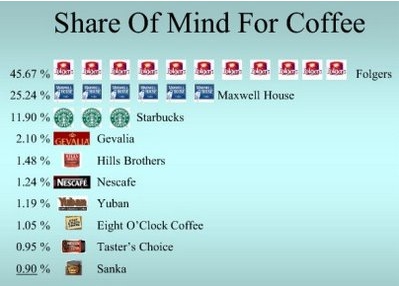
    Would you like to see how 3,000 other people* answered that question?

    Share of Mind for Coffee
    Share of Mind for Coffee

    People remembered these brands in roughly the same proportion they buy them.

    Conclusion #1: Share of mind predicts share of market.
    Conclusion #2: The first name that shoppers think of is the one they buy.

    How does a company become the first name on the customer’s mental list, and thus hold the face cards in the marketing poker game?

    The Easiest Way is to Actually be First.

    Who was the first man to fly solo across the Atlantic? The second? How about the first woman to fly solo across the Atlantic?** Charles Lindberg and Amelia Earhart won those hands. You can’t even name the losers.

    You might remember the second man to set foot on the surface of the moon, but can you name the third?

    Can you name the third expedition to the North Pole? The third Pope? The third signature on the US Declaration of Independence? (How about the third amendment to the Constitution)?

    In share of mind, share of market, and poker, third position is a loser. Winners come in first. Second place sometimes makes a few bucks. Beyond that, money gets very tight.

    “But wait a minute, Chuck” (I can hear you saying), “I have a small business in a small town. I’m not the first at anything.”

    This is Where Marketing Makes a Difference.

    Charles and Frank Duryea built the first gasoline-powered automobile in 1893 – a full ten years before Henry Ford got into the business.*** Henry made the automobile affordable to every household, creating phenomenal word of mouth on the Model T. Henry held the winning poker hand, and became the most famous automobile manufacturer of all time. How many of the losing hands can you even remember?

    The best selling MP3 player of all time is the iPod, but Apple didn’t invent the device. Rio did, in 1998, nearly three years before the iPod hit the market. Rio built an expensive toy for people who loved technology. Apple created a toy for people who love music. Apple wins that poker hand. (And, tell the truth, until I mentioned the name, you didn’t even remember the Rio player, did you)?

    Your objective is to make your company the one that people automatically think of when they need what you sell. When you’re first on that list, they don’t even think about buying elsewhere.

    You see, the first company to make a claim has an 85% chance of being remembered for that claim. The second company has about a 15% chance. The third company less than 5%.

    Ford and Apple simply out promoted Duryea and Rio, respectively. Neither was first in the market. Each became first in the minds of their prospective customers.

    Can You be First at Something?

    Absolutely. In fact, its essential.

    To be remembered, to hold top position in share of mind, to hold the winning hand in marketing your business, you must be first at something.

    I’d suggest that you choose to be first in the reason your existing customers do business with you now.

    Find out what your current customers believe you provide that they can’t get anywhere else. Then, start promoting that. Promote it to the point that you’re now playing in a whole new game, and in this game you hold the winning cards.

    Your Guide,
    Chuck McKay

    Marketing consultant Chuck McKayYour Fishing for Customers guide, Chuck McKay, gets people to buy more of what you sell.

    Have questions about finding a niche and being first in it? Drop Chuck a note at ChuckMcKay@ChuckMcKayOnLine.com. Or call him at 304-208-7654.


    * BRANDPOLL survey of coffee brands, January-March 2001.

    ** Charles Lindberg, May 20, 1927; Amelia Earhart, May 20, 1932 on the fifth anniversary of Lindberg’s crossing.

    *** Nicholas Joseph Cugnot designed the first steam powered self-propelled vehicle in 1769. The device was so heavy that it had to run on roadways of steel, and evolved into the modern locomotive. Etienne Lenoir patented the first practical gas engine (coal gas) and drove a car powered with one from Paris to Joinville in 1862.


  • The Customer’s Buying Process – Systemic Marketing™ Part III

    The Customer’s Buying Process – Systemic Marketing™ Part III

    Tire Sale
    Tire Sale Sign

    There tend to be two schools of marketing. The creative and the scientific.

    Imagination and mathematics.

    Right brain, left brain.

    At least, it looks that way on the surface.

    Marketing Yin & Yang

    Some highly effective marketing uses evocative imagery.

    “Melts in your mouth,”
    “Cleans like a white tornado,”
    or “Where’s the beef?”

    Some is a bit less exciting.

    “click here to learn more,”
    “save 13 cents on your next purchase,”
    “Dear Fellow nature lover.”

    But truly effective marketing uses both. First the math. Then the imagination. First the who, and what. Then the how and why. And that makes sense, doesn’t it?

    A marketer identifies the target market, measures responses, and calculates ROI. Then he provides the creative team with very specific direction: “Here’s what we know about the prospect, what we believe to be her motivation, and the offer we’re going to present.

    The creative folks, the copywriters and art directors, focus on that customer profile. They detail our prospect’s life. They account for her time, her activities, and her choices. They find correlations in her other purchases.

    And then they create “We are Farmers, dum te dum dum dum dum dum,” or “What it feels like to chew 5 gum.”

    But it always starts with detailing, and measuring the buying process.

    Tread Wears, “Blowout Worry” Accumulates

    Eventually, the tread wears down on every tire, and every automobile requires replacement tires.

    In most cases the wear happens gradually.

    An early stage buyer notes that wear is accumulating on her tires. She’ll file that observation away into her subconscious as something that will need attention sometime in the future.

    Her subconscious will, through reticular activation, allow tire ads to pass the mental filter which helps her to tune out the thousands of advertising impressions she’s subjected to each day.

    What Runs Through The Shopper’s Mind?

    At minimum (“Humm. Tires are showing slight signs of wear.”) she knows she can put off the purchase decision. Not feeling any pressure to buy, but aware that it will eventually become necessary, those lower price offerings from Mr. Tire Store Owner will appear more attractive and better hold her attention.

    As the tread continues wearing, she’ll think less about price, and worry more about safety. As you might expect, the closer she gets to “OK… I’m scared to drive any farther on these tires,” the less price acts as the primary motivator.

    Then there are those cases in which the tire catastrophically fails. When that happens, she will make a purchase. Probably today.

    Purchase Trigger

    It may be growing worry. It may be performance failure. It may be because she’s leaving in a week to drive across three states on her family’s vacation. It may be that she came across an unexpected tire sale. It may be an unexpected salary bonus. But something will happen that causes the owner of that car to decide it’s time for new tires.

    We call that event a purchase trigger.

    A trigger is a change in perception on the part of the shopper.  Its the realization that the actual discomfort of NOT owning has become greater than the perceived discomfort in making the purchase.

    Triggers happen to different shoppers at different times, but all shoppers experience similar triggers.

    That’s the fact which allows us to design customer acquisition programs.

    Once we determine a strong appeal to an early stage shopper (say… reduced price), that appeal will be equally attractive to a different early stage shopper next month. Yet another completely different early stage shoper will be attracted with that same appeal the month after that.

    Likewise, the appeal which works to attract this month’s late stage shoppers (perhaps safety, or guilt about safety) will work with other late stage shoppers later this year.

    And when our primary appeal meets with a prospect’s strongly felt need, it acts as a trigger, moving that prospect to the next step, perhaps all the way to completing the purchase.

    What Steps does the Shopper Take?

    The specific shopping steps will be slightly different for every business. Some purchases are made on a whim. Others require research and the approval of a committee. Some buyers initiate purchase orders. Others simply pay cash.

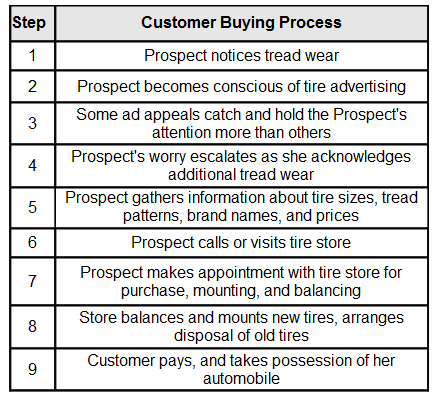
    Our tire shopping prospect likely goes through nine separate steps to buy tires.

    Tire Customer Buying Steps
    Tire Customer Buying Steps

    The Sales Process is Always Similar, but Never the Same

    So far, we’ve described the buying process, which begins with the shopper feeling a need.  Is the selling process the same?

    Usually, its not.

    The selling process begins when the seller identifies the buyer as a new prospect, and attempts to get her to engage.

    And other than advertising, the seller has no control over communication with the prospect until she identifies herself.

    In our tire purchase example the buyer has already taken five independent steps before the  seller knows she exists.

    But detailing the customer’s steps between the first interaction with the seller, and the completion of the purchase, are what allow us to standardize the process.  It’s what allows us to set our marketing on  “Cruise Control,” when we’re fishing for customers.

    Your Guide,
    Chuck McKay

    Marketing consultant Chuck McKayYour Fishing for Customers guide, Chuck McKay, gets people to buy more of what you sell.

    Got questions about detailing your customer’s shopping process? Drop Chuck a note at ChuckMcKay@ChuckMcKayOnLine.com. Or call him at 304-208-7654.


  • Reach vs Frequency – Systemic Marketing™ Part II

    Reach vs Frequency – Systemic Marketing™ Part II

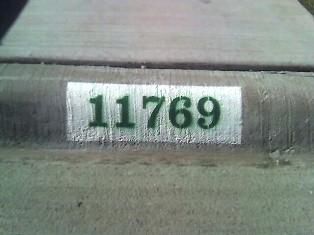
    curb number
    Curb Number

    A young man shows up at your door.  For only ten dollars he’ll paint your house number in florescent paint on the curb in front of your house. Feeling no need for glow in the dark numbers on your curb, you pass on the offer.

    The next day a different young man makes a similar offer. Again, you refuse.

    He’s followed that afternoon by a young woman with virtually the same offer. Will you buy from her?

    Believe it or not, you’ve just determined whether frequency or reach is of greater importance as a driver of sales.

    Reach Trumps Frequency

    In Systemic Marketing™ – Customer Acquisition on Cruise Control, we discussed the advantages of creating a a Marketing Cruise Control, a system to increase your marketing efforts in slack times and keep your company operating at capacity.

    But the first decision is how to increase those efforts.

    For decades media planners, buyers, and salespeople have argued whether it was more important to reach more people with your message (offer), or to deliver that message with greater repetition to the same people.

    There are good arguments for both, but common sense will guide us to the following conclusions:

    1. The more relevant the message, the more likely people are to notice it.
    2. The simpler the message, the less repetition necessary for a prospective customer to “get it.”
    3. Once a prospect has decided to purchase (or not), additional exposure to the message (during this purchase cycle) is pointless.

    What should our original young man do to sell more fluorescent numbers? Go door to door on your block again? Obviously he should choose another neighborhood and make his offer to new potential customers.

    And likewise, if you’re going to set up a Cruise Control system for customer acquisition, you won’t prompt additional sales by again offering the same people what you sell.* You’ll need to boost the number of people who receive your offer.

    How to do the Boost

    Don’t increase the number of ads in the same section of the newpaper you’re currently using. Put your new ads in a different section.

    Don’t run additional ads in the local TV six o’clock news. Run new ads in the 10 o’clock news. Run new ads on another TV station’s six o’clock news.

    1. Add a schedule on another radio station, or another TV station.
    2. Add another section of the newspaper. Or another paper.
    3. Post a billboard in a new neighborhood.
    4. Send postcards to a fresh list.
    5. Telemarket to a fresh list.
    6. Expand the radius around your business and distribute more door hangers or flyers or yard signs in neighborhoods you haven’t been “working.”
    7. Increase your pay per click budget.

    You may be tempted to pull ad dollars from the media outlets you’ve been using, but if you unhook the engine, how long can we expect that train to keep rolling? And substituting an unknown return from a new media outlet in the place of the known ROI of a tested outlet only increases risk.

    Systemic Marketing™ maximizes cash flow by eliminating speculation.

    Everyone Has Opinions

    Media people, printers, and your brother-in-law may feel qualified to opine about your marketing. Especially when you’re adding media to expose your message to additional prospects.

    Your new media representative will want to make a strong positive impression in hopes of keeping more of your business. The printer will assess your need for additional flyers, or direct response packages as an opportunity. They will offer to produce new and/or different ads. Don’t let them do that.

    By the time you’ve implemented a Marketing Cruise Control, your message will have been tested, refined, and polished. Everything from the offer to the choice of words to the colors, fonts, and images will be selected because they work better than those you tested them against.

    And testing always works better than opinions when you’re fishing for customers.

    Your Guide,
    Chuck McKay


    * OK. This is not completely true. But increasing the frequency of the message costs much more than it generates in additional sales for reason number three above. Most of the people exposed to your message will be those who’ve already decided whether or not to buy.


    Marketing consultant Chuck McKayYour Fishing for Customers guide, Chuck McKay, gets people to buy more of what you sell.

    Got questions boosting the number of people exposed to your message? Drop Chuck a note at ChuckMcKay@ChuckMcKayOnLine.com. Or call him at 304-208-7654.


  • The Circle Layout

    The Circle Layout

    Originally Published December 7, 2005

    Fishing 101
    Fishing 101
    Marketing consultant George S. Cullinan (1911-1963) was inducted into the Direct Marketing Hall of Fame in 1989 for being “the first to recognize the significance of databases as a foundation for successful direct marketing.”

    Today we’re going to look an another George Cullinan creation: the “circle layout.” This concept is an idea of value to everyone who uses words and images to promote business.
     

    Artists Don’t Think Like You Do

    Cullinan believed that the art department should never be trusted to correctly lay out the advertising, that instead those decisions should always come from the merchandising department.

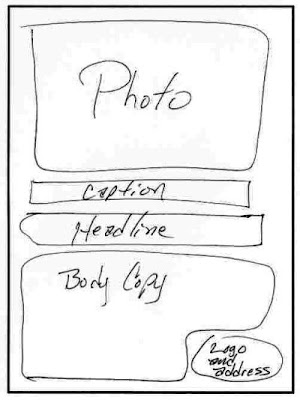
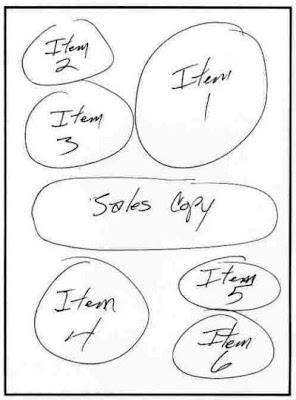
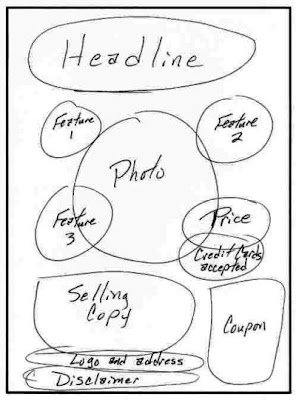
    Since Cullinan didn’t expect his merchandise buyers to become skilled artists, he suggested that they use a simple set of circles of various sizes to communicate with the art department what to include, and the relative placement and space of each element.

    In a circle layout, the number of circles is equal to the number of illustrations, headlines, and story elements to be included. Of course, one need not be limited to oval shapes. Rectangles have their uses, too. The key is to use the relative sizes of the shapes to quickly convey the approximate importance of each design element.

    Example 1: Newspaper Ad

    Let’s assume that my local newspaper has offered to build my new ad. I’ve told the newspaper account executive about my business. He should be able to take this sketch and his notes to his advertising department and bring back an ad proof with no surprises.


    Example 2: Catalog Page

    Were I working with an advertising agency, I’d be providing the agency raw information and this sketch. I’d expect their artists and copywriters to be able to build my catalog page pretty much as I’d imagined it.


    Example 3: Flyer

    If I needed a local printer to make up some flyers for my business, I would provide the photo or line drawing, my logo, and the selling verbiage to be included in the copy. Any local printer should be able to follow this concept and deliver the flyer I’m expecting.

    It’s Communication

    Why should you provide the circle layout to your commercial artwork provider? Simple. She isn’t you.

    You’re the person responsible for moving product. You probably already know which advertising elements will capture attention and motivate a purchaser to buy. Who knows better than you do exactly what must be emphasized? Or what could be left out? Whether the photo or the body copy needed more emphasis? Whether or not to include a coupon?


    How (and What) to Lay Out

    Before starting your circle layout, make a checklist for yourself, and include such items as:

    • Headlines
    • Photos / illustrations
    • Body copy
    • Prices
    • Special offers
    • Coupons
    • Logos or other company identification
    • Legal disclaimers

    Modify your checklist so that nothing gets overlooked during the planning stages.

    It Even Works for Non-Visual Media

    Cullinan developed the circle layout for catalog pages and flyers, but I’m sure you can see that this simple communication method can work equally well for other media.

    Not only will you find it useful for magazines, newspapers, and billboards, but you’ll find that it helps the copywriter of your television ads or radio ads to better understand the message you need her to deliver. I wouldn’t hesitate to give a copy to a direct response writer who was composing a solicitation letter.

    Try it on your next advertising project and see if you don’t agree. I’d love to hear how you implement the circle layout in fishing for customers.

    Your Guide,
    Chuck McKay

    Marketing consultant Chuck McKayYour Fishing for Customers guide, Chuck McKay, gets people to buy more of what you sell.

    Have questions about communicating your vision to your service providers? Drop Chuck a note at ChuckMcKay@ChuckMcKayOnLine.com. Or call him at 304-208-7654.