When I write something for this blog, I frequently hit the “preview” button to make sure that it’s going to look on your screen the way it looks on mine.
I wanted to post an article that involved data in tables. It didn’t preview well. Not well at all.
At first, I tried to space the data so that it would line up as if it were in a table.
Blog software appears to HATE spaces, and kept collapsing my carefully spaced columns. I tried inserting a series of periods to hold the space, and colored them the same as the background so they’d effectively be invisible. Something wierd was happening with proportional spacing that kept messing up those columns, too.
Ok. Let’s change tactics.
I created actual tables in an HTML editor and pasted them in the post. The tables looked ok, but the blog software added a dozen line feeds after each, which pushed the next bit of text down past the bottom of the page.
That didn’t preview well, either.
After a bit of studying the on-line help files, I determined that I should turn off the automatic line feed feature. Unfortunately, that one is a global command and affects every article on the blog. I got the article in question to look right, but the rest of the last year-and-a-half of my posts collapsed into one giant paragraph each.
Not pretty.
But, even though it didn’t work properly on this blog, that particular change did make the e-mailed Fishing For Customers newsletter look right. If you’re a subscriber, you will have already received “The Cost Of Effectiveness.”
If you aren’t, I’ll happily e-mail you a copy. Drop me a note and ask for the April 7 newsletter.
Sorry for the inconvenience.
Chuck
PS. Anyone who is a whiz at HTML, PHP, and Server Side Scripting, and who might have some time to help resolve a few of these issues, please click the link and send me your rates.
PPS. Why haven’t you subscribed to the Fishing For Customers newsletter? It’s free, and your information will never be shared. I take your trust seriously.
I just got off the phone with a client. We discussed the results of a two-step campaign he’s been running to establish a relationship with potential customers. He quickly steered our conversation toward response percentages.
“Response is not yet relevant,” I said. “The first numbers we must count are dollars expended on the campaign, and dollars coming back to your business as a result of that campaign.
“Its the response rate, and the average sale, and the upsell, and the markup, and the repeat sales factored against the cost. This is Return On Advertising Investment. It’s the first and most critical number.”
Start with gross sales. Subtract your cost of goods (or cost of services). Divide the difference by the cost of the campaign to calculate your Return On Advertising Investment.
Any whole number is good, and the larger the number the greater your return.
Suppose that your ROAI calculations show that you’re getting back $3.00 for every $1.00 you’ve invested. Is your advertising too expensive? (Lemme ask it this way: could you consistently get a 300% return on any other investment?)
But now that you know your 3.0 ROAI, perhaps it’s time to examine that response rate. A ten percent improvement in any of the vairables will also increase your ROAI by ten percent, to 3.1. Could you improve that rate with a stronger offer? More frequency of repetition? Adjusting for seasonality?
When you know the ROAI, it’s easy to determine whether tweaking the other variables is making things better or worse. Until you know the ROAI you have no way of determining whether you can even afford to continue the campaign.
Let me give you an example* of why response isn’t important by itself, but ROAI is.
A few years ago an acquaintence of mine took over recruitment advertising for a large employer in Minneapolis. The company had been running regular display advertising in the “want ads” section of the Minneapolis Tribune. He placed all of their ad dollars on six local radio stations.
About ten days into the new strategy the client called, somewhat agitated, and said “We normally get a hundred applicants a week. This last week we got only three.”
The ad man asked “How many of those hundred applicants do you typically hire?” His client told him the usual number was three. He then asked “How many of the three applicants who did respond to the ads did you hire?” His client said “Well, all three.”
“Humm…” said the ad man. “So for the same investment you got the same three qualified employees, but this time you didn’t have to interview the ninety-seven deadbeats? That upsets you?“
In this example, adjusting the advertising because of the change in response rate would have been counter productive. But tracking the Return On Advertising Investment makes sure the campaign is accomplishing the job we need to get done.
* Choice of medium should involve the strategy, the desired audience, the offer, and a number of other variables, including cost. Please do not interpret this story as an endorsement of radio over newspaper.
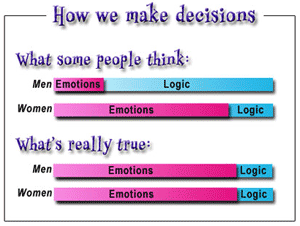
You’ve no doubt heard that people emotionally decide what to purchase, and then use logic to justify that purchase.
Can a product be sold on emotion alone?
Yes. Usually to children.
Children desperately want to fit in. The easiest way to entice a child is to present your product as the one purchase that every other kid is getting.
Truthfully, does anyone need shoes that light up at each step? They don’t even flash a light in the direction the kid is traveling. Instead, they light up to show where he’s been.
When I was a kid, everybody had streamers – long strips of colored plastic attached to the plastic grips on bicycle handlebars. They flapped in the breeze and were absolutely useless except to show all of the other kids that you had ’em.
And if it weren’t for other kids owning them, could there be any justification for Pokemon cards?
Bigger kids, even sixty-year-old kids, still feel this pressure to belong. They’ve just become much better at justifying their purchase choices. As I said, they’ve learned to use facts as if the facts were how they came to the decision. It’s seldom the case.
But, for a minute, let’s consider the other extreme.
Can a product be sold purely on logic alone?
Yes, it can, if it’s a commodity.
Commodities are interchangeable mass-produced, unspecialized products like gasoline, rice, airline seats, and pork bellies. Since they’re all virtually identical, one buys them from a strictly transactional mindset: by dividing benefits by price. More benefits, lower price, better deal.
But, for everything else we buy, emotion plays a major part in our decisions.
Emotions, or Logic?
So, which is better? Should you use emotion or logic to sell your products and services?
It’s a trick question. You need both.
Your ads should provide emotional appeal to help shoppers to choose your offering; and then back the decision up with solid facts they can use to explain their purchase to anyone else.
A Fictitious Example
Nothing warms and protects you like genuine leather. And nothing else will look so good on you, either. Ajax Leather jackets are exceptionally flattering. They can be worn for business, but you’ll find them equally comfortable for causal wear. The first thing you’ll notice as you slip into a lined Ajax Leather jacket is the weight. This jacket won’t wear out in a lifetime of use. Secondly you’ll admire the strong zippers and snaps and the quality of the stitching. But you’ll probably choose it because it looks so good on you. Step in to the Ajax Leather store and step out in style. Ajax Leather on Bovine Boulevard.
More will take the bait if you give them the intellectual rationale they need to justify the decision they wish to make emotionally. Help your customers to buy when you’re fishing for customers.
Your Guide, Chuck McKay
Your Fishing for Customers guide, Chuck McKay, gets people to buy more of what you sell.
Got questions about combining logic with emotional appeals? Drop Chuck a note at ChuckMcKay@FishingforCustomers.com. Or call him at 760-813-5474.
A Zen truism: when the student is ready, the teacher will appear.
All over the world the vast majority of people are passing through stages of their lives, and ignoring advertising. Most people don’t need, don’t want, and are not even interested in most products being advertised. Thus, they ignore the ads.
At age 14 did you pay attention to stockbroker’s ads? When you were 21 had you ever noticed an ad for a retirement community? I can assure you that the ads existed. Why don’t you remember any of them?
If you’re like most of us, at that stage of your life you had no interest in these things. You ignored the ads. Their message didn’t even enter your consciousness. No wonder you don’t remember seeing any of them.
We live in an information rich society. Frankly, we live in an information-overloaded society. Out of sheer self-defense we ignore most of the adverbabble that surrounds us.
When you think of your high school graduating class, how many of you married at the same time, and had children simultaneously? Few, I’ll bet. So though you and your classmates may have had very similar life experiences, you didn’t have them at the same time. You moved through the various stages of your life independently of those around you.
And for most of your life, you’ve ignored most advertising.
The person most aware of advertising? The owner of the business. The owner has such a high exposure to his own ads that he’ll get tired of them much more quickly than the public ever will. He’ll want to “try something new” just out of boredom.
He shouldn’t.
If the ads are working to deliver a steady stream of customers, he should let them continue to do the job they were designed to do. The Sherwin Cody School of English ran the same ad for 42 years – “Do You Make These Mistakes In English?” Mr. Cody was never bored when he heard his cash register ringing.
Last year’s shoppers are already someone’s customers. Maybe the business we’re discussing. Maybe a competitor.
Once people’s lives enter a new stage, they have new motivations to listen to the ads, and to hear them for the first time. And the messages that worked so well last year, will work equally well this year on a whole new group of shoppers.
This is why successful ads shouldn’t be changed often.
The rhythm of life doesn’t have us all marching to the same beat. And at any given time we pass out of a life stage as someone new enters. Think of this as a steady stream of first time buyers.
When the student is ready…
A woman becomes pregnant for the first time. For the first time in his life, her husband is becoming aware of ads for baby furniture, for disposable diapers, for college funds. Those ads, which surrounded him for years, are suddenly just “there.” Now, though, they are getting his attention.
How many first time pregnancies will there be this year?
America’s birth rate is 1.4%. Our population is 51% female. The U.S. Census tells us that the average family has 1.9 children. Therefore: less than four tenths of one percent of the population will be pregnant for the first time this year. Slightly more than three hundredths of one percent will be pregnant for the first time this month.
A company that manufactures or sells baby monitors, for instance, will have roughly three hundredths of a percent of the population in their marketing area become aware of them for the first time this month. And that’s enough to keep them profitably in business.
The ads they ran last year will be noticed for the first time by a whole new group of shoppers this year, and last year’s appeals will be just as attractive to this year’s shoppers.
When the student is ready, the teacher will appear.
It takes a lot of effort to just be noticed in our over communicated world. When you (or your advertising manager / agent / consultant) have come up with an idea that actually persuades someone to purchase from you, don’t stop running that ad until it stops “pulling.”
1) If people don’t know you exist, they can’t buy from you. (You’ve heard before that it pays to advertise).
2) Just because customers don’t complain doesn’t mean they are happy.
3) Don’t assume that everyone is like you. Other people don’t watch the same television programs you do. They don’t live in the same part of town you do. They don’t share your tastes in anything. Never assume that your marketing dollars should be spent on those things that would satisfy you as a customer.
4) Most small business marketing is focused on what the owner wants, instead of what the customer wants. Customers respond by ignoring the ad. Stop talking about you. Shoppers don’t care about your hours of operation, your location, or the number of years you’re claiming as “experience.” They want to know how you can save their time, make them money, or make other people think highly of them. Talking about yourself may be gratifying to your ego, but it also wastes your money.
5) If you make sales presentations to people who don’t need what you offer, it’s a tough sale, and would dwindle your sales promotion. Your advertising will have an equally difficult time in converting shoppers who don’t need what you offer. Stop trying to reach everyone. The narrower you target, the more successful your marketing will become.
6) An effective ad is focused. Like a hammer driving a nail into a hard board, an effective ad drives a single message into the mind of a prospective buyer. If you have more to say about your business, say the rest in another ads.
7) Make it easy for people to buy from you. If they’re interested in what you’re selling, tell them in your ad exactly what to do next. If you don’t, many will take no action at all.
8) Give people a reason to want to know how to get in touch, and they’ll figure out how.
9) You don’t need your phone number in your radio or television ad. Never say “we’re in the yellow pages,” and direct your prospect to your competitor’s ads as well as yours. Instead make sure shoppers remember your name, and remind them to find you in the white pages.
10) Stop putting your address in your ads. Use your location instead. Don’t say “4321 Liftoff Lane.” Say instead “At the corner of Liftoff Lane and First Avenue.” Can you tie in a landmark (“across from the water tower”)? So much the better.
11) Shoppers don’t call a logistics strategist when they want a package delivered. They call a shipping company. By the same token they don’t buy insurance from a financial services company. They don’t buy telephone systems from an integrated information systems specialist. People talk in terms of specifics, rather than in generalities. Tell them, in simple one or two syllable words exactly what you do.
12) The client almost always tires of the ad before the buying public does.
13) Good marketing is art. It is also science and business. It rarely works instantly. Sometimes the most important part of your marketing is patience.
14) Effective ads involve news that will impact shopper’s lives. Do you know what news is?
I’m uncomfortable with most clever or creative advertising. Clever and/or creative is dangerous, because it’s too easy to get sucked into the creativity, and forget that our purpose is communication and persuasion.
If your attention is drawn to the cleverness of the ad, rather than to the product, it’s a bad ad.
Today, however, that same warning applies to dull ads. Our purpose is communication and persuasion. You’ll do neither by boring people.
About a week ago I received a phone call from a representative of a nationwide yellow pages publisher, who said “Hi, Chuck. I’ve been handling Abraham’s yellow pages advertising since he first opened his business fifteen years ago. When I called him today he gave me your number and said I should deal with you. His ad is ready to go.”
I asked him to fax me a copy. When he did, I rejected the ad, and told him I’d submit a different one later that day.
“Chuck,” he said, “this ad’s ready to go. You don’t understand yellow pages. What’s important in yellow pages is size and position. The bigger the ad and the closer to the front of the category the more likely it is to be read.”
A Larger Ad Will Be Noticed
Is he wrong? No, not completely. When all other factors are equal (as they never are in real life) a larger ad will be noticed more easily than a smaller ad. And there is some evidence that being listed earlier in the category improves the odds of being noticed, too.
However, a bad ad won’t be read regardless of size or postion. Adding color won’t ad to your persuasive ability, and getting noticed does not directly lead to persuading anyone to buy. Size, position, or color don’t communicate a message.
You’ll recognize a bad ad by it’s focus.
Bad ads are about the advertiser. Good ads are about the customer. A bad ad says “This three stone diamond pendant is only $299 just in time for Mother’s Day.” A good ad says “She’ll kiss you like you’ve never been kissed before.”
What’s the most important part of any ad? The headline. It draws attention and naturally leads the reader into the rest of the ad. At least, that’s how it’s supposed to work.
The ad which had been faxed to me used my client’s logo as the headline. Can’t you just see a potential customer’s eyes glazing over as she sees page after page of yellow pages ads with business name after business name as the focal points of those ads? Unfortunately this kind of design is all too common in the yellow pages.
Think about this: people go to listing media when they have a problem to solve. They go to the business category that seems most likely to address their problem. Page after page of business names makes the customer do all of the work. And make no mistake, trying to figure out whether your business can help IS work.
The name of your business doesn’t say anything of interest to a customer searching for a solution to her problem.
Make it easy for a prospective customer.
Make your headline promise a big benefit, which will naturally pull the reader’s eyes to the rest of the ad. Once the customer is confidant that you understand her immediate need, include your name, address, and phone number – at the bottom, where they belong.
How does this story end? I re-wrote the ad.
The headline now promises a benefit to the reader. The information that the client had been “serving the community for fifteen years” was replaced with body copy and an illustration which expands on that promise. Finally the client’s logo was reduced to a reasonable size, and his address and phone number were placed at the bottom of the ad, where they become the last thing a potential customer reads.
If she’s been persuaded, she’ll now pick up the phone and call. Is there a better outcome when you’re fishing for customers?
Your Guide, Chuck McKay
Your Fishing for Customers guide, Chuck McKay, gets people to buy more of what you sell.
Got questions about making Yellow Pages advertising more effective? Drop Chuck a note at ChuckMcKay@ChuckMcKayOnLine.com. Or call him at 304-523-0163.
You’ve decided to run a series of newspaper ads, and the paper wants to know how much space to reserve for your ad. Is bigger always better?
In terms of increased readership, yes. But it also comes with an increase in cost.
You need to take both into account to calculate the return on your advertising investment.
(And in the interest of keeping this post to a reasonable length, we’ll put off the “optimum size” discussion for one more installment. Today we’ll limit the discussion to variables in ad size).
Depending on the section of the paper in which it’s placed, and depending on the demographic profile of the readers one is attempting to reach, the newspaper readership studies conducted by Daniel Starch And Company lead to some interesting conclusions as to size and placement of ads.
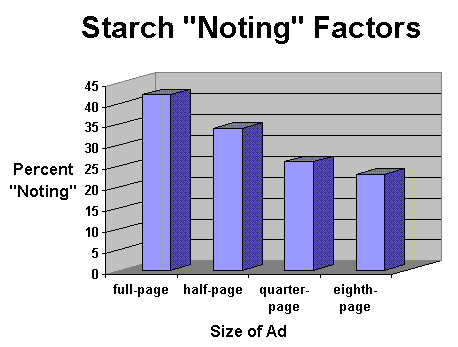
According to Starch, when all other factors are equal, it’s possible to cut the size of an ad in half and lose only 3% readership.1
Newspaper advertising is sold by the column inch. Ignoring contract discounts, and advertiser can buy a full-page, two half-pages, four quarter-pages, eight eighth-pages (you get the idea) all for roughly the same price.
As we pointed out in the last post repetition is a critical element in persuasion, and running an ad twice, or four times, or eight dramatically increases the frequency of shoppers noticing the ad.
A single full-page ad delivers a frequency of one. Eight eighth-page ads, assuming different pages or different days for each ad insertion, will deliver a frequency of approximately six. (See A Strategy For Frequency In Newspaper Advertising for a more complete explanation).
So, why is this not an easy decision? If frequency sells, why not always buy eight one-eighth page ads instead of a single full-page ad?
Because in order for an ad to “work” it must first be noticed. A full page ad is more likely to be noticed.
How much more?
A full-page ad is likely to be “noted” by 42% of the readers. An eighth-page by only 23%. The bigger the ad, the more people will see it.
But wait a minute. A full page only get’s “noted” 43% fo the time? Does this mean that no matter what size your ad, more than half the readership will never notice your ad?
Yes. Exactly.
And so what?
Let’s be honest, nothing being advertised appeals to everyone. People who are interested in what you have for sale are the readers likely to note, or to read your ad.
This is where it gets interesting. The number of people who see the ad is of lesser importance than the number of those people who, upon reading the ad, are motivated to buy from you.
With enough patience, and a good tracking system, you can actually measure the impact of different sizes of newspaper or magazine ads.
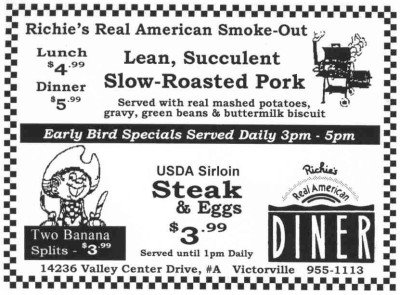
My good friend and restauranteur extraordinaire, Roger de la Paz, owner of Richie’s Real American Diner in Victorville, California, has that patience. He’s been keeping incredibly detailed records of the effect of his advertising since he opened Richie’s.
Roger tracks his newspaper ads with the simplest of measurements. He compares the demand for specific food items before the ad runs, and again afterward. He is then able to calculate the increased demand for specific menu items against the cost of the ads.
Over a three year period, Roger demonstrated that his most profitable ad size is two columns wide by three inches deep. Ads smaller than “two-by-three” had less impact on sales. Ads progressively larger than two-by-three did increase gross sales, but not enough to warrant the additional cost.
By carefully tracking the specifics of size, placement, and frequency of his newspaper advertising Roger is now able to predict to within a few dollars what Richie’s Real American Diner’s return on newspaper advertising investment will be.
By the way, he regularly tests the content of his ads, too.
Right now, Richie’s newspaper advertising delivers a consistantly predictable 118.06% increase in gross sales every day the ads run.
Next post we’ll definately reach some conclusions about the optimum ad size for top return on investment. Until then, are you keeping track of the effect of your ads?
Isn’t it time you started?
1 The reduction in noting scores from a quarter-page (26%) to an eighth-page (23%) is a difference of three percent when referenced to total readership. It is, however, a loss of nearly 12% of the number of people who notice the ad.
In most cases, a single exposure to an ad has very limited value. It takes a campaign of advertisements to effect shoppers, although truthfully this will vary slightly by medium.
For instance, a supermarket that buys two adjacent full page newspaper ads every Thursday to list all of the specially priced items that week, will in short time train Transactional shoppers to pick up every Thursday’s paper to scan the ad for bargains.
Large automobile dealers will also have some success attracting Transactional shoppers using this strategy. Unfortunately, as soon as their competitors start doing the same thing, the effectiveness of the ads becomes dependant not upon the size of ad, but upon the size of the loss leaders.
And this “list everything” strategy is virtually useless in attracting new Relational shoppers to your business.
So does that mean newspaper advertising is only valuable when the advertiser’s goal is Transactional (loss leader) business?
No. Not at all. It merely means that you need to take steps to increase the frequency of your ads. Why? Because sleep is the great eraser of short-term memory, which makes it the single biggest obsticle to advertising retention.
As we pointed out in How Many Ads Do I Need To Buy?, the evidence indicates that a minimum of three exposures to the ad in a seven day period is the minimum required to produce a positive return on investment.
Does this mean three ads a week will push your results into black ink?
Unfortunately, no.
Suppose your local daily newspaper has 20,000 readers per average day. That means 20,000 readers will scan the Monday paper. 20,000 will also scan the Tuesday paper. Not all of them will be the same 20,000 persons.
Perhaps 3,000 of Monday’s readers didn’t see the paper on Tuesday, but another 3,000 people who didn’t read Monday’s paper will pick up the paper on Tuesday. That means 17,000 people saw both papers.
If yet another 3,000 people didn’t pick up the paper Monday or Tuesday, but read Wednesday’s paper, it means 14,000 saw all three.
In actuality, the frequency build up in most papers is a bit quicker. In most newspapers across the U.S. it will take four ads within a single five day period for all of the average daily readers to be exposed an average of three times each.
Q: So, what’s the most effective way to purchase newspaper advertising?
A: Cut your ad size to one fourth and run it four times as often.
Next time we’ll discuss determining the optimum ad size to make this strategy deliver the best return on your newspaper advertising investment.
Too many times we design an advertising schedule to reach the “average consumer.”
If you look at the usage of media by consumers, it’s easy to come up with averages. It’s much harder to schedule your ads for maximum return on investment.
Take radio listening, as an example. Dividing the number of people listening at any particular time by the number who have listened over the course of the week, and then multiplying that fraction by the time they listened will give us an average “time spent listening,” say, 20 hours per week.
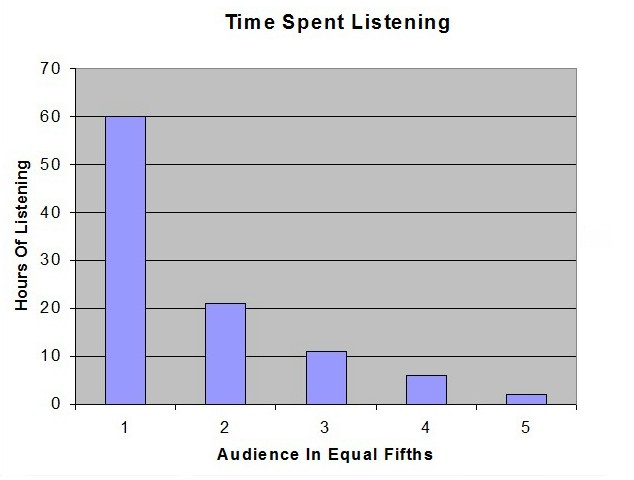
But 20 hours is very misleading. Seminal researcher Alfred Politz1 divided the audience into equal fifths (quintiles). He discovered that not all radio listeners are created equal.
When the average is 20 hours per week, the heaviest users, (the top 20%), stick with their favorite station for a full 60 hours per week. At the other extreme, the lightest users listen for only 2 hours per week.
Within each quintile (equal fifth) the average listening might look like:
Radio Time Spent Listening chart.
Several studies 1 have confirmed that consumers of media are not equal, even within the medium. Each medium has very heavy consumption at the top quintile, which grows progressively lighter as each additional quintile enters the equation. This same pattern occurs in television viewing, reading of newspapers and magazines, and even the reading of outdoor signs.
It’s been demonstrated that the average person needs to be “exposed” to your ad a minimum of three times within each seven day period 2 for the ad to be effective at motivating that person to shop with you.
But, with each of our quintiles listening for progressively shorter periods of time, it’s going to take more ads to reach each successive quintile.
And that makes sense, doesn’t it?
Our top quintile listens 60 hours per week. If we run 3 ads per week, they’re likely to hear all of them.
The bottom quintile listens for only 2 hours per week. Unless the ad runs during those two hours, they’ll never hear it.
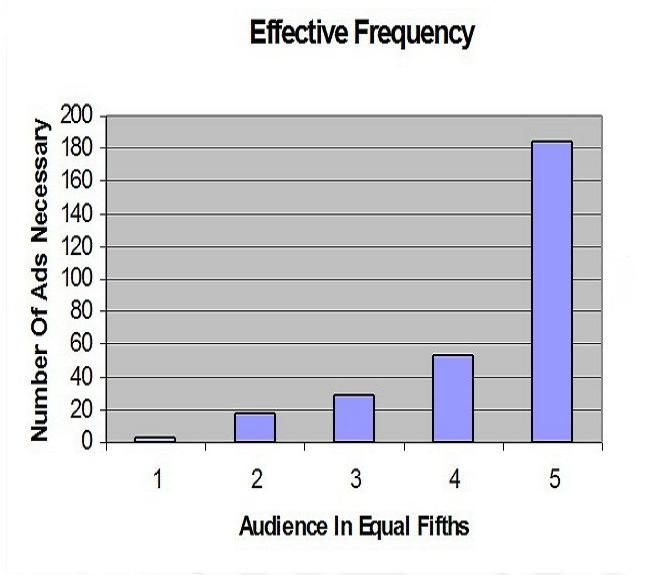
To assure enough ads that the bottom quintile will be exposed to three of them, we’ll need a schedule of 184 ads 3.
Radio Ads Required to Reach Audience
184 ads? Per week? How much would you have to pay for 184 ads per week? I’m willing to wager that you can’t afford such a heavy schedule. At least, not long-term. You can’t afford to persue the bottom quintile. Without a monster advertising budget, one fifth of the potential audience will never hear your ads.
Perhaps you could stretch the budget enough to afford 53 ads. That’s a schedule that could motivate the fourth quintile. Congratulations. You’ve broadcast enough ads to persuade quintiles one, two, three, and four.
Of course, we now have another problem.
The first quintile only needed 3 ads to “get it.” Run 50 additional ads per week once they understand your message, and it’s highly probable that you’ll irritate those listeners. Annoy them this much and they’ll refuse to do business with you. Somewhere around ad number 17 they’ll tune in some other radio station.4
Customize your schedule for the heavy listeners and the light listeners will miss your ads. Plan to impact light listeners and you’ll repel heavy listeners.
You’re going to miss half of the audience. There’s no way around it.
Newspapers have a similar weekly buildup of awareness. Like radio, one ad is minimally effective. It takes the same three exposures a week to make newspaper advertising provide maximum return on your advertising investment. We’ll look at newspaper scheduling next time.
And depending upon the purchase cycle, as few as 2% of those people will be “in the market” on any given week. You’ll need to run this schedule next week to get the people who are ready to buy next week. You’ll need to run it the week after that to reach the people who are ready to buy that week. You’ll need to… well, you understand. You’ll need to run it every week that you intend to stay open for business.
However, some good news: the light users of one radio station tend to be the heavy users of another. And the average listener tunes into 3.6 stations per week. Find stations which share the same listeners, run 21 ads per week on each, and start getting spectacular results – assuming, of course, that your message is compelling and your offer is appealing.
Your Guide, Chuck McKay
Chuck McKay
Chuck McKay gets more people to buy what you sell.
Questions about scheduling ads for the highest return on your advertising investment may be directed to ChuckMcKay@ChuckMcKayOnLine.com.
If you know someone who would find this article useful, please share it.
Your comments are always welcome. How does your company schedule its ads?
1. Beginning with the 1963 Politz Study of New York Radio.
4. Radio Program Directors HATE ads which run in double digits daily. Of course, Program Directors also know that about the time listeners are just learning the words, Disc Jockeys say they’ll puke if that song plays again. Through the nature of their jobs Disc Jockeys have long Times Spent Listening.
You have a new store. It’s ready to open to the public. What’s the first thing you should do?
You should hang out a “Now Open” sign.
People will drive by and see the sign. Some will walk in to see what you have to offer. Some will buy. Then, depending on that first experience, some will come back to buy again, and some will recommend you to other customers.
You advertise to reach people who never drive by.
I bring this up because a very common question is, “If I spend money on advertising, what will I get back? Can you guarantee I’ll see any results at all?”
To that I have to answer “Maybe.”
Let’s look at the variables.
Your traffic driven sales will depend on location. Your repeat sales and referral sales will depend on customer experience. Your advertising driven sales will depend on the salience of your message, your share of voice, and the frequency of delivery of your message.
If you had a high profile location, perhaps the intersection of two major highways, your sales may develop like this:
That high profile location, coupled with the experience your customers have shopping with you, can determine as much as 91% of future growth. The last 9% will come from effective advertising.
Consistently well done advertising could also effect the number of people who normally just drive by, but today decided have decided to walk in.
Perhaps you don’t have a prime location, but are instead a neighborhood store on an average street with average parking. Your sales could develop this way:
Sometimes business people expect that if they increase their advertising budget by 10% that they should see a corresponding 10% increase in sales.
Under the best of circumstances a 10% advertising increase in our first example would boost sales by slightly less than 1%. In our second example our best possible outcome would be a sales boost of slightly more than 3%.
You’ll note that I said “best of circumstances.” We’ve assumed that your competitors aren’t increasing their spending or increasing the relevance of their message.
It also assumes that you don’t have any new competitors.
Most businesses aren’t willing to advertise aggressively enough to maximize sales and gain significant market share.
This provides a major opportunity for those who are.
 Your Fishing for Customers guide,