Blog

  • Higher Profits Through Testing of Every Variable

    Higher Profits Through Testing of Every Variable

    Pretend with me you’ve been conducting a direct mail campaign.

    In testing your headline you’ve discovered that changing its focus from greed to fear increases the response rate from 1.5% to 1.85%.

    Not bad. Three-tenths of a percent. That’s enough to get marketers excited.

    You’re kidding,” I can almost hear you say. “People get excited about a tiny fraction of better response?

    Well, yes. Yes, they do. You see, that tiny fraction amounts to a 23.3% improvement in top line sales. It has an even bigger impact on the bottom line.


    zero point three equals two times
    Zero point three equals two times

    First, Run the Numbers

    For the sake of this example, let’s assume the following:

    Your selling price is $74.95, and your gross margin is 65%.

    The cost of printing your single-page, one color letter and its envelope, folding, stuffing, and addressing is $0.33 per piece.
    The cost of postage (bulk mail) is $0.21 per letter.
    You’re paying a list broker $40 per 1,000 names (4 cents each).

    Add these individual sums, and the cost of promotion becomes $0.58 per lead.

    You mailed 10,000 pieces with the first headline.

    1.5% of the recipients of the letter purchased: a total of 150 sales. Each sale produced revenue of $74.95, for a total of $11,243.

    You’re working with a 65% margin. Therefore, your gross profit is $7,308.

    It cost $5,800 ($0.58 per lead times 10,000 leads) to make those 150 sales, which makes your net profit on this mailing $1,508.

    Then You Tested Your New Headline.

    You mailed 10,000 more pieces with the second headline.

    This time, 1.85% of the recipients of your letter bought: a total of 185 sales.  (This is the three tenths sales lift we mentioned).

    Each sale produced revenue of $74.95, for a total of $13,866.

    You’re still working with a 65% margin, which makes your gross profit is $9,013.

    The cost of promotion is the same $5,800.

    Your net profit with the second headline is now $3,213.

    When you run the numbers, this new headline has more than doubled your profit.

    Wow.

    Testing Needs to be Mandatory

    This is why you must test at every stage of the persuasion process. (It’s also why you must keep detailed records of your results).

    Test your headline, test your offer, test the medium, test the frequency of repetition of your message. Test every variable.

    When you find an outcome which works better than what you’ve been doing, make the new way your new standard.  Then start testing against that.

    It only makes sense that you use the most attractive bait when you’re fishing for customers.

    Your Guide,
    Chuck McKay

    Marketing consultant Chuck McKayYour Fishing for Customers guide, Chuck McKay, gets people to buy more of what you sell.

    Got questions about creating maximum impact through testing of your marketing? Drop Chuck a note at ChuckMcKay@ChuckMcKayOnLine.com. Or call him at 317-207-0028.

  • The Long And Short Of Persuasion

    The Long And Short Of Persuasion

    Researchers must be careful to neutrally phrase a question, so as not to influence the response.

    My partner, Roy Williams, offers a perfect example. When a penitent asked if it was proper to smoke during prayer, he was told it was not. But when the question was rephrased as: “Is it acceptable to pray while smoking?” he was assured that prayer was always appropriate.

    Sometimes it’s not the phrasing that controls the outcome. Sometimes people ask the wrong question. The wrong question, in this case, is “Which sells better? Long copy or short copy?”

    I’m a long copy proponent. That is, I’m opposed to the “nobody will read more than 300 words” school of advertising.

    Short copy has inherent risks. Because it has limited amounts of compelling information, response rates are frequently low. There’s also the risk of high numbers of cancellations and refund requests because the product or service wasn’t what the customer imagined.

    The short copy crowd assumes that everyone is like them. “I wouldn’t read this,” they argue, “therefore no one else would either.” However, these people are not interested in what you have for sale. Without any interest, no matter how short the copy is, they will not read it. Will they read 300 words? They won’t read 100.

    Fans of short copy are almost never successful copywriters.

    When the copywriter ignores people who won’t buy, and concentrates on those who may, copy invariably grows longer. Be careful, though. Long copy in the hands of an unskilled writer becomes an excuse for sloppy, non-focused, undisciplined writing.

    Long copy proponents have research on their side. Split-testing research shows that long copy consistently outperforms short copy. Additional research indicates that although readership does fall off dramatically at 300 words (when the non-interested browsers lose interest) it does not show further erosion until 3,000 words.

    This argument over long copy vs. short copy has raged for years. Unfortunately, it’s a tangential issue.

    Long vs Short asks the wrong question.

    To get to the right question we need to assess the customer’s perceived risk, and the emotional commitment necessary to persuade her to buy.

    The biggest risk any purchaser makes is the possibility of wasting her money in a bad purchase – one that doesn’t suit her needs. The lower the price, the less risk. The less the risk, the lesser amount of emotional commitment. A lessened amount of persuasion becomes necessary.

    We’ve all been in a check out line at a convenience store or a grocery. We’ve noticed the magazines, the candy bars, the breath mints. In retail, these are known as “impulse items.” No emotional involvement required. No financial risk. Impulse items are low priced items.

    Long copy may well bore the potential purchaser of low-risk items.

    Note that you won’t be able to pick up and admire the portable DVD players, or the jewelry, or anything with a stiff price tag as you wait in line. These things don’t usually sell on impulse.

    The higher the price, the less likely Miss Prospect is to purchase it on a whim. As price goes up, so does the risk that she’s making the wrong purchase. As risk goes up, so does the requirement for emotional commitment on the part of the buyer.

    When our prospect is considering a major purchase, short copy may leave her wanting to know what she gets for her money.

    So, in order to decide how long to make your copy, you’ll need to determine the amount of reassurance Miss Prospect requires. If you’re selling candy bars, she won’t worry about the rent check bouncing. If you’re selling college enrollment and asking for a commitment of $25,000 over the next eighteen months, she will require more assurance.

    This leads directly to the right question

    How much persuasion does the prospective customer require to be comfortable making the purchase?

    Her comfort level will be directly proportional to the number of dollars in the “ask.”

    The length of your copy should also be proportional to the size of the ask. When asking for a small amount a simple easily remembered message is appropriate. When asking for a large amount your copy must anticipate every objection, every question, every doubt that your prospect has in you, or in the product or service you’re selling.

    Of course, it must also be well-written, persuasive, and compelling.

    The message must be salient.

    Salience is the relevance of the message to your prospect. It’s the most overlooked quality in advertising. It’s the reason for the long copy / short copy debate. It’s also the reason the debate is bogus.

    Remember, your purpose is persuasion

    You’re trying to get a total stranger to open her purse and give you money. Write something that speaks directly to her. Give your message salience.

    Write what needs to be said to convince Miss Prospect that owning your product or service will affect her life. Get her emotionally involved. Tell a story. Share testimonials. Use statistics. Boost your credibility by whatever means is available to you to remove as much risk as possible. Guarantees are golden. Add as much information as necessary to make the sale, and not a bit more.

    Then start cutting any excess from your copy. Remove any word that can be removed without changing the meaning of the sentence.

    Do you now have strong, persuasive, motivational copy? Long enough to make your points? Short enough to get right to them?

    Assuming that you truly understand your prospect, and have written to her concerns, your writing will automatically be the appropriate length, whatever that length may be. And providing enough persuasion, but just enough, will increase your catch when you’re fishing for customers.

    Your Guide,
    Chuck McKay

    Marketing consultant Chuck McKayYour Fishing for Customers guide, Chuck McKay, gets people to buy more of what you sell.

    Need help making your advertising copy persuasive?  Drop Chuck a note at ChuckMcKay@FishingforCustomers.com. Or call him at 317-207-0028.

  • Stuffing the Golden Goose

    Stuffing the Golden Goose


    A number of years ago the late Fred Murr asked me, “How old do you want to be when you retire?

    I said, “I don’t know. Seventy five, maybe?

    He asked, “Are you serious?

    I said, “Fred people retire and they DIE!

    Exit Strategy

    I love my job. I’m going to keep on doing it forever. Well, I don’t intend to stick with the job until I die. But I do intend to do it for a long time because I’m enjoying what I do.

    But we all need to create an exit strategy from the companies we own and operate for a couple of reasons. One of them is the bulk of our wealth may be tied up in equity in that company, and its going to be very difficult to retire without taking it with you.

    So, let’s talk for a little bit about what you need in an exit strategy.

    When Will You Sell, and for How Much?

    You’re going to need two numbers. The first is, you need to know how much to sell your company for. And the second is you need to know when you’re going to do that. So, you need an amount and a timetable. And once you have that any good marketing consultant can help you get there.

    What’s the amount? It’s a sum big enough that you could invest it, live on the interest, and never touch the principal. There are a few other strategies, too, but that one’s my favorite.

    If you’re going to be retiring by selling your company, the first thing we need to do is determine out how much money you need to retire on. And the second thing we need to figure is will your company sell for that amount.

    For most of us that answer is “no,” and we’re going to have to grow the company to create enough wealth to sell the company and be able to spend the rest of our time with the grandkids, or pass the company along to the kids, or sell that company to a total stranger for cash, or help the employees to buy out your interest in the company. But one way or the other you need to plan your exit from the company.

    I don’t care if you just started your business yesterday, or if you’ve been doing it for 30 years. Trust me, you need to plan what’s going to happen when you no longer choose to come to work everyday.

    What Do Buyers Want?

    Investors who might be interested in your company are looking for three things:

    1. Operational Excellence
    2. Consistent Growth (with no surprises)
    3. Predictable Cash Flow


    The first thing in determining your selling price is to figure out exactly how much you’re going to need. And whether you take it as a salary, or owner distributions, or investor dividends, you’ll have to replace that much money.

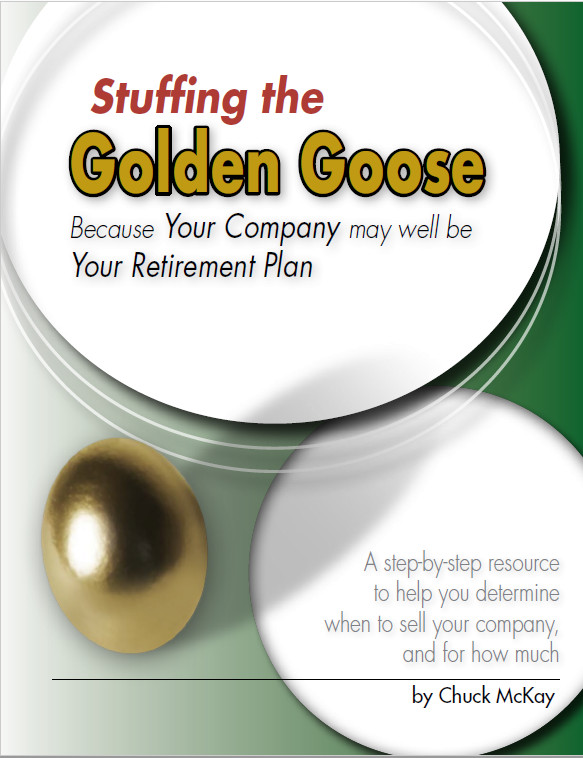
    I’ve prepared a step-by-step booklet called Stuffing the Golden Goose. Download your FREE copy. It will help you to figure out exactly how much you’re going to need to fund your retirement, and what you need to sell the company for to be left with that much. It’s straightforward and the steps are quite simple.

    Case Study – Beckley Imports

    Steve Beckley, owner and operator of Beckley Imports, Des Moines, IA.

    Let me tell you about my client and friend, Steve Beckley. He called me some time ago. He’d participated in a group call that I was hosting and said, “Chuck, can you hang on the line when everybody else hangs up?” I did. He said, “I need your help. I need to create another million dollars in top line sales in order for me to sell this company in three years.”

    I said, “I’m flattered that you think I can help you with that, but you’ve caught me at a time when I’m maxed out on the time I have available. I can’t help you now.” He called back the next month. And the month after that. Until finally I said, “Steve, my schedule has just opened up.”

    I flew to Des Moines where Steve Beckley owns and operates Beckley Imports.

    At the age of 22 Steve Beckley was the Service Manager of the local Mercedes dealer. He quit. He opened his own shop. A single bay.  He worked on import automobiles. Steve’s belief was that people who paid a lot of money for a precision automobile would be willing to pay a little bit more to keep it operating at peak efficiency. And he was proven right.

    They kept on growing. He now has a state-of-the-art, 15-bay facility in Des Moines.

    Starting the Research

    I joined him there. We spent three days digging through how his operation works. Where do customers come from? How long do they stay? Where do they go? Which ones are very valuable? Which ones are not? We mystery shopped his competitors.

    I said, “Steve, I love the postcard campaign you’re using to draw customers in. The only suggestion I have is they all say the same thing – ‘Dear Import Auto Owner.’ I promise you somebody that drives a BMW does not consider himself an import auto owner. He considers himself a BMW driver. Anybody who’s got a Rolls Royce doesn’t consider himself an import automobile owner.”

    We redid those postcards so that the Saab owner got one that said, “Dear Saab Owner.” And the Mercedes owner got one that said, “Dear Mercedes Owner.”

    One of the things I loved about working with Steve is he implements! I gave him that recommendation on the 10th of February, and by March he had the new postcards out. He called me about the 7th of April and said, “Chuck, we’ve just had our best month in the history of the company. We are $50,000 above where we predicted we’d be for the month.

    Then in April we were up about $50,000. In May we were up about $50,000. If you annualize that (and I quickly did) we were $600,000 on our way to that million he needed.

    I looked at it and said, “Steve, you’ve got one customer leaving out the back door for every two you’ve got coming in the front door. What’s happening?

    He said, “Well, some people sell the car and don’t need us any more. Some trade it in on a new one and now they’re covered under the factory warranty. Some of them leave the community or they die. But, you’re right. That is an awfully high turnover.

    So, we studied the operation, we came up with a customer retention program, and cut the attrition to about half.

    Well, now we’re getting very close to that million a year, and it hasn’t been a year yet.

    Owning an Asset, Not a Job

    Steve decided the next thing he must do is take himself out of the picture because nobody wants to buy a job. They want to buy a company that is functioning well without outside supervision. So, he hired a manager. A very good manager. And that manager did things so well that the staff started saying, “Steve, do you think you could go home? You’re getting in the way.

    Steve took his mother to Turkey because she’d always wanted to see it.

    The he visited an orphanage in Africa that he’d been supporting for a few years. He brought his tools this time and spent the next two months fixing and tuning up every Range Rover automobile they had. That was the only brand they bought.

    When he got back to America a couple of his buddies said, “Get your bike out.” They rode their Harleys from Des Moines to Seattle and back. They stopped at some national parks along the way.

    Then he called me. And he said, “Chuck, I’ve decided not to sell.” I asked “Why is that?” “Because I’m now making more money than I’ve ever made in my life, and I don’t have to go to work any more.

    Revising the Exit Strategy

    Steve has hit on something really important.

    The exact attributes that make your company attractive to a buyer also make it a great company to own and operate.

    If you don’t have an exit plan, it’s time to start one. You need to run through the material in the Stuffing the Golden Goose booklet to calculate how much money you’re going to need to support yourself in retirement. Once you have the amount you’ll need and have determined the timetable, get a good marketing consultant to help you bridge the gap between them.

    For most of us the company we own and operate is the biggest asset we own. You need to start planning your exit from that asset, while you’re actively fishing for customers.

    Your Guide,
    Chuck McKay

    Your Fishing for Customers guide, Chuck McKay, gets people to buy more of what you sell.

    How many years before you want the choice of whether to go in to work today? Start a conversation with Chuck by email at ChuckMcKay@ChuckMcKayOnLine.com. Or call him at 317-2073-0028.

  • A Banking Story – The Ten Day Hold

    A Banking Story – The Ten Day Hold

    grouchy receptionistI’ve just had an unpleasant experience with my bank.

    Interesting. I called it “My” Bank. Why did I do that? Merely because its the institution I’ve used for several years?

    I remember why I chose this bank to begin with. I’d just moved to a new community to take a job with a company which required direct deposit of all payroll checks.

    I chose this bank because it was directly across the street from my office.

    Not because they offered free checking (they didn’t), or for the vast number of their ATMs (which they didn’t have in this community). I didn’t even choose them because they were “big enough to handle my needs but small enough to care.” The bank in question was owned by one of the biggest bank holding companies in the U.S., and since then they’ve been acquired by an even bigger company.

    (Side question: “My” bank changed owners two years ago. Are they still mine? Probably. I haven’t noticed any significant changes other than the signage.)

    Nope. All of the reasons banks put in their ads about why I should choose them meant nothing to me. I chose by location, and accepted everything which came with the package: the hours of operation, the fees, the interest rates… all of it. After I went into business for myself as a marketing consultant I opened a business account with the same bank.

    Flash forward with me.

    A couple of weeks ago, I, an otherwise satisfied customer, closed out a brokerage account and deposited the funds into “My” bank account. I hadn’t brought a deposit ticket with me, so I had to ask the teller for a blank deposit slip and to look up my checking account number.

    I was told there would be a minimum ten day hold on this check, so that it could clear the issuing bank. Knowing this to be standard policy for many banks around the country, I merely nodded, took my deposit receipt, and left for my office.

    On the eleventh day I called to ask about my deposit. I was told the hold on my check was for ten “business days.” Oh. Business days. OK. Because of the weekends, another four calendar days, I guess.

    On the fifth day following, also known as the eleventh business day – called by most people the seventeenth day after – I checked my balance online and found the check had still not been credited to my account. I started looking for the bank’s phone number. It took far more effort than it should have to locate the national 800 number for the bank holding company.

    I spoke to Rita in customer service. “Rita,” I asked, “what’s the point of requiring me to punch my account number into the phone, if you’re just going to ask me to repeat it when you come on the line?” Rita had no answer, other than their system couldn’t transfer the number with the call.

    I asked that she explain why the funds from my former brokerage account had not been credited to my checking account. Rita assured me that the hold up was the fault of the issuing bank. I politely suggested that wasn’t likely, but that I would follow up with the brokerage.

    The brokerage house didn’t leave me on hold.

    Nor did their system drop my account number when transferring me to a human in account service. Ron looked up the check, and assured me that it had cleared their bank three days after it had been issued (in other words, two days after I deposited the check).

    Some serious Google searching for another few minutes and I finally located a number for the local branch, which I dialed. I got the branch manager’s voice mail, hit “zero,” and was transferred to the receptionist. After checking, she told me that my funds would be available the following day.

    “Why are those funds not available now?” I wanted to know. I was told that until midnight, they wouldn’t know how much money they’d received in the transfer from the other bank. (No, I am not making this up). “You’re a bank. You don’t know how much money people are sending you?” I asked, incredulously. Again, I was told my funds would be available after midnight.

    So, the following morning I logged on to the bank’s on-line banking service to find the deposit had been made into my business account, rather than my personal account. I assumed a trip to the branch was in order.

    Picture this layout

    Walking through the door puts the tellers on the left, the office cubicles on the right, a waiting area with couches and coffee on the back wall, and the receptionist desk in the middle of the big open area.

    I approached the receptionist, who was busy ignoring me and curtly answering questions on the phone. I recognized her voice (and attitude) from the day before. The receptionist explained even though the customer had personally brought a check to the bank yesterday morning, that didn’t immediately put funds into her account. Her deposit wasn’t counted until midnight, and the check she was attempting to cover had been presented for payment yesterday afternoon. (Again, I’m not making this up).

    Finally, when she asked how she might help me, I dragged a chair from an adjacent desk and settled in. I showed her both checkbooks. I explained that the deposit had been made in the wrong account, and asked her to make it right.

    As she silently whacked the keys on her terminal an older woman, using a cane to steady herself, walked to the desk and asked, “Miss, can you tell me how much longer it will be?” The receptionist stated in a cold, professional voice, “I’ve told them you’re out here.” The older woman said “We’ve been waiting forty minutes. My friend gave me a ride, and she has another appointment soon.”

    Without making eye contact the receptionist said “I don’t know what to tell you,” and went back to ignoring the woman.

    When my transfer was complete, and the new receipts printed, I left. The older woman was looking at her watch. The receptionist was avoiding eye contact with the gentleman who’d been waiting his turn to speak to her.

    I’m trying to decide whether to call the branch manager.

    On the one hand, if I was the manager and didn’t know of poor customer service, I’d appreciate having it pointed out. On the other hand, this woman’s desk is in full view (and earshot) of six teller windows and four loan officer cubicles. I suspect all of the other employees have seen this behavior regularly. If that’s the case, why doesn’t the manager already know?

    Should I call? Do I care? Will I move my accounts?

    Truthfully, I don’t believe that the next bank will be any different.

    What’s the difference between Bank of America and Sun Bank? Between Wachovia and Chase? Between Fifth Third and Wells Fargo? Can anyone articulate even a slight difference?

    I can’t, and I’m paid to find and exploit those differences.

    Bank advertising is so homogeneous we could probably exchange logos and no one would notice. (Except maybe for WaMu. Their ads are much more memorable. They don’t offer anything their competitors don’t, however. In the end they only have more clever advertising).

    We can’t find the differences because there aren’t any. They all keep the same hours, pay the same interest rates, charge the same interest rates, offer the same free checking, and have coffee in the lobby. They all have the same automated tellers and charge the same fees for using someone else’s automated teller. All are “big enough to serve me and small enough to care.”

    I should hope so. Who’d do business with a bank that can’t even reach the minimum criteria for entering the game. Telling me that you’re just like everyone else in your industry effectively makes you invisible.

    I suspect many people choose banks as I did: they pick the one on the closest corner. And if that is the case, the only way any bank will gain market share will be to build on more corners.

    Of course, the capital outlay required for this strategy will severely cut into operational profit, and the shareholders will probably revolt.

    If I’m right, people don’t change banks because they perceive any advantage in the new bank. They only change when they’re upset enough to refuse to do business with the current institution. Advertising under these circumstances can only try to attract the attention of someone who’s getting ready to abandon her current bank.

    That person is likely to choose the next bank based on location and convenience.

    Isn’t it time for concierge banking?

    Isn’t it time for someone to open a bank that caters to the needs, perhaps even to the whims of the customers? Wouldn’t you be willing to accept a lower interest rate on your savings in order to have a bank call and say “If you can get a deposit to us before midnight tonight, we won’t have to bounce this check?”

    That only happens to me a couple of times a decade, but I’d be intensely loyal to a bank that cared that much about me.

    Because when all of your competitors are pretty much the same, its not your advertising that drives market share. Its the way you treat customers. The way you do business.

    I’ll be reinvesting the funds from my brokerage account. None of my investments will be in bank stocks.

    And I still haven’t decided whether to call the branch manager about the receptionist. What’s your opinion? Should I bother?

    Can massive amounts of advertising draw in more customers than service drives away? An important decision when you’re fishing for customers.

    Your Guide,
    Chuck McKay

    Your Fishing for Customers guide, Chuck McKay, gets people to buy more of what you sell.

    Got questions about differentiating your company from your competitors? Drop Chuck a note at ChuckMcKay@ChuckMcKayOnLine.com. Or call him at 317-2073-0028.

  • Applying The Persuasion Diagram To Newspaper Ads

    In the last post we used the persuasion diagram to organize advertiser information, which we then used to compose a radio ad.

    Let’s use the same exact information to build our newspaper ad. We fleshed out the rough points into this radio script:

    “Sometimes late at night you’ll hear their filthy little feet scuffling across the linoleum. You move a soap bottle from under the sink, and you think you see something ducking down the drain opening. And you’ll know that your home has been invaded. They’re filthy, disgusting, and once they establish a presence in your home they’re nearly impossible to get rid of. They’re roaches. You could try the powders… the sprays… and you’ll find that they just keep coming back. Until you finally call Elite Exterminating, the full service pest control and termite company. Elite Exterminating will kill the roaches you see, and the thousands of roaches you’ll never see. Call Elite Exterminating now at eight five three, eighty-three seventy. Eight five three, Eighty-three seventy. Eilte Exterminating, the full-service pest control and termite company proudly serving all of Texas and committed to complete customer satisfaction. One call… no more roaches. Elite Exterminating: eight five three, eighty-three seventy.”

    How much different will our content be for the newspaper? Surprisingly little.

    Using the sequence shown in the diagram, let’s put the pieces together.

    You’ll note that we’ve used the radio script, with a few additional touches, such as the additional local phone numbers, the internet address, and the MasterCard, Visa, and Amex logos.

    The use of some of the verbiage as headlines or subheads allows people to skim the ad to see if it has any interest to them. Just as we used radio sound effects, we injected photos of roaches in the newspaper ad to evoke emotion.

    So what is the difference between a radio ad and a newspaper ad?

    Very little, actually, and that’s a key point. With only minor modifications, this same message will work as a Yellow Pages ad or as a flyer.

    Try using the Persuasion Diagram for your next ads. I suspect you’ll be pleased with the results.

  • Using The Persuasion Diagram To Make A Radio Ad

    Using The Persuasion Diagram To Make A Radio Ad

    Let’s create an ad using the Persuasion Diagram from What I Know About Writing Ads I Learned In High School.

    Elite-Web-Logo-280This ad is for Elite Exterminating in Corpus Christi, Texas. Our objective is to promote their monthly in-home roach treatment. After interviewing the client, we are able to quickly determine most of the elements to fill in the Persuasion Diagram.

    Use this outline to create persuasive advertising in any medium.
    Use this outline to create persuasive advertising in any medium.

    The Persuasive Proposition: roaches will keep coming back until you call Elite Exterminating.

    Point One: Once they establish a presence in your home they’re nearly impossible to remove.

    Point Two: You only see a few of the thousands of roaches in your home. Elite Exterminating will kill them all.

    Point Three: Elite Exterminating is committed to complete customer satisfaction.

    Call To Action: Pick up the phone and dial 853-8570.

    Make ‘Em FEEL The Roach Infestation

    We need a vivid first mental image for our Attention-Getting Headline. We need to make sure people who have seen roaches in their home pay attention. With a little creativity we come up with:

    Attention-Getting Headline: Sometimes late at night you’ll hear their filthy little feet scuffling across the floor.

    OK. We have all of the major parts. Using the sequence shown in the diagram, let’s put the pieces together.

    Sometimes late at night you’ll hear their filthy little feet scuffling across the floor.

    Roaches will keep coming back until you call Elite Exterminating.

    Once they establish a presence in your home they’re nearly impossible to get rid of.

    You only see a few of the thousands of roaches in your home. Elite Exterminating will kill them all.

    Elite Exterminating is committed to complete customer satisfaction.

    Roaches will keep coming back until you call Elite Exterminating.

    Pick up the phone and dial 853-8570.

    This ad isn’t done, but even in this bare bones form you can read the sentences out loud and can quickly judge whether or not this strategy is valid. Our incomplete example already sounds as if it will get the attention of homeowners with roaches, and guide them to call.

    The Editing Step

    Let’s flesh out the skeleton a bit, and re-write some of the minor points to make our ad compelling.

    Sometimes late at night you’ll hear their filthy little feet scuffling across the floor linoleum. You move a soap bottle from under the sink, and you think you see something ducking down the drain opening. And you know that your home has been invaded.

    They’re roaches. You could try the powders, the sprays, and you’ll find that they roaches will just keep coming back until you finally call Elite Exterminating the full service pest control and termite company.

    They’re filthy, disgusting, and once they establish a presence in your home they’re nearly impossible to get rid of.

    You only see a few of the thousands of roaches in your home. Elite Exterminating will kill them all the roaches you see, and the thousands of roaches you’ll never see.

    Elite Exterminating, the full service pest control and termite company serving all of Texas and is committed to complete customer satisfaction.

    Roaches will keep coming back until you call Elite Exterminating. One call. No more roaches. Elite Exterminating: Pick up the phone and dial 853-8570.

    If we swap the second and third paragraphs the sequence will flow better. Here’s the final script. Produced with the appropriate sound effects, our radio ad is done.

    It’s Radio Ready

    “Sometimes late at night you’ll hear their filthy little feet scuffling across the linoleum. You move a soap bottle from under the sink, and you think you see something ducking down the drain opening. And you’ll know that your home has been invaded. They’re filthy, disgusting, and once they establish a presence in your home they’re nearly impossible to get rid of. They’re roaches. You could try the powders… the sprays… and you’ll find that they just keep coming back. Until you finally call Elite Exterminating, the full service pest control and termite company. Elite Exterminating will kill the roaches you see, and the thousands of roaches you’ll never see. Call Elite Exterminating now at eight five three, eighty-three seventy. Eight five three, Eighty-three seventy. Eilte Exterminating, the full-service pest control and termite company proudly serving all of Texas and committed to complete customer satisfaction. One call… no more roaches. Elite Exterminating: eight five three, eighty-three seventy.”


    I wrote and produced this ad in 2003. Reviewing it now it’s obvious to me that the wordy and somewhat passive “Once they establish a presence in your home they’re nearly impossible to get rid of” would have been stronger as “Once you’ve got roaches they’re nearly impossible to get rid of.

    And yes, Mrs. Jacobson, I do remember that you told us not to end a sentence with a preposition. (A silly rule, up with which I shall not put). Please understand that my objective is persuasion, which tends to work more effectively when I write the way people speak.

    Next time, we’ll use the Persuasion Diagram to create a newspaper ad.

    Your Guide,
    Chuck McKay

    Marketing consultant Chuck McKayYour Fishing for Customers guide, Chuck McKay, gets people to buy more of what you sell.


    Need help applying the persuasion diagram to the story you need to tell? Drop Chuck a note at ChuckMcKay@FishingforCustomers.com. Or call him at 760-813-5474.

  • What I Know About Writing Ads, I Learned In High School

    What I Know About Writing Ads, I Learned In High School

    Carol Jacobson, who inspired and guided several crops of reporters, novelists, and advertising copywriters.
    Carol Jacobson, who inspired and guided several crops of reporters, novelists, and advertising copywriters.
    On August 23, 1969 the late Carol Jacobson began teaching us how to write effective advertising.

    By us, I mean the English composition class of Alamo High School, Alamo, North Dakota.

    Oh, she didn’t call it effective advertising. She called it “writing.”

    Carol Jacobson believed that people who could write a persuasive essay could write anything. I’ve been using the structure she taught us to create advertising copy for the last three decades.

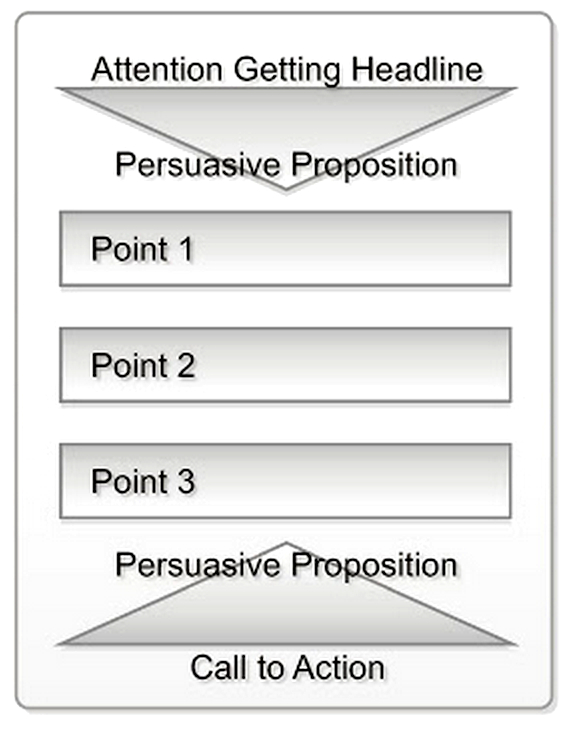
    Mrs. Jacobson used a diagram similar to this one:

    Use this outline to create persuasive advertising in any medium.
    Use this outline to create persuasive advertising in any medium.


    The Attention-Getting Headline, sometimes called the First Mental Image, is what draws you into the ad.

    Once you have the prospect’s attention, lead up to the Persuasive Proposition.

    Mrs. Jacobson called this part the thesis. Sometimes it’s called the Value Proposition. Rosser Reeves called it the Unique Selling Proposition.

    Regardless of what it’s called, this is the main point of our ad. This is the one thought that we want to stick in people’s minds.

    We usually use three points (or benefits) to convince our prospect of the validity of our Persuasive Proposition. For some reason three is a magic number. Any fewer, the proposition appears weak. Any more and you run the risk of a long and boring list.

    Exception: If you’re targeting Transactional Shoppers, and are showing off items included in your big sale, three groups of three items is magic. “They come in red, blue, and yellow; with zippered front, buttons, or pullover; and are available in medium, large, and extra large.”)

    Finally, the Call To Action tells your prospect what you want her to do next.

    Get familiar with this diagram. You can use it to create effective advertising copy for radio, for newspapers, for flyers, for sales letters, for television ads.

    Next time we’ll use the diagram to create actual ads – the perfect bait when you’re fishing for customers.

    Your Guide,
    Chuck McKay

    Marketing consultant Chuck McKayYour Fishing for Customers guide, Chuck McKay, gets people to buy more of what you sell.

    Need help applying the persuasion diagram to the story you need to tell? Drop Chuck a note at ChuckMcKay@FishingforCustomers.com. Or call him at 760-813-5474.

  • Allstate Gets It

    Allstate Gets It

    Dennis HaysbertYou get your new insurance bill, and grumble about the rate. You’ve grumbled every month when the bill comes, but today you’re especially irritated. “I wonder if I’m overpaying,” you mumble as you walk to your computer and search for “auto insurance.”

    You go to the first site, and click on the “get rate” button. Whatzzis? You want me to register to use your site? Why do I have to register to get a quote online? Amazed, you look for an answer. A couple of clicks later you find this explanation:

    * The online Rate Quote uses personalized pricing data. We use a one-time registration process to make sure we keep confidential data confidential.

    * It takes only 2 minutes to register, and within 24 hours you’ll be set up and ready to receive personalized rate quotes and lots of other customized information to make your use of our web site easier.

    These points constitute an answer?

    I don’t want to use your web site. I just want to know what it will cost me to insure my car. You won’t tell me what your premiums cost without me telling you who I am? Why do you need to know that?

    I know what this is all about. You’re going to send some salesperson to pressure me to buy from your company. I’m not sharing anything with you.

    And with that, you go back to your search engine to try some other site. Pity. You still don’t know what the first company charged, and now you’re not going to say anything positive about them, are you?

    Maybe it wasn’t insurance you wanted pricing on. Maybe you were searching for a gift for your mother, or checking the price of a rental car. Or maybe you’d actually found something you wanted to buy, but they won’t let you put anything in their shopping cart until you open an account. Have you ever had this particular experience?

    It must have happened to Jim Whimpey and the Brisbane Creative Team. They’re parodying useless accounts at a site appropriately called Useless Account.

    Every Obsticle Costs Sales

    Here’s a truism: everything that gets in the way of your customer is going to cost you sales.

    • Should you hide the $20 jeans featured in your radio ad to see if anyone asks for them? NO! You should place them prominently and count how many you sell.
    • Should you charge your customer’s credit card, then tell her the item is back ordered? NO! You should inform the customer that the item can’t be shipped for a specific number of days, and not charge her card until you’ve actually sent the item.
    • Should you “capture” visitor information so that you can add one more name to your mailing list? NO! You should give people the information they’re seeking, and then let them choose to associate with you.

    Now, the good news. Allstate gets it. Allstate’s newest television ad* is delightful. Here’s the script:

    Say you want a hot dog. You go up to the vendor and you ask “How much?” He says “Give me your name and social security number.” Humm. You probably won’t buy from him. So why put up with it when you’re looking to buy car insurance on-line? At Allstate you can get a ballpark estimate without even giving up your name. Go to the new GetAllstate.com. Without even giving your name or Social Security Number you can compare different car insurance options and levels of coverage and get a ballpark estimate. Then, if you like the price, you can go on to get a full, personalized quote with an option to buy on-line. People who switched to Allstate saved an average of $338 per year. Log on to GetAllstate.com now and see how much you can save. Protecting you should start with protecting your privacy. That’s Allstate’s stand. Are you in good hands?

    You’ll be pleasantly surprised at how many of your prospects take the bait, online or off, when you make it easy for them. And that bait is critical when you’re fishing for customers. .

    Your Guide,
    Chuck McKay

    Marketing consultant Chuck McKayYour Fishing for Customers guide, Chuck McKay, gets people to buy more of what you sell.

    Got questions about uncovering the obstacles to letting people buy?  Drop Chuck a note at ChuckMcKay@FishingforCustomers.com. Or call him at 760-813-5474.

    * Article written and originally published May 15, 2007. Obviously no longer Allstate’s newest television ad.

  • The Truth About Recycled Ads & Pickup Lines

    The Truth About Recycled Ads & Pickup Lines

    Swipe Files / Headline Banks

    Have you seen those ads for “headline banks” or “swipe files?” Collections of the 100 greatest advertisements of all time so you don’t even have to learn anything about marketing or advertising. You just have to copy these “proven ads” and you will, of course, have success.

    If you believe that.

    You know, you’re going to get about the same one hundred ads from every one of these suppliers and they’re all approaching one hundred years old, because those are the ads that the copyrights have expired on.

    And seriously, these were great ads when they came out.

    Great Advertising Examples

    Max Sackheim’s ad for Sherwin Cody’s home study course in the English language was brilliant: “Do you make these mistakes in English?” You know, that ad made money for Cody for over four decades, and they never changed the copy ’cause it just kept on working. This was a great ad.

    John Caples classic for the U.S. School of Music, “They laughed when I sat down at the piano, but when I started to play…” In those years leading up to the great crash of ’29, when money was easy and confidence was everywhere, thousands of (largely rural) Americans looked at this and thought, “Hey, maybe the key to becoming popular is mastering a musical instrument.

    Then there’s the Wall Street Journal ad that asked, “Who else wants to get promoted?

    No Thinking Necessary

    The idea is you take your name and put it where their name used to be, and you put your offer where their offer used to be. And now you run the ad.

    And because these ads were so brilliantly written they’re going to pull in hundreds of thousands of sales for you.

    For your heating and air conditioning company.

    For your family restaurant.

    For your income tax service.

    If you believe in magic.

    Here’s the reality. Those ads were so good because they were designed to work in a specific time, in a specific market, against specific competitors, in specific media… and none of those conditions exists anymore.

    So, recycling somebody’s old ads makes as much sense and recycling old pick up lines, for pretty much the same reason.

    He: “Do you make these mistakes in heating and air conditioning repair?”

    She throws her drink in his face.

    He: “They laughed when I sat down at Mom’s Family Diner, but when I started to eat…”

    She throws her drink in his face.

    He: “Who else wants to file Schedule A with their long form 1040?”

    She throws her drink in his face.

    Here’s What Really Works

    Find out what your potential customers are already talking about, and join in on that conversation.

    He: “If you wake up every morning with a backache, maybe it’s time for a new mattress.”

    She: “Tell me more.”

    Stop Using Other People’s Ads

    You can’t afford to lose any sales, and the right bait is the right information for your customers, at this point in time, in the medium you’re choosing, against the competitors you’ve got.

    Yes, there are magic words, but they’ll be unique for your company. And you need that kind of powerful customer bait when you’re fishing for customers.

    Your Guide,
    Chuck McKay

    Marketing consultant Chuck McKayYour Fishing for Customers guide, Chuck McKay, gets people to buy more of what you sell.
    Got questions about expressing the specific values and advantages of what you sell? Drop Chuck a note at ChuckMcKay@FishingforCustomers.com. Or call him at 760-813-5474.