Blog

  • Sperry, Hutchinson, and the Hotel, Part II

    We ended Sperry, Hutchinson, and the Hotel, Part I with a promise of Chuck’s personal hotel story, and posed this question: Can you buy customer loyalty?

    Let’s start with the hotel story.

    I have business in Austin every few months. A couple of years ago I started staying at a hotel on South Interstate 35. It was convenient. The staff was always nice. And they had free, high speed wireless.

    Now truthfully, their wireless had issues. At one point I had to explain to the night auditor how to re-initialize the router. But, as I said, the people were nice, and it was close to the places I needed to be.

    As I checked out at the end of my third stay, the desk clerk handed me a punch card with three of twelve punches already marked for the three nights I’d been a guest this trip. He told me they were implementing a new loyalty program, and explained that after twelve paid nights, the thirteenth was free.

    Remember, the card was not a factor when I decided to stay. I was satisfied with my previous visits, and would have chosen this hotel again anyway.

    But, there is something powerful about the word “free.”

    I kept the card.

    Last month at the conclusion of another Austin trip, the manager on duty ran my Visa, printed the receipt, and informed me that since I’d booked this stay on-line they couldn’t punch my card.

    I swear, until that very moment, the card had been of minor consequence, but she was taking away my punches. I got indignant. I informed her that I had booked online every time I stayed at her hotel. I wondered why this had never been an issue in the proceeding three years.

    She told me it was “policy.”

    I understand that I’m being petty. I know this is an emotional reaction, rather than a logical one. But truthfully, I feel that I’ve been wronged. And much as I’d like to think I’m above making purely emotional decisions, until I get an apology (and my three punches), there’s an excellent chance that I’ll be looking for a new hotel for my next trip to Austin.

    Loyalty program? I had chosen the hotel before they even started their loyalty program. I made the choice without any additional incentives.

    Hotel incentives are common. They range from free continental breakfast to refrigerators in the room. And once those incentives have been offered, they become part of the negotiation. They were what the hotel was willing to do offer in order to get your business, and what you can expect them to deliver when you accept their offer.

    Consider a couple of this hotel’s competitors.

    Motel 6 offers a clean, comfortable room, with free color TV and free local calls.

    AmeriSuites promises that every room will be a suite. They commit to a microwave and refrigerator in each room, high speed Internet access, free hot breakfast, and available meeting rooms.

    If you accept the Motel 6 offer, you won’t expect a microwave and refrigerator, or high speed Internet, or hot breakfast. You won’t even expect to find a hair dryer or clock radio. Will this disappoint you? Probably not. Motel 6 never promised these amenities.

    But since they did promise television and telephone, you may justifiably feel that you didn’t receive all you had been promised if you check in and don’t find them. (Translation: “I have been cheated.”)

    Remember in Sperry, Hutchinson, and the Hotel, Part I we noted that since all major airlines now offer frequent flyer miles, and since none of those airlines dares to eliminate their frequent flyer program, they’ve effectively become trapped into a “keeping up with the Joneses” marketing program that doesn’t promote loyalty.

    Frequent flyer programs not only don’t lead to additional future sales, they don’t even induce additional current sales.

    Do any loyalty programs work?

    Perhaps. How should we define “loyalty?” By the time we’ve eliminated sentiment and devotion to family or sovereign, the dictionary leaves us with “faithfulness to commitments or obligations.”

    Humm. Is a customer ever obligated to do business with us? Perhaps loyalty is the wrong term.

    The original loyalty programs did what they should have. They rewarded the company’s best customers for continuing to do business with the company.

    Sperry and Hutchinson’s Green Stamps rewarded cash payments. The bigger the payment, the bigger the reward. Frequent flyer programs originally rewarded the airline’s most profitable business travelers for flying that particular airline.

    But as soon as programs like these become commonplace, they no longer differentiate your business. They no longer attract your most profitable customers. Instead, they allow your least profitable customers to sell out your least profitible services. They become just another cost of doing business. And make no mistake; loyalty programs cost a lot to maintain.

    The hotel in my story discovered their loyalty program killed profitability when it was combined with other offers (in this case, on-line discounts). They solved for their poor planning by refusing to honor the agreement. I promise, this will cost them more than one free room night somewhere down the line. I can’t be the only person who books online.

    If we don’t call it a loyalty program, can we still keep our best customers choosing to do business with us?

    Yes, we can. Some are complicated and require committments to technology. Some are amazingly simple and you should be doing them anyway.

    We’ll examine those solutions in the final installment of Sperry, Hutchinson, and the Hotel.

  • Sperry, Hutchinson, and the Hotel, Part I.

    Are customer loyalty programs a good thing for retail? Should you have one? Do you participate in any? In part two of this article, I’ll tell you a story about a hotel’s loyalty program from my own experience, and share with you both rational and emotional conclusions.

    You will, of course, decide for yourself.

    My story starts with a hotel in Austin, but the story of loyalty programs goes back to 1896, when Thomas Sperry and Shelly Hutchinson came up with an idea to improve retail cash flow.

    Sperry and Hutchinson sold S+H Green Stamps to retailers, who gave them to customers that paid in cash instead of using store credit.

    The First Loyalty Program

    Customers flocked to stores that gave stamps. Filling stations, gift shops, and grocery stores gave them as bonuses with every purchase, based on the dollar amount of the purchase.

    Eventually shoppers saved up books of stamps and redeemed them for gifts from the S+H Green Stamp catalog. Stamps could be redeemed for anything from furniture, to appliances, to life insurance. During the 1960s the S+H catalog was the largest publication in the US, and the company issued three times as many stamps as the US Postal Service.

    S+H made money selling the stamps, and even more money because so many stamps were never redeemed. (Note to loyalty program planners: paper gets lost. Computer records don’t).

    During the recession of the 70’s when customers were afraid that each dollar they spent might be the last for a while, and retail sales were taking a beating, retailers cut every available cost of operation. The ongoing expense of Green Stamps became hard to justify. When the competition dropped the stamps and lowered prices by the same percentage, thrifty shoppers voted with their feet to forgo the reward and take the lower price.

    By the time Sperry’s and Hutchinson’s heirs sold the company in 1981 only about 100 stores were still offering the stamps.

    Why is Customer Loyalty Important?

    Fred Reichheld, author of Loyalty Rules, says an increase of customer retention of only 5 percent can result in a 75 percent improvement in customer value.

    Reichheld cites other values from customer retention including greater sales, higher profitability, better word of mouth, and the ability to identify service problems earlier.

    It’s no wonder that retailers are so enamored of customer loyalty programs.

    Punch Cards

    The simplest loyalty program is the wallet-sized card which can be punched or stamped with each purchase. Buy eight sandwiches and the ninth is free. Stay a dozen nights in our hotel and the thirteenth is on us. Sorry… the hotel story helped to shape my view on loyalty programs, but I’m not quite ready to tell it, yet.

    A variation of the punch card is the magnetic card which gets swiped in the credit card reader. It provides discounts on selected items to members of the store’s loyalty club. At least, that’s what they want you to believe. The actual purpose is to record data on your personal purchase habits, in order to tailor future offers that you’re more likely to respond to.

    Improve your punch card response rate.

    Professors Xavier Drèze of Wharton, and Joseph Nunes of USC’s Marshall School of Business have concluded in a paper titled The Endowed Progress Effect that people are more likely to buy eight sandwiches to get the free one if you increase the total required to ten, but give them three punches on their first purchase.

    To quote the study: “By converting a task requiring eight steps into a task requiring 10 steps, but with two already complete, the task is reframed as one that has been undertaken and incomplete rather than not yet begun. This increases the likelihood of task completion and decreases completion time.

    Are you rewarding the wrong customers?

    Many credit card companies are now offering airline miles when you apply for, and are granted their card. It’s a variation on those first three punches on the ten punch card.

    But again and again it’s been statistically shown that the least loyal customers are those who are drawn to you because of special pricing. The special pricing usually kills profitability. The last thing you should attempt is to make an unprofitable customer loyal.

    Does this hotel offer airline miles?

    Are you a member of any airline’s frequent flyer program? Several of them? Do you use them all? So, which of the airlines are you loyal to? Or, like most of us do you shop for best price and purchase that ticket?

    When all of the competitors use the same rewards, we’re back to a level playing field. Frequent flyer miles are now part of the airlines’ cost of doing business. Having one won’t increase sales, but not having one may actually decrease them.

    Can you buy customer loyalty?

    Or, more specifically, can you purchase customer loyalty with premiums and discounts?

    This is the basic flaw in the whole concept of customer loyalty programs, and a hint of the conclusions to expect in Sperry, Hutchinson, and the Hotel, Part II.


  • Managing the Gap, Part Deux

    From my “in” box:

    Chuck;

    I always look forward to your articles. I don’t always agree, however. And today, I’d like to argue one point with you that you mention in your Managing the Gap article.

    You stated that “Without advertising, you’ll be primarily conducting business with people who just happen to pass by and see your sign.”

    That leaves out a couple of things.

    1. Sales staff. I have seen a number of businesses that do very little advertising but have an aggressive sales staff bringing in good numbers. While you may say that a sales staff is a form of advertising, I would instead say they are a form of marketing.

    2. Same with a company’s PR. PR is not necessarily “advertising.” It is however, marketing.

    3. Networking. Again, not “advertising,” but a form of marketing.

    Just my two cents:)

    Norm Minnick
    Total Marketing, Inc.
    www.totalmarketinginc.biz

    Hi, Norm:

    I should never make statements like the one you quoted without first qualifying them. You’re absolutely right. “Without advertising, you’ll be primarily conducting business with people who just happen to pass by and see your sign” is at best incomplete (if you’re feeling generous). As it stands, it’s flat out wrong.

    Aggressive selling and PR are obviously factors in growing new customers. Networking is slightly different, but again, I agree. It is a form of marketing.

    To be sure that we don’t have different understandings of what these terms mean. Let me share mine.

    • Marketing. – everything a company does to acquire new customers and maintain relationships with them. The goal is to match a company’s offerings of products or services to people who need, want, and can pay for them.
    • Advertising – calling attention to a business, a product, or a service in some public medium in order to induce people to purchase. It’s generally accepted that advertisements are announcements paid for by the seller.
    • Networking – making new contacts and spreading the word about yourself or your company. Usually this implies meeting one to one.
    • Public Relations – the actions of a company to promote goodwill between itself and its buying public.

Now, lets address the points you made in your e-mail.

Point One: salespeople. I suspect you’re referring to outside sales. Sales clerks, who wait for customers to enter the business, are going to be dependent on either walk-in traffic, or on advertising, for the same reasons I put forth in Managing the Gap. There will also always be referral business, if those sales clerks provide a remarkably good customer experience.

An outside sales staff’s function is to seek out new customers. Outside salespeople will be much more important to your bottom line when your business depends on relatively few purchasers, who spend proportionally larger amounts in each transaction. Sales of services immediately come to mind. Think of a typical insurance broker’s office. The walk-in traffic will be miniscule compared to the number of sales it takes to keep that office open and thriving.

Outside sales wouldn’t work well for a grocery store, though. Businesses which rely on large numbers of customers, each of whom makes relatively small purchases, still won’t be able to trade their advertising for direct sales.

We can conclude that the value of outside sales is inversely proportional to the size of the typical purchase.

Point Two: public relations. Again, I agree. Public Relations is not advertising, but it is marketing. Public Relations is what you do with your reputation to attract new customers.

Some PR companies spend a lot of time and effort getting stories written about their clients in the major media. They justify the value of the story placement on the equivalent cost of purchasing advertising time or space. Frankly, I think stories that carry the credibility of the news medium are worth far more than their advertising equivalent.

Unfortunately, no one can predict when an editor will find such a press release useful and newsworthy. This makes Public Relations as a publicity mechanism highly limited.

A company’s ability to grow its customer base through its PR efforts faces the same limitations as a company trying to grow through outside sales – too few opportunities to convert mass impressions into multiples of new customers. If the business relies on a few customers to make large purchases, it may do quite well with Public Relations as its exclusive driving mechanism. Businesses which depend on large numbers of customers, though, will require large amounts of exposure.

Marketing professionals whom I respect disagree with me. Al and Laura Ries in The Fall of Advertising & The Rise of PR, for instance, make the bold claim that great brands are not built with advertising, but rather with PR. At a national level, they make a compelling case. I’ve seen very few local businesses, though, that could qualify as great brands.

Point Three: networking. By “networking,” did you mean attending networking events? We both likely know people who use networking events quite effectively. Much like outside salespeople, they need to forge relationships with folks who make somewhat larger purchases, or who will make multiple purchases over a reasonable period of time.

For companies who deal with hundreds of customers in small dollar increments, networking is too inefficient to drive sales.

I truly suck at networking events. Perhaps if I were better at them, I’d be more enthusiastic. Though I don’t attend the events, I am constantly networking. Being open to people who cross my path, and staying in touch with them, has proven to be the best way to create my own luck

Norm, I appreciate you bringing up these points. Until I gave it more thought, I hadn’t realized that “The value of outside sales is inversely proportional to the size of the typical purchase.” I suspect I’ll be quoting myself on that one.

Best regards,
Chuck

PS – we didn’t address Professional Reputation – the assessment by the community of the quality of your work, your knowledge of your trade, and your honesty and integrity. Maybe that would make a good discussion topic sometime soon.


Share This Article With A Friend.

  • Managing the Gap

    All advertising does is try to convince people to buy things they don’t want and don’t need.

    Ever heard that? If you have, it was probably a statement made by an employee. A non-sales employee of some large company. A non-sales employee who doesn’t understand commerce and has never been involved in attracting new customers to the company which employs him.

    Owners of businesses (as well as their salespeople) instinctively know two things:

    1. you can’t convince anyone to buy what she doesn’t need (at least, not more than once), and

    2. without advertising, you’ll be primarily conducting business with people who just happened to pass by and see your sign.

    Nobody buys anything she doesn’t want or need. What? That can’t be right. People don’t need tattoos. They don’t need newer cars. They don’t need the latest hot video game.

    Kind of arrogant, isn’t it, to assume that just because you don’t feel the need, that no one else does, either?

    The only reason a purchaser buys anything is because she feels a lack in her life. Advertising only speeds up what would have happened anyway by helping Ms. Prospective Customer to recognize her feelings of dissatisfaction, and to help her to learn about ways she could eliminate the gap between what she has, and what she wants. No gap, no reason to buy.

    As marketers, our job is to manage the gap.

    What makes up the gap? What’s the difference between the customer’s ideal and her reality? How can purchasing from you satisfy the need she feels? How can purchasing from your competitors satisfy her? Inside her mind, where do you and your competitors rank in your ability to eliminate that gaping lack she perceives in her life?

    Those questions inevitably give rise to other questions:

    • Can she articulate what it is she feels? (A problem well stated is, after all, half solved).
    • Do you know her perceptions of you? Of your competitors?
    • Does she understand the ideal state, that is, does she know how good it could be if she purchased from you?

    The gap is always based on perceptions, and feelings. If she doesn’t feel the need, she won’t buy. What can you do to help her to understand what it is she’s feeling, and how buying from you will satisfy the need she feels?

    Could this “managing the gap” concept provide a key to creating your own powerful marketing program?


    Share This Article With A Friend.

  • A Good Ad

    A Good Ad

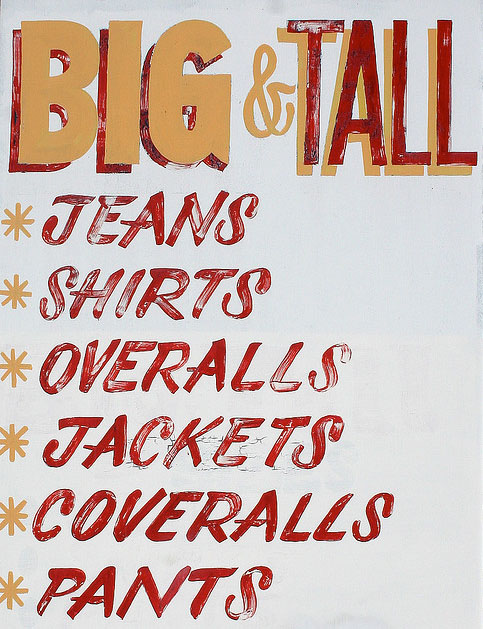
    Big and Tall Clothing Sign
    Big and Tall Clothing Sign

    For years I’ve said (and I have not been kidding) that the problem with most advertising is it’s written by the advertiser.

    A typical small business ad makes a major feature of the name of the business. In newspaper the tendency is to make the business name the biggest thing in the layout. On radio the rule seems to be insert the name every ten seconds. Television? Put the name full screen for the last five seconds of the ad and make sure people know directions to the store.

    But, for just a minute, let’s pretend that your business is a big and tall men’s clothing store, and that I’m a prospective customer.

    We can assume that I don’t have any interest in having you try to sell me things I don’t want. We can further assume that I don’t want to pay more than a fair price, and that I wish to be treated as if I’m important. Those are just the generic concerns.

    Suppose that I’m six feet eight inches tall. I now have additional concerns: I don’t want to shop for clothes that don’t fit. I don’t want to find clothing designed for a much smaller man, even if it has been manufactured in my size.

    Let’s look at your ad and see what it says.

    Your name is the headline. You have a photo of your family, who apparently do double duty as your staff. Your ad tells me how long you’ve been in business, your address, phone number, your hours of operation, and a list of the product lines you carry.

    What your ad has not addressed is any of my issues. Actually, your ad hasn’t said anything to catch my attention. I find this amazing. You’re trying to attract me, and other people like me, but you insist on talking about yourself.

    And suppose, for just a minute, that I’ve decided I need a couple of white business shirts with French cuffs. Suppose that I see your ad, come to your store, and discover that you only stock casual clothing for big and tall men. When I discover you don’t have what I want, and walk out, you’ll probably claim the ad “brought in the wrong people.”

    Don't set me up for embarrassment.  Do you carry my neck size?  Say so in your ad.
    Don’t set me up for embarrassment. Do you carry my neck size? Say so in your ad.

    You only got lookers instead of buyers?

    Hummm. Does this happen to you a lot?

    Of course, even bad ads will usually produce some business. If you have clothing that is in high demand, and there are enough big and tall men, some of them will respond to your ad and will probably buy something before they leave.

    Of course, a great many more will be spreading their business among your competitors, because their ads are interchangeable with yours.

    Or maybe they just chose the store with the most convenient location.

    Advertising is too expensive to waste.

    As expensive as advertising is, shouldn’t we strive for the greatest possible return on investment?

    Your self centered ads are not persuasive. I don’t care that you’re the biggest, the oldest, the most popular, or that you will not be undersold. I, your prospect want you to talk to me. I want better advertising, more salient advertising from you.

    Let’s consider what makes an ad effective.

  • A good ad is about the customer.
  • A good ad speaks directly to a specific group of people, in language they use, about concerns those people have recognized.
  • A good ad sells benefits, and explains exactly what each benefit does for your prospect. It is honest, and believable.
  • A good ad is built on a simple concept, conveys its message clearly, and leaves one easily remembered thought in the mind of the prospect. It makes the prospect remember the product, or the advertiser, instead of the ad.
  • A good ad is distinctive, and easily recognizable. It helps to build a positive image for the advertiser.
  • A good ad conveys a sense of urgency. It has a clear call to action and tells the prospect what to do next.
  • Suppose, instead of making your name the headline, you ran an ad that with a headline that said “Are you as tall as Larry Byrd, and can’t find shirts long enough to stay in your pants when you reach for the top shelf?

    I know, I know. You’re going to tell me you can’t run an ad like that, because when you talk to the tall men, you don’t let the big men know you have shirts for them, too, and as much as you’re spending for this ad you’re not going to leave anyone out.

    So, here’s my question. Who you think is reacting to your current ad? Who feels it’s speaking to them? (Hint: announcing you stock both big and tall men’s clothing doesn’t mean you’ve said anything of interest to either).

    Are you ready to kick your advertising into high gear?

    Then talk to me, your prospect. Talk about the things I think are important. Talk about exactly how you’re going to help me.

    And please stop thinking that the only “benefit” I care about is price. You must have more to offer than low price when you’re fishing for customers.

    Your Guide,
    Chuck McKay

    Marketing consultant Chuck McKayYour Fishing for Customers guide, Chuck McKay, gets people to buy more of what you sell.

    Got questions about articulating your value, and making sure people know it? Drop Chuck a note at ChuckMcKay@ChuckMcKayOnLine.com. Or call him at 304-208-7654.

  • The Smaller your Focus, the Bigger your Profits

    I understand how you feel. I do.

    You’re paying for your advertisement to be seen / heard / read / viewed by 40,000 people. And the cost of reaching that many people is sooooo high, that you’re going to add copy points, then add more copy points, and then add even more in order to make sure you say something which will appeal to all of them.

    That would be a mistake.

    I do understand that you’re trying to make the biggest impact with those dollars, but it’s still the wrong thing to do. There is nothing you can say that will appeal to 40,000 out of 40,000 people.

    Consider this: if you were able to successfully persuade one half of one percent of those people to come do business with you, you’d come away from this advertising schedule with 200 new customers. If you’re like most businesses, you couldn’t possibly handle 200 new customers – at least, not all at once.

    Would you agree that under most circumstances for most businesses, 25 new customers from one advertising schedule would be a phenomenal success? Then stop trying to talk to the other 39,975, and tell those 25 exactly what you can do for them.

    Odd, isn’t it? The more you narrow your focus, the stronger your message becomes.

    Don’t be afraid to specialize. Don’t be afraid to get very specific in your advertising.


    Share This Article With A Friend.

  • Location, Location, and the UVP

    Does your business have a Unique Value Proposition (U.V.P.)? The strategy I’m about to share requires one.

    DO NOT attempt this if you can’t articulate a very compelling reason for people to conduct business with you, rather than with than a competitor.

    You’ve, no doubt, heard that there are three critical considerations in real estate. They are, in order, location, location, and location. There are also several philosophies involving the selection of that location, especially as it applies to choosing one for your business.

    One school of thought is to go where there are no competitors. Another is to go where all of the competitors are.

    I suggest that the difference may come down to your U.V.P.

    I’m visiting a major southern city in the U.S. My client is considering a location for his new retail store. We’ve looked at, and considered, several.

    One is particularly attractive to us. It’s at the intersection of two streets which are primary arteries for the community. Within a block of this intersection are four other businesses which are my client’s direct competitors.

    If we can negotiate an acceptable lease, we’ll be the fifth competitor.

    Several advantages to this location become obvious, once you think about them.

    1. This intersection has become known to the public as the part of town where one goes to conduct business with someone in my client’s industry. If a shopper doesn’t know exactly what she wants, it’s easier to get her to go where she more choices.

    You’ll note that most large cities have a “restaurant row,” or a several car dealers in a two or three block area. They all tend to do better than the lone restaurant or car dealer on some other thoroughfare.

    2. This location eliminates fourteen of the eighteen direct competitors from the minds of shoppers passing by. As a potential customer drives through this intersection, and notes that four competitors exist at this one place, she’s not as likely to actively be thinking of the fifth on the South side of town, the sixth on the North side, or the seventh near the courthouse.

    Where it counts, in the mind of the shopper, it’s easier to compete with only four other businesses at this location, than it is to compete with eighteen others scattered across the city. (As they say, out of site, out of mind).

    3. It’s much easier to get people to walk across the street to comparison shop than it is to get them to come see you at a place they’ve never been, when you are new and they have no relationship with your company.

    4. One of the primary purposes of advertising is to help people remember who you are and why they should seek you out. Won’t you have to spend substantially less to do so when thousands of potential customers drive by your store, and it’s signage, daily?

    Enough traffic already passes through this intersection that four direct competitors have been able to run successful businesses with minimal advertising.

    Despite these major advantages, there is a strong danger to this strategy. It invites direct comparison of your business to multiple established competitors. If you can’t hold up under such scrutiny, this decision could effectively kill your business.

    If you have a strong U.V.P. choosing such a location can be a powerful strategy. Without one, you’re all too often at the mercy of the competitor who does.

    You do have an easily articulated, customer-focused U.V.P. don’t you?


    Share This Article With A Friend.

  • Chuck’s 2007 Letter to the Ad Fairy

    Dear Advertising Fairy:

    Thank you for the wishes you granted last year. I’m happy that the “Lost another loan to DiTech” banker appears to be gone. And, although I’m still waiting for you to eliminate those stupid TAG Body Spray storylines that so blatently rip off the old Hai Karate ads from 1967, I’m confidant you’ll get to them soon.

    Ad Fairy, I hope you’ve dusted off your magic wand, ‘cause we’ve flipped the calendar over again and I have my usual five more advertising wishes for for the new year.

    5. The phrase “Now THAT’s what I’m talking about” will never be used again in any ad any time anywhere. In fact, let’s strike it from the vocabulary. OK, Ad Fairy?

    4. Instead of saying “This product has not been evaluated by the FDA,” natural male enhancement products will not be allowed on TV until evaluated by the FDA.

    3. X-Treme anything will no longer be allowed. Let’s find a new word. How about… um… Poofy? That could work. “Tonight on Poofy Sports….

    2. Ads for ED medications will get past that pesky four hour issue.

    And my top wish for advertising in 2007?

    1. That Apple give us more “I’m a PC / I’m a Mac” ads.

    If they did that, then maybe other advertisers would catch on to the power of a simple explanation of benefits to the purchaser. If Apple lead by their current fine example, other companies might drop the “entertainment” thats being passed off as solid marketing.

    Perhaps that guy building the stand up comedy club in his back yard would simply consider the STARZ comedy pack for $12.95. Maybe then the Quaker Oatmeal To Go guy would stop cooking on the bus. With those examples could Carmen Electra quit throwing herself at the ordinary guy who dumped her in the Taco Bell commercials? And then would it be possible for Halls Sugar-Free Bursts not to be used to take the scratches out of an LP record?

    Could they all stop talking to me as if I’m mentally deficient?

    Hummm.

    While I think of it, let’s put Countrywide Finance and E-Harmony on the list of advertisers who don’t pander to, don’t talk down to, and don’t treat me as if I’m stupid. Ad Fairy. I wish them all greater success in 2007.

    But see what you can do with those TAG Body Spray ads, ok?


    Share This Article With A Friend.

  • Familiarity Breeds Relationships

    It’s an old folk saying. “Familiarity breeds contempt.”

    It’s a warning that we can learn too much about each other, and not like what we find.

    But, what marketer wouldn’t go to excessive lengths to create more and more familiarity with his company? After all, the more a potential customer thinks about a company, the more likely she is to ultimately buy from that company, isn’t she?

    Assuming a salient message, yes.

    Evidence indicates that when no one has a obviously superior product, customers tend to buy from the company most familiar to them.

    Market share tends to equal share of mind.

    This kind of advertising is used by brand builders, and is known as top-of-mind-awareness. The strategy? Constantly remind people of what the company can do for them, then wait patiently for them to need what the company offers.

    We call those customers relational. They’re most interested in doing business with companies they trust not to take advantage of them. Marketers hope to build brand recognition with relational customers because it eventually can lead to a long series of purchases from that customer. Brand building doesn’t insist on a sale today, but rather builds awareness today for sales tomorrow.

    Then there is the other school of marketing.

    Direct marketers also build brands, as evidenced by successful companies like Land’s End, or Eddie Bauer. But though their customers can be every bit as loyal, direct marketers aren’t willing to wait for “someday” to acquire those customers. They aren’t interested in the value of “getting their name out there.” They want the cash register to ring, now.

    Direct marketers study the numbers, and adjust tactics to gain minor fractions of advantage.

    Direct marketers use call-to-action ads, and assume each time the ad is run, the phone must ring. If the phone doesn’t ring, the ad is a failure. Direct marketers know that every dollar they spend has got to return more than a dollar, and they measure to know exactly how much more.

    To make that phone ring, direct marketers primarily target transactional shoppers – shoppers who are simply looking for a great deal today.

    A direct marketer closely watches the costs of customer acquisition, so he can stop sending those relatively expensive mailings to people who don’t respond to his offer. The individuals on his “list” either react in the first, second, or fifth mailing (whatever his cost ceiling) or they’re dropped from the list and they don’t hear from him again.

    But mass media can’t offer that kind of selectivity.

    You can’t change the physics of television broadcasting to prevent the people who didn’t buy from being exposed to your ad again. You can’t block the view of the billboard only when non-purchasers drive by (and by the nature of the medium the cost of customer acquisition wouldn’t change, anyway).

    Which is why direct marketers don’t often use mass media. They consider those non-buyers to be “wasted circulation.”

    And that’s a shame, because mass media provides great opportunities to cost effectively reach those transactional buyers. Of course, the same mass media provide great opportunities to cost effectively reach relational buyers.

    And eventually someone always asks, “Can’t we design an ad to appeal to both transactional and relational buyers?”

    No. We can’t.

    No ad can successfully appeal to two opposite purchase motives. The right thing to say to one is exactly the wrong thing to say to the other.

    Which prompts today’s question.

    On those rare occasions when a direct marketer uses mass media to attract transactional buyers, is it possible to achieve top-of-mind-awareness, too?

    Humm.

    Yes. Yes it is. A lot depends on how long those ads continue to run.

    Here’s why.

    Take an attorney. Call him, oh… call him “Hammering Henry.” Henry traditionally screams into the tube “I’ll fight hard to get you the money you deserve for your pain and suffering. Call me now.”

    Henry buys massive amounts of gross rating points. Henry is also the only lawyer advertising on television in his market.

    Over a period of time, when Henry’s ad is heavily repeated and no one else bothers to put any message on TV, who are accident victims likely to call? Which name is top-of-their-collective-minds?

    It’s Henry.

    Henry isn’t screaming at the camera in order to build the Henry brand. He’s simply doing his best to make the phone ring. He’s telling people who’ve had an accident to pick up the phone and call him NOW.

    But, over the months and years that he continues to advertise, how many other names will the average driver remember?

    By default Henry IS top-of-mind.

    Sometimes there will be a medium that none of your competitors advertises in.

    That medium could be the local television station. It could also be the local church bulletin. The medium could be a radio station or an outdoor sign company, then again, it could be a thirty second video running before the feature attraction at the local Cineplex.

    Assuming a salient message, if a specific targeted audience is exposed to that ad over and over and over, and no competitors bother to respond, a strictly transactional ad could capture the attention of, and be remembered by, relational buyers as well.

    Of course, as soon as competitors start advertising in the same medium, that natural advantage disappears. At that point, more than one solution comes to mind, all shoppers will respond to whichever ad which most closely addresses their needs.

    But to a small advertiser with minimal competition, this strategy of being the only advertiser in a business category using a particular medium, could be worth considering.


    Share This Article With A Friend.

  • Four Stories – Two Outcomes – One Moral

    It’s been said, perhaps too often, that nothing happens until someone sells something.

    Then again, maybe it hasn’t been said enough.

    Example #1 – The concert.

    A not-for-profit agency decided to promote a concert as a fundraiser for their organization. They paid the deposit on a minor-league baseball stadium in which to hold the event.

    They contacted a great number of family-friendly performing artists, asking them to perform gratis, to benefit the good works of the organization. Several artists indicated interest, but were unable to immediately commit, citing the need to clear their schedules.

    The not-for-profit agency was advised to find sponsors for the event, in order to be able to pay for printing, advertising, security, and legitimate out-of-pocket expenses. They determined that they’d have an easier time acquiring sponsorship if they waited until the acts had all confirmed.

    Things went along smoothly, until time to start paying miscellaneous expenses.

    The not-for-profit group kicked into panic selling mode. Prospective sponsors, feeling the desperation, quite naturally distanced themselves. The family-friendly acts stared asking why no agreements were being put into final form.

    The not-for-profit ran out of time, forfeited the deposit on the venue, as well as their credibility with the artists, the venue, and the community.

    Example #2 – The study tool.

    A husband and wife sold the business they’d built over the last decade for enough money to last the rest of their lives. They signed a non-compete agreement, which prevented them from creating a new business in the same industry.

    They attempted to retire. They failed at it.

    Feeling the need to do something, they looked for an opportunity in a new industry. The No Child Left Behind Act of 2001 had become the law of the land, and someone mentioned the need for additional study material. How much study material? Enough to provide tutoring for every class taught in all 13 years of public education.

    They formed a company to produce self-tutoring study guides. They hired several school teachers to write the individual learning modules.

    Our entrepreneurs determined that there would be less pirating of their soon-to-be copyrighted materials, if the study guides were only accessible on-line. They hired two software coders to make the materials interactive.

    When they were finished composing, debugging, and making the product user friendly, everyone admitted that they’d created an incredible product. By their estimate, they sunk half a million dollars into this project.

    Completely prepared, they started contacting school districts. None of those districts made appointments for demonstrations. Seems those school districts had already contracted to use another company’s product, even though it was still in the early stages of development and wouldn’t be available for another year.

    Example #3 – The radio show.

    A real estate broker, wanting to enhance his reputation in the community as a credible problem solver, contacted the local talk radio station to purchase an hour of time each week.

    Then, as the host of a new call-in show, he sold ads within his program to a mortgage broker, a plumber, a landscaper, and a building contractor. By the time the first program aired, his broadcast had turned from an expense to a new profit center for his brokerage.

    Example #4 – The headhunter.

    While looking through the help wanted ads, an unemployed salesperson noticed a large number of positions available in a specific narrow field.

    On a whim he phoned a few, represented himself as a headhunter who worked in that field, and asked about the range of compensation. He also asked about the employers’ willingness to pay a fee for his services. When enough of them agreed, he offered to send over an agreement.

    Then he started phoning companies who employed workers in that field. When he got them on the phone, he told them he had employers lined up who were paying well for people with their particular skills. Did they know of anyone who would be interested in interviewing?

    A quick trip to a quick printer 48 hours after reading the first want-ads, and our new headhunter had business cards, letterhead, confidentiality agreements, and contracts to act as agent. He also had several interviews set up for his professional clients to meet with his employer clients, and a company operating in the black within his first 30 days in business.

    Finally, the moral.

    Sell the concept first. Get commitment, then create the service.

    Not only does this guarantee a market for the services you’ll deliver, but it also allows you to get your new customer(s) involved in the development of those deliverables. (Which is another way to keep them committed to you, by the way).

    There is nothing more important to the success of any new venture than the acquisition of customers.

    Without a customer you don’t have a business. You have a hobby.


    Share This Article With A Friend.