Blog

  • Marketing P.A.I.N. – Part 7, Tie It All Together.

    Thus far in the Marketing P.A.I.N. Series, you’ve seen the value of talking to your customer about the exact discomfort she’s experiencing.

    You’re able to identify four stages of pain. You can help your customers to identify with your solution at each stage of pain.

    You know how to use that identification to help your advertising messages to cut through the media clutter to get their attention. You’ve learned to propose a solution appropriate for each pain stage.

    Is that all it takes to make a sale?

    Not quite. Although you now have your prospect’s attention, you still have no credibility with her. This is where acknowledgment of her pain mindset comes in. There are only two:

    1. People in a Transactional mindset believe they know everything necessary to choose the right solution for their pain. Transactional shoppers are primarily interested in prices.

    2. But people in a Relational mindset are well aware that they don’t know enough to make an uninformed decision. They’re seeking an expert they can trust.

    In every business category, roughly half of the customers fall into each designation. And depending on what it is we’re shopping for, we each are already both.

    Buy whichever gas is cheapest? Purely a transactional move. Choose to dine at Mario’s Spaghetti House because the waitresses all flirt with you? You’re as relational as they come – at least when it comes to spaghetti.

    No message can appeal to both pain mindsets.

    Did you notice that these mindsets tend to be polar opposites? The right thing to say to one is exactly the wrong thing to say to the other.

    To get the attention of Transactional shoppers, you could offer reduced fees, promotional sales events, or coupons. If you charge “too much,” you have no credibility with them.

    But Relational shoppers want to know you understand them, and that they can count on you to offer informed advice. Anything which indicates you are driven solely by profit, rather than concern for your customers, costs you credibility with Relationals.

    Examples:

    (click to enlarge)
    Either can be a profitable customer base, so it comes down to the kind of business you’re comfortable running.


    If you enjoy a fast-paced, “Wham. Bam. Next.” (oh, and “thank you”) style of operation, you may be able to compete on price to reach Transactional shoppers.

    But a more methodical, slower-paced, “get to know the customer” style of business necessitates appealing to Relationals, who are willing to pay higher prices, and are more likely to continue being profitable customers over the long-term.

    There’s an added benefit to getting the attention of Transactional patients. They contribute to “buzz” about you in the community. Relational customers are responsible for the more slowly growing “word-of-mouth.”

    Let’s tie it all together.

    Multiply four stages of pain by two pain mindsets, and it becomes obvious that there are only eight possible message positions.

    Look at how much more credible the message becomes when you catch the shopper’s attention (by identifying the stage of pain), and then present your message in accordance with the pain mindset she’s already inclined to trust.

    (click to enlarge)
    The marketing of every service business, of every retail business, of every not-for-profit can be described in one of these eight positions.


    Why only one position?

    Few businesses have the financial resources to simultaneously pursue two completely different markets.

    Since each marketing position resonates with a different group of shoppers, each position is ignored by other groups. Any impression you may have already made will not have been noticed by your second target.

    Once you’ve expended the resources to anchor your message firmly in a prospective customer’s mind, you’ll get the best return on your advertising investment by sticking to that position, and building on it.

    Please note: This does not mean that you can’t change the message, only that the message position – the stage of pain and mindset it addresses – remains the same.

    Choose the position with the greatest potential.

    You must decide whether you prefer to work with Transactional or Relational customers. And you must identify the stage of pain at which you choose to offer your solution.

    Which factors do you balance?

  • Which segment has the greatest growth potential for your business?
  •  

  • Is that segment big enough to support your business?
  •  

  • Will this result in the type of business you’d care to run?
  • Can you begin to see the power of the Marketing P.A.I.N. concept?

    When your local media rep invites you to become a sponsor of a new promotion, you simply need to compare the promotion’s focus against your eight position grid.

    If it matches, consider the investment. If not, pass.

    Once you’ve identified your position, you’ll instantly know whether any advertising you’re considering will help your business to grow.


    Your Guide,
    Chuck McKay

    Marketing consultant Chuck McKayYour Fishing for Customers guide, Chuck McKay, gets people to buy more of what you sell.

    Questions about focusing on the issues your customers care about may be directed to ChuckMcKay@ChuckMcKayOnLine.com. Or call Chuck at 304-208-7654.

    If you know someone who would find this article useful, please share it.


    Marketing P.A.I.N. Series


    Part 8, Message Frequency, Media Choices, and Tracking

  • Marketing P.A.I.N. – Part 6, Make It Stop!

    Suppose you go to bed Tuesday evening at the usual time, following your usual routine.

    Wednesday morning you sit up in bed, swing your feet over the side, and are startled as you put your feet into a cold, wet puddle of standing water.

    You discover that somehow, someone left the cold water trickling into the bathroom sink. It appears to have a clogged drain.

    You’re feeling the pain.

    Wow. In just moments you’ve just moved directly from Pain Stage 1 (no pain, no need for services) to Pain Stage 4 (make it stop hurting, NOW!).

    Screaming “I’ll get the mop. You grab the Yellow Pages,” you address the immediate standing water problem as your husband/wife/roommate opens the book to “plumbers” and sees this ad:


    Scanning to the adjacent page, this ad leaps into consciousness:


    Is there a difference between T.R. Johnson & Son’s ad, and that of Phillip S. Johnson Plumbing Co.?

    Pretty obvious, isn’t it?

    The first company seems to think their name is the most important information the customer needs. The second focuses on the customer’s emergent need.

    They may not be fighting an emergency, but by the time they’ve consulted the Yellow Pages, people are ready to buy. They’re fed up with suffering. They’ve concluded that they suffer from not owning what you sell.

    If these people have been influenced by your earlier advertising, they may look you up by name. If not, they’ll search through the listings for someone who can solve their problem, and solve it now.

    You won’t impress anyone as a problem solver if the headline of your ad is the name of your business, and that’s followed by a listing of brand names and services you offer.

    Stage 4 Messaging

    According to the folks at the solar marketing agency, a lot of advertising consists of the very common “We’re wonderful. We’re the best” kind of chest thumping one would expect from car dealers or personal injury attorneys. Among those businesses which sell services, “We’ve been in business for 70 years,” is an all too typical statement.

    But, if it was your sink is running over, would you care how long anyone’s been in business?

    A much more salient message to a prospective customer at Pain Stage 4, is “Stop hurting, now.”

    Stage 4 pain isn’t limited to emergencies. What if your sink isn’t running over, but its not draining properly either?

    You still need a plumber. What’s the headline you’ll look for?

    Your pain is likely to be . . .

    . . . that you’ll need to take time off work.

    More specifically, it’s trying to schedule your day when you don’t know exactly when the plumber will show up.

    That pain, time deprivation, is addressed by this * plumber:


    Compare TV Plumbing’s ad with that of T.R. Johnson & Son.

    Which one would you call, if you needed to take time off work in order to make that call?

    Pain Stage 4 occurs every time someone needs a solution NOW!

    Stage 4 ads aren’t limited to Yellow Pages ads. There can be times in which a Stage 4 message works well to build your brand awareness in a Stage 1 medium. (Let’s be honest, sometimes the urgency isn’t caused by the specific problem, but rather by the customer’s circumstances).

    Woman: Didja fix it, yet? Didja fix it, yet? Didja fix it, yet?

    Man: I’m workin’ on it, alright? Give me a break.

    ‘Nouncer: All Pro Plumbing. For all the times you can’t fix it.

    Woman: Didja fix it, yet?

    ‘Nouncer: We can. Call All Pro, today.

    Woman: Didja fix it, yet?

    Man: Yeah, I fixed it.

    Plumber: Problem solved.

    Of course, there are Stage 4 pains which don’t involve plumbing issues.

    Urges as simple as “I’m hungry” are much more effective when you promise immediate relief, as in this classic Domino’s ad:

    Announcer: When Domino’s Pizza delivers, quality comes first. We custom bake each pizza with carefully selected, skillfully prepared ingredients. Taste the quality.

    Singers: Domino’s Pizza. Domino’s Pizza delivers.

    Announcer: Call now and we’ll deliver a hot delicious custom made pizza to you in less than 30 minutes. One call does it all.

    Recognizing the degree of pain is the first half of the Marketing P.A.I.N. strategy. Although it has taken us six installments to describe that pain, we’ll address the other half of the formula in the next post.

    Get ready to apply Marketing P.A.I.N. to your advertising messages and watch your ROI explode.

    Your Guide,
    Chuck McKay

    Marketing consultant Chuck McKayYour Fishing for Customers guide, Chuck McKay, gets people to buy more of what you sell.

    Questions about focusing on the issues your customers care about may be directed to ChuckMcKay@ChuckMcKayOnLine.com. Or call Chuck at 304-208-7654.

    If you know someone who would find this article useful, please share it.

    Marketing P.A.I.N. Series

    Part 1, Relationships
    Part 2, What Do People Want?
    Part 3, Advertising the First Stage of Pain
    Part 4, When People Realize They’re Hurting
    Part 5, Testimonials and Comparisons
    Part 6, Make It Stop!
    Part 7, Tie It All Together

    Part 8, Message Frequency, Media Choices, and Tracking

    __________

    * TV Plumber was created by Adam Strange, and featured in Ringing Up Profits in the Yellow Pages by Dick Larkin.
    You’ll find the T.R. Johnson & Son and Phillip S. Johnson Plumbing Co. ads in the current Verizon Yellow Pages directory for Huntington, WV.


  • Unattached Marketer Seeks Self-Employed Professional For Long Term Relationship

    I’m dating again. Oh, not because my marriage to the Lovely Mrs. McKay is in trouble, far from it. I’m “dating” in that I’m ready for a new consulting relationship. I’ll be taking my time to find the right fit for the long term.

    You see, marketing isn’t art. It’s not science. Its a series of decisions based on relevant case studies and historical examples. Those decisions may, or may not, predict results. So, truthfully, marketing is a gamble. A good relationship requires the client to understand, and accept, that the consultant’s function is risk management.

    A good consultant stacks the odds in the client’s favor by having a broad knowledge of proven marketing techniques. By knowing what has worked for other businesses. By seeing the parallels between the client’s issues and similar problems that other industries have solved. By recognizing not only the factors which can derail business, but also the opportunities that can help the client leapfrog over his competitors.

    Yeah, I’ve been called an “expert.” But don’t expect me, or any other consultant, to show up and give you the magic formula for endless wealth. Instead, expect me to be your business B.S. meter.

    You see, I love speaking and writing, but I have little respect for those speakers who have been talking for twenty years about the things they accomplished twenty-five years ago. I work with a select group of clients in order to stay current, and relevant, and focused on the real problems faced by businesspeople every day. As a speaker, it provides an edge that just can’t be faked.

    Some consultants look for opportunities to run the clock, and bill the client for more hours. Instead, I charge a flat fee, which changes each year at the same proportions as my client’s top-line revenue. This isn’t called a relationship by accident. When the client does well, so do I. When the client doesn’t, I don’t, either.

    And I don’t profit from the traditional 15 percent commission that the media pays to advertising agencies who place advertising for a client. Oh, the media still provides that commission, but my client pockets the cash. Some clients get back more in those commissions than the fees I charge, and thus actually make money by using my services.

    But, past the mechanics, the primary values any consultant provides are perspective, and advice, which brings us to the point of this writing.

    Sometimes the client doesn’t wish to follow that advice.

    I once heard this dilemma compared to a duffer on the golf course refusing to accept the help of the club pro. When the pro advises a three iron, and the duffer insists on using a wood, the pro’s choices are to tell the duffer he’s on his own, or to help him to get the best shot possible with his own choice of club. “Get a good stance, keep your left arm stiff, keep your head down, be sure to follow through.”

    A client I’ve been working with, however, will not use any club I recommend. As much as I’ve tried to help him get distance on his shots, he insists that I do things his way. It appears he’s hoping I can execute his marketing strategy better than he did. But, even a brilliant execution of a flawed strategy still leaves a flawed strategy.

    Since I don’t believe that our professional relationship is benefiting his business, I can’t in good conscience continue to charge him for my services. I hope we can stay friends, because I truly enjoy his company, but I have resigned the account.

    So now, I’m dating again. I’m looking for a new relationship. I’m meeting some new business owners for the first time, to see if there’s any chemistry, not for a quick project, but rather for the long-term. My most recent client and I have worked together for a year and a half, now. Others go back as much as eleven years. The best fit is likely to be a professional practice or owner-operated company, whose owner is ready to take that company to the next level.

    Do you know someone like this? Would you care to introduce us?


    Chuck McKay is a marketing consultant who helps customers discover you, and choose your business. Questions about marketing your business may be directed to ChuckMcKay@ChuckMcKayOnLine.com.

  • Marketing P.A.I.N. – Part 5, Testimonials and Comparisons

    Most models of effective advertising list getting attention as the first step.

    Doesn’t it stand to reason that your communications will become powerful when your prospect recognizes that you’re talking to her?

    That’s the purpose of the Marketing P.A.I.N. Concept – to identify the discomfort your prospective customer is already feeling; to address that pain, and in so doing put forth an advertising message that she will recognize as relevant to her.

    Targeting the early stages of pain will help prospects know of you weeks, months, or even years before they recognize a need for what you sell. The largest number of people will be exposed to your message. This is the concept behind Top-Of-Mind-Awareness and building your “brand.”

    But advertising your goods or services for so long before they’re needed, ratchets up the expenses. You’ll have to continue advertising for a long period of time to make Pain Stage 1, or even Pain Stage 2 payoff.

    Targeting later stages pays off much more quickly.

    The triggers to purchase occur more frequently. That’s the good news. The bad news is the pool of available prospects is much smaller. Effective marketing at Stages 3 or 4, must be much more specific.

    At Stage 3, shoppers are sorting options.

    They’re dealing with the reality of constant discomfort, and considering the perceived value of options to make the pain stop hurting. What’s most likely to catch and hold their attention? The story of someone who had their exact problem, and eliminated it.

    At Stage 3, an appeal like this one from Nutrasystem becomes highly relevant. And a celebrity admitting she also shares our prospect’s pain helps to elevate the awareness level.

    The other thing common to Stage 3 ads is the comparison between solutions. You may remember cleaning products that get out the stain, better tasting coffee, or the gasoline additive that adds six mpg to your car’s mileage. Or, this example from Apple Computing.

    Mac: Hello, I’m a Mac.
    Vista: Mac has issued a salutation. Cancel or allow?
    PC: Allow. And I’m a PC.
    Vista: You’re returning Mac’s salutation. Cancel or allow?
    PC: Allow.
    Mac: What gives?
    Vista: Mac is asking a question. Cancel or allow?
    PC: Allow. He’s part of Vista, my new operating system. PCs have a lot of security problems, so he asks me to authorize pretty much evertything I do.
    Vista: You’re pointing out Vista’s flaws. Cancel or allow?
    PC: Allow. I could turn him off, but then he wouldn’t give me any warnings at all. That would defeat the purpose.
    Vista: You are coming to a sad realization. Cancel or allow?
    PC: Allow.

    Not all comparisons are obvious. This one from the Ladders sneaks up on you.

    If you think about it, this is the trouble with most job search sites. When you let everyone play, nobody wins. Join the Ladders. The premium job site for only one hundred K plus jobs, and one hundred K plus people.

    When you’re targeting a prospect at Stage 3, help her to see you as the solution by directly identifying her issues. Help her see herself doing business with you. Help her remember who you are and how to get in touch with you.


    Your Guide,
    Chuck McKay

    Marketing consultant Chuck McKayYour Fishing for Customers guide, Chuck McKay, gets people to buy more of what you sell.

    Questions about focusing on the issues your customers care about may be directed to ChuckMcKay@ChuckMcKayOnLine.com. Or call Chuck at 304-208-7654.

    If you know someone who would find this article useful, please share it.


    Marketing P.A.I.N. Series

    Part 1, Relationships
    Part 2, What Do People Want?
    Part 3, Advertising the First Stage of Pain
    Part 4, When People Realize They’re Hurting
    Part 5, Testimonials and Comparisons
    Part 6, Make It Stop!
    Part 7, Tie It All Together

    Part 8, Message Frequency, Media Choices, and Tracking

  • Marketing P.A.I.N. – Part 4, When People Realize They’re Hurting

    There are three ideas critical to the Marketing P.A.I.N. concept.

    1.Nobody buys anything until she becomes aware that the absence of that thing in her life causes discomfort.

    2.Your prospective customer will be much more likely to pay attention to your advertising when you match your marketing message to her specific stage of pain.

    3.While the degree of pain is a recognition of intensity of the need felt by your prospect, the stage of her pain is an acknowledgment of her awareness of that need. These two ideas are independent of one another.


    Let’s clarify those points.

    First, we’re referring to the feeling caused by physical or emotional distress as “pain.”

    Why call it pain?

    Truthfully, because P.A.I.N. becomes a straightforward acronym.

    M.I.S.E.R.Y. does not.

    E.M.B.A.R.R.A.S.S.M.E.N.T. is nearly impossible.

    Whatever you choose to call this awareness (discomfort, longing, loss, disappointment, anxiety, embarrassment, or in our case, pain) people don’t buy anything until they recognize the feeling caused by a lack of it in their lives.

    Second, out of self-defense against information overload, most of us ignore everything that doesn’t appear to effect us directly. (Some estimates have us exposed to thousands of marketing impressions every day). Matching your message to her stage of pain immediately tells our prospective customer that you’re speaking directly to her, about things that matter to her.

    And finally, our focus on the Stages of Pain is based on the prospect’s awareness of need, rather than on the depth of the need. Stage 2 pain is not a greater intensity than stage 1. It is a greater understanding that something is lacking in her life. The magnitude of pain is personal, but people’s reactions to pain are similar and predictable. You will recognize the stage of pain by the actions a person takes.

    Now, on to Pain Stage 2.

    At the second stage, people are becoming aware of their discomfort. This awareness is generally a slow process, and is often only grudgingly admitted.

    Typical Stage 2 messaging is “Let us tell you all about us.

    A much more salient Stage 2 message is “Do you have this problem?

    Early stage buyers need to know you can help them, even if they don’t yet have the vocabulary to ask the critical questions. Sometimes people don’t realize their discomfort until you point it out.

    Advertising at Stage 2 should concentrate on your prospect’s new awareness of the problem. At Stage 2, the single thought we wish to plant in people’s minds is, “we understand, and can relieve your pain.”

    Here’s a great example of an ad that makes people aware of their own discomfort. The Sherwin Cody School of English ad “Do You Make These Mistakes In English?” ran for 42 years, only changing the typeface and photo from time to time to keep it updated. (Now THERE’s a return on investment we can all envy). Click the ad to enlarge it for easier reading.

    This ad from Cash Call addresses people who have come up a few bucks short before payday.

    Need some cash to stay afloat? Cash Call wants to get you the cash, fast, without collateral because we trust you. Just call 877-860-CASH. And remember, make sure you can afford the monthly payment before you borrow. Make the cash call at 877-860-CASH.

    Though the target in our next example also needs cash, JG Wentworth’s end user is a more qualified prospect – one who owns an annuity. As is typical of Stage 2 prospects, Wentworth’s candidate is just becoming aware of the possibilities.

    Announcer: A JG Wentworth Success Story.
    Felecia: A few years ago I inherited an annuity from my grandfather. I started receiving monthly payments from his insurance company.
    Announcer: Recently Felecia’s employer moved to another state, and she was left out of work with lots of bills to pay.
    Felecia: I heard about JG Wentworth through TV ads.
    Announcer: I told Felecia that they helped thousands of annuity holders get their cash now.
    Felecia: And they made it really easy.
    Spokesman: Its your money. Use it when you need it.
    Voice Over: Call 866-447-0910.

    Once you’ve determined that your most profitable customers are at Pain Stage 2 ( just becoming aware of the nature of their discomfort) make it easy for them to get information from you. Make it easy for them to see themselves easing their pain by buying from you.

    And remember that any medium can carry any message. These Stage 2 examples used television and magazine ads to deliver the words. You may find, though, that other media with less mass might convey your message more efficiently.

    Consider the return on advertising investment should you choose to employ signage, newsletters, brochures, specialty advertising, or public speaking as alternatives to radio, television, newspaper, and outdoor ads.


    Your Guide,
    Chuck McKay

    Marketing consultant Chuck McKayYour Fishing for Customers guide, Chuck McKay, gets people to buy more of what you sell.

    Questions about focusing on the issues your customers care about may be directed to ChuckMcKay@ChuckMcKayOnLine.com. Or call Chuck at 304-208-7654.

    If you know someone who would find this article useful, please share it.


    Marketing P.A.I.N. Series

    Part 1, Relationships
    Part 2, What Do People Want?
    Part 3, Advertising the First Stage of Pain
    Part 4, When People Realize They’re Hurting
    Part 5, Testimonials and Comparisons
    Part 6, Make It Stop!
    Part 7, Tie It All Together

    Part 8, Message Frequency, Media Choices, and Tracking

  • Marketing P.A.I.N. – Part 3, Advertising the First Stage of Pain

    A brand is a trademark or distinctive name identifying a product or a manufacturer. Branding is the process of raising awareness of the advantages of a particular trademark, and building strong emotional ties between customers and products.

    The advantage in building a brand is that people ask by name for what you sell. The disadvantage is that they’ll buy when they want to, rather than when you wish to sell.

    But if your prospective customer feels no discomfort, she will feel no incentive to buy. Not your brand. Not anyone else’s.

    Truthfully, the vast majority of people at any given point in time feel no pain. They have no interest in what you offer. They consider your ads a nuisance. They wish your ads would go away. And that assumes that you managed to catch their attention at all. And yet, effective branding happens at Pain Stage 1.

    Branding strategy targets people who are not yet aware of discomfort.

    Why would you advertise to those non-prospects?

    To increase the reach of your advertising.

    The broad, all-inclusive lack of focus in the message, “eliminate your pain by purchasing our product/service,” doesn’t allow the targeting of specific audiences. Ads for pregnancy tests, for instance, will be exposed to retired men as well as to women of childbearing years. Ads for weight loss products will reach thin people. Ads for cars will become familiar to children.

    At Stage 1, your message reaches “everyone,” and waits for some of them to experience a triggering event. People’s status occasionally changes, and for some, an event will occur which places them firmly in the market. Some women of childbearing age will need a pregnancy test. Some thin people will overindulge over the holidays. Children will grow up, and some of them will purchase automobiles.

    Combined with top-of-mind awareness caused by your advertising, this new perception of need will lead them to look you up in the white pages, rather than looking up your business category in the Yellow Pages.

    Typical Stage 1 messaging is “We Want Your Business.”

    A much more effective Stage 1 message is “If you ever need us, we’re here for you.

    My favorite example of a successful Stage 1 advertising campaign is Roto Rooter. For the last five decades their message has been “When your drain clogs, we’re a phone call away.

    The company’s Public Relations Manager tells me they refer to their campaigns as “grudge marketing.” Paul Abrams describes this mindset as, “We’re the company people call when they have drain problems. People know us by name, but they resent being forced to call.

    The public knows Roto Rooter’s name because of the consistency with which the company’s advertising exposes the mythical “everyone.” Roto Rooter knows eventually some drains will clog.

    Here’s a sample Roto Rooter ad from 1968.

    When stopped up drains get you down, why wait, watch, and worry over home remedies that just don’t work? Next time remember to call the expert, your professional Roto Rooter Man. (jingle) When Roto Rooter comes, that’s when your troubles go. When Roto Rooter’s here, that’s when your troubles disappear. Call Roto Rooter, that’s the name, and away go troubles down the drain. Roto Rooter sewer service.

    A more contemporary version of “When you need us, we’ll be here,” is demonstrated by Countrywide Mortgage.

    Countrywide’s delivery is solidly at Pain Stage 1. The strategy is simple: get the attention of homeowners, and plant in their minds the idea that Countrywide can bail them out of a financial shortfall. Then wait for some of those folk to need the cash.

    Homeowners, want to refinance and get cash? Countrywide has a great reason to do it now. A no cost REFI. It has no points, no finance fee, no credit reporting fee. And no third party fees. No title, escrow, or appraisal fees. Absolutely no closing costs, so you wind up with a lot more cash. Call now and ask for a no-cost REFI. We’re America’s number one home loan lender, and no one can do what Countrywide can. (Announcer) Call one, eight hundred, six four one, seven one three six.

    As we’ve already discussed, advertising what you sell at Pain Stage 1 is the most costly of marketing options, but it also offers the largest potential number of sales, and profit. The combination of 75 million American homeowners and a tight economy promises a huge payoff for Countrywide.

    Matching your advertising message to the degree of pain your prospect feels will make your ads more effective.

    In Part 4 we’ll look at focusing your message toward people who already feel the discomfort. We’ll help them to realize that buying from you is the surest way to soothe their pain.


    Your Guide,
    Chuck McKay

    Marketing consultant Chuck McKayYour Fishing for Customers guide, Chuck McKay, gets people to buy more of what you sell.

    Questions about focusing on the issues your customers care about may be directed to ChuckMcKay@ChuckMcKayOnLine.com. Or call Chuck at 304-208-7654.

    If you know someone who would find this article useful, please share it.


    Marketing P.A.I.N. Series

    Part 1, Relationships
    Part 2, What Do People Want?
    Part 3, Advertising the First Stage of Pain
    Part 4, When People Realize They’re Hurting
    Part 5, Testimonials and Comparisons
    Part 6, Make It Stop!
    Part 7, Tie It All Together
    Part 8, Message Frequency, Media Choices, and Tracking

  • Marketing P.A.I.N. – Part 2, What Do People Want?

    Marketing P.A.I.N. – Part 2, What Do People Want?

    Originally published March 8, 2008

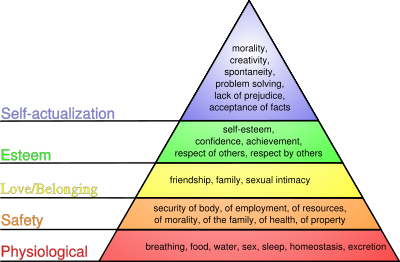
    Maslow's hierarchy
    Illustration of Abraham Maslow's hierarchy of human needs.

    They want you to make it stop hurting.


    Remember Abraham Maslow’s Hierarchy of Human Needs? Maslow described “deficiencies” that cause an individual discomfort when her needs are not being met.

    In other words, deprivation causes some degree of pain.

    Making that pain stop is the motivation for nearly all purchasing decisions. People buy to lessen the physical or emotional pain; pain of loss, of disappointment, of longing.

    The decision to purchase isn’t instant. People naturally hope the pain is temporary. They will continue to do things as they’ve always done them, at least at first, because change is painful, too. The second level of Maslow’s pyramid is Safety Needs, which include orderliness and predictability.

    But when the growing pain of postponing action becomes greater than the pain of change, people will make a purchase decision.

    Usually an event brings the new pain to greater focus and finally prompts the sufferer to act. We call this event a trigger.

    Triggers occur at every stage of pain.

    At each stage some prospective customers actively seek relief. At deeper stages, the triggers become both more predictable and more frequent. And, regardless of the business you’re in, there are only four stages of pain your customer can feel.

    Stage 1: No Interest, No Need. – The vast majority of the public has no interest in what you sell. (A good reminder that no message can possibly reach “everyone.”)

    Stage 2: Initial Awareness. – At this stage, your message should help early stage buyers to understand you can help them, even if they don’t have the vocabulary to ask the critical questions.

    Stage 3: Sorting Options. – Stage three shoppers are dealing with constant pain, and considering the perceived value of options to make the pain stop hurting. At stage 3, your customer will listen carefully to testimonials of people who have eliminated her exact problem.

    Stage 4: Ready to Purchase a Solution. – Stage four shoppers are no longer willing to suffer. They will make a purchase. They’ll do it within hours.

    These four stages can be used to describe every retailer, every not-for-profit, every service business.

    Let’s look at a few.

    The Stages of Pain for Plumbing.

    Stage 1: “Wash your hands.

    Stage 2: “Be sure to turn the knob tightly. It tends to drip.

    Stage 3: “I could buy the washer kit at Wal-Mart. I hope I don’t have to replace the whole faucet. Do I have any friends who know anything about plumbing? I wonder what a plumber will charge?

    Stage 4: “You grab the Yellow Pages. I’ll get the mop.

    The Stages of Pain for Accounting.

    Stage 1: “Put it in the payables pile. I’ll get to it.

    Stage 2: “I really need to get organized.

    Stage 3: “Why can’t I get the checkbook to balance?

    Stage 4: “The IRS wants me to bring my records.

    The Stages of Pain for Appliance Sales.

    Stage 1: “Its in the ‘fridge. Help yourself.

    Stage 2: “The milk doesn’t seem to stay cold enough anymore.

    Stage 3: “Who’s got a good selection of refrigerators?

    Stage 4: “Can you deliver this afternoon?

    The key to effective marketing (critical point).

    Most models of effective advertising list getting attention as the first step. Doesn’t it stand to reason that your communications will become powerful when your prospect recognizes that you’re talking to her?

    Match your marketing message to the pain your prospective customer already feels.

    But, if people experience a triggering event and are ready to buy at every level of pain, which pain level do your prospective customers feel?

    Your customers will go through all four stages, just like everyone else. You choose to address them at the stage which brings you the most profit. It’s a value judgment.

    Targeting people in the early stages of pain will help them to know of you weeks, months, or even years before they recognize a need for what you sell. The largest number of people will be exposed to your message. This is the concept behind Top-Of-Mind-Awareness and building your “brand.”

    But since you’re advertising your goods or services for so long before they’re needed, you’ll have to continue advertising for a longer period of time. That makes it more expensive. Choose early stages if you have the resources to stay the course, and the ultimate ability to handle huge numbers of customers.

    Marketing to later stages pays off much more quickly, since the triggers to purchase occur more frequently, but the pool of available prospects is much smaller. Effective marketing at later pain stages must be much more specific.

    In other words, when there are fewer fish biting, make very sure you’re using the right bait as you fish for customers.

    Your Guide,

    Chuck McKay

    Marketing consultant Chuck McKayYour Fishing for Customers guide, Chuck McKay, gets people to buy more of what you sell.

    Questions about determining the most effective pain remedy to offer your customers may be directed to ChuckMcKay@ChuckMcKayOnLine.com. Or call Chuck at 304-208-7654.

    If you know someone who would find this article useful, please share it.


    Marketing P.A.I.N. Series

    Part 1, Relationships
    Part 2, What Do People Want?
    Part 3, Advertising the First Stage of Pain
    Part 4, When People Realize They’re Hurting
    Part 5, Testimonials and Comparisons
    Part 6, Make It Stop!
    Part 7, Tie It All Together
    Part 8, Message Frequency, Media Choices, and Tracking

  • Marketing P.A.I.N. – Part 1, Relationships

    Marketing P.A.I.N. – Part 1, Relationships

    Vacuum Cleaner
    Vacuum Cleaner

    Assume John sells vacuums. He feels he needs to advertise.

    Does he…

    1) Explain to people why clean floors are important?

    2) Explain how vacuums remove dust, allergens, and pollens to keep your family healthier?

    3) Announce that his store has vacuums with HEPA filters in stock?

    4) Announce a big sale on vacuums this weekend?

    At one time or another John will be advised to do each of these things. Is any of them a valid strategy? Truthfully, each can be, but not to the same potential markets, and not at the same time.

    As you might imagine, those people looking for a vacuum today would probably respond better to appeal #3 – vacuums with HEPA filters in stock; or perhaps appeal #4 – big sale this weekend announcement.

    On the other hand, people who wonder about the effect of pollen on their family’s health are probably not yet ready to commit to any purchase.

    And no matter which appeal he selects, it will work better against some segments of the potential vacuum cleaner market than against other segments. It logically follows that some appeals will lead to greater profits.

    In a series of posts we’re going to discuss how to determine which segment of the potential market is most profitable, how to attract their attention, and how to craft a message which appeals to them. Finally, we’ll discuss how to choose a medium to deliver your message.


    Before we start, let’s look at John and Marsha.

    Consider John. John has just spent $200 taking Marsha to a very nice restaurant for dinner. Its their first date. John tries to impress Marsha. His shirt is unbuttoned down to the fourth button, so as to better show off the collection of gold chains he wears. Through dinner John tells Marsha all about himself: that he owns his own company, which he expects to take public in a couple of years; that his other car, the Porche, is in the garage again, at his vacation home, in Boca Raton. That a local political party has approached him about running for his state’s House of Representatives.

    Show of hands, who believes Marsha will accept a second date with John?

    Now, let’s consider John’s company. They just spent $2,000 on an ad which runs in American Idol on the local Fox affiliate. John’s Vaccuum ad states, “We’re an end-to-end solution for the wholesale purchase, shipping, warehousing, display, retail advertising, and financing of residential vacuum cleaners.

    Show your hands again. Who believes that Marsha will drop buy John’s Vacuums to shop for a vacuum cleaner?


    What’s the problem with the ad for John’s Vacuums?

    There are two, actually.

    The first problem is that the ad talks about the company. Frankly, customers don’t care about your company. They care about what you can do for them. If its so obvious that bragging about yourself is a terrible strategy to build an interpersonal relationship, why do business people insist on doing it to try for a professional relationship with a customer?

    Why would you want a relationship with a customer?

    Primarily because you don’t want to sell one item to one customer one time, and then start all over. You’ll make a lot more money with referrals and repeat sales.

    The second problem with the John’s Vacuum ad is it describes what the company does, from the company’s viewpoint. “An end-to-end solution for the wholesale purchase, shipping, warehousing, display, retail advertising, and financing of residential vacuum cleaners,” may be how those people who work for John’s Vacuums view their duties, but it’s not the way customers describe what they want.

    Next time we’ll discuss what people want, and why, for successful fishing for customers, your advertising should address those wants.

    Your Guide,
    Chuck McKay

    Marketing consultant Chuck McKayYour Fishing for Customers guide, Chuck McKay, gets people to buy more of what you sell.

    Questions about focusing on the issues your customers care about may be directed to ChuckMcKay@ChuckMcKayOnLine.com. Or call Chuck at 304-208-7654.

    If you know someone who would find this article useful, please share it.


    Marketing P.A.I.N. Series

    Part 1, Relationships
    Part 2, What Do People Want?
    Part 3, Advertising the First Stage of Pain
    Part 4, When People Realize They’re Hurting
    Part 5, Testimonials and Comparisons
    Part 6, Make It Stop!
    Part 7, Tie It All Together
    Part 8, Message Frequency, Media Choices, and Tracking

  • Where Are The Goal Posts? Where Is Your Team?

    Imagine yourself the quarterback of a football team. You understand the game. You know what the goal looks like, and how to score.

    There’s only one problem. You don’t have any idea of where you are on the field.

    You could be on your own 30-yard line. On the other hand, you may be within ten yards of your competitor’s goal.

    What should your next play be?

    Should you rush up the middle?

    Should you try for the long forward pass?

    Should you call in the place kicker?

    Truthfully, you can’t answer this one. If you tried, shame on you. You’re gambling the future of your team without any idea of where you are or where you’re going.

    Navigating Without Landmarks

    I was recently discussing this tendency of business owners to “shoot blind” with Wizard of Ads® partner, Michael Keeseee, who directed me to the February 19, 2008 issue of Fortune Magazine, and an article titled The Pepsi Challenge.

    “Nooyi also gave a pivotal presentation to the board in 1998 – just as the heat from Coke was becoming unbearable – that dissected the rival’s business model and made a persuasive case that its double-digit growth was not sustainable.

    It was a tour de force,” says Enrico, who is convinced that “at that moment the PepsiCo board understood Coke’s business model better than Coke’s board did.” Four months after the presentation Coke stock peaked at $88 and began a long downward slide.”

    Can you imagine knowing your competitor’s business so well that you could predict how that competitor will react to various changes in the marketplace? What might Coke do if the price of corn syrup went up by 10 percent? Could Pepsi know which preemptive moves to take for that, or for any other business eventuality?

    Based on their stock prices since 1998, the answer appears to be, “yes.”

    But, if you’re not one of the big guys…

    OK. Granted, the world’s a different place for two corporate behemoths who can afford hundreds of analysts each to do nothing but gather business intelligence and study each other.

    But, I remember a weekend in 1979 in which the general manager of the company I worked for took the entire management team away for the weekend. Our mission? To presume the next Presidential election’s possible outcomes, and to predict our competitor’s actions under each scenario.

    I don’t believe it was coincidence that over the next two years we grew 17 percent and 22 percent respectively.

    How well do you know your competitors? Do you know where your goal is? How accurately can you gage your own field position?

    Can you afford not to sequester your key employees for a weekend of brainstorming, before you next go fishing for customers?

    Your Guide,
    Chuck McKay

    Marketing consultant Chuck McKayYour Fishing for Customers guide, Chuck McKay, gets people to buy more of what you sell.

    Got questions about understanding your competitors as well as they do themselves? Drop Chuck a note at ChuckMcKay@ChuckMcKayOnLine.com. Or call him at 304-208-7654.

  • Blenders, Marbles, and i-Phones

    Its hard to believe that a dozen years have gone by since Jeffrey F. Rayport of Harvard Business School coined the term Viral Marketing.

    A viral message replicates itself through voluntary participation of the recipients, spreading an idea through preexisting social networks, much like a pathological virus spreads through a population.

    The self-replicating part is what excites marketers.

    A popular video clip which is shared through the Internet or camera phones is known as viral video. Popular examples include the Evolution of the Dance or the Star Wars Kid (which has been viewed more than 900 million times).

    Imagine the possibilities. People circulating your video, for free? But, wait a minute. These videos have high entertainment value. Not too many carry any company’s advertising message.

    Humm.

    How does a company use viral video to promote its products?

    You do something, or say something, that makes people want to share the video clip with their friends.

    Take Blendtec, for instance.

    Blendtec is an appliance manufacturer. They make a pretty good food blender. How does one convince people to talk about kitchen appliances, and more importantly, to promote the Blendtec brand?

    You show the power of the blender.

    Blendtec spent an average of $50 each on their “Will it blend?” series of videos. Anyone could have blended food. Blendtec got attention by demonstrating their blender’s ability to turn anything into dust.

    Tom Dickson, Blendtec’s CEO, stars in all of the company’s videos. Google “Blendtec” to watch Tom (and his blender) pulverize such items as marbles, hockey pucks, and even crowbars.

    If that wasn’t outrageous enough, Tom successfully pushed his company’s awareness levels in the public consciousness over the top, by turning a $600 i-Phone into powder?

    Some viral strategies work better than others.

    Blendtec’s strategy is brilliant on two levels.

    • First, the shear outrageousness of blending hockey pucks and crowbars is likely to get people to talk about the power of this blender – which focuses on the attributes the manufacturer wants you, the consumer, to remember.
    • Second, people don’t usually Google search “marbles,” but you can bet that with the highly publicized launch of the product they did search for “i-Phone.” Over six million visitors hit
      Blendtec‘s web site in the first ten days following this video’s release.

    Remember, getting noticed is only part of the equation. Being remembered for something which promotes attributes of what you’re selling is the other part.


    Chuck McKay is a marketing consultant who works with professional practices and owner operated businesses. Questions about producing viral video may be directed to ChuckMcKay@ChuckMcKayOnLine.com.