Blog

  • Cherish Your Existing Customers – Surviving the Recession – Part 2 of 7

    How many times have we read that it costs 5 to 7 times as much to acquire a customer as it does to retain one? And yet, knowing that existing relationships are more profitable, we spend the majority of our planning and budget on new customer acquisition.

    Unless you’re a brand new company, quit it. Until you’ve optimized profitability of your existing relationships, you’re wasting resources.

    What are you doing to make your customers feel appreciated? Don’t have time? WRONG! Appreciating people adds directly to your bottom line for three excellent reasons:

    1.Your best customers buy more often
    2.Their average purchase is two-thirds greater
    3.They refer others in greater number


    I love the Ritz Carlton’s formula.

    They offer a warm and sincere greeting, using the guest’s name when possible. They pride themselves on anticipating the needs of each guest. They offer a fond farewell at the end of each guest’s stay.

    Do you treat every customer as if they were your best customer? Maybe it’s time. Some of these basics should be automatic. Respect your customer’s time. Keep your promises. Keep your customer in the information loop. Deliver the same day your customer purchases. Show genuine interest in your customer’s satisfaction and success.

    Look for additional customer touch points. Send “thank you” messages. Send birthday cards. Ask your customers about their dealings with your company, and ask their advice. Its flattering to be asked. Gather, analyze, and act on their feedback. Not only will your customers feel as if you consider their opinions valuable, you’ll also improve your service.

    You plan to remember special dates for your friends and loved ones, don’t you? Birthday card for Grandma has to be mailed by Friday? Call your brother on his birthday? What are we going to do for the folk’s anniversary?

    Do you know your customer’s birthdays? Hummm. Well, you do know the anniversary of their first purchase, don’t you? Why not? Send a “You’ve been our customer for a year, and we appreciate you” card. Drop a hand-written post card to your best customers telling them of the new inventory you’ve just received. If you think about it, there are dozens of reasons to contact your customers.

    Back to anticipating your customer’s needs:

    Do you sell products in a predictable order? Does your homeowner customer typically purchase a lawnmower, then a chainsaw, then a brush cutter? Send information about the next probable purchase to customers who haven’t even asked about it, yet.

    Is it likely that your customer needs accessories when she makes a specific purchase? If she’s just bought a laptop computer, does she need a docking station for her desk? Does she need an MP3 player to store her downloaded songs? Would she appreciate a kit of cables, blank recordable media, and rechargeable batteries?

    Can you introduce your customer to your service manager, and schedule her first preventive maintenance appointment?

    As your customers own and use your products, they’ll learn of other needs they haven’t even suspected, yet. Help your customers to buy more from you by helping them to anticipate and don’t forget to always work with an appointment scheduling software, just to keep track of your appointments, there is nothing worse than having your customers waiting.

    And when you screw up?

    Proactively taking care of a customer’s problem can actually improve your relationship. Customers expect you to care. They prefer you to competently fix their problem, now.

    One of the best customer service formulas is “Whomever takes the call owns the problem.” In other words, the employee who is dealing with the customer is not allowed to pass that customer off to another employee. Of course, that also means you have to delegate authority to your employees to accompany the additional responsibility.

    Owning the problem means making it personal. Not “We’re sorry,” but rather “I’m sorry. I will fix this for you..”

    What are your customers worth?

    Don’t know? Here’s a tool from Harvard Business School to help you with your calculations.

    Last thought (for today):

    No more excuses. Buy a box of “Thank you” cards, and start sending them today.

    __________

    Chuck McKay is a marketing consultant who helps customers discover you, and choose your business. Questions about helping your business thrive during an economic recession may be directed to ChuckMcKay@ChuckMcKayOnLine.com.

  • Focus on Revenue and Customer Service – Surviving The Recession – Part 1 of 7

    Concentrate on Business.

    At the base of the brain stem, in the primitive part of the human brain which controls breathing, sweating, blinking of the eyes, and other forms of involuntary action, is the amygdala.

    This tiny region of nerve cells is the part of the brain responsible for the four “Fs” of human behavior: Fight, Flight, Feed, and Reproduce.

    To many of us the uncertainty of the economy feels dangerous. When the human animal feels threatened, the amygdala kicks into overdrive, provoking survival behaviors. Under these conditions people look for security. They reconnect to their core values.

    But, this is key: during turbulent times, people don’t stop spending. They shop harder for value.

    How are your customers responding to fear of the unknown?

    Are you selling to other businesses? During a recession your business customers will still purchase equipment, services, or even advertising – especially when those have been proven to generate revenue. They will be much less concerned about brand building, and much more focused on making the cash register ring.

    Do your business customers appear reluctant to buy new equipment? Then change your value proposition. Let your customers know by p2p texting that your mission is to protect their investment by making sure their equipment runs as efficiently as possible for as long as possible.

    Are you selling to consumers? Tell your hard-core economic value story first. This is what will get them to consider your offering. Then bring in your core values, as well as the other value-added elements.

    In hard times people are especially focused on doing the best they can for their families. Provide high value, AND make them feel good about doing business with you, and you’ll find your customers showing loyalty to you that they won’t show your competitors.

    One more thing you should remember is that no one likes talking to voicemail box. Learn more about PCN if you don’t want to miss another customer call, and more importantly, another opportunity.

    With less money in circulation, focus on revenue.

    Contemplate smaller jobs that wouldn’t normally excite you. In a slowdown your staff is likely to have less to do. Keep them busy with whatever business there is. Lose the “OK, we’ll even do this, now” attitude. You’ll be competing for those jobs, and the competition is likely to be stiff.

    The rules of how business is done are changing. Focus your attention on maximizing revenue and on leveraging your intellectual capital. How much do you need to be in control? Think about outsourcing work that doesn’t create revenue. Consider, too, that it’s almost intern season, and help can be cheap.

    Contact your customers and ask for referrals. Tell people you need more work. If they believe in your competence, they’ll come through for you. Don’t worry about looking as if you’re begging for work. You ARE.

    Service those customers.

    With fewer customers you’ll be tempted to reduce the number of customer service personnel. Many of your competitors will. Don’t do it. Of course now is the time to cut expenses, but not in ways that touch the customer. Instead, we encourage you to start using a Software like Loop in order to strengthen your customer service.

    As Richard D. Hanks of Mindshare Technologies has said, “Be the business where a customer can actually get served quickly. Have the call center with the shortest “on hold” wait times. Let your business be the one that doesn’t skimp on portion sizes, quality ingredients, packaging materials, or add-ons. Be the business that surveys customers on service satisfaction and continuously improves based on customer feedback. Let your business be known for urgency, responsiveness, and quality.

    The most important thing you can do.

    Listen.

    Listen to what your customers are telling you. Watch how they’re behaving. Consider what it feels like to be your customer in this economy. What would you do in their situation?

    Now, help them to do it.

    __________

    Chuck McKay is a marketing consultant who helps customers discover you, and choose your business. Questions about helping your business thrive during an economic recession may be directed to ChuckMcKay@ChuckMcKayOnLine.com.

  • Bad News For Business Owners

    The economy is in trouble. Which loosely translates as people are spending less.

    We’re all feeling the pinch. That’s obvious. And though no official source will admit it, we’re now in the middle of the recession of 2008.

    But there’s also good news.

    The average recession in this country lasts 11 months. Which means in about another six months we should start seeing signs of improvement. (I wasn’t kidding when I called this “the middle.” There’s only another half a year to go).

    The obvious question to small business owners is “How do we get through the next six months?

    Over the next week, I’ll be posting a series of steps you should take to keep your business healthy. On second thought, forget “should.” You need to implement each of the seven items on this list. They are:

    1.Concentrate on business and customer service.
    2.Cherish your existing customers.
    3.Accelerate your advertising and PR.
    4.Adjust your staffing.
    5.Lower your profit margins.
    6.Speed up cash flow.
    7.Cut overhead. 

    These recommendations are simple.

    Not easy, but simple. They are plans and processes that can help your business to actually thrive, provided of course, you’re willing to be proactive when all those around you are hunkering down, hoping the unpleasantness will end soon.

    Which will be your choice?

    Meet me here tomorrow. We’ll talk.

    __________

    Chuck McKay is a marketing consultant who helps customers discover you, and choose your business. Questions about helping your business thrive during an economic recession may be directed to ChuckMcKay@ChuckMcKayOnLine.com.

  • Basics of Retail Marketing from a Nine-Year-Old

    Nine-year-old Lindsey, who’s visiting her grandmother and me, obviously has the entrepreneurial gene.

    She decided on Wednesday to open the classic American neighborhood business, the lemonade stand. I suspect there are a few retail marketing lessons every business person could take from her example. In the real business though, small companies usually get help in the form of social media likes and shares from agencies like themarketingheaven.com, so they can emerge on these platforms with adequate support, which is inevitable nowadays. But let’s get back to Lindsey!

    Optimism.

    Have you ever met a nine-year-old who didn’t believe anything was possible? When told “that won’t work,” her response is automatically, “well, what if we did this?

    I’m not recommending that anyone take on the Don Quixote role, but there’s something to be said for enthusiasm and attitude.

    Location.

    Although the ambient temperature hovered in the mid-90s, Lindsey chose to park her table in the direct sunshine next to the street, rather in the shaded (and much harder to see) front porch.

    People must know you exist if they are to buy from you. If they can’t see you, you’re too easily ignored.

    Pricing

    Her question wasn’t “How much can I charge to make maximum profit,” but rather “how little can I charge so that everyone will want to buy?” She settled on twenty-five cents per eight ounce cup.

    Advertising.

    Lindsey posted signs a block in every direction. She also was quite vocal. Not a pedestrian nor the driver of any automobile on Collis Avenue missed the message that she had “ice cold lemonade for sale.”

    Upselling.

    As each customer finished a cup of lemonade, Lindsey first confirmed that they were satisfied. “It was good, wasn’t it?” When her customer affirmed that it was, indeed, good, she pointed out that a single eight ounce cup probably hadn’t completely quenched the customer’s thirst. She poured another and held it out to each customer.

    Most bought a second cup.

    Location, Reprised

    Discovering that a crowd had gathered half a block away at a yard sale, Lindsey re-located her table to the yard sale, and offered cups of her lemonade to the hostess, and to the yard sale customers as well.

    Summary: In a single afternoon, Lindsey grossed thirty-three dollars. And at twenty-five cents each, creating that many customers from scratch seems to me to be a rather impressive success.  Paying attention to retail marketing basics is always worthwhile when you’re fishing for customers.

    Your Guide,
    Chuck McKay

    Marketing consultant Chuck McKayYour Fishing for Customers guide, Chuck McKay, gets people to buy more of what you sell.

    Got questions about retail marketing fundimentals? Drop Chuck a note atChuckMcKay@ChuckMcKayOnLine.com. Or call him at 304-523-0163.

  • Will A Doomsday Cult Buy A New Dishwasher?

    Cognitive dissonance.

    It’s the discomfort caused by two conflicting thoughts.

    It’s the pain of learning something new, which contradicts what’s already accepted as true. And it’s often strongest when a person believes something about himself, but acts in a contradictory fashion.

    Dr. Leon Festinger, then of the University of Minnesota, first proposed the theory of cognitive dissonance after studying a doomsday cult lead by a suburban Minneapolis housewife.

    Marion Keech was convinced that aliens would rescue her and her followers before a massive flood occured at midnight, December 20, 1954. Many of the cult members waiting for the end of the world quit their jobs, sold their homes, and gave away their belongings and savings.

    What does a cult follower do when faced with incontrovertible evidence that his beliefs are wrong? Right. He rationalizes. And interestingly, his belief becomes even stronger.

    Rather than admit they had changed their lives on an invalid premise (and rather than risk being laughed at), Keech’s followers chose to believe their faith had persuaded the aliens to save the world.

    Dr. Festinger explained that the more important conflicting ideas are to a person the greater the cognitive dissonance they cause. The discomfort also increases when accepting the validity of one idea requires the complete denunciation of the other. If a person can’t rationalize, or explain away the discrepancy, he suffers.

    And according to Festinger, when learning the new information forces people to compromise their self-image, they will not learn from their mistakes. Instead of admitting their own fallibility, they’ll continue making the same bad choices. (This denial of the evidence also contributes to confirmation bias, in which an individual picks and chooses among the “facts” he’ll accept as true.)

    When it comes to marketing surveys?

    One of the least reliable methods of predicting consumer behavior is to ask consumers what they intend to do. And yet, companies keep using “intent to purchase” surveys to determine the course of their business.

    Do you intend to purchase a hard drive? A dishwasher? A case of Cabernet Sauvignon? A new home?

    Do people really know what they’re going to buy?

    In the next year will you buy a digital camera? Shares of stock? An iPhone? A timeshare? A second vehicle?

    Does anyone know?

    Some do. Most don’t.

    Why is that?

    When the ideal of “what I want” collides with the reality of “what I can afford,” cognitive dissonance is the likely outcome. We’re a nation of optimists. We all want to believe that next year will be better than this one. It’s painful to admit that we don’t have the power to create the lives we want, even when we only have to admit it to ourselves.

    So we deny. We rationalize. We hope. And we don’t tell the researchers what we suspect to be true. We don’t even tell them what we think they want to hear.

    We tell them how we see ourselves.

    What can you expect when you ask what people want?

    You can expect them not to care that you want to know.

    You can expect them not to want to do any mental work to help you get to your answers.

    You can expect the vast majority to refuse to answer. They don’t have time.

    And expect that most don’t truly know what they want. By definition, any of these folks who take your survey are giving an inaccurate description of their preferences.

    Those who know what they want, and complete your survey, often provide incomplete answers.

    And in those very few cases where your survey does compile a complete and accurate description of your customer’s preferences, what you have is a static picture of a constantly moving target. Over time, those preferences will become stale and less accurate.

    And there’s still the question of what you’re measuring. When you ask about intent to purchase, are you measuring stated preferences? Behavioral preferences? Predictive behavior? Are they the same? If not, how do they differ?

    Be very careful with intentions.

    Frankly, the only reliable data tracks behaviors. Actual purchases. Not what people want, but what they’ve actually paid for.

    A recent study of automobile shoppers indicates that 58 percent of those who bought, drove off in a car other than the one they came looking for. And when questioned, a full 42 percent arrived at the lot without having made a clear choice between a new vehicle and a used one. Maybe what they were “just looking” for was a good salesperson.

    Regardless, you can easily see that surveying intention to purchase provides pretty much useless data.

    Information is moving faster than ever. The rate of change keeps accelerating. And it’s unfortunate that in some industries, by the time changes in customer behavior have become obvious, its too late to adjust and stay competitive.

    How can you predict what people will buy?

    Even people who don’t know what they want can usually rank their preferences.

    Ask them to choose between options.

    Ask them for trade offs.

    Help them to the decision point. Help them to choose which products, or even features and benefits are worth more to them.

    Would they like a cell phone that can give them directions to the nearest Italian restaurant? Sure. Who wouldn’t?

    Would they pay an extra $100 for it? Ehhhhhh, maybe not.

    If there was only one extra feature beyond basic telephone service, would they give up the ability to play MP3s in order to have those restaurant directions? Absolutely not.

    Would they give up the four function calculator? OK, perhaps they would, but they still won’t pay extra for the directions.

    Ah, now you have a way to uncover some truly meaningful information about market demand.

    In the absence of actual sales data, identifying the important trade offs they’ll pay for is critical when you’re fishing for customers.

    Your Guide,
    Chuck McKay

    Marketing consultant Chuck McKay
    Chuck McKay.
    Your Fishing for Customers guide, Chuck McKay, gets people to buy more of what you sell.

    Questions about getting meaningful information from your customers may be directed to ChuckMcKay@FishingforCustomers.com.  Or call Chuck at 304-208-7654.


    If you know someone who would find this article useful, please share it.

  • If Elected, I Will Not Serve

    How much are we willing to pay for a non-material experience?

    Among the super rich it’s no longer enough to give a loved one a new Maserati GranTourismo (MSRP $110,000). Now, the proper gift is a private concert by the Rolling Stones (MSRP $4,000,000).

    Or so I’m told.

    Even those of us who are not so rich seem to be more often choosing day spas or trips to Italy over the more traditional leisure activities. (When was the last time you went bowling?)

    Sociologist Melanie Howard suggests that, as people have more expendable income and more options, we are, as a society, hauling ourselves up Maslow’s hierarchy of needs toward the apex of self-actualization.

    She says, “There’s this emerging idea of ourselves as projects — we are no longer labelled by our education or gender, or born into a social situation that we then play out for the rest of our lives. We can do new things, pick up new skills, learn a new language. Because we’re living longer, we have more time to think about who we really want to be. We are all asking ourselves, ‘How can I get more out of my life?’

    What do we want to be?

    Involved, apparently.

    A couple of days ago I received this e-mail from Bill Drew, Jr, of New View Options blog:

    Hey Chuck,
    Just saw a news report that you were on. Cool! Here is the link: www.News3Online.com
    Best,
    Bill

    My first thought was that this was a co-incidence, one of several other Chuck McKays which includes a high school English teacher, a medical doctor, and the disc jockey from CKLW.

    Then the disclaimer popped up to explain the hoax, and offered to help me perpetuate it on my friends.

    But my second thought was, “Wow. They customized this experience for me eight times in slightly less than two minutes.

    It’s the Personal Experience Factor.

    It’s exactly the topic my colleague, Mike Dandridge, speaks and writes about.

    It was through Mike that I first learned of the 1999 book, The Experience Economy, by B. Joseph Pine II and James H. Gilmore. He drew my attention to Pine’s and Gilmore’s observation that the price of coffee depends largely upon the way it’s delivered to the consumer.

    Consider, however, a true commodity: the coffee bean. Companies that harvest coffee or trade it on the futures market receive — at the time of this writing — a little more than $1 a pound, which translates into one or two cents a cup. When a manufacturer grinds, packages, and sells those same beans in a grocery store, turning them into a good, the price to a consumer jumps to between 5 and 25 cents a cup (depending on brand and package size). Brew the ground beans in a run-of-the-mill diner, corner coffee shop, or bodega, and that service now sells for 50 cents to a dollar a cup.

    So depending on what a business does with it, coffee can be any of three economic offerings — commodity, good, or service — with three distinct ranges of value customers attach to the offering. But wait: Serve that same coffee in a five-star restaurant or expresso bar, where the ordering, creation, and consumption of the cup embodies a heightened ambience or sense of theatre, and consumers gladly pay anywhere from $2 to $5 for each cup. Businesses that ascend to this fourth level of value establish a distinctive experience that envelops the purchase of coffee, increasing its value (and therefore its price) by two orders of magnitude over the original commodity.

    Its time to stop selling simple “services.”

    Highly profitable companies are those which sell those services as individual experiences. Those which sell at retail assume their “guests” will want to purchase mementos which remind them of a specific experience.

  • Walt Disney Company has been the shining example of selling the experience since the opening of their first theme park in 1955.
  • Progressive Corporation makes both the purchase of vehicle insurance, and the settling of claims an experience. Check out their web site to get a feel for the purchase, then imagine the effect their claims adjusters have on accident victims when they show up with a van designed to calm them. Refreshments, mobile phones, and someone to arrange to have your vehicle towed and repaired, perhaps even to set up overnight accomodation for you if necessary.
  • Want to visit Apple’s stores in Great Britain? Use their “online concierge” to plan the trip. Apple sells much more than iPods and Macs. Apple now sells hospitality. In other words, an experience.
  • Pizza Hut offers to host your child’s birthday party. In addition to feeding the birthday party, they provide birthday cake and other amusements.
  • And this is perhaps the way to mass produce individual experiences. Treat the whole company as theatre. Treat the underlying goods and services as props.

    Can you do this with your customers?

    Can you stop focusing on delivering a less expensive widget, and instead deliver a memorable experience, of which the purchase of the widget is only one of the steps?

    Can you, like the practical joke nominating Chuck McKay for President, embed simple customizations into your presentation, and customize your experience for each shopper?

    __________

    Chuck McKay is a marketing consultant who helps customers discover you, and choose your business. Questions about creating individual customer experiences may be directed to ChuckMcKay@ChuckMcKayOnLine.com.

  • Bottled Water, Fresh Fruit, and the Price of Gasoline

    Are you in retail? Have your sales been affected by gas prices?

    I just eavesdropped on a conversation between the managers of two local stores.*

    They both noted that store traffic has decreased, and the telephone is ringing much more consistently, since the price of gas passed $3.50 per gallon. People are now calling to confirm inventory before they drive to the store.

    There’s no doubt that, as surely as it’s effecting the rest of our economy, the price of gas is effecting retail sales, too.

    There’s also no doubt that this is a time of great opportunity for those businesses who recognize what’s happening, and have the courage to take immediate action.

    The change in consumer behavior will be short lived.

    People will return to their old habits.

    How do I know?

    Because they always do.

    When the Mother Earth News was a fledgling publication, people worried about protecting the ecology. Later they joined the conservation movement, then the environmental movement. Today, they’re enlisting in the green movement.

    Roughly every decade the name changes. And every decade new people get involved. The old people are only willing to discomfort themselves so far.

    Green is a great promotional tool.

    Unfortunately, it runs counter to our consumer-centric way of life.

  • Have you seen the ads from the bottled water company claiming their thinner plastic bottle has less impact on the environment? Do you secretly wonder if people truly worried about the effects of plastic in landfills would drink tap water? They aren’t. They don’t.
  •  

  • The Toyota Yaris gets 40 mpg with a standard gasoline engine. The Lexus LS 600h L is a hybrid which gets 22 mpg. Care to bet how many people are so concerned about the price of gas that they switch from the Lexus to the Toyota? They aren’t, and they won’t.
  •  

  • For that matter, wouldn’t repairing the existing car rather than buying a new one be the ultimate in recycling?
  •  

  • People worried about the cost of gasoline should logically move closer to their jobs, wouldn’t you think? Today the average home-owning family demands another bedroom, another bath, an attached two car garage, and at least 800 square feet more living space than they did 50 years ago. Will they give up those larger suburban homes to economize? They aren’t, and they won’t.
  •  

  • Purchasing bedding, draperies, or carpets made of recyclable fabrics reduces the demand for new natural fibers by as much as 15 percent. More than 15 percent, and they wouldn’t be able to make the resulting fabrics fire retardant. Will people risk their families’ safety to recycle? They won’t, and they don’t.
  •  

  • Do we really need fresh fruit in January? Apparently we do, even if it’s flown in from the southern hemisphere on giant transport jets with excessive “carbon footprints.” In any economy, some people will pay a premium to get exactly what they want.
  • Please don’t misunderstand. I’m not passing judgment. Frankly, my job is to help sell fruit in January. I’m merely pointing out the realities of human nature. People are willing to accept only a certain amount of discomfort before they revert to form.

    $4.19 a gallon? Drivers will get used to it.

    Some of us remember when gas was $0.25 per gallon. We remember the grumbling when it hit $1.00. This story has been replayed a few times, and people always adjust. They will not change their consumption patterns for homes, bottled water, fresh fruit, or even gasoline… it will just take them a bit to grow accustomed to the changes.

    What’s driving shoppers’ fears today is the speed at which prices are increasing.

    How can shoppers explain what’s happening? Most can’t. And that inability to articulate leaves them simply threatened enough to invoke survival behaviors. People scared (consciously or unconsciously) for their family’s survival look for security. They hunker down and wait for the threat to pass. In the short term, they’ll spend money reluctantly, and only when they must.

    But they will continue to buy.

    Turn this highly-predictable behavior to your advantage. As my dear friend Tyler Engberg told me back in 1971, “There is great money to be made at times of confusion.

    Capitalize on confusion.

    As long as people perceive a problem, you’ll gain market share by offering a solution.

    Ad another body to your payroll if necessary, and cater to your customers survival fears. In your advertising, invite people to save gas by shopping with you.

    Offer to check your inventory in order to be sure you have specific items in stock before your shoppers make the trip.

    Offer order fulfillment and save them the trip. Confirm that you have the goods in stock, then take your customer’s credit card numbers and ship items to them at their homes or offices.

    And, for goodness sakes, learn their names.

    But if you intend to do these things, move quickly.** As soon as shoppers adjust to higher gas prices your competitive advantage goes away.  You need every advantage when you’re fishing for customers.

    Your Guide,
    Chuck McKay

    Marketing consultant Chuck McKayYour Fishing for Customers guide, Chuck McKay, gets people to buy more of what you sell.

    Got questions about retail strategies for to counter high gas prices? Drop Chuck a note atChuckMcKay@ChuckMcKayOnLine.com. Or call him at 304-523-0163.

    __________

    * One of those managers was my wife. She, the other manager, and I were all having lunch at the same table. As much as I find a certain appeal in assuming the James Bond persona, I wasn’t sneaking around spying on my retail brethren.

    ** Need help crafting such ads? Come to the Boom Your Business Seminar in Nashville August 1 and 2, and catch Chris Maddock’s Ad Writing 101. Can’t make it to Nashville? Call me.

    __________


  • A Business Seminar For the 21st Century


    The formula used to be simple. You advertised. People responded. They called. They came. They bought what you sold.

    Today fewer are calling. Fewer are buying. And if you’re in business for yourself, you’re probably asking yourself “What happened?”

    I have the privilege of working with an exceptional group of marketers in the Wizard of Ads ® organization. Nearly five years ago the partners began talking to our clients about social changes that were beginning to effect the business landscape.

    Those changes are no longer predictions.

    They’re upon us. They’re a direct result of the Internet – but not for the reasons you may suspect. You see, value is created when there’s an information imbalance.

    Sometimes the inequity is obvious. If you had a medical doctor’s knowledge, for instance, you wouldn’t need to consult one.

    But sometimes the information spread is not as easily recognized. Successful retail merchants know where to buy at wholesale, how to ship, and how to competitively price in order to keep shoppers buying from them. Yes, their profit comes from buying low and selling higher, but it also comes from the retailer’s specialized knowledge – what to buy, how much to buy, how to price it.

    But the Internet places massive amounts of information just a few keystrokes away, and for free, which changes your entire relationship with your customers. They now dictate exactly how, and under what circumstances, they’re willing to do business with you.

    What can that retailer do?

    What’s the new strategy when the information that always delivered profit no longer provides a competitive advantage? Businesses that services rather than goods face the same issues. The consumer mindset has changed. Advertising which produced results since World War II isn’t working as it used to.

    Twice a year the Wizard of Ads ® partners from around the world * congregate to bring each other up to speed on our various areas of specialized knowledge.

    We’ve never before offered to share these insights with the general public.

    That’s about to change.

    The Boom Your Business Seminar in Nashville, August 1 & 2 will provide 200 owners access to the most powerful business seminar ever offered to small business.

  • Want to know How to Fight the Big Boys and Win? Mike Dandridge, author of the One Year Business Turnaround will tell you exactly how it’s done. Mike grew a small electrical supply company into a million dollar a month powerhouse in a small town while flanked by Lowe’s on one side and Home Depot on the other.
  • Do you suspect you’re not effectively marketing to women? You’re probably right. Michelle Miller, author of The Natural Advantages of Women, and co-author of the new The Soccer Mom Myth will tell you exactly what to do, and how in The Motherlode: Hitting the Vein of Gold in Marketing to Women.
  • If you instinctively know that customers need to discern a difference between your business and your competitors, Scott Fraser will show you how to apply the lessons of one of America’s strongest brands to the local level in Commodity Revolution; Differentiate Your Business at the Local Level.
  • Clay Campbell‘s Get Big Results From Small Ad Dollars presentation will let you in on simple marketing techniques that are invisible to your competitors. They work especially well when you have more time than money. Clay is the author of How to Get Big Results From Your Small Ad Budget, and Leading the Above Average Life.
  • Does your company have a web presence? International web expert Dave Young, author of Why We Blog, will show you how to make your site more persuasive, generate more leads, and increase your on-line revenue in Your Website: The Marketing Tool for the 21st Century.

    Then web strategist Paul Boomer will teach easily-implemented techniques to improve your customer’s on line experience in 10 Things You Can Do TODAY to Improve Your Website.

    Finally, web video producer extraordinaire, Rex Williams, will detail the keys to becoming personable, direct, and real to people you’ve never met in his Building Relationships On-Line presentation.

  • Many small businesses constantly struggle to create an appropriate marketing budget. How much is enough? How much is too much to spend in advertising your business? In How to Calculate Your Ad Budget, Ray Seggern will not only make the budgeting process simple, he’ll share a secret on-line tool which does all of the calculations for you. (Ray will also show you how to buy word-of-mouth, and how to budget for that).
  • Tom Waynek has spent years studying the signals radiated by both predators and their prey, and has distilled six key business truths in Signaling Theory: What Are You Really Saying to Your Customers? Tom will teach you how to make powerful marketing statements to increase store traffic, sales, and word-of-mouth.
  • Do you suspect your ads could be better, but you’re not sure where to start? Take Ad Writing 101 from one of America’s top copywriters and writing teachers, Chris Maddock. You’ll be able to apply Chris’ techniques to advertising copy and to brochures and web sites.
  • In Thinking Outside the Box, engineer-turned-poet Peter Nevland looks at those crazy little ideas that most of us dismiss as impossible, and shows how nearly every great businesses success starts as one. When you understand how to recognize and harness those ideas, you’ll also see the dangers of not implementing them.
  • Marketing (and all other social trends) will make more sense after you’ve seen Michael Keesee‘s The Pendulum: Marketing in 2008 and Beyond. You’ll recognize the driving and predictable forces shaping society and make better decisions on communicating with the public after this multi-media presentation.
  • As a regular reader of this blog, you’ve seen my P.A.I.N. series of posts. I’ll be explaining which messages work better on TV, which in newspaper, on radio, in outdoor, and in Yellow Pages in my presentation Marketing P.A.I.N. – Explode Your Advertising ROI Through More Effective Messaging.
  • Sound like information your company could put to good use? Yeah, I think so, too. I hope you’ll make plans to join us. There are only 200 seats available, though, and word-of-mouth on this event has already sold roughly half. Don’t put off this decision or you’ll miss out.

    __________

    * Wizard of Ads has offices in Australia, Great Britain, Central America, Canada, and the U.S.

    I have an extra pair of tickets to the Boom Your Business Seminar. If you’re a business owner ready to take your company to the next level, drop me a note, and briefly tell me the issues you’re facing. I’ll give the tickets to whomever I think might get the most benefit from attending.


    Chuck McKay is a marketing consultant who helps customers discover you, and choose your business. Questions about the Boom Your Business Seminar or about the Wizard of Ads ® partners may be directed to ChuckMcKay@ChuckMcKayOnLine.com.

  • Military Positioning as Marketing Strategy

    Military Positioning as Marketing Strategy

    Your company is the newcomer. You’re the young upstart that has innovated, and is generating significant buzz. How can you expect the leader in your business category to react?

    The expression “level playing field” implies a fair contest. In battle, as in marketing, a level field is the last thing we want. Military strategists from Genghis Kahn to Douglas MacArthur have all understood the advantages of taking the high ground. We’re not referring to any moral superiority, but rather to the literal highest point in the physical terrain of the battlefield.

    The first army on the field claims the high ground. And field position makes up the bulk of military strategy.

    Look at the high ground advantage geometrically. There is only a narrow angle at which shots fired uphill can hit their intended target. But shooting downhill opens the enemy to exposure from three or four times as big an area. The easier target will suffer greater casualties.

    In the 80s marketers studied the writings of Carl von Clausewitz and Sun Tzu and tried to apply battlefield strategies to marketing “warfare.” The parallels work on a superficial level, and the illustrations can make key marketing concepts come to life.

    I offer one such illustration.

    Imagine two military sections (small squads of 12 soldiers), each under the command of a sergeant. One firmly entrenched at the top of the hill. The other trying to take that hill.

    They each take aim and fire. The attacking section, shooting through the narrow aperture provided by the terrain, hit about 20 percent of the targets they shoot at. The defenders, without such limitation, manage to hit 60 percent of the time.

    After the first volley, seven of the twelve attackers are shot (60 percent of twelve bullets), leaving five standing. Only four of the defenders were wounded (20 percent of twelve, rounded), leaving eight.

    The second volley takes out three more attackers, leaving only two standing. One additional defender is wounded, leaving seven.

    The third volley wipes out the attackers with no additional injury to the defenders.

    It works this way nearly every time.

    Like the military parallel, marketing field position is largely determined by the first army in the field.

    Uh, lemme rephrase that.

    Marketing position is created by the first product in the consumer’s mind. This is why it’s critical that your company be first in the minds of your prospective customers. Its the reason the incumbent nearly always gets re-elected. Its the reason Coke still outsells Pepsi. Its the reason nobody sells more prepared chicken than the Colonel.

    How is marketing dominance achieved?

    The easiest way is to actually be first.

    That’s a rough requirement when your company is second, or third, or even farther down the list of competitors. Someone else already owns the high ground.

    The second way to claim a winning position is to create a whole new mental battlefield and be first to occupy it.

    If you can’t be the first lawn and garden equipment store in your community, be the first which doubles the manufacturer’s warranty. If you can’t be the first pawn shop, be the first that only deals in jewelry.

    Astute readers will recognize this strategy as specialization.

    One more point. The market leader also gets the benefit of the halo effect. Because the leader is so well known, it’s usually assumed that the leading company is “better.” Which means when people hear good news about your industry, they figure it’s news about the better known company.

    If you think about the ramifications of this for just a minute, you’ll have the answer to the original question.

    Copying for fun and profit.

    How does the established competitor defend his hill against you, the innovative new upstart company?

    By doing exactly what you’re doing.

    As long as the innovation is peripheral to the core business, the market leader can squash the upstart by simply offering the same innovation.

    Sadly, (for you) by duplicating, they’re also likely to get credit for the innovation, and you’re likely to be seen as a small copycat.

    But when your innovation IS the core business?

    Then you own the high ground on a brand new marketing battlefield, which places you first in the minds of customers who see value in your innovation.

    The best thing that can happen to you in this case is your competitor, the market leader, changes the way he does business to remain competitive. If his customers perceive that he’s abandoning his core business, he’ll lose a significant number of those customers.

  • If the established radio station with strong personalities shuts them up to take on the new “more music” radio station, the established competitor loses listeners who tuned in to hear those personalities talk.
  • When the established Chinese restaurant replaces moo goo gai pan or sweet and sour pork with spaghetti, tater tots, and cheeseburgers on the buffet, the established competitor’s image is diluted and less appealing to those customers prefer Chinese cooking.
  • As soon as the established overnight courier service, in an attempt to combat the new inexpensive courier, limits the cities to which the “overnight, or else” guarantee no longer applies, this established competitor will start losing market share among customers who’s jobs depend on guaranteed delivery.
  • Defending against innovation.

    If the new competitor’s innovation is only tangential to the core business, he should copy the upstart. If it’s critical to the core business, a savvy market leader shouldn’t overreact to the new competitor’s innovation. He won’t be able to stop it, either.

    Where’s the new high ground?  Which kind of innovation will your company offer your market?

    Innovation is critical when you’re fishing for customers.

    Your Guide,
    Chuck McKay

    Marketing consultant Chuck McKayYour Fishing for Customers guide, Chuck McKay, gets people to buy more of what you sell.

    Got questions about innovating or defending against innovation? Drop Chuck a note atChuckMcKay@ChuckMcKayOnLine.com. Or call him at 304-523-0163.


  • Marketing P.A.I.N. – Part 8, Message Frequency, Media Choices, and Tracking

    Marketing P.A.I.N. is a step-by-step guide to more effective advertising. I’ve made reference to the P.A.I.N. acronym, and since this is the last post in the series, I’d best explain it.

    1. Pinpoint your prospect’s specific pain to create a salient message.

    2. Acknowledge your prospect’s buying mode for credibility.

    3. Increase message frequency in the medium which best suits your message.

    4. Note and track all outcomes.

    In the first six parts of this series we increased the salience of your advertising by matching your message to your potential customer’s pain.

    In part seven we persuaded her to act. We added a strong dose of credibility to your ads by acknowledging her pain mindset.

    Today we’ll wrap up with the final two elements in the Marketing P.A.I.N. concept – matching the media (and determining how often to run your ad), and keeping records of your results.

    One repetition of any message is seldom enough.

    Have you ever helped a child to learn the multiplication tables? Then you already know rote memorization requires massive amounts of repetition.


    3 x 4 = 12

    3 x 4 = 12

    3 x 4 = 12

    You already had the child’s attention. How many repetitions would it take if you were trying to implant “three times four equals twelve” in the minds of casual bystanders?

    Similarly, your message is more likely to persuade customers to call when at least half of the audience has been exposed to your ad three or more times (in a seven day period). You’ll see this referred to as an average frequency of “3.”
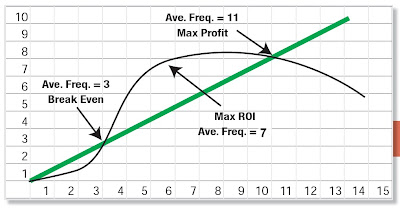
    This doesn’t mean purchase three ads.

    Different people use media differently. It takes a lot more than three ads for the average reader/viewer/listener to be exposed three (or more) times in a seven day period.

  • Most people don’t read every page of the newspaper. If your ad is in the Real Estate section, and they only read the Sports section, they miss it.
  •  

  • No one can watch every television channel. If your ad is on the ABC six o’clock news, the person watching the M*A*S*H re-runs on Lifetime won’t see your ad.
  •  

  • People see outdoor ads (billboards) as they drive at different times to different destinations. Your board at the corner of Main and Second will be missed by everyone who takes the bypass.
  •  

  • And radio? Most people listen in their cars, while they drive at those different times to different destinations. Your 7:20 ad will not be heard by people who don’t get in their cars until 7:30.
  • Any message in any medium?

    Mass media exists to communicate with large groups of people at one time. Though all media are capable of carrying any message, each excels in a different area.

    And at each stage of pain one medium becomes more efficient and cost effective.

    Your message position suggests the best medium to deliver that message. What follows is a guideline. Always do the math and keep track of the return on your investment.

    Stage 1 Media:

    Television, radio, newspapers, and outdoor signs are, by their nature, the most expensive media, and thus require more staying power. Use them when you have the potential to convert huge numbers of the public into customers.

    Television – If your message requires a demonstration, there is no better medium. Your production quality (film vs video tape, actors, lighting, etc) will be compared to national advertisers who frequently spend as much as a third of a million dollars on the production of their ads.

    Newspaper – Sometimes your message requires written detail, illustrations, photographs, maps, or lists of prices. Newspaper is an excellent medium for Transactional appeals, but it can also be a great way to build image. If your weekly ad looks like editorial content, such as a regular column, your reputation as an expert will grow each week.

    Radio – Reach shoppers emotionally through radio’s theater of the mind. Don’t be concerned about getting a deep voiced announcer. Sincerity, that is, perceived sincerity, is much more important than vocal quality.

    Outdoor – The most effective use of a billboard is for directions, like a huge “Turn Here.” Outdoor signs also make an excellent reminder medium for additional frequency.

    Stage 2 Media:

    At Pain Stage 2 your prospective customer will begin to notice signs, brochures, and topics of conversation that formerly had her eyes glazing over.

    Signage – Illuminated signs attract more attention. Simpler type fonts and very large letters are easier to read and understand when people are driving. Use attention-getting colors if they reflect well on your image.

    Newsletters – Frequency, great imaging, the ability to position you as an expert, and the ability to let potential customers get to know you and your staff as people, all make newsletters a powerful tool. Don’t do fewer than four, or more than twelve issues per year.

    Brochures – Create a separate brochure addressing one single pain for each product or service you offer. Don’t limit placement of those brochures to your lobby or showroom. How many other local businesses have customers who could benefit from what you sell? Work out a deal to leave your brochures in their lobbies and showrooms.

    Specialty Advertising – Refrigerator magnets, calendars with your name (and picture), paperweights, or pens will be useless without three important ingredients:

    1. Invest in something people will want to keep on their refrigerators, their desks, their dashboards.

    2. Include your message, as well as your name. It’s not enough to “get your name out there.”

    3. Don’t be clichéd. (Bent pens for chiropractors were novel fifty years ago. Today they are just sad.)

    Public Speaking – Put together a 17-20 minute talk about the problems your company solves. Local service clubs need 40 to 50 speakers per year for their weekly meetings. The business owner who shakes more hands will grow his company bigger, faster.

    Stage 3 Media:

    Stage 3 is the most profitable message position for most small businesses. Potential customers have considered several options, but haven’t purchased a solution yet. Your message may involve comparisons between your company and alternatives. These presentations do well in writing, but be sure to include illustrations, charts, or photos that reinforce your message.

    Direct Mail – Highly targeted, geographically limited, and response easily tracked, direct mail is the Stage 3 medium of choice. Like other media, direct mail needs frequency in order to maximize return. Most business owners try one mailing and give up. It’s not uncommon for the second mailing to the same group to get a better response than the first.

    E-Mail – Unless you have been invited to send e-mail messages to prospective patients, it’s probably best to avoid it. The spam image will be hard to overcome. But get people to opt-in to your mailing list, and you can eliminate printing and postage costs. E-mail is a great delivery system for your newsletter.

    Web Pages – Another electronic medium with minimal expense is your website, which has the ability to dedicate complete pages to specific offerings.

    Stage 4 Media:

    Within hours of experiencing the final trigger, people at Stage 4 will become someone’s customer. When they don’t have experience with anyone in your business category, people turn to the Yellow Pages and local Internet searches.

    Yellow Pages – Don’t waste your ad space by using your name as a headline or by talking about the number of years you’ve been in business. Your message needs to scream, “Stop hurting, NOW.” Done correctly, your ad itself may become the final trigger to call.

    Local Internet Search – Include the names of the communities you serve in the text on your Internet pages, so when someone Googles “Ft. Worth car stereo,” “Fargo men’s shoes,” or “Bakersfield appliance repair,” (whatever your city and business) your page will be part of the search results.

    Note too, that branding (or awareness) campaigns tend to work better in early stage media. Later stage media excel at delivering direct response campaigns.

    Community variables:

    In larger cities, direct mail delivered to a very small neighborhood may be the most cost effective choice for advertising your business. In smaller towns, the better choices may be radio, television, or newspapers.
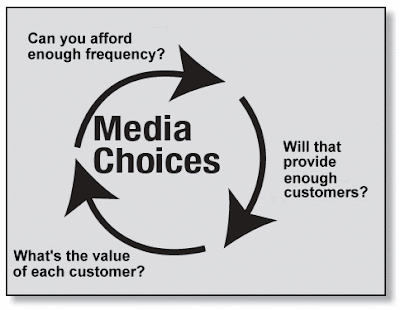

    How much profit are you willing to give up to re-fuel the engine and pay for more advertising? It always comes down to ROI. When you’re considering a medium in which to advertise your business, ask yourself:

    1. Will your choice of medium deliver a “3” average frequency at a price you can afford?

    2. Will that advertising schedule provide your business with enough new customers to justify the advertising?

    3. What’s the value of each new customer? How much of that sum is profit for your business?

    If this produces a positive ROI, do more of it.

    If not, try another medium or a different media outlet.

    Keep improving your results by keeping detailed records of what you did, when you did it, and the outcome.

    Track the revenue per customer provided by each source. Some techniques bring customers with greater value than other techniques and other customers.

    In most cases, your first set of calculations will have to be done after the fact, but should definitely be done before you invest in another schedule.

    Also, remember that the size of your community and the number of competitors advertising their companies will affect the time it takes for any marketing to work.

    In conclusion:

    As a marketing consultant I’ve seen campaign after campaign after campaign fail from lack of direction and focus.

    I created Marketing P.A.I.N. to help small businesses achieve the highest and best use of their marketing dollars. Drop me a note when you’re ready to apply it to your own advertising.

    It’s my sincere wish that you see solid growth in your marketing ROI.


    Marketing P.A.I.N. Series


    Part 1, Relationships
    Part 2, What Do People Want?
    Part 3, Advertising the First Stage of Pain
    Part 4, When People Realize They’re Hurting
    Part 5, Testimonials and Comparisons
    Part 6, Make It Stop!
    Part 7, Tie It All Together


    Part 8, Message Frequency, Media Choices, and Tracking


    Chuck McKay is a marketing consultant who helps customers discover you, and choose your business. Questions about choosing the appropriate medium to carry your advertising message may be directed to ChuckMcKay@ChuckMcKayOnLine.com.