What my new acquaintance actually said was, “I know it takes money to make money, but promoting my business doesn’t feel like investing, and I can’t afford too many more bad rolls of the dice.”
The implied question was, “What should I spend on marketing?”
What Does it Cost to Acquire a Customer?
The concept is simple, but the answer isn’t, mainly because it costs less to attract shoppers who are physically close to your business than those farther away.
The easiest way to explain this may be with jam, and toast.
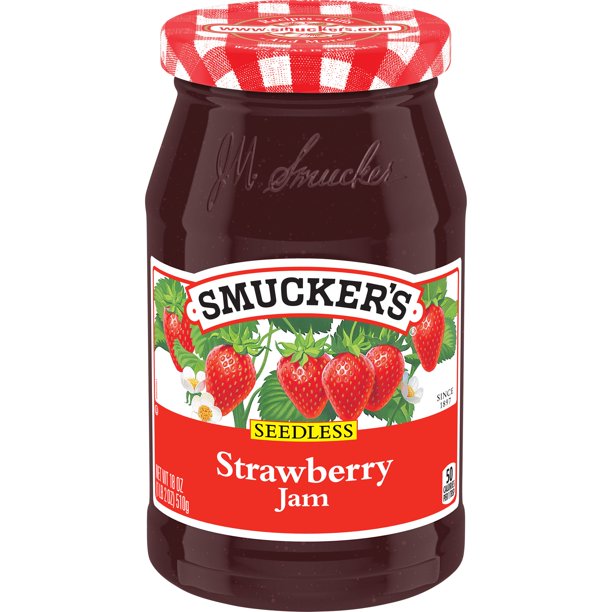
Pretend Your Marketing Budget is One Tablespoon of Strawberry Jam
Spread over half a slice it covers the bread with a thick, generous coating of strawberry goodness that’s evident with every bite.
On Two Slices of Toast it Starts Getting Thin
And if you wanted to spread our delicious strawberry jam over seven and a half slices of toast, well, the result will be disappointing every time.
There’s just not enough jam for a satisfying coverage of that much toast.
Strawberry Jam in the Real World
Whether you’re an esthetician, an attorney, or run a smoke shop; whether you weave custom rugs, or fit custom toupees, the concept works exactly the same way as jam on toast.
Today, let’s consider an HVAC (heating and air) contractor in Rancho Cucamonga, California.
Half a slice of toast in this case would equal all of the homes within half a mile of the shop – 2,132 households.
One slice (one mile) includes 5,002 homes.
At a two mile radius from the shop that number of households jumps to 20,268.
At five miles the number of households has grown to 74,804.
And within a 7.5 mile radius the household total has reached 146,585.
How Do We Reach All Those Homes?
We’re going to rely on one of the oldest forms of traditional media: direct mail. We’ll send a postcard to all of the homes around our shop promising heat when it’s cold, cool when it’s hot, and lightning fast emergency service.
What’s Our Budget?
For illustration, let’s say our tablespoon of jam would let us deliver postcards to 150,000 homes.
Hey, that’s great news! Everyone gets a postcard…
…But No One Gets a Real Taste
One tablespoon of jam spread across seven and a half slices of toast doesn’t provide any flavor. Worse yet, the jam arrived before the bread finished toasting.
You see, most homeowners don’t think about hiring a heating and air contractor when their system is working. They don’t even think about heating or air until their system breaks down and, with a loud kerchunk, the toast pops up.
If we send our mailing out in April we have to hope it arrives just as someone’s heating or air conditioning system fails. We also have to hope they become very uncomfortable very quickly. Because if they don’t have any issues until July they’ll never remember we offered jam when there was no toast.
That tiny morsel of April sweetness was effectively gone before anyone bit into it.
The Solution? Less Toast
5,002 postcards, one sent to every home within a mile of our business, will leave enough budget to print and send 144,998 more cards.
What do we do with them? Simple. We send them to the same 5,002 homes a couple of weeks later.
And again ten days or so after that.
In fact, our budget will permit us to reach those homes 30 times over the next 12 months.
Why only 5,002 Homes?
Those other households are simply too far away for cost-effective reach.
We could try to reach 146,585 households once each. Mathematically, in a single contact, we’re likely to convince them only 3 percent of the way to picking up the phone and calling for help.
But with 30 ongoing reminders we could instead reach 5,002 homes 100 percent of the way to becoming customers. (And when I show you how to get the Postal Service to deliver those cards for as little as 18 cents each? Oh, my. Life does get sweet!)
When you understand how to send your marketing dollars out into the world, and have them bring several friends when they come back home, you get to decide your own growth rate.
How high do you want your company to fly? How fast do you choose to get there?
Assume the Variables
It will become obvious that building a brand that customers think of when they need what you sell requires a different strategy than asking for that sale right now.
You need to budget differently to build that brand, too. And regardless of which strategy you choose, you’ll need to “right size” your company’s marketing budget so that every dollar contributes to maximum impact.
Can you afford anything less when you’re fishing for customers?
Your Guide, Chuck McKay
Your Fishing for Customers guide, Chuck McKay, gets people to buy more of what you sell.
Wondering how often to make an offer to a potential customer? Drop Chuck a note at ChuckMcKay@ChuckMcKayOnLine.com. Or call him at 307-207-0028.
Chuck Blore once told of a study he did for CBS. Beer drinkers were surveyed as they entered his testing facility. They each proclaimed a preference, as well as an explanation of why they they had chosen that particular brand of beer.
The participants were then given tasting cups, and were told to help themselves to any of the 20 beers available for comparison tasting.
As they finished and were leaving the testing facility, the participants, all 104 of them, were again surveyed as to their preferences.
Interestingly, not a single participant had changed his or her mind. Each had found validation in the actual testing that the beer he or she had preferred on the way in was indeed more robust, or smoother, or lighter.
Blore never told them that the beers in each bottle had been replaced. Each sample was now exactly the same brew.
His conclusion: Advertising makes beer taste better.
What Would You Take For A Headache?
If you were suffering from a headache would you be more likely to take Midol Menstrual Formula® or Excedrin Tension Headache®? If you were suffering from menstrual cramping which would you be more likely to take to relieve your symptoms?
They each have the same active ingredients: acetaminophen and caffeine.* One could get the same relief by chasing a Tylenol with a cup of coffee.
My conclusion: Effective advertising makes pain manageable.
But notice something else at work, here. By limiting themselves to headache relief, or to menstrual pain relief, aren’t the makers of Excedrin™ and Midol™ (McNeil Consumer & Specialty Pharmaceuticals and Bayer Corporation, respectively) limiting the number of sales they could make to people with backaches, toothaches, or sore muscles?
Absolutely they are.
They will probably make no sales to those people. And it doesn’t matter.
Name three other products marketed for the relief of menstrual pain. Go ahead, I’ll wait.
I’m waiting.
OK. Were you able to name three? Two? Most of us named only one.
Why Specialization is Valuable
Now, which would you rather be, one of a dozen products for general pain relief, or the one product that comes to mind when a customer is suffering a particular ailment? If you are looking for a product for general pain relief, learn this here now.
By specializing and becoming the solution to a specific problem, you automatically become the most likely choice of consumers who are experiencing that particular discomfort.
When customers ask for you by name, you’ve succeeded at genuine branding. The lack of branding is the single biggest reason most business advertising isn’t as effective as it should be.
Your first step getting them to ask for you by name is to help shoppers figure out what they get from you that they can’t get from anyone else.
What is it? You sell the same products. You deliver the same services. What differentiates your business from those of your competitors? Why should anyone think of you as the solution to their problem?
Well, why should they?
The perfect solution is also the perfect bait when you’re fishing for customers.
Your Guide, Chuck McKay
Your Fishing for Customers guide, Chuck McKay, gets people to buy more of what you sell.
Wondering how to articulate your value to a potential customer? Drop Chuck a note at ChuckMcKay@ChuckMcKayOnLine.com. Or call him at 307-207-0028.
* The active ingredients are acetaminophen and caffeine. Midol Menstrual Formula® also includes 15 mg of Pyrilamine maleate, a diuretic to relieve water-weight gain.
A couple of decades ago I introduced a friend who sold pianos to the manager of a local radio station. The manager suggested that the piano salesman consider radio advertising sales. The salesman refused.
“Sometimes advertising works,” he said, “and many more times it doesn’t. The worst part is you can never predict which is going to happen. I couldn’t in good conscience sell something that I don’t believe will work.”
Ouch.
Is advertising more of a gamble than a science?
If advertising is an investment, you should expect to see a predictable profit from that investment. Invest a dollar in advertising, get back four, or five, or six. At the very least, shouldn’t you get back a dollar ten?
But if you you don’t know whether your ads are driving revenue, you can’t very well call it investing. If you don’t know whether you’ll win, or lose, or break even, you are gambling.
And if you put your money into ads that you “feel” are working, but but can’t measure their effect, you’re still gambling.
Noted investor Peter Lynch once said, “An investment is simply a gamble in which you’ve managed to tilt the odds in your favor.”
So, maybe effective advertising is that which has been tilted in your favor. Not so much an answer, as a process, which includes better targeting, more effective messaging, and improved media selection.
The purpose of an ad budget?
The reality is that most of us fear that we aren’t turning our marketing dollars into profit. Not consistently. Not directly. Which is why we have advertising budgets. To limit risk.
An ad budget serves the same purpose as going to the casino with a hundred dollars in your pocket and saying “When this hundred is gone I’m done playing. Maybe I’ll get lucky. But I’ve got to set a limit on how much I can afford to lose.”
Think about it. If you knew you were going to get back more than you spent, why would you ever stop spending?
Perhaps You Need a Lever.
The Greek mathematician, Archimedes, understood leverage. He’s reported to have said, “Give me a long enough lever and a place to stand, and I will move the earth.”
When applied to advertising, leverage means doing more with less. Getting more bang for your buck. Controlling large sums of revenue with relatively small sums invested in advertising. Stacking the odds in your favor.
But, if you were capable of stacking those odds, wouldn’t you also be running more advertising?
A surprising number of companies try to avoid advertising, then force themselves run ads when sales are down or when they have excess inventory.
Unfortunately, they’re open for business all of those other days, too. And they need customers to come buy what they sell on every one of them.
That constant need for additional sales makes advertising the most important thing any of us can do for our own business. What other activity can multiply raw dollars with this kind of leverage?
First, measure.
Do you know your rate of return?
Note your sales levels. Run your campaign. Note any change in your sales levels.
Divide increase by the amount spent. This is Return On Advertising Investment (ROAI). If you are bringing in more money than you are spending, your ROAI is positive. Congratulations.
Of course if your advertising is not effective, the negative ROAI produces a constant drain on your resources. Is this why you don’t advertise often? Do you justify the resulting poor return as “getting your name out there?”
How effective is your lever?
Is your advertising an investment or a gamble?
The primary question you must ask is the rate of your ROAI. This is the most important question when you’re fishing for customers.
Your Guide,
Chuck McKay
Your Fishing for Customers guide, Chuck McKay, gets people to buy more of what you sell.
Have you calculated the rate of your Return On Advertising Investment? How good is it? Are there simple changes that could improve your ROAI? Start a conversation with Chuck by email at ChuckMcKay@ChuckMcKayOnLine.com. Or call him at 317-207-0028.
While browsing the web, I came across an article titled, “Why is My Restaurant Not Full Every Monday Night?” (Google search if you’re all that curious. The article doesn’t answer the question, which is why I’m not linking it).
But it does pose a valid question. Why isn’t your restaurant full on Mondays?
Its a common desire in retail to advertise the things which aren’t selling, and let those which will sell easily sell themselves. This is frequently bad strategy. Very bad.
It may well be part of the reason Wal-Mart thrived while K-Mart worked its way through bankruptcy. Of course, their respective advertising policies may only be a reflection of their inventory management. Then again, this all may be only a coincidence.
And for the record, our story is completely fictitious.
Assume that we have one Wal-Mart store and one K-Mart store, each stocked with various sizes of golf shirts in four colors: red, blue, green, and yellow. We’ll further assume that each store stocks ten in each color.
For some reason, the yellow shirts are in hot demand.
Each store sells out of yellow golf shirts.
K-Mart, in the traditional Henry Ford fashion * notes that they still have 30 shirts in stock. No problem.
Wal-Mart however, takes note that they are completely out of yellow golf shirts, and promptly puts ten more in inventory.
Humm. People will buy what they want, when its available to them. The won’t necessarily buy what’s being advertised. So, while K-Mart is advertising golf shirts in various colors, Wal-Mart advertises that they have yellow golf shirts, and they have them in stock. (Again, this story is of my own invention. It has only a passing relationship to any reality).
Can advertising sell them things they don’t want?
The bitter experience of K-Mart would indicate that people will purchase only what appeals to them, rather than what’s being advertised.
But our question wasn’t about golf shirts, was it? The question was “Why is My Restaurant Not Full Every Monday Night?”
The reason is simple.
Its not lack of advertising. (Rookie media salespeople will assure you that it is. They are wrong. It has nothing to do with advertising.)
It is because people customarily don’t go out to dinner on Monday evening.
They just don’t want to.
They tend to go out to dinner on Friday nites, on Saturday, even on Sunday. By the time Monday rolls around, they’re feeling as if they should stop being so extravagant.
On Mondays they plan to eat at home.
Is there a Monday appeal?
Is there a way to attract a relational customer to your restaurant on a Monday? Sadly, if Monday isn’t Valentine’s Day, Mother’s Day, or a spouse’s birthday, there is not. You could maybe get a transactional customer into your restaurant on a Monday if you offered a discount, but transactional customers tend to stay home on Mondays too.
OK, make it a BIG discount. That will insure two things:
1. bad turnout, and
2. no profit from those rare few who do show up.
Humm. Advertising a restaurant is very much like duck hunting. You shoot when there are ducks to shoot at.
So what can you do about those Monday nights in your restaurant?
You can cut back on your staffing on Monday and hold your costs to a minimum. Then advertise your great Friday night specials, or your Saturday dinners, or even your Sunday brunch.
Wait for them to be inclined to dine away from home, then remind them to pick you. Cater to what your customers want – and do so on their timetable, and you’ll start boosting attendance as you fish for customers.
Your Guide, Chuck McKay
Your Fishing for Customers guide, Chuck McKay, gets people to buy more of what you sell.
Got questions about allocating and scheduling your advertising dollars? Drop Chuck a note at ChuckMcKay@ChuckMcKayOnLine.com. Or call him at 317-207-0028.
* Henry Ford is rumored to have said about the available colors of his Model T automobile, “You can have any color you want, as long as that color is black.”
Just as a river flows downhill from higher terrain, shoppers always flow from the smaller community to the larger.
Advertising in the bigger community to draw customers to your smaller community is as futile as trying to make the water in a river defy gravity.
Tom’s Letter
I was reminded of the effects of swimming against the current when I received this letter:
“I’ve owned a boat dealership for over 30 years. We are located 1.5 – 2.5 hours northwest of Chicago in an area of lakes where our best customers own a second home. How do I use radio to reach these people?
A. They are primarily up here only on week-ends in the summer.
B. They live full-time in the greater Chicagoland area where radio advertising is too expensive for us.
C. We have local radio stations, but our customers can still tune in their favorite Chicago area stations.
Over the past few years, I’ve run a Reed’s Marine radio commercial three times a day, seven days a week from April thru August. I’ve used the two biggest stations in our county, so we are permeating our area. My hope was that I might be heard by my best prospects on a rare occasion, but I was primarily targeting all the people in my county who would eventually mention us when they come in contact with the tourist coming from Chicago on the week-ends.
Do you think “second-hand” radio advertising can have an actual effect … sort of like second-hand cigarette smoke?”
Yes, it can have an amazing effect. Another name for it is “word of mouth.” It’s also known as your professional reputation, the sum of the experiences customers have had with you. An individual customer’s personal experience determines whether that individual customer will be a good source of word of mouth.
Exceptional experiences turn shoppers into Customer Evangelists. These are people who can’t wait to rave to the world about your exceptional business. (Of course, give them a bad experience and they could just as easily become vigilante customers – also eager to tell the world about your business).
So whether you call it word of mouth or professional reputation, those personal experiences drive repeat business, referral business, and collectively drive first-time business. Yes, “second-hand radio advertising,” works. It’s also one of the requirements of business success.
But Tom actually asked two questions, didn’t he? The second, the unstated question, wasn’t about professional reputations, or customer experiences, or referral business.
Tom Wonders if He Can Make Customers Flow Uphill
He wants to know if his situation is different enough to justify advertising in Chicago.
It’s not.
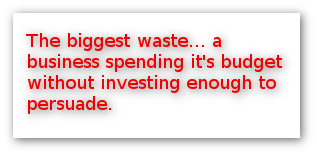
The biggest waste of money in advertising happens when a business spends it’s budget, but didn’t invest enough to persuade anyone. Compare it to buying a ticket three-quarters of the way to Europe. You spent your money, but still didn’t arrive.
The first problem is the sheer size of the Chicago market. The number of people in Chicago who own homes in Delavan is going to be a tiny fraction of a tiny fraction of a tiny percentage of the population.
In order to reach that minuscule segment of the market, you’re forced to also address the rest of the Chicago audience. And Tom, you can’t afford enough repetition of your ad on Chicago radio stations to effectively persuade anyone.** Like the salmon using all of it’s physical resources swimming against the current, you’re going to expend your financial resources fighting the inclination of all of those radio listeners to shop in bigger communities.
There is a practical way, though, to pursue that tiny fraction of Chicago’s population.
Stop Using Mass Media
Start making personal contact with Chicago residents who own homes in Delavan. The good news is it’s easier, and less costly, to make that personal contact once they’ve already arrived.
In most communities you can find the names and addresses of all new homeowners at the courthouse (or wherever the deeds are recorded). These are highly-targeted potential customers. Consider a “Welcome to your new home” letter to those folks, and include a CD ROM of the e-book you offer on your web site: The Five Biggest Mistakes People Make When Buying A Boat. Perhaps you could make that letter a full package of “welcome” gifts. Be sure to keep testing different letters and keeping very careful records of your expenses and conversion rates. Whenever you determine that one works better, dump the old one.
Find locations that tourists frequently patronize… restaurants, gas stations, and local service businesses. Any possibilities for flyers? Display ads in those locations?
Find referral partners. Team up with other local businesses who’s reputations are as good as your own; non-competitors who share your customers. Exchange sales leads. Support one another, publicly and privately. Start with the realtors, motorcycle / ATV dealers, and sporting goods stores.
Consider a “boat out” on a weekday evening. Take some of your best-selling models out on the water and invite local folks (as well as any visitors in the area) to look and ride. Make it a party atmosphere. Tie in a local restaurant or caterer. Get some local artists to show off their work. Find some local musicians to perform. Most of those folks will participate for the publicity. Twist the arm of your Chaparral Boat representative to pick up any out-of-pocket costs.
These personal contact ideas are not replacements for your primary marketing plan, which will include local mass media. Any can be added to a good plan, however.
Reed’s Marine Strategy is Solid
Long term, twenty-one ads per week will be sufficient on most radio stations, provided that you’re targeting relational shoppers.
I’m assuming that your ads are customer focused. You are personally involved in the writing of those ads, aren’t you? Please don’t leave it up to the local radio stations.
We already discussed the power of word of mouth. If your message isn’t worth repeating, it won’t be repeated.
A Few Additional Things to Consider
Maximize your local media impact with heavier schedules early in the season and heavier schedules on weekends throughout the season.
Purchase gift certificates for dinners, concert events, or movies. Offer them to your local radio stations as give-away items. “Be the 9th caller and win a family four-pack of movie tickets, courtesy of Reed’s Marine in Delavan.”
Consider billboards on the main roads into town. In some small communities, especially those with few roads into town, three or four boards can provide as much as a 100 showing.
Your web site is very well done. Crisp, clean, informative, and easy to navigate. I’d suggest that you add the free download of your e-book to the home page as well. (More companies should be following your lead in this area – its an excellent piece.)
Also consider making a link from your home page to the “Reed’s Marine Pledge To You” statement. You can’t go wrong telling customers what’s in it for them. Tell them early and often.
Most advertisers in a smaller communities can afford enough frequency in local newspaper or radio to persuade local shoppers to come do business. You’re already doing the things most businesses should be doing. Stick with your existing strategy, and when tempted to purchase advertising in Chicago, remember what happens to the Salmon. Don’t wear yourself out fighting the current when you’re fishing for customers.
Your Guide,
Chuck McKay
Your Fishing for Customers guide, Chuck McKay, gets people to buy more of what you sell.
Should you be promoting your business in mass media? Or is there a different solution in your local market? Start a conversation with Chuck by email at ChuckMcKay@ChuckMcKayOnLine.com. Or call him at 317-207-0028.
* Please don’t confuse comments about marketers swimming against the current as a condemnation of any contrarian philosophy. Contrarians find opportunities in serving the existing needs of customers which other businesses are ignoring.
** There is one possible exception in which Chicago radio could pay off, but it’s a long shot.
Are there outdoor shows in the Chicago area sponsored by Chicago radio stations? Is the attendance at those shows such that you could justify your involvement?
Many of the stations will tie your involvement in the show to purchases of advertising packages. Your mission is to get the largest number of announcements with the financial investment they require. See if they’ll let you exchange prime time ads for overnight placement to increase frequency, then concentrate those between 4am – 6am, especially Friday and Saturday. Consider sponsoring Friday evening or Saturday traffic reports.
And remember, the primary value of this strategy is to get face-to-face with potential customers at the outdoor show. The radio schedule is the price of your participation.
“Roger’s feet get cold easily, so I bought him a pair of sheepskin slippers. He loved them, but it wasn’t long before the wool lining started wearing off. So I called Lands’ End to see if I could get them replaced under warranty. The lady I talked to was very nice, but she couldn’t find any record of my purchase, and she couldn’t figure out which slippers I was describing. But, she cheerfully told me that she’d be happy to exchange them, and gave me a return authorization. I was pretty excited when I told Roger that Lands’ End had agreed to replace his slippers even though I couldn’t find the sales receipt. He told me that was because I bought those slippers from LL Bean.”
Stephanie tells her story well. People laugh at it. It’s the kind of story that people tell each other daily. It’s the kind of story likely to be repeated by people who don’t know either Stephanie or Roger.
There’s a critical lesson, though, in Stephanie’s story. Did you catch it? No problem. We’ll come back to it in a minute.
Stephanie’s story is an example of Word-of-Mouth.
It’s not, however, an example of Word-of-Mouth “marketing.”
And apologies to WOMMA aside, I’m not convinced that Word-of-Mouth marketing exists.
Why? Because adding the word “marketing” assumes that it’s something the business causes to happen. Word-of-Mouth may be influenced by business, but by it’s very nature it can never be controlled.
Go back to Stephanie’s story for the critical distinction. Is she telling a story about customer service at Lands’ End? No. She’s telling a story about her own experience as a customer. People love to tell stories about themselves.
Exactly how important is your product or your service in the telling of any customer’s story? If the stuff you’re selling fits into her narration, it might be included. But whether it is or not, Word-of-Mouth in any of its forms is always about the experience of the buyer. Only indirectly is the seller even involved.
Which makes Word-of-Mouth “marketing” a misnomer.
Word-of-Mouth is not marketing for several reasons.
Marketing becomes cost effective when there are efficiencies of scale. Word-of-Mouth takes place on a one-to-one basis.
In marketing, a company sends its message directly to prospects. Word-of-Mouth is farther removed from the company with each iteration of the story. People who know the story teller will be influenced. People who know those people may be slightly influenced. At three degrees removed there will be minimal effect, if any. (And yes, I’m fully expecting a few e-mails pointing out “Viral Marketing” as an example to the contrary. Can anyone even predict what goes viral? I thought not).
Finally, people may get your message wrong, and you can’t stop it from happening. In a few more tellings Stephanie’s story could easily mutate into a tale about a lady who had a funny interaction with Sears.
Word-of-Mouth is not marketing. It’s not advertising.
Word-of-Mouth existed long before advertising. When most people lived in smaller communities, walked to the market, talked to their neighbors, and gathered in churches or meeting halls, Word-of-Mouth was simply conversation.
Advertising became important communication when our communities got too big for the people selling stuff to personally know their customers. Mass media carried the message from the manufacturers of goods to the new post-war middle class.
But for the last century, probably due to over exposure, we’ve all become less susceptible to advertising’s claims. Customers now are more likely to believe the opinions of total strangers than the advertising messages of local companies.
Ouch.
Word-of-Mouth is now more critical to business success than at any time since the dawn of mass media. And yet, you can’t make a customer talk about you. You can’t make her not talk about you. You’re going to be mentioned when you’re part of her story. No more. No less.
Change your role in her story.
Although you may view Miss Customer as a purchaser of the things you sell, she sees herself as the protagonist in her own story. When you try to make the story about your company, Miss Customer will dismiss your whole effort as irrelevant.
But if your business is willing to become the secondary character in Miss Customer’s personal narrative, is willing to engage Miss Customer, and indeed to make her story possible, that’s when she’ll take you along for the ride. Your business “character” will be portrayed in much the same way as her interaction with you happened in real life.
Treating her well may be the only influence you have in the creation of positive Word-of-Mouth. Treating her badly ads drama to her story. This not only makes your appearance in her story more likely to be negative, dramatic stories tend to be told more often, and over a longer period of time.
Which leads to what may be the most important question: when she does business with your company, do you treat Miss Customer as the star she is?
Or, in fishing terms, there’s no point in hiding the bait when you’re fishing for customers.
Your Guide, Chuck McKay
Your Fishing for Customers guide, Chuck McKay, gets people to buy more of what you sell.
What’s your customer’s story? Call Chuck at 317-207-0028 to discuss helping her to tell the story well. Or, you can reach him by email at ChuckMcKay@ChuckMcKayOnLine.com.
You’re a lion. It’s dawn on the Serengeti. The hunger pangs of three days without food are becoming impossible to ignore.
Off in the distance is a herd of zebra. You’re down wind. You can smell the herd but they can’t smell you. You crouch closely to the damp earth, stealthily moving through the tall grasses. Your padded feet don’t make a sound.
The zebra slowly mingle in the herd. The stripes of one blend seamlessly into the stripes of the next, creating a vermiculite tapestry of white and black. Your only hope of catching one is to single it out from the rest, but which? How do you focus on any individual when you can’t determine where one begins and the other ends?
Wait. What’s that?
One zebra is grazing apart from the others. You can see it’s nostrils contract with each inhale and expand as each warm breath leaves its body. You watch its tail idly swatting at flies as it slowly steps forward to reach the next succulent blade of grass. You are now focused on the one, rather than being confused by the many.
And the many? They have taken advantage of the safety of the herd.
Our instincts are to hide from predators. Herd animals like zebra, or sheep, or even people protect themselves by looking and acting like every other herd animal. Taking risks gets one noticed. It exposes vulnerabilities. Taking risks is… risky.
And what’s the upside?
Is there an upside?
No banker has ever been fired for refusing to make a loan.
No investment broker was ever fired for buying IBM.
Not taking risks is instinctive.
So we do the things we’ve seen other businesses do.
We recite the same messages, replicate the same images, and deliver them through the same media. We stick with what works. We choose the tried and true and smugly congratulate ourselves on not taking any risks.
What passes for most business strategy is simply a “me too” game of “We do what they do, but you should buy from us instead.”
Unfortunately, “we do what they do” makes your business blend back into the herd. You’ve made the very things that make you the best solution to your customers problems impossible for the lions (uh… the customers) to single out. Brace yourself.
“Me too” as a strategy fails because you’ve hidden your strengths.
Successful marketing of your business requires behavior that’s not only risky, it runs counter to instinct.
Successful marketing requires you to step apart from the herd, and draw attention to yourself.
Successful marketing requires you to shed your stripes.
Or, in fishing terms, there’s no point in hiding the bait when you’re fishing for customers.
Your Guide,
Chuck McKay
Your Fishing for Customers guide, Chuck McKay, gets people to buy more of what you sell.
Ready to discuss calculating your marketing risk? Start a conversation with Chuck by email at ChuckMcKay@ChuckMcKayOnLine.com. Or call him at 317-207-0028.
There’s a gas station at one of the Interstate 20 off ramps in Columbia, South Carolina that is rumored to have the lowest prices in town. If they don’t have the lowest prices, they certainly have convinced a large group of drivers that they do. Most hours of the day they have a constant line of cars at each of the eight pumps.
A casual observer will notice a young man drifting from car to car, speaking with each driver in sequence. The young man you notice on Monday will not be there on Thursday. Another young man will have taken his place.
And should the observer become an eavesdropper, he’ll hear the young man explain that he works for a glass company “up in Greenville,” has his materials with him, and can repair the dings and chips in the driver’s windshield for between forty and sixty-five dollars. He opines that the motorists insurance will cover it, reimbursing the driver so there will be no “out of pocket” expense.
Apparently, enough people accept his offer that it’s profitable for the young man, or one very much like him. They keep coming back.
Occasionally one of the motorists, wanting to “think it over,” will ask the young man du jour for a business card. He never seems to have one on him. Although he can name the company he works for, he can’t remember it’s phone number. No, he doesn’t carry a cell, so he can’t provide that number either.
In any buyer / prospective seller relationship, there are two basic reasons that people choose not to buy, and the young man carrying the battery-powered drill and pocket epoxy illustrates them vividly.
People don’t buy when they don’t feel the need for what you’re selling.
They don’t buy when don’t trust you.
People avoid risk on three levels.
The biggest risk is that they’ll purchase the wrong solution – that they’ll have spent the money and still have the problem.
But, there’s also the risk that the solution they purchase won’t last, and their problem will be back. (The variant on this is buying from a company who won’t warrant the purchase, or even be in business if the purchaser ever needs their support).
And finally, if all of the solutions seem roughly equal, there’s the risk of over paying.
Put yourself in the mindset of someone who’s just become aware of a problem, which could be anything from “ring around the collar” to “my back hurts every morning when I wake up.” Whatever the problem she’s identified, she’s now looking for a solution.
Ring around the collar? One of the oldest formulas in advertising was perfected by major packaged goods companies like Lever Brothers and Proctor and Gamble. The familiar presentation is called slice-of-life, and is presented as if we, the viewers / listeners / readers are peeking in on a conversation between real people.
The formula is basic:
State problem. Agitate problem. Announce solution.
First, our slice of life dialog establishes that “ring around the collar” is an easily noticed condition which will reduce social standing.
The off-camera announcer states the problem: “You’ve got ring around the collar.”
He now agitates the problem: “Those dirty rings. You’ve tried scrubbing. You’ve tried soaking. You’ve tried powders. And nothing works.”
We’re treated to a close-up demonstration of Wisk liquid laundry detergent being poured on the offensive sweat stain. The camera cuts to a close up of the same collar without the stains.
The off-camera announcer proudly announces the solution: “Wisk around the collar gets ring around the collar every time.”
This is a good example of a single-step ad. Its also known as an order generation ad. Its purpose is to get the prospect to recognize her problem, accept the solution, and purchase it. Now.
Does order generation advertising work? Most assuredly, it does. You’ve seen examples of it every day of your life.
The catalog from Sears or Terry’s Village. Every Yellow Pages ad. The “cash for gold” ads on television. The long-running television or magazine ads for Miracle Grow. A significant percentage of the letters in your mailbox from companies you’ve never heard of.
Let’s review those three risks.
Our slice-of-life laundry lady is highly likely to purchase Wisk, now that she’s seen, and accepted, the premise of the ad: “Wisk around the collar gets ring around the collar.”
Is she risking the wrong solution (no pun intended)? She recognizes ring around the collar as her problem, because she sees the sweat stains every time she does laundry. This appears to be an exact solution. Minimal risk.
Is she risking that her solution will be temporary? No. It’s a disposable product. If it doesn’t work as well as she expected, she can simply not replace it when she runs out. Again, no real risk.
Is she risking paying too much?* Probably not. If our shopper purchases the economy size “32 load” bottle of Wisk, she can expect to pay roughly $7.50. If she pays $7.83 will that price increase damage her cleaning budget? Hardly
Without the perception of risk it shouldn’t surprise us that this customer will quickly decide to buy the product.
Single-step ads tend to work best for simple, non-technical, and inexpensive products. The simpler the proposal, the easier it is to explain in a small ad. This is the principle which makes classified advertising work.
But what if the product or service needs more explanation than will fit into a small space ad, or half a minute on TV or radio? In general, the more complex the product, the more technical the nature of the product, the higher the price, the less likely a single-step ad will convert people from prospects to customers.
Back to the lady with the backache.
She wakes up, and groans while getting out of bed. By her second cup of coffee she’s moving freely and has forgotten about the stiffness.
But one day she realizes that this “back hurts first thing in the morning” business has gone on for weeks. In her mind (which is where it counts), that realization moves her backache to the status of a problem. Problems need resolution.
She begins to pay attention to what web marketers call “keywords.” Keywords aren’t limited to the Internet. Regardless of medium, they are one or two word phrases that trigger her reticular activation system and reach her conscious brain. In her case, the words will be “backache,” and “morning backache.”
Now that her subconscious is aware that they are important she begins to notice the advertising messages which surround her. As her eye skims the newspaper the keywords seem to leap off the page. She’ll be riveted to certain radio ads. She’ll stop talking during television advertising in which the keywords resonate in her conscious mind.
“Morning backache is a sign of a too soft mattress. See how good you feel after 30 nights on a Simmons Beauty Rest.”
“Morning backache is a sign of poor posture. WalkFit Orthotic Shoe Inserts helped over 90% of the people tested reduce pain levels in their feet, knees, spine and pelvis.”
“Morning backache is a sign of poor spinal alignment. Should that stiff neck or sore back persist, call your Doctor of Chiropractic.”
“Morning backache can be treated with Doan’s Backache Pills. They relieve the aches and pains and that helpless feeling of stiffness, so that the system can be restored to full health.”
“Morning backache is a sign that the vital magnetic energy from the earth’s natural magnetic field has been interrupted. Magnetic insoles provide penetrating magnetic therapy for the entire body while soft massage nodes stimulate reflexology points.”
Multiple products promise to relieve her discomfort. Multiple disciplines claim to treat her condition. With the limited knowledge she possesses as an entry level shopper, she could easily choose the wrong solution, or one that doesn’t last. Without knowing which solution is appropriate she could easily overpay. She’s swimming in risk.
Sellers would love for her to buy from a single-step ad.
From the seller’s perspective a single-step order generation ad is a quick sale. It doesn’t require any follow up. Done well, salespeople may not even be necessary. The process seems so simple, so straightforward, so easy. “Here’s my offer. Come buy it.” There is no intent for these ads to build image or “brand” the advertiser. Their only purpose is to get the sale. Miss Prospect will buy, or not. No second chance.
But Miss Prospect may not be ready to buy when you want to sell. She may not need it today. Even if you do, she doesn’t know you. She doesn’t know your product. From her perspective she’s surrounded by risk. Did I mention that she doesn’t know you?
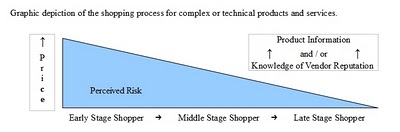
Amount of Risk at Each Stage of Shopping.
She needs information about how you can solve her problem. She needs information about your professional reputation. She requires more information than can fit into a small newspaper or magazine ad; more than will fit into a radio or television ad.
When she’s in the early stages of seeking a solution for her problem, Miss Prospect will want to see a demonstration, read a specification sheet, see an estimate, meet for a consultation, or expect a presentation before she buys.
See the problem? One-step ads work best when the offer is simple, and inexpensive. They work when the prospect is a late stage shopper, and is very close to making a purchase. But when Miss Prospect is an entry stage shopper, is bewildered by the sheer number of choices, and feels overwhelmed by risk, they tend not to work at all. Mr. Advertiser schedules his single-step offer to run in the noon newscast, and at 12:15 is standing at the door wondering where all of the buyers are.
If we’re selling mattresses, orthotic shoe inserts, chiropractic services, analgesic pills, or magnetic therapy – if we’re selling anything which takes a more detailed explanation than “this detergent gets the dirt out” – we’ll do better breaking the sales process into two or more parts.
Instead of asking Miss Prospect to commit to the purchase, we ask that she only commit to the risk-free next step in our selling process.
What’s the risk-free first step?
Example 1:
How do Proctor and Gamble minimize the customer’s $7.50 risk for any of their new detergents? They offer a free sample of the product. Enough for two or three uses. Miss Prospect tries the soap, likes the way it cleans, really likes the new fragrance, and adds the product to her next shopping list.
Summary: the manufacturer invests roughly 57₵ to acquire a new customer of their consumable product. Its likely that she’ll spend roughly $90 per year re-purchasing it.
Example 2:
“If we pre-qualify you and your claim is denied, the Scooter Store will GIVE you your new power chair or scooter, FREE.”
Summary: by offering a “pre-qualification,” the advertiser gets the complete personal information on an active prospect.
Example 3:
“Well I married my dream girl, I married my dream girl, but she didn’t tell me her credit was bad…” This delightful ad for Free Credit Report dot com offers a three bureau credit report, at no cost to the caller. There are two reasons this one is worthy of note. First, it uses network television (with only :30 seconds to tell a story) to drive traffic to a web site where there’s no limit to the amount of information which can be presented to the prospect.
But, pay close attention to both the tiny screen writing and the subdued voice over, each of which say, “Offer applies with enrollment in Triple Advantage.” Did you catch it? The entire 30 seconds pushes the free credit report which people get by enrolling in a monthly credit monitoring service for $14.95 per month.
Summary: for the price of a single credit report (no incremental cost to the advertiser), and by focusing ONLY on the premium – the free report – they get a subscriber who will pay nearly $180 per year.
Imagine trying to convince people to sign up for a monthly credit monitoring service in a :30 second single-step TV ad. “Call now. Protect yourself from identity theft for only $14.95 a month. Operators are standing by…..” But asking them to identify themselves by requesting their own credit report? How elegantly simple.
They call it two-step marketing, but…
It may be the second, third, or forth step which closes the sale after the first step provides the “lead.”
Or it may be a series of progressively larger sales. Roy H. Williams says the subscribers to his free newsletter may become familiar enough with his writing to purchase a $12.95 book. Some of the book buyers may purchase a $49.00 video, or a $495 training program, or a $3,000 three-day seminar. Some of those purchasers will become consulting clients. Roy calls this his “gravity well.”
Whether you call the two-step process a prospect funnel, a gravity well, or lead generation, there are a few things you can do to maximize its effectiveness.
Not everyone you meet will be a qualified prospect for what you sell. And remember that qualified prospects still won’t buy if they don’t believe they need what you’re selling, or if they don’t trust you.
Two-step marketing allows you to persuade your prospects that what you sell is the exact solution they’re seeking. More importantly, it allows them to experience your trustworthiness. And both are critical to the reduction of perceived risk among your prospects.
And risk makes the bait less attractive when you’re fishing for customers.
Your Guide, Chuck McKay
Your Fishing for Customers guide, Chuck McKay, gets people to buy more of what you sell.
Questions about focusing your messages on specific stages of shopping may be directed to ChuckMcKay@FishingforCustomers.com. Or call Chuck at 317-207-0028.
___________
*Doesn’t it strike anyone else as odd that so many business people skip by the two more critical perceived risks, and immediately cut price to stimulate sales?
___________
“Everyone needs our product,” said Bob. “All we need to do is to tell them about it.”
Bob’s enthusiasm is contagious. He’s convinced that America’s tap water isn’t safe to drink because of the presence of pollutants. The water filter he sells removes minerals, microorganisms, toxic metals, and organic chemicals.
If sales is truly a transfer of confidence from the seller to the buyer, Bob is going to sell a lot of water filters. Assuming, of course, he can get his message to enough people.
He thinks advertising problems in the water supply is an excellent way to attract potential customers to his business.
He’s wrong.
Bob has two problems. Each will affect his marketing strategy. Can you identify them?
First, he offers a solution to people who don’t recognize that they have a problem. They will naturally be skeptical.
Second, as small as his industry is, he has competitors. That means if he chooses to educate potential customers about the need for water filtration, they may well buy filters from some other company.
Bob is not alone with this “Teach them why they need it” vs “Ask them to choose mine” dilemma.
A manufacturer can’t sell his brand of coffee to people who don’t drink coffee. First, those people must choose coffee as their beverage. Only then can the manufacturer persuade them to choose his brand instead of another.
The provider of high-speed Internet can’t sell connections to households without computers. First, the family must choose to purchase a computer. Secondly they must elect to be connected to the Internet. Only then can the provider convince that family to select his service over that of a competitor.
And Bob can’t sell his brand of water filters to consumers who find the quality of their tap water to be quite acceptable.
Why Shouldn’t Bob’s ads explain and educate?
Because even the most effective marketing message can only advance the decision making process by a single step at a time, and there are too many steps between “Have you ever wondered what’s in your drinking water?” and “Will you buy my filter today?”
Convincing people they have a problem is tough enough. Persuasion becomes even more difficult when they know you benefit from the sale.
“You have a problem that you’re not aware of. Really, you do. And I’m here to help. Just buy my product…”
Selling to an existing need may eliminate the credibility issue, but it doesn’t eliminate those additional steps.
Consider the local automobile dealer who no longer needs to convince people cars are superior to horses or bicycles. He still has three decisions standing between each prospect and each sale.
First, the prospect must decide she needs a car.
Then she needs to select a brand.
Finally she has to choose a dealership.
Advertising can advance the process by only a single decision at a time. Which of those choices should the dealer’s advertising try to influence?
Sometimes competitors join forces to inform.
Cooperation can be a smart move when increasing the size of the market benefits all of those who serve that market, even those who compete directly with each other.
The Cattlemen’s Beef Board pools the individual members marketing dollars in the “Beef. It’s what’s for dinner” campaign.
The Las Vegas Convention and Visitor’s Authority promotes all hospitality providers in the city with their promise of “What happens in Vegas stays in Vegas.”
The Florida Citrus Commission helps to create demand for all Florida growers with, “Florida orange juice. Healthy, pure and simple.”
You may see this cooperation on a local level when the county veterinary association pools dollars to encourage pet vaccinations, or a group of chiropractors each contribute to an educational campaign explaining the benefits of chiropractic treatment.
Short term, with enough concentrated advertising, programs such as this can create a bump in the sales curve. Unfortunately, most co-operative advertising programs don’t have the resources long term to significantly grow the number of buyers.
Which is the smarter strategy?
Convincing people who don’t already feel the need is hugely expensive. More expensive than most small companies can afford. Educating customers is not a cost effective advertising strategy for most small business.
Instead, consider addressing “pre-educated” potential customers – those people who already understand the issue. They will be searching for solutions. They will consider yours.
The car dealer should concentrate on drivers who are already inclined to buy the brand he represents and invite those people to his dealership.
The Internet service provider should address his ads to people actively seeking connectivity, and explain the advantages of his service.
And Bob needs to stop trying to tell everyone about his product. He needs to find people who share his concern for unfiltered tap water. He needs to target those customers with every advertising dollar he invests, and persuade them to purchase their filters from him.
Bob needs to seek out those folks who are already looking for him, but don’t know it yet. Choosing bait for the fish which are biting is efficient fishing for customers.
__________
Part Two of this series will look at the effect brands have on each other when advertising.
In Part Three we’ll consider a multimedia solution for growing the size of the market (and our individual share of it), as well as an exception to the conclusion you just read.
__________
Your Guide, Chuck McKay
Your Fishing for Customers guide, Chuck McKay, gets people to buy more of what you sell.
Questions about the cost trade-off between educating customers vs targeting those ready to buy may be directed to ChuckMcKay@FishingforCustomers.com. Or call Chuck at 304-208-7654.
Does it make you want to buy a can of John’s Tomato Juice?
A good ad would.
A good ad would catch the attention of someone who wanted tomato juice, and offer compelling reasons to choose John’s brand.
But this ad?
People expect tomato juice to be pure and fresh. The “whole tomatoes” part isn’t an expectation, but it’s not surprising, either. Nope. Not a single reason to choose John’s Tomato Juice.
Without a demonstrable difference people tend to buy the more familiar over the less familiar. Even after they’ve seen advertising for the lesser known brand? Unfortunately, yes.
John’s ad may well encourage a shopper to pick up a can of tomato juice. Odds are, though, it will be a can of Del Monte’s, or Hunt’s, or Campbell’s.
Ouch.
John’s, like all of the rest of us, needs a compelling difference to become the brand of choice. If shoppers believe John’s Tomato Juice is just like all of the other brands, the only reason a shopper would choose a lesser known brand like John’s would be price.
Awareness.
But suppose I point out that tomato quality makes a difference in the taste of the juice. John’s Tomato Juice uses only heirloom tomato varieties, chosen for exceptional flavor. John’s tomatoes are individually selected and hand picked at the peak of ripeness. They are processed within hours to capture their freshness.
I’ve just made you aware of a significant difference offered by John’s Tomato Juice, and provided enough specific detail to make my claim of improved taste believable.
Ideally awareness (and in this case curiosity) might prompt you to sample John’s. If you like the taste, John’s could become your preferred juice. And if large numbers of customers sample and prefer John’s, that will lead to increased demand, increased market share, and through economies of scale, greater profits.
This process always starts with awareness, which happens in one of two ways: though large amounts of advertising, or more spontaneously because the product (service) is noticeably different.
Cognitive Overload.
Thinking is hard. Remembering, not so much. And once a preference is established in the mind of a consumer, that decision won’t be revisited.
Unless, of course, that consumer is presented with a compelling new reason to reconsider.
Have you ever talked to a homeowner who has decided she needs a new home? Listen carefully to her descriptions. She may only vaguely be able to describe what she wants in her new home, but she will explain the shortcomings of her current house in great detail. Her dissatisfaction will nearly always be a predictor of her purchase behavior.
You could build an ad around her specific irritations. Other disgruntled homeowners would immediately identify and pay attention.
Unfortunately, too many companies don’t bother to research their customers. When it comes time to make something happen their inclination is to cut price. Long term this is seldom a valid strategy.
Why? Because there can only be one lowest-price producer in each market, and chances are its not you. That lowest-price strategy is nearly impossible to sustain, and there’s no particular advantage in becoming second-lowest.
Distinguish.
Advertising becomes more effective when there’s a difference upon which to build the ads. But difference for its own sake is only weird, and weirdness doesn’t sell.
To persuade a customer to buy, the difference must be meaningful to her.
As noted in How Do You Educate A Customer?, most businesses don’t have enough time or money to convince non-users to enter the market.
Most can, however, convert customers who’ve already been persuaded by the market leader to enter the category.
Stealing someone else’s customers is the most efficient use of your advertising dollars.
Therefore, the only advertising strategy that makes sense for most businesses is to influence your competitor’s customer to switch brands. For highest return on your advertising investment, do this close to the time of purchase.
Effective advertising solves a problem.
What’s the one clear and overriding reason that will get your business noticed, provide new information, and persuade some other company’s formerly satisfied customers to try your brand?
Here’s a hint: most opportunities will not be the direct opposite of the market leader’s strategy, but rather in exploiting an opportunity that is either too small or too far removed from the market leader’s primary focus.
McDonalds sells fast, fresh, and fun. Subway is best-known as the provider of non-fried low-fat sandwiches.
Wal-Mart is positioned as the lowest price retailer. Target’s more sophisticated image is that of the “hip discounter.”
Goodyear focuses on quality: “The best tires in the world have Goodyear written all over them.” Michelin’s appeal is safety: “Because so much is riding on your tires.”
Michelin didn’t create the desire to keep family members safe. They did, however, recognize and exploit a genuine need already felt by a significant number of customers. A need that Goodyear’s quality/value position can’t fulfill.
Will Michelin ever overtake Goodyear in gross sales? Unlikely. However, among people who’s primary concern is the safety of their families, Michelin is much more likely than Goodyear to be their first choice.
Being the first choice in your own unique category is the basis of developing a solid U.S.P. This makes it tremendously difficult for any competitor to counter your advertising.
The market leader can’t do what you’re doing without abandoning his own highly-profitable position in the market. And when the other smaller competitors try to copy what you’re doing (and they will) their ads will only remind people of you.
In his book, The Ad Contrarian, (great read, by the way), Bob Hoffman says:
“We don’t get them to try our product by convincing them to love our brand. We get them to love our brand by convincing them to try our product.“
Care for a glass of tomato juice? Its John’s. You’ll taste the difference those heirloom tomatoes make.
The more you convince to try the product, the greater the catch when you’re fishing for customers.
Your Guide, Chuck McKay
Chuck McKay
Your Fishing for Customers guide, Chuck McKay, gets people to buy more of what you sell.
 Spread over half a slice it covers the bread with a thick, generous coating of strawberry goodness that’s evident with every bite.
 Your Fishing for Customers guide, Chuck McKay, gets people to buy more of what you sell.



 Your Fishing for Customers guide,