Author: Chuck McKay

  • Is a Radio Remote Broadcast a Good Investment?

    Is a Radio Remote Broadcast a Good Investment?

    Originally published October 4, 2009
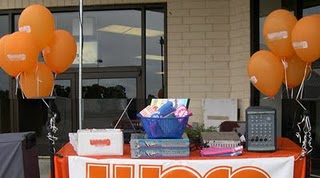
    One of the advantages electronic news has over print is the capability to deliver information in real time “live from the scene.” As you might imagine it didn’t take long for this proficiency to migrate from the news department to the sales department, giving birth to the radio “remote broadcast.”

    Remotes are traditionally expensive. But as advertising sales remain weak in this economy, advertisers are being offered discounted rates on almost all advertising, including remote broadcasts. And that prompts a critical question: is a radio remote a good investment of advertising dollars? Like everything else in business, the correct answer is “possibly.” The problem is there are at least four different people involved in the decisions effecting such a broadcast. Most of the time each has a different objective. Those four people are:

    1. the Manager/Owner of the business,
    2. the Radio Sales Person,
    3. the Radio Program Director, and
    4. the Disc Jockey.

    What do each of these people want?

    The Manager/Owner wants buyers.

    His objective is to sell merchandise in such quantity that he can pay for the advertising and still show additional profit for his efforts.

    He believes his store offers value. He believes when large numbers of people hear about his offers, they’ll flock to the store to buy. This is usually expressed as “you get people in the door, and we’ll sell ’em.

    The Radio Sales Person translates this instruction.

    Get them in the door” becomes, in her mind, “your job is to attract a crowd.”

    She will arrange all of the crowd drawing techniques at her disposal. These will include a clearly identified station vehicle in front of the store as an attention-getting device. It will be augmented with banners and sound system.

    She’ll provide tee shirts emblazoned with the station logo and other station paraphernalia to give away to listeners who come to the event.

    She’ll try to arrange to have clowns, balloons, and face-painting to attract kids, free food to attract their parents, and the ever-popular “register to win” entry box. (The prize will, of course, be provided by the customer).

    The Radio Program Director will coordinate.

    After determining there are no conflicts on the proposed broadcast date, the Program Director will assign a Disc Jockey as “talent.”

    The Program Director’s job is to keep listenership high. She hates remotes, considering them to be interruptions to the programming (music), and potentially harmful to ratings. The Program Director will thus limit the number of reports from the scene, limit the length of each report, and do her best to disguise the reports by running instrumental music under the Disc Jockey’s voice.

    The Disc Jockey will be expected to attract a crowd.

    Feeling pressure from the Manager/Owner and Radio Salesperson, the Disc Jockey will attempt to bribe listeners. He’ll repeatedly emphasize “C’mon down. We’re having a great time,” and will list all of the free items they could win just for showing up.

    A few listeners will be impressed by being close to a celebrity. He’ll be tempted to talk to those people who come to him, rather than introducing himself to other potential customers. Part of this, believe it or not, is shyness.

    The results are entirely too predictable.

    In order they will be:

    1. Reacting to the offers made during the broadcast, people will come to the event for the free food, the clowns, the balloons. They will register for the prizes. They will then leave without buying anything.
    2. Frustrated by the lack of sales, the Manager/Owner will accuse the Radio Sales Person of bringing the wrong people to his event.
    3. The Sales Person will explain to the Manager/Owner the benefits of branding and name recognition. She’ll explain the positive effects of today’s high-profile advertising might not be immediate, but will definitely impact future sales.Back in the privacy of the radio station she will find fault with the Disc Jockey who spent too much time socializing with fans and not enough persuading them to buy.
    4. Of the four people involved, the Disc Jockey will take the majority of the heat when the outcome is disappointing. He’s not a seller. He’s an entertainer. And even though he feared it might end this way when he agreed to accept the talent fee, he will bitterly resent being held accountable for lack of sales, which he believes are beyond his control.
    5. Oddly, the Program Director has the best grasp of the situation. After listening to the Sales Person’s criticism, will resolve to discourage future remotes as too much hassle. “Next time sell ’em a schedule of ads” will be her recommendation.By doing her best to hide the event from her own listeners, she’s created a self-fulfilling prediction of failure.

    Unfortunately, the Disc Jockey did attract the wrong people. When listeners hear words like “fun” and “free” instead of compelling reasons to purchase right now, they react accordingly.

    Equally unfortunate is the Sales Person’s claim that future sales will benefit from today’s advertising of an event. Although branding and image building ads do take a while to affect customers, and do frequently work better over time, event advertising is quickly forgotten.

    No immediate sales. No future sales. Conclusion? Most remote broadcasts are a waste of money.

    Which is why, in general, I don’t recommend them.

    However. . .

    When done correctly they are powerful marketing tools that provide opportunity for greater sales. And at some of the prices we’re now seeing, this may be an excellent time to consider adding one, or more, to your marketing plan.

    In our example the four people involved had mutually contradictory objectives. To have a successful event all four must embrace the same purpose: greater sales during the event. That goal must guide every decision effecting the broadcast.

    Here’s how to assure higher remote broadcast ROI.

    Mr. Manager/Owner,

    … take a step back. Recognize that you are more excited about the things you sell than the public will ever be. Expect them to be less excited about your remote broadcast, too.

    Think of it this way: a remote broadcast is not an event. Much like a newscast, it is only coverage of an something newsworthy which is already happening. People want to know the news.

    A strong concept works well if promoted in the newspaper, on television, or through direct mail. It doesn’t require creativity of the medium to make up for lack of customer interest. If your event that exciting, continue planning the remote. If not, abandon the idea. There’s no sin in passing up an inexpensive opportunity which won’t benefit your company.

    OK. You have a strong concept. Good. Don’t use the station as your only source of publicity. We’re not trying to prove this station can draw a crowd. We’re focused on attracting as many buyers as possible. Buy a newspaper ad or two. Keep those ads customer focused.

    The headline should address the primary benefit you’re offering. The body copy should say the things your best salespeople say to customers on your sales floor. Put your logo, as well as that of the station, at the bottom of the ad. If your headline catches people’s attention, and your body copy offers strong reasons to buy, only then will they care who’s making the offer.

    Miss Radio Sales Person,

    … give your client’s business the benefit of your experience. “Great savings throughout the store” is much too generic and won’t persuade anyone. Make sure all of the parties agree on a message which is both specific and highly beneficial.

    Is the proposed remote broadcast the best use of your client’s money? As you know, grocery stores make dozens of offers in a “double truck” two-page newspaper layout. They focus so many reasons to buy into a single space every week because it works. If you believe you could create more sales impact with an intense, highly-focused schedule of recorded ads packed into a single time period, do that instead of the remote. The cost to the advertiser is the same either way. Give him the choice with less risk.

    Miss Program Director,

    … stop compromising. Either refuse to interrupt your music with talk, or commit to making the talk segments so compelling that your music listeners don’t want to be left out.

    Would you refuse to interview the top artists in your format? Of course not. Listeners don’t resent talk. They resent people blathering on about topics that don’t interest them. You, Miss Program Director are uniquely qualified to find the exciting appeals that your listeners will want to learn more about.

    Your presentation skills can turn this potentially dull and boring jabber into the most exciting information available on the day of the broadcast. Hype won’t work. You’ve got to dig for genuine value, and then make sure it’s presented in a way that helps your listeners imagine themselves owning what the advertiser sells.

    Schedule three reports per hour during the broadcast. Have the Disc Jockey announce his location during the FCC required legal ID. Require your studio talent to plug the event during each music segment. That works out to acknowledging the remote seven times per hour. Just as you wouldn’t allow your station to go a quarter hour without reminding listeners to whom they’re listening, this proposed broadcast will also need that frequency of repetition.

    Give your Disc Jockey the latitude to react with his own personality from the scene, but make sure each key point is included in each remote break by scripting a standard beginning and ending.

    Here’s the part you’re going to hate: kill the music bed during reports from the scene. We want people to take note that something unusual is going on. Play a quick attention-getting intro (think fanfare) as he’s introduced, and then, other than the Disc Jockey’s voice, let the natural ambiance of the event be the only sound.

    Can you commit to promoting this event for maximum advertiser impact? If not, do both the client and your listeners a favor and offer to help create a persuasive advertising campaign for him instead.

    Mr. Disc Jockey,

    … your role needs to change. You’re no longer being asked to host this broadcast because you’re popular and have fans who are likely to come see you. You’re being asked to use all of the presentation skills you’ve acquired in your career to introduce your listeners to the advertiser’s business.

    Why would you do that? Because they will benefit from the resulting relationship. Believe it, or recommend another talent. Use that conviction every time you open the microphone.

    Get rid of every cliché in your vocabulary – especially those things which you’ve grown used to saying on similar occasions. Repeating the same old verbiage will only produce the same old results.

    Watch for customers leaving the store. People who’ve purchased something are sold on the value of their purchase. If they’re reasonably articulate, invite them to briefly answer a couple of questions during your next break. Tell them what you’ll be asking, and help them to quickly express their reasons for buying. These people have exceptional credibility with other folks listening to your broadcast.

    And don’t worry about what the station provides for you to give away. We’re now looking for different responses from different people than you’ve invited to past events. Truthfully, you’ll make more money persuading people to visit the store who don’t care so much about meeting you as they are interested in the client’s offer.

    By the way, shaking hands with everyone in the crowd and personally welcoming them builds listener loyalty in a way nothing else can.

    Finally, Mr. Manager/Owner . . .

    The question was, are remote broadcasts good investments? Normally, no. But with the prices now being offered, maybe.

    If you decide to try it, don’t choose a station as your promotional partner because of ratings, or even because of price. Instead, choose a partner committed to getting qualified buyers to your event. You’ll know whether you have the right radio station early in the planning process.

    Get the station’s Sales Person, Program Director, and Disc Jockey into a planning meeting. Bluntly ask if the station will commit to the three breaks per hour, plus the legal ID, plus three more mentions by the on-air host. Ask if the station will eliminate any music during reports from the scene. Ask if they are willing to make your broadcast the single most important event on the air.

    If they are not willing, call a meeting with a different radio station. If they are, commit your resources and schedule the event.

    And remember that media partners who put your needs first have earned a significant part of your non-event advertising budget, too. A willing partner can multiply your impact when you’re fishing for customers.

    Your Guide,
    Chuck McKay

    Marketing consultant Chuck McKayYour Fishing for Customers guide, Chuck McKay, gets people to buy more of what you sell.

    Got questions about remote broadcasts or other event marketing? Drop Chuck a note at ChuckMcKay@ChuckMcKayOnLine.com. Or call him at 304-523-0163.
  • Five Advertising Lessons From The Personals

    Five Advertising Lessons From The Personals

    Originally published June 17, 2005

    Classified Ad
    Personals Ad

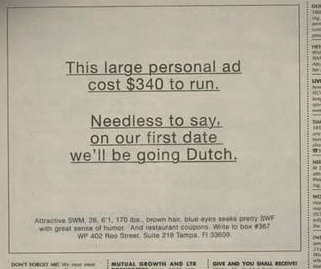
    Is any advertising more closely monitored by the advertiser than a “personals” ad? I don’t believe so. If ever an advertiser wanted results, and wanted them now, this is it.

    Personals ads demonstrate some of the best, and the worst, techniques in advertising. Let’s look at these examples and see what we can apply to advertising in general.

    1. Stop trying to reach everyone

    Personals ads immediately need to focus on prospects, and eliminate non-prospects.

    All too often, business advertisers try to make their ads appeal to “everyone.” If you’re a single woman posting in the personals, though, you don’t want responses from everyone. Other women are probably of no interest to you. You likely don’t want to hear from married men, either. If your objective is dating, it’s pointless to attempt to reach people that aren’t potential dates.

    Trying to reach everyone is a fool’s strategy in business, too. You probably don’t have any interest in people who can’t afford what you have to sell. You also aren’t likely to want to reach the idly curious. As a business your objective is to reach people who could become good customers.

    Make your ads speak directly to those people.

    2. Your Headline Is Critical

    Get your prospect’s attention. Get it immediately. If you don’t get your prospect’s attention, will he even notice the rest of your ad?

    “Relationship wanted” will never get as much attention as “North Texas filly looking for stable mate.”

    Draw the business parallel. Your retail ad shouldn’t say “We want your business.” Instead, it should say
    “Everything you need to make your garden grow is waiting for you at Mineral Wells Hardware.”

    3. Make me want to learn more

    The objective of personals advertising is to find someone to date. The objective of mass media advertising is to find new customers for your business. In neither case will you benefit from skimping on the descriptions.

    “Single woman desires long term relationship.” is less likely to get the attention of gentlemen reading the ads than is “Witty, flirtatious, and outgoing. I smile easily and enjoy laughing, am open-minded, honest, and like to talk about ideas. I would like to get to know a man who is confident of who he is and what he wants out of life. I’m single, have never been married, but like the idea of finding my soul mate.”

    By the same token, “Bedding plants in stock” is weak when compared to “Brighten your yard with salvia, iceplant, petunias, and pansies. Color your flower beds with all the hues of spring, ready to take home today from the Nolan River Nursery.”

    4. Tell potential customers what you give them that your competitors can’t

    Nobody spends advertising dollars in hopes of being ignored, and yet every day business owners manage to fade into obscurity by making their ads sound exactly like other ads.

    Consider an all-too-typical personals listing: “I love sunsets, long romantic walks by the ocean, and candlelight dinners.”

    No kidding? Is there a woman alive who doesn’t like sunsets, long romantic walks by the ocean and candlelight dinners? This will not make anyone stand out as worthy of attention.

    By the same token, does there exist any business that doesn’t offer helpful, courteous service and years of experience? Helpful courteous service doesn’t make you special. It’s the minimum entry-level behavior that customers expect.

    Statements like “helpful, courteous service” make your ads fade into background as noise. Your store ad could just as well say that you “love sunsets and long romantic walks.

    When your ads sound like everyone else’s, you’re not likely to be noticed, let alone be remembered.

    5. Tell me what’s in it for me

    If you met a stranger who opened the conversation with “I want to tell you all about myself,” how much interest would you have in talking to that stranger?

    Here’s the personals ad which takes that posture: “I’m looking for a long term relationship. Honest men only. I’m tired of fakes and game players. And if you are looking for someone to hang on your every word, keep on looking. No mama’s boys need apply.”

    Think she gets many replies?

    No, I don’t suppose so. The business equivalent is: “We need to sell one hundred cars to meet our sales goals, so we’re going to be making the best deals we can remember. Limited to items in stock. Limit one per household. Not valid with other offers. You must take delivery from dealer stock before close of business Friday.”

    “We, us, our.” “We” again. Aren’t we something? Just ask us. Bleh.

    Stop talking about you, and what you want from me. Start telling me why I should want to do business with you.

    Here’s a better example from the personals: “Would you like to spend some time with someone who’s optimistic and fun to be around? I hope you’re comfortable in jeans, you know what you want, and aren’t afraid to show it. You’ll find me open-minded, non-judgmental, and loyal.”

    Much more effective, isn’t it?

    In the business community you’ll get substantially better results when you drop the “we / us / our” verbiage, and replace it with “you.” “Have you ever noticed that you walk a little bit taller and you even feel better, when you know you look good? We promise that you’ll turn heads when you’ve had your hair cut at the Singing Scissors Salon.”

    Use these five rules as a starting point. Study the personals, and take note of those that get your attention. The basic principles will make good business ads, too.

    Whether their purpose is personal or business, good ads don’t scream for attention, they seduce – a crucial skill when you’re fishing for customers.

    Your Guide,
    Chuck McKay

    Marketing consultant Chuck McKayYour Fishing for Customers guide, Chuck McKay, gets people to buy more of what you sell.

    Got questions about writing secucing headlines and emotional appeals? Call Chuck at 304-523-0163, or write ChuckMcKay@ChuckMcKayOnLine.com.

  • Budgeting For Word Of Mouth

    Budgeting For Word Of Mouth

    Airplane atop gas station.
    WWII Vintage Airplane Sits on Gas Station

    You’ve just spent the day, a long day, at a Disney theme park. You’re beyond tired when you finally make it back to your car to find you’ve locked the keys inside. Can you imagine a more frustrating feeling? Now imagine the arrival of Disney’s locksmith.

    He reads your VIN, punches the numbers into a computer in the van, which bounces the lock information off satellite, and cuts a replacement key. You unlock the door, and with a fair amount of relief, you ask him what you owe for his service. He tells you that you owe nothing. He hopes you enjoyed your day at the park.

    What will you be doing when you get home? And for years afterward?

    Yeah. You’ll be providing excellent word of mouth for Disney Corporation.

    Positive Word-of-Mouth

    Positive word of mouth is triggered when your customer experiences something way beyond his expectations.

    It isn’t enough to be good.

    It isn’t enough to be very good.

    To be noticed, and to be so unusual that people want to talk about it, you have to be so far above the norm for your industry that your competitors would never even think about doing what you’re doing.

    Roy Williams has said that physical, non-verbal statements are the surest way of triggering positive word of mouth. These statements can be generated from one of three possible sources: architectural, kinetic, or generous.

    • I vividly remember a gas station that had a WWII fighter on the roof. When Dad was pumping gas we could climb up a ladder and sit in the cockpit. Architectural word of mouth at work.
    • The restaurateur in Mississippi who made the 6 o’clock news by throwing dinner rolls at his patrons from across the restaurant understands kinetic word of mouth.
    • The Orlando car dealer who’s “Good Samaritan Van” provides a can of gas, water, help changing a tire, or jump starting your car, and then tells you there’s no charge has generous word of mouth down pat.

    Can you plan one of these strategies for your business?

    Absolutely.

    Should you advertise it?

    Absolutely not.

    Worth Repeating?

    Remember, you must exceed expectations to make your customer’s experience memorable, and worth repeating.

    If you advertise your new architectural, or kinetic, or generous word of mouth trigger, you’ve just raised your customer’s expectations.

    Oops.

    Budget for your next word of mouth trigger, then hush up about it, and allow your customers to deliver the good news.  Sometimes it’s best to sit quietly and wait for them to be drawn to you when you’re fishing for customers.

    Your Guide,
    Chuck McKay

    Marketing consultant Chuck McKayYour Fishing for Customers guide, Chuck McKay, gets people to buy more of what you sell.

    Got questions about helping people to talk about your business?  Drop Chuck a note at ChuckMcKay@ChuckMcKayOnLine.com. Or call him at 304-523-0163.

    _________________________

    Mike Dandridge’s book The One Year Business Turn Around is all about generating positive word of mouth. Mike details fifty-two tested techniques that helped him build an electrical supply company to more than a million dollars a month in sales, in a town of 50,000 people, even though he was challenged by Home Depot on the left and Lowe’s on the right.

  • Why I Don’t Care For Co-Op Advertising

    Why I Don’t Care For Co-Op Advertising

    Fishing 101
    Fishing 101

    Sounds like such a great idea, doesn’t it? You’re a retailer – say a hardware store owner. Your store carries Ajax Widgets. You want to advertise in your local market to get customers into your store, but the cost is high. Ajax wants people to buy Ajax brand widgets, but the cost of advertising in every local market is exceptionally high.

    Ajax problem: spreading the word to people who can’t purchase from them (those who live in a community without a store which carries the Ajax brand, for instance) is a waste of money.

    Ajax solution? They will team up with you to share the cost of advertising to your market, as long as you promote Ajax Widgets in those ads, too. You’re trying to reach the same people, aren’t you? Why not share the cost? What a great deal for both of you.

    You simply use the Ajax Widget pre-approved script, and submit the appropriate media documentation to Ajax. They will reimburse you for part of the cost of the ads.

    Fifty percent is the most common plan, but I’ve seen ‘em go up as high as one hundred percent. And all cooperative advertising programs “cap” the amount of advertising dollars you’re allowed to spend at a percentage of dollar volume of the product you’ve purchased from the manufacturer.

    A great deal. Or is it?

    You’re trying to build an image for your hardware store. Every ad you run should re-enforce that image. Perhaps your desired image is “The store that has everything you need in stock.”

    What’s Ajax’ image? “The most dependable widget money can buy.”

    How does it benefit your hardware store’s image to have a fifty-second message about Ajax dependable widgets, followed by an effectively different message: “Ajax Widgets are available at fine retailers like Your Hardware Store?” (Don’t kid your self. It’s not a continuation of the same ad. It is a completely different message).

    The equity issue

    Ajax dictates the radio or television script, fifty seconds of which is dedicated to Ajax and their widgets. You get the ten second “tag” at the end. They provide the newspaper or magazine layout. You get the small white space at the bottom to drop in your logo and location.

    At the end of the advertising schedule the medium sends you the invoice, and a notarized “affidavit of performance.” You pay for the ad. You send the required documentation to Ajax, who reimburses you for half the cost.

    Let me repeat: you got only ten of the sixty seconds. You got only three of the 15 column inches. And yet, you paid for half.

    Anyway you look at it, you’re paying way too much for ads, and worse yet, those ads deliver the wrong message.

    I don’t care for co-op advertising. At least, most of the time.

    The Exception

    Some co-op programs will let you write you own ad and still claim reimbursement under the terms of their co-op program, provided that you mention their brand and product a minimum number of times.

    One of my clients has an annual sale one time each year. For fifty weeks a year his store advertising reinforces the benefits of purchasing from him. For those fifty weeks co-op doesn’t help him to meet his goals.

    But for the two weeks of the sale, he uses every accrued co-op dollar to fund the promotion of an event. It’s a completely different message presented in a completely different style. The sale event message is delivered with enough frequency to effectively reach most of the community. For those two weeks you can’t turn a radio to a local station or open a local newspaper without being exposed to his ads.

    Then, event over, it’s back to business as usual.

    If you’re going to use cooperative advertising in the promotion of your business, plan it’s use carefully. Don’t kid yourself, though, that co-op funds can replace any portion of your ad budget for the year. Run co-op ads IN ADDITION to your regular ads, not in place of any of them.

    Your Guide,
    Chuck McKay

    Marketing consultant Chuck McKayYour Fishing for Customers guide, Chuck McKay, gets people to buy more of what you sell.

    Wondering if you can get real value from your available co-op advertising funds? Drop Chuck a note at ChuckMcKay@ChuckMcKayOnLine.com. Or pick up the phone and call him 304-208-7654.

     
    This article was first published August 6, 2006

  • Could I Offer You a Free $100 Bill?

    Could I Offer You a Free $100 Bill?

    Origninally published October 23, 2007

    BankrollIn Shel Silverstein’s 1970 song I Got Stoned And I Missed It, he tells of “a nut down on the corner givin’ hunnert dollar bills away.” Being otherwise preoccupied, Silverstein wasn’t able to take advantage of the opportunity.

    But untold numbers of websurfers essentially passed on the same opportunity when Mike Enlow tried to give away $100 bills on a web site he created for that purpose. (We can only hope that most were not operating their computers in Silverstein’s impaired state).

    Mike tells the story in Internet Marketing Expert Can’t Give Away $100 Bills. The story has great insight into the need for credibility in everything Internet.

    What’s The General Conclusion?

    Enlow expressed it well when he said about shoppers on the web, “They Don’t Believe One Darned Word You Say! Literally. They’re sick of being lied to. Sick of being misled. Tired of outrageous offers, unsolicited email spam, products that don’t work as advertised, and people who hide behind fake names and fake email addresses.

    “And Here’s The Problem: Even if you are selling the greatest, most effective, amazing product or service in the history of the world (even free $100 bills), I GUARANTEE you that whatever you are doing to establish your credibility right now isn’t enough.

    Does your website make it easy for people to snail mail you? Place a phone call? Do you show your name? Your photograph?

    The more of these things you make easily accessible, the more trustworthy you appear.

    Hancox adds, “The funny thing is, in so many aspects of our lives, we’re all trying to give away hundred dollar bills. Maybe not that specific dollar amount, but we may be trying to give away something we think is of value.”

    He goes on to say “One of the simplest and yet most effective things you can do in life to improve your marketing and, quite frankly, just about everything you do to persuade and influence others, is to look at it from the other person’s perspective.”

    And this, my friends, is the secret to all great advertising as well, when you’re fishing for customers.

    Your Guide,
    Chuck McKay

    Marketing consultant Chuck McKayYour Fishing for Customers guide, Chuck McKay, gets people to buy more of what you sell.

    Questions about increasing your credibility through your advertising may be directed to ChuckMcKay@ChuckMcKayOnLine.com. Or call Chuck at 304-523-0163.

  • Your Professional Reputation – Three Distinct Levels of Word-of-Mouth

    Your Professional Reputation – Three Distinct Levels of Word-of-Mouth

    Originally posted April 30, 2009

    Car Trouble
    Car Trouble

    According to an old saying there are only two things people want to know about you: what you stand for, and what you won’t stand for. This is the basis of reputation.

    We intuitively understand that people’s actions are nearly always in accordance with their values. Someone who embraces fairness and treats other people honorably is likely to treat us honorably. Someone known to be dishonest has a higher likelihood of cheating us, as well.

    And like our personal reputations, our companies have professional reputations, built on the experience customers have in dealing with our companies, along with their willingness to talk about those experiences.

    Call it Word-of-Mouth

    Another name for professional reputation is word-of-mouth, which comes in three variants. From least to most influential, they are:

    1. Market Awareness – Do I recognize any of these names in this directory?

    2. Recognition – Have I heard of anyone who has the ability to help me with my problem?

    3. Customer Experience – Do I have knowledge of, or experience with someone who can help me to solve this problem?

    Each successive level takes priority over the previous.

    Market Awareness

    At the awareness level, customers recognizing your company’s name trumps them never having heard of you. This is the weakest level of word-of-mouth. If you stay in business long enough, you’ll achieve some level of awareness. You’ll then have a slight advantage over some newer company that has yet to achieve any awareness at all. Why? With no other information to go on, shoppers will usually buy from the company they’ve heard of.

    Professional Awareness is largely a function of repetition. A customer notes your name on the outfield sign at the ball park. Hears your jingle each morning on the radio. Sees your banner ad on the Internet. Catches your sponsorship of the six o’clock news. Recognizes your logo on the a coffee cup. If you’re part of the community, eventually people will bump into your name in the course of living their lives. The longer they’re aware of you without hearing specific negatives about you, the more generally positive this awareness becomes.

    Small businesses like to advertise how long they’ve been in business, as if years of “experience” automatically translates to a benefit in the minds of shoppers. Unfortunately, shoppers have proven not to care. (Kind of ironic, isn’t it? All those years of doing business in the community have lead to awareness of your company – but the benefit is to you, not to them).

    Recognition

    The next step up, recognition, beats out basic awareness because people now have attributes to attach to your name. “Here’s what people say” is the next best thing to first-hand knowledge – provided of course people aren’t saying uncomplimentary things.

    The size of the community is a factor, too. The fewer people who make up the population, the more likely a shopper to run into someone with a story to tell about the business.  Recognition is a bigger factor in small communities than in large ones.

    According to Wikipedia, one study found that a good reputation added 7.6% to the price businesses received for their goods. Some companies are finding that improving their reputations can actually boost stock prices.

    Side note: the Internet has changed the nature of “community.” It simultaneously offers the potential of world wide reach while providing individual gossip to anyone who seeks it. And just as bricks and mortar stores have public relations companies to put a positive spin on community perception, their web-based brethren are now hiring reputation managers to keep track of on-line credibility.

    Personal Experience

    And finally, those people who have had actual dealings with the companies in question will have the most convincing word-of-mouth of all.

    Shoppers who get what they expect will not give interaction with that business much thought. Word-of-mouth commentary happens when the customer’s actual experience differs from the expected. Delighted, wowed, or amazed customers spread positive word-of-mouth. Disappointed, disgruntled, or dissatisfied customers will spread negative.

    A real life example

    The new guy on the staff has just relocated here to take the job. This morning he heard a strange grinding sound as he drove to work. New guy is worried. The disparity between his lack of knowledge about possible causes, and his pressing need for such knowledge makes him feel vulnerable.

    He asks his co-workers for credible information to help him choose a solution, or at least his next step.

    Does anyone know anything about cars?” Note that he starts looking for information at the highest level of credibility – personal knowledge.

    Not finding an expert among his co-workers, new guy begins to rely on word-of-mouth. Why? He’s trying to lower his risk level. A bad choice in a mechanic could have him paying for services he doesn’t need. Worse yet, he could choose someone who won’t be able to fix his problem (but will charge him for time invested anyway).

    His next question: “Does anyone know a good mechanic?” addresses the most credible level of word-of-mouth – personal experience.

    In the absence of such knowledge, he will quickly go down the probability scale, asking next what his co-workers have heard about mechanics in town.

    Finally, he’ll go to his newspaper, or to the Yellow Pages and start studying the ads to see who appears to exhibit expertise in his specific grinding noise, or at least a company affiliated with a national chain.

    Back to the beginning

    There are three levels of word-of-mouth. Only two can be effected by your advertising. The third is strictly a function of the way you operate your business.

    So what are your company’s values? What do you stand for? What won’t you stand for? Do you consistently project those values in each interaction with customers?

    Is your business not growing because potential customers don’t know about you, or is it because they think they do?

    Are you scaring the fish, as you fish for customers?

    Your Guide,
    Chuck McKay

    Marketing consultant Chuck McKay
    Chuck McKay

    Your Fishing for Customers guide, Chuck McKay, gets people to buy more of what you sell.

    Have questions about helping word-of-mouth to help build your professional reputation? Send them to ChuckMcKay@FishingforCustomers.com. Better yet, pick up the phone and call Chuck at 304-523-0163.


  • The Flaw In The Advertising Plan

    The Flaw In The Advertising Plan

    Chess pieces on board.
    Pieces on chess board.

    A regional community college has just contacted the marketing rep for the local TV station.

    They’ve spoken the words which strike fear into the hearts of salespeople everywhere: ““The advertising isn’t working.”

    Tell me more,” says the rep.

    Well, we’re getting a lot of calls – probably more than we’ve ever gotten before. We send our information kit to everyone who calls, but they don’t become students. We’re spending more on printing and postage than ever before, and aren’t getting much to show for it.

    “Seems you’re wasting our money by bringing us the wrong people.

    The wrong people. Those would be people who don’t buy.

    The advertising plan didn’t account for appealing to the “wrong people.” The plan assumed the right people would respond to the ads.

    Radio stations are accused of bringing the wrong people when 200 listeners show up at Mr. Car Dealer’s remote broadcast but don’t buy cars.

    The wrong people come to the grocery store and only buy the items featured in the coupon.

    And now, you’re telling me the wrong people are picking up the phone and asking the college to send them information?

    Why would they bother?

    Who has so little to do today that he’s going to pick up the phone and call an institution of higher learning for information he doesn’t need or want?

    The “wrong people” are common to nearly all businesses.

    In the on-line world we refer to this as the “bounce rate” – the percentage of people who followed the link to your website and immediately changed their mind and went away. Its funny, but the conventional on-line wisdom doesn’t blame the advertising for bringing the wrong people, it INCREASES the advertising to get more people to the site.

    Bricks and mortar stores? A recent study indicates that 81 percent of the people who enter such a store will leave without buying anything. What do they say when a salesperson approaches them? “No, thanks. I’m just looking.”

    In both the real world and the virtual world, people are pressed for time. They don’t just go wandering around your store to alleviate boredom. They don’t enter your web store just to kill time. They don’t pick up the phone and call your 800 number out of indifference.

    They’re never just looking.

    They’re looking for something specific. They’re leaving because they didn’t find it – at least not the quality they demand or at a price they’re willing to pay. If they thought they’d found it, they’d have bought.

    Stop blaming the advertising plan.

    Your advertising isn’t bringing the wrong people. Your sales process is failing to convert them into buyers.

    Its time to examine your sales process.

    Begin by determining what your customers are seeking when they make contact. Then look for any impediment to prevent them from purchasing. Anticipate their questions and answer them in the way that makes them most comfortable buying from you.

    Do you recognize this process as Persuasion Architecture TM?

    There’s no use blaming your advertising if you have a long list of steady prospects and you’re not turning them into customers.

    There’s very little point in trying to hook ’em when you can’t reel them in. It could be your brochures. Maybe it’s your salespeople. Either way, the flaw isn’t in your advertising. You’ll need to fix your sales process, before you can successfully fish for customers.

    Your Guide,
    Chuck McKay

    Marketing consultant Chuck McKayYour Fishing for Customers guide, Chuck McKay, gets people to buy more of what you sell.

    Questions about reaching the right people with your advertising may be directed to ChuckMcKay@ChuckMcKayOnLine.com.  Or call Chuck at 317-207-0028.

  • Very Simple Newspaper Metrics

    Very Simple Newspaper Metrics

    Originally Published January 22, 2006

    Vintage Newspaper Ad
    Classic Newspaper Ad

    I’ve had the privilege of working with a few select clients who are willing to invest the time and resources to make their companies very good very quickly.

    These are the business people who understand that their marketing deserves as much attention as their merchandising. They know that a shopper’s first personal experience in their store must be consistant with the image created in their advertising.

    They have the discipline to track the results of every advertising campaign.

    And for many of them, eighth-page newspaper ads turn out to be the most cost-effective investment1.

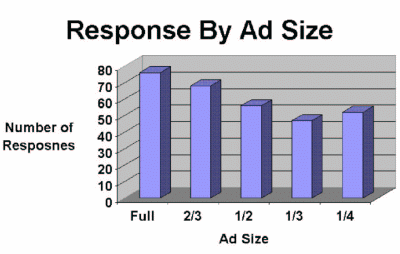
    I was reminded of this when I came across a study by business-to-business magazine publisher Cahners Publishing (now Reed Business Information) to determine the average number of inquiries about products that were generated by various sized ads in their publications. Cahners Research looked at 86,002 ads in 34 of their publications. They analyzed nearly nine million inquiries for more information.

    They concluded that the average number of responses increase as the size of the ad increases.2 Without intending to, it appears that they also make a case for smaller ads.

    The Cahners Study shows that, much like the Starch “noting factors,” response falls off with decreases in ad size, but not on a one-to-one ratio. A full-page ad gets an average of 76 responses, but a half-page ad, which costs half as much, gets an average of 56 responses. And a quarter-page ad, which costs one-forth as much as a full page, gets an average of 52 responses.

    Remember, we are not trying to reach the largest possible audience with this analysis. We’re trying to achieve the largest possible return on our advertising investment. The evidence is that smaller ads are more cost effective.

    When compared on a cost per “sale” basis, the chart looks like this:

    A full page ad returns 76 responses. A half page ad returns 56. When the ad cost is compared to the ad response, it becomes obvious that each “sale” resulting from the half-page ad cost only 21% as much as each sale which resulted from the full-page ad. Each quarter-page “sale” costs only 10% as much.

    Let me repeat that: The cost per sale from a quarter-page ad is one tenth the cost per sale of a full-page ad.

    Now, granted, the Cahners Study looked at technical magazines, and not at newspapers, but it’s conclusions reinforce what several of my clients have observed from their own advertising tracking.

    This doesn’t mean that you now only need to spend one-forth or one-eighth as much. What it means is running smaller ads at a greatly reduced cost will now allow you to run those smaller ads more often.

    Finally, these observations should only be used as guidelines. In addition to frequency of exposure, response to your advertising will be affected by several other factors, including:

    The impact quotient of your advertising copy.  If you say nothing of interest to shoppers, don’t be surprised when they respond with disinterest.

    Your share of voice. Think of this as the size of your ad budget when compared to the budgets of all of your competitors.

    Your professional reputation, which is based on Customer Experience. How good are you at what you do, when compared to each of your competitors?

    The market’s potential. The number of dollars in your trade area isn’t something that you’re likely to change.

    And finally, your choice of medium. There is evidence that products with short purchase cycles will sell better when advertised in visual media, and auditory media will provide better results when used to promote products with long purchase cycles.

    All of these factors become less guesswork if you’re willing to keep accurate records. Record the number of customers who buy from you each day. Record the times they return to purchase again each week, each month, each year. Calculate your largest selling items. Calculate the average ticket price. Track these averages and compare them to yesterday, to last week, last month, last year.

    This will take fanatical dedication.

    It’s too easy to say “I’ll bring those records up to speed tomorrow.” This is far too important to delegate the responsibility to an employee. And it’s all too much a reality that most business owners just do not have enough hours to handle the rest of their responsibilities and this as well.

    What about you?  Will you find the time to go fishing for customers?

    Your Guide,
    Chuck McKay

    Marketing consultant Chuck McKayYour Fishing for Customers guide, Chuck McKay, gets people to buy more of what you sell.

    Questions about tracking the results of your advertising may be directed to ChuckMcKay@ChuckMcKayOnLine.com. Or call Chuck at 304-208-7654.

    If you know someone who would find this article useful, please share it.


    1 Please do not assume that I’ve just endorsed eighth-page ads at the exclusion of all other possibilites. As I pointed out in Is Bigger Really Better the only way to truthfully know your most cost effective ad size is to track responses to your business’ advertising.

    2 Cahner’s Conclusion: “Inquiries, on the average will increase as the size of the advertisement increases. The type of audience reached and the content of the advertisement play a major role in the number of inquiries generated, as well. Certain audiences do not inquire at all. This data sheet makes no attempt at analyzing the qualitative aspects of audience or advertisement.

  • Ten “Dids” to Examine Your Failed Ads and Make Them Work Next Time

    Ten “Dids” to Examine Your Failed Ads and Make Them Work Next Time

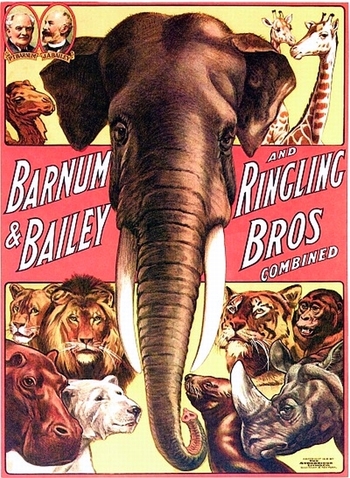
    Ringling Brothers Barnum & Bailey poster
    Ringling Brothers Barnum & Bailey poster.

    There are some pretty silly statements made about advertising. Many are quite obviously irrational.

    I can’t advertise in July, the circus will be in town.” 

    Don’t talk to me about advertising. Your publication carries my competitors ads.

    I have all of the business I need.

    Some, like “I tried advertising. It doesn’t work,” at first seem to be perfectly logical conclusions. The conviction of the people making this claim is unshakable – most likely because they’re describing exactly what happened to them.

    Of course, if they had said, “My kid tried riding a bike, but he fell over. Bicycles don’t work,” or “I tried golf once. I didn’t get a hole in one. Golf is a stupid waste of time,” everyone would recognize the absurdity of the statements.

    But every kid, (and every golfer) knows even common activities require some basic skills.

    At its basis, advertising is simple.

    Incredibly simple. Just deliver to the public your offer to sell something.

    The public’s reaction, though, is not as uncomplicated as “I’ll buy” or “I won’t buy.”

    Actual responses range from absolutely no interest on the unsuccessful end of the response continuum, to, on the successful end, people pounding on the door because the sign says the store opens at 8:30, and it’s now 8:32.

    Why do most ads produce results somewhere between these extremes?

    I’ve identified ten factors that could cause your advertising to produce disappointing results.

    Causes #1 and #2 involve your offer.

    Cause #1: Did anyone want the stuff you had to offer?

    Sale Tag
    Sale Tag

    Ideally, businesses would identify and research a market, then develop what the customer really wants. In the real world, manufacturers create, and retailers stock things, they believe people will want.

    Sometimes, they’re wrong.

    When those retailers say to the world, “Hey, come and buy our diamonelle encrusted left-handed can openers,” people don’t say, “I don’t want any, thank you.”

    They don’t say anything.

    They care so little about the offering, they don’t even notice the ad, and won’t remember ever seeing or hearing it.
    __________

    Cause #2: Did you offer what people needed when they were most likely to need it?

    Think seasonality. Swimsuits don’t sell well in November. Halloween candy won’t get much attention in April.

    Causes #3 – #6 involve the content of your message.

    ADD
    Did you hold shoppers attention?

    Cause #3: Did your ad snag shoppers attention? Were you able to hold that attention long enough to deliver your offer?

    There are three broad categories of advertising communication – entertainment, information, and engagement.

    1. Entertaining ads can work, if there’s a direct connection between entertainment and the one thought you’re trying to plant in the minds of shoppers. In far too many ads the entertainment is not relevant to the advertising message.

    2. Most ads offer information. Unfortunately, its about the advertiser. Good ads are about the customer. Instead of “We have a huge selection of clean, late model cars to fit any budget,” try “Admit it, you’re going to like the way people look at you when you wear Ajax.”

    3. Engagement requires the shopper to pay close attention to, and consciously consider, the content of your advertising. Unless that shopper is ready to purchase, catching her with a marginally different offer won’t elevate your ad to consideration status.

    Say the same things your competitors do, and rest assured that most shoppers will ignore you.

    But say something salient, something highly meaningful, and watch the difference.

    __________

    Cause #4: Did you engage? Did you actually say anything worth remembering?

    Too many ads are tedious, dreary, boring, and monotonous. Are yours?

    Just because you have a lot to say doesn’t mean your audience will sit still and pay attention.

    Nobody gets emotionally involved in a laundry list of brand names, sale items, or the number of collective years of your staff’s experience.

    The most you can expect of any ad is to convey one single, compelling idea. Find that one idea, and express it.

    __________

    Old Spice Body Wash
    Old Spice Body Wash

    Cause #5: Did your ad persuade? Did you extend an invitation to buy (a call to action)?

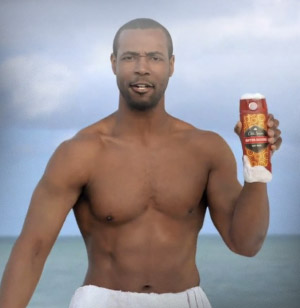
    Sometimes we notice a highly creative and entertaining ad campaign, only to find out later that the advertiser lost market share while the campaign ran. The “¡Yo quiero Taco Bell!” chihuahua, “Joe Isuzu,” and Old Spice’s “The Man Your Man Could Smell Like” campaigns come to mind. High entertainment value. Precious little persuasion.

    Entertainment aside, shoppers are skeptical. No matter how truthful any claim you in your ad, people don’t automatically believe you.

    That process which falls between demonstrating your evidence, and leading them to agree with your claim, is persuasion.

    __________

    Reputation
    Your Professional Reputation

    Cause #6: Did your ad complement your image?

    People who project different personalities, depending on which group of people they’re associating with, are not trusted. Without trust, you don’t have customers.

    Like people, companies have personalities, which are a critical part of their brand. Advertising is an extension of that brand. If it’s loud, insulting, self-centered, annoying, or otherwise offensive, people will assume your business is organized around those qualities.

    What is it that people know about you? What is your professional reputation? What is your image among customers? Among non-customers?

    Do you have an image?

    How do you know?

    Causes #7 – #10 involve external factors.

    Cause #7: Did you choose the right medium? Did you have the right sized ad?

    Think of advertising as your cost to acquire customers.

    Costs per exposure, per thousand, or per rating point only matter indirectly. Media efficiency is calculated by dividing the number of dollars invested by the number of new customers you’ve acquired.

    Magazines with tiny circulations but active readership may be a great investment. Regional television stations with the highest priced ads in town may also be a great investment.

    Until you track the number of new customers each produces, and the average sale of each new customer, you can’t do a meaningful comparison.

    __________

    Cause #8: Did you schedule your ads at the optimum frequency?

    There are two factors which combine to make media impact. One is the size of the ad (in column inches, or seconds, or pixels), and the other is the number of times shoppers read  / hear / view it.

    Exceptionally salient ads may only need one exposure. Most require multiple exposures to the ad before people respond to your offer.

    Under normal circumstances you’re going to need to run that ad several times.

    __________

    Old Refrigerator
    Old Refrigerator

    Cause #9: Did you allow enough time for shoppers to need what you sell?

    People eat several times a day. They need new tires every year or two. They buy refrigerators and mattresses maybe once per decade. How many of them are in the market for what you sell at any given time?

    Ads for short purchase cycle offerings should pay off quickly. The impact of grocery or restaurant ads can be measured in days.

    Other products, which have longer purchase cycles require more patience, and more persistence.

    __________

    The Plan
    Business Plan, Illustrated

    Cause #10: Did you start with a clear goal?

    What was it you wanted to happen when you bought that advertising which didn’t work?

    Did you expect to see new faces in your store? Additional referrals? Greater market awareness for your company (“getting your name out there”)? Sales increases? Additional goodwill?

    If you don’t know what you were attempting to accomplish, how can you be sure your advertising DIDN’T work?

    __________
    Advertising works. I suspect we all know that.

    A former boss, when told advertising didn’t work, offered to run some free radio ads for the skeptic. He said, “Let me tell you what they’ll say: Free $100 bills at your business.”

    No one ever took him up on it.

    Maybe yours is one of those companies which has all of the customers it needs. Congratulations. I envy you.

    Most every business owner I talk to, however, needs a steady influx of new customers.

    Like playing golf or riding a bicycle, there are skills you’ll need to make it work. You weren’t born with the ability to run your own company, but you learned what to do, and when, and why. Likewise, you can develop the ability to profitably advertise that same company.

    You’ll need to invest a modest budget, commit to some seriously detailed record keeping, and allocate enough time to develop and hone those skills. Thirty minutes a day for the next year will give you the rough equivalent of one semester of Intro to Marketing.

    Fortunately, there’s a lot of great information available, and much of it free. If you’re ready to get started, drop me a note and I’ll send you a recommended reading list.

    And take another look at the “Dids.” If you’re ready to start fishing for customers, isn’t time for you to give advertising another shot?

    Your Guide,
    Chuck McKay

    Marketing consultant Chuck McKayYour Fishing for Customers guide, Chuck McKay, gets people to buy more of what you sell.

    Questions about making your company’s advertising “work” may be directed to ChuckMcKay@ChuckMcKayOnLine.com. Or, call him at 304-523-0163.


  • A Marketing Lesson from American Idol

    A Marketing Lesson from American Idol

    American Idol logo
    American Idol opening logo

    Roughly 20 minutes into the Nashville auditions for American Idol, the Lovely Mrs McKay turned to me and said, “These people MUST know how awful they are.” “They don’t have a clue,” I sighed.

    Have you noticed how often incompetent people are supremely confident? Not just auditioning for American Idol, but throughout life?

    Professor Justin Kruger and graduate student David Dunning of Cornell University studied this effect in their 1999 paper, Unskilled and Unaware of It. Their conclusion: those who knew the least rated themselves most knowledgeable, and those who actually understood the topic were far less sure of themselves.

    This result has been confirmed in multiple follow-up studies involving several skills and fields of expertise. It is known as the Dunning-Kruger effect.

    Which begs the question: why does this happen?

    Answer: the basic skills and awareness needed for competency are exactly the same skills necessary to evaluate the competency.

    Their lack of knowledge (incompetence) prevents them from recognizing their lack of knowledge (incompetence). People don’t know what they don’t know. They don’t even know where to look or how to look at it.

    And it doesn’t dawn on them that skilled performers DO know this stuff, until they’re exposed, dramatically to their own ignorance. Until then, they delude their incompetent selves into illusions of confident competency.

    If you’ve ever wondered how:

    • people who can’t articulate the issues, still feel confident casting their vote (or making inflammatory statements);
    • how people with no experience teaching, know exactly what’s wrong with our education system; and
    • how those who have never studied investing, can blithely plow their life savings into the real estate market

    Incompetence leads people to make poor choices. Incompetence prevents them from realizing they make poor choices. This is the Dunning-Kruger Effect (DK). On the other end of the DK continuum, competent people tend to rate themselves lower than they should. Their internal voices seem to say, “Hey, everyone knows this.”

    The dumb get confident; the intelligent get doubtful. And to a greater or lesser degree we’re all guilty.

    How Biased Feedback Makes it Even Worse

    Imagine a typical Friday nite in any typical neighborhood watering hole. The regular crowd shuffles in. One of them, Miss Karaoke Singer, is recognized by the rest as being the “best” in the club.

    What kind of feedback does she get?

    Do any of the other contestants tell her that her breath control is bad, her vibrato unnatural, or mention the odd affectation she’s developed? Hardly. They don’t know anything about nuanced performance. Since the only feedback she gets is positive, she thinks she’s good.

    Good? No, FANTASTIC! The Dunning-Kruger effect helps her to believe she’s ready for American Idol!

    Then comes the audition.

    The judges tell her she’s a poor singer. Her own incompetence prevents her from understanding what they’re telling her. These judges must be stupid. After all, she just gave a great performance.

    Se gets angry. Tells off the judges. Not because she’s defending herself. Not because she’s trying not to look bad in front of her supporters. But because she’s completely incapable of understanding just how bad she is.

    Advertising That Doesn’t Work Probably Has More to Do With Dunning-Kruger Than Advertising

    Much like our karaoke singer, every city has an advertiser who, rather than admit his advertising strategy and execution are flawed, convinces himself that advertising doesn’t work.

    Does anyone in Mr. Businessman’s entourage tell him his ads have nothing substantive to say? That they don’t speak to the buyer in natural language, and instead just spew out ad clichés like “fast, friendly, service?” Does anyone tell him that putting his kid and his dog in the ad won’t convince anyone to buy things from him?

    Or more technically, does anyone tell our businessman that his ads don’t have enough frequency to make an impact? That he’s using the wrong medium? That his competition has effectively co-opted his position?

    No. His friends get a kick out of seeing him on TV, or in the paper, or on radio, and the only feedback Mr. Businessman gets is positive. He thinks he’s good.

    Until he sees his sales figures. Plummeting or flat-lined sales force a confrontation with reality, and it’s the rare businessman indeed who doesn’t address his frustration and anger at advertising medium – or on advertising in general. Hence, the near-ubiquitous refrain of: “I tried advertising and it didn’t work.”

    Unfortunately for Mr. Businessman, if he doesn’t want to follow Miss Karaoke Singer back to waiting tables, he still needs to get more customers. And fast!

    How Small Clients Can Get the Best Ads And Grow to Become Big Companies

    The thing about big fish / small pond business owners is, they often believe their success in one field translates to competency in almost everything else. Rather than leveraging the expertise of their ad man, they’ll bully him until they get the kind of ads they want – ads full of Dunning-Kruger-esque
    follies.

    But sometimes business owners who are genuinely good at what they do manage to overcome the Dunning-Kruger effect. They find a professional to bring to them the same hard-won competency and expertise they offer to their own customers.

    Its much like what happens when a truly talented singer gets on American Idol: with the right direction and promotion, some dreams do come true.

    What about you?

    Are you an average karaoke singer? Or a true star in search of the right stage and the right spotlight?

    Knowing which is critical when you’re fishing for customers.

    Your Guide,
    Chuck McKay

    Marketing consultant Chuck McKayYour Fishing for Customers guide, Chuck McKay, gets people to buy more of what you sell.

    Questions about finding your own right spotlight may be directed to ChuckMcKay@ChuckMcKayOnLine.com. Or, call him at 304-523-0163.