Author: Chuck McKay

  • Inclusive Communication By Design

    Inclusive Communication By Design

    Infomercial
    Infomercial
    Your company is looking at a lot of late night local cable availability, and thinking that a 30-minute infomercial might be appropriate.

    The boss has just found out that companies which specialize in infomercial marketing will charge tens of thousands of dollars to produce your program.

    He wants to know why you can’t do it “in house.”

    Can’t you just put a talent in front of a camera and let him persuade those late night visitors to buy?


    DIY Infomercial?

    I wouldn’t.

    Too many dollars would stay on the table.

    In addition to the obvious differences in production quality that an infomercial specialist brings to the table, there is the difference in strategy. The pros know you can’t treat all potential customers alike.

    You see, some people want you to just cut to the bottom line and tell them what your product will do for them.

    Some want to read the fine print.

    Some want to know if other people have successfully used your product to solve their problems.

    And then there’s the group that wants to know a whole lot more about your company before they consider doing business with you.

    The right thing to say to one is exactly the wrong thing to say to the others.

    What’s an aspiring infomercial producer to do?

    According to Dr. Richard Grant, you should make a specific appeal to each of the eight different Meyers-Briggs communication styles in our offers. He calls the process Inclusive Communication by design.

    It only makes sense that if we talk to people about their concerns, in a style that makes them comfortable, and address the questions that are important to them, that we’ll persuade more of them to do business with us.

    Here is my assessment of the approach we need to take with each of the Meyers-Briggs “types” for your new 30-minute infomercial.

    E – needs a good verbal presentation. Cover the major points at a fast pace without too much detail.
    I – needs time to reflect. Will buy, but not before deliberating.
    S – begin with facts, and build to “big picture.”
    N – begin with “big picture” and fill in the facts.
    T – emphasize soundness, reliability, and statistics.
    F – support with first-hand testimonials
    J – no surprises. Appear to stay organized.
    P – diplomatically remind that a decision must be made within certain time constraints

    Here’s how I would organize a program.

    In Practical Application

    Minutes 1-3
    Introduce the show, and summarize the next thirty minutes for the “Js”. Make the overall claims for the product quickly for the “Ns”. Then, for both the “Ns” and the “Ss,” start building your facts. For the “Ss,” build to your conclusion and restate the claims for the product.

    Minutes 4-8
    For the “Ts” support the claims with science. For the “Fs” bring in the testimonials. Keep it fun and fast paced for the “Es”. Explain the dependability of your staff/call center for the “Js” and the fun people will have interacting with them for “Es.” Remind the “Ps” that this special offer is only good during this program.

    Make your first call to action.

    Minutes 9-17
    Repeat your overall claims in summary form for the “Ns.” Build your facts, and re-state your conclusions for the “Ss.” Amplify and expand on the science for the “Ts.” Refer the “Is” to your web site. Reassure the “Js” that everything you’ve promised will happen right on schedule with no surprises. Consider using recorded testimonials from other customers, and use them now for the “Fs.” Again, remind the “Ps” that this special offer is only good during this program.

    Make your second call to action.

    Minutes 18-29
    Have the interviewer “put you on the ropes” and make you defend the claims for the “Ss” and the “Js.” Keep it logical for the “Ts” but light-hearted for the “Es.” Pull out the science in deeper detail, and discuss the manufacturing process for the “Js” and “Ns.”

    Talk about the company, and your commitments to quality and customer satisfaction for the “Ns,” “Ss,” and “Is.” Consider a :40 second interview with one of the call center operators as entertainment for the “Es” and reassurance for the “Js.” Restate that your customers get exactly what they expect on the timetable you’ve committed.

    Remind the “Ps” that it’s time to place an order, if they want to take advantage of this special offer.

    Make your final call to action, and wrap up.

    Cast a Wider Net

    Each personality type is more comfortable with information presented in a particular style. Respecting those communications styles, satisfying each in succession, multiplies the bait when you’re fishing for customers.

    Your Guide,
    Chuck McKay

    Your Fishing for Customers guide, Chuck McKay, gets people to buy more of what you sell.

    Got questions about articulating your value, and making sure people know it? Drop Chuck a note at ChuckMcKay@ChuckMcKayOnLine.com. Or, you can call Chuck at 317-207-0028.


    If you’re interested in learning more about persona-based marketing, I recommend Waiting for Your Cat to Bark by Bryan Eisenberg, Jeffrey Eisenberg, and Lisa T. Davis. They make simple what could be a confusing subject. That’s probably why the book hit all 4 bestseller lists: New York Times, Wall Street Journal, USA Today and BusinessWeek.

  • Dear Doctor – How Do Your Patients Rate YOU?

    Dear Doctor – How Do Your Patients Rate YOU?

    Dear Doctor:

    For a single, brief instant I was your patient.

    I was new in the community and needed to have my diabetic prescriptions renewed.

    I didn’t mind that I had to wait five weeks for the first appointment. I like that your practice is that busy. It implies that you’re in demand.

    I appreciated the reminder phone call yesterday, confirming the appointment and suggesting that I arrive 15 minutes early to handle any necessary paperwork.

    Perhaps you remember that my appointment was for 10am. Since I didn’t know what the traffic would be like, or how difficult your office would be to find, I left for your office at 9am, and arrived at 9:30. After checking in and completing your new patient forms I sat patiently waiting to be called.

    I wasn’t upset when 10am passed and no one had called my name.

    I wasn’t really upset at 10:15.

    By 10:30 I was becoming annoyed. I asked your receptionist if it was going to be much longer. Without even looking up she told me she didn’t know, but they’d call me as soon as they were ready for me.

    By 10:45 I should have walked out, but I needed my prescriptions. I didn’t have five weeks left to start this process with another doctor.

    I Waited

    At 11:02 a nurse called my name. She weighed me, took my blood pressure, confirmed the meds I’m taking, and showed me to an exam room. She closed the door upon her exit, and I sat alone there until you finally walked in at 11:36.

    Instead of making eye contact you looked at the chart, and introduced yourself. No apology. No recognition of my inconvenience. In fact, you didn’t look up at all until I asked what had caused you to be running 97 minutes behind on your first 120 minutes of operation.

    As you looked into my ears and mouth you told me that you couldn’t anticipate how long each patient would need your attention.

    I wondered why not? You’ve been in business for at least 90 days. It seems to me that tallying the number of patients you see, the number of hours you’re open, and dividing one by the other should get you in the ballpark.

    Perhaps you recall, Doctor, indignantly telling me that you haven’t been able to take a lunch in the last two months? That you worked straight through your scheduled 90 minute mid-day break to take care of the patients waiting to see you?

    If, in every one of the last 60 days it took an extra hour and a half to catch up on half a day’s appointments, then you obviously are scheduling them too close together. This accomplishes nothing but to really make your patients cranky.

    Not as cranky as you appeared, though, when you handed me the scrip I’d come in for. (That was when I explained that by working through lunch you were only making my point).

    And We Arrived at the Critical Moment

    Do you remember when you angrily demanded to know if I understood how much it costs to have your staff standing around waiting on patients, and that you still had student loans to pay off?

    That was the exact moment when our doctor/patient relationship ended.

    Oh, you’re probably not aware of it. I took the sheet with your charges to the clerk and paid on my way out. But, the relationship has definitely ended. I decided that long before I arrived back at my office at 12:29, very angry to have wasted half a day to simply renew the prescriptions I’ve been taking for years.

    You see, whether you realize it or not, you’re a consultant.

    People hire you for the expert advice you give them when they have health care concerns. Many other people are consultants, too. Insurance agents, hair dressers, and Realtors come to mind.

    They call people who purchase their services “customers,” while yours are known as “patients,” but it’s pretty much the same relationship.

    I wouldn’t have waited an hour and a half beyond a firm appointment for any of them. I wouldn’t have expected them to wait on me were the tables turned. But with you and a great many of your colleagues, this is business as usual.

    You Keep Your Productivity High by Insuring That Mine is Low

    That, and your total disrespect for me as your customer are the reasons I won’t be back.

    So, as I tell you goodbye, let me leave you with two thoughts:

    1.Your accountant has been counting your inactive patient files as assets of your practice.

    He’s kidding himself.

    If he ever sat in your waiting room he’d understand why you have such a large percentage of inactive patients.

    2.People like me, the well-paid executives who can afford your services, don’t normally make a scene as we leave.

    We simply determine that you’re not worth the investment of any further time.

    So, when you find yourself squeezed between managed care and deadbeat patients, remember that I’m in my peak earning years, my time is valuable to me, and I’d have gladly paid more for express service.

    Remind yourself, too, that I am a great source of word-of-mouth. Unfortunately, in your case, it won’t be favorable. I will, however, get a massive amount of satisfaction repeating this story. I’ll be telling it for years. When you advertise your practice, how many gross ratings points will you have to purchase just to neutralize me?

    One of these days one of your colleagues is going to figure this out. He’s going to appear on television with a simple message:

    I’m Doctor Johnson, the business person’s doctor. I’m not one of the lower priced doctors in town – in fact, I’m probably one of the most expensive. But, if you’re accepted as my patient (and not everyone is) I promise you’ll never wait more than 15 minutes for your appointment. Come see me. Doctor Johnson, the business person’s doctor, at the corner of Main and Second Street for your convenience.

    He’s going to make a fortune on people like me. Something to consider when you’re fishing for patients.

    Your Guide,
    Chuck McKay

    Your Fishing for Customers guide, Chuck McKay, gets people to buy more of what you sell.

    Do you have more respect for your customer’s time than the average medical doctor? Are your customers aware of that? Call Chuck at 317-207-0028 to discuss efectively telling that story. Or, you can reach him by email at ChuckMcKay@FishingforCustomers.com.

  • Coffee, The Moon Landing, And A Game Of Poker

    Coffee, The Moon Landing, And A Game Of Poker

    Poker Hand
    A winning poker hand.

    I don’t play often, but I appreciate a good game of poker. Poker makes a pretty good analogy for marketing, and for business.

    Poker players know what they hold in their hands, they carefully watch what everyone else appears to be doing. They make educated guesses as to the cards the other players hold.

    Poker players hoard their resources until they know they hold a winner, then they confidently apply all of their resources to winning that particular hand.

    At the end of the game the winner takes the whole pot. The loser loses everything.

    The other players pick up a few bucks now and then and manage to stay in the game.

    In real life marketing the winning hand is held by the company with the greatest share of mind. Let me give you an example.

    Name the First Brand of Coffee You Think of

    Now name another.

    Can you name a third?

    Chances are that you named your first coffee brand rather quickly.  The second came almost as quickly.

    Most people take slightly longer to name the third brand.

    Most People Purchase the First Brand that Comes to Mind.

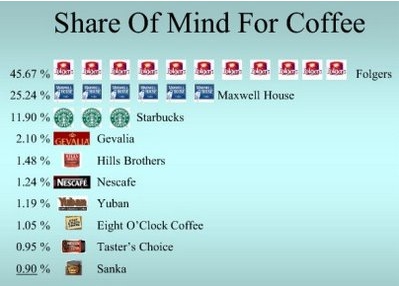
    Would you like to see how 3,000 other people* answered that question?

    Share of Mind for Coffee
    Share of Mind for Coffee

    People remembered these brands in roughly the same proportion they buy them.

    Conclusion #1: Share of mind predicts share of market.
    Conclusion #2: The first name that shoppers think of is the one they buy.

    How does a company become the first name on the customer’s mental list, and thus hold the face cards in the marketing poker game?

    The Easiest Way is to Actually be First.

    Who was the first man to fly solo across the Atlantic? The second? How about the first woman to fly solo across the Atlantic?** Charles Lindberg and Amelia Earhart won those hands. You can’t even name the losers.

    You might remember the second man to set foot on the surface of the moon, but can you name the third?

    Can you name the third expedition to the North Pole? The third Pope? The third signature on the US Declaration of Independence? (How about the third amendment to the Constitution)?

    In share of mind, share of market, and poker, third position is a loser. Winners come in first. Second place sometimes makes a few bucks. Beyond that, money gets very tight.

    “But wait a minute, Chuck” (I can hear you saying), “I have a small business in a small town. I’m not the first at anything.”

    This is Where Marketing Makes a Difference.

    Charles and Frank Duryea built the first gasoline-powered automobile in 1893 – a full ten years before Henry Ford got into the business.*** Henry made the automobile affordable to every household, creating phenomenal word of mouth on the Model T. Henry held the winning poker hand, and became the most famous automobile manufacturer of all time. How many of the losing hands can you even remember?

    The best selling MP3 player of all time is the iPod, but Apple didn’t invent the device. Rio did, in 1998, nearly three years before the iPod hit the market. Rio built an expensive toy for people who loved technology. Apple created a toy for people who love music. Apple wins that poker hand. (And, tell the truth, until I mentioned the name, you didn’t even remember the Rio player, did you)?

    Your objective is to make your company the one that people automatically think of when they need what you sell. When you’re first on that list, they don’t even think about buying elsewhere.

    You see, the first company to make a claim has an 85% chance of being remembered for that claim. The second company has about a 15% chance. The third company less than 5%.

    Ford and Apple simply out promoted Duryea and Rio, respectively. Neither was first in the market. Each became first in the minds of their prospective customers.

    Can You be First at Something?

    Absolutely. In fact, its essential.

    To be remembered, to hold top position in share of mind, to hold the winning hand in marketing your business, you must be first at something.

    I’d suggest that you choose to be first in the reason your existing customers do business with you now.

    Find out what your current customers believe you provide that they can’t get anywhere else. Then, start promoting that. Promote it to the point that you’re now playing in a whole new game, and in this game you hold the winning cards.

    Your Guide,
    Chuck McKay

    Marketing consultant Chuck McKayYour Fishing for Customers guide, Chuck McKay, gets people to buy more of what you sell.

    Have questions about finding a niche and being first in it? Drop Chuck a note at ChuckMcKay@ChuckMcKayOnLine.com. Or call him at 304-208-7654.


    * BRANDPOLL survey of coffee brands, January-March 2001.

    ** Charles Lindberg, May 20, 1927; Amelia Earhart, May 20, 1932 on the fifth anniversary of Lindberg’s crossing.

    *** Nicholas Joseph Cugnot designed the first steam powered self-propelled vehicle in 1769. The device was so heavy that it had to run on roadways of steel, and evolved into the modern locomotive. Etienne Lenoir patented the first practical gas engine (coal gas) and drove a car powered with one from Paris to Joinville in 1862.


  • The Circle Layout

    The Circle Layout

    Originally Published December 7, 2005

    Fishing 101
    Fishing 101
    Marketing consultant George S. Cullinan (1911-1963) was inducted into the Direct Marketing Hall of Fame in 1989 for being “the first to recognize the significance of databases as a foundation for successful direct marketing.”

    Today we’re going to look an another George Cullinan creation: the “circle layout.” This concept is an idea of value to everyone who uses words and images to promote business.
     

    Artists Don’t Think Like You Do

    Cullinan believed that the art department should never be trusted to correctly lay out the advertising, that instead those decisions should always come from the merchandising department.

    Since Cullinan didn’t expect his merchandise buyers to become skilled artists, he suggested that they use a simple set of circles of various sizes to communicate with the art department what to include, and the relative placement and space of each element.

    In a circle layout, the number of circles is equal to the number of illustrations, headlines, and story elements to be included. Of course, one need not be limited to oval shapes. Rectangles have their uses, too. The key is to use the relative sizes of the shapes to quickly convey the approximate importance of each design element.

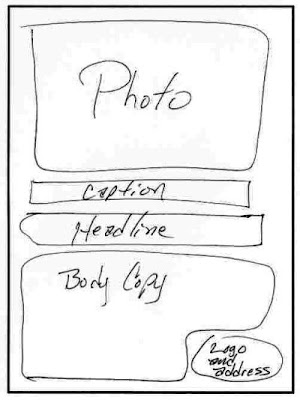
    Example 1: Newspaper Ad

    Let’s assume that my local newspaper has offered to build my new ad. I’ve told the newspaper account executive about my business. He should be able to take this sketch and his notes to his advertising department and bring back an ad proof with no surprises.


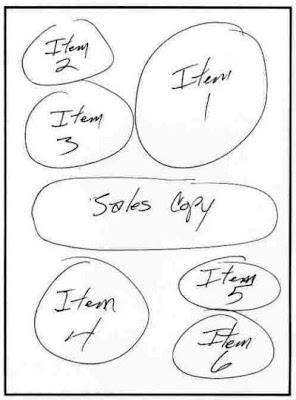
    Example 2: Catalog Page

    Were I working with an advertising agency, I’d be providing the agency raw information and this sketch. I’d expect their artists and copywriters to be able to build my catalog page pretty much as I’d imagined it.


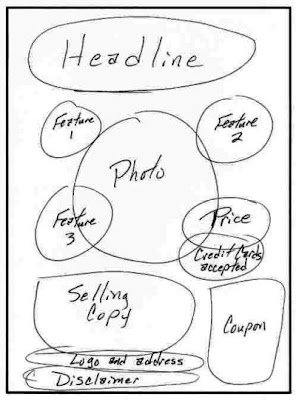
    Example 3: Flyer

    If I needed a local printer to make up some flyers for my business, I would provide the photo or line drawing, my logo, and the selling verbiage to be included in the copy. Any local printer should be able to follow this concept and deliver the flyer I’m expecting.

    It’s Communication

    Why should you provide the circle layout to your commercial artwork provider? Simple. She isn’t you.

    You’re the person responsible for moving product. You probably already know which advertising elements will capture attention and motivate a purchaser to buy. Who knows better than you do exactly what must be emphasized? Or what could be left out? Whether the photo or the body copy needed more emphasis? Whether or not to include a coupon?


    How (and What) to Lay Out

    Before starting your circle layout, make a checklist for yourself, and include such items as:

    • Headlines
    • Photos / illustrations
    • Body copy
    • Prices
    • Special offers
    • Coupons
    • Logos or other company identification
    • Legal disclaimers

    Modify your checklist so that nothing gets overlooked during the planning stages.

    It Even Works for Non-Visual Media

    Cullinan developed the circle layout for catalog pages and flyers, but I’m sure you can see that this simple communication method can work equally well for other media.

    Not only will you find it useful for magazines, newspapers, and billboards, but you’ll find that it helps the copywriter of your television ads or radio ads to better understand the message you need her to deliver. I wouldn’t hesitate to give a copy to a direct response writer who was composing a solicitation letter.

    Try it on your next advertising project and see if you don’t agree. I’d love to hear how you implement the circle layout in fishing for customers.

    Your Guide,
    Chuck McKay

    Marketing consultant Chuck McKayYour Fishing for Customers guide, Chuck McKay, gets people to buy more of what you sell.

    Have questions about communicating your vision to your service providers? Drop Chuck a note at ChuckMcKay@ChuckMcKayOnLine.com. Or call him at 304-208-7654.

  • Physicists, Piano Tuners, and Market Research

    Physicists, Piano Tuners, and Market Research

    Enrico Fermi
    Enrico Fermi

    Don’t expect most scientists to admit it, but a physics technique called the Fermi Question provides a quick and simple way for business people to determine whether a new market is large enough to be profitable.

    Enrico Fermi was one of most well-rounded physicists of the last century, a Nobel Prize winner who was able to switch from practical to theoretical and back to practical, and make it look easy.

    Until his death in 1954, Enrico taught the estimating technique that now bears his name. In the absence of definite knowledge or an exact answer, a Fermi Question’s goal is to obtain an informed estimate by making reasonable assumptions.

    Fermi Used Common Sense in Science

    Fermi would demand that his students at the University of Chicago explain to him how many grains of sand are on the world’s beaches. How far can a crow fly without stopping? How many atoms of Caesar’s last breath do you inhale with each lungful of air? How many piano tuners are there in Chicago?

    Fermi Questions required students to use their understanding of the world, and their everyday experience, to make rough approximations in areas of which they had no knowledge.

    But as I said, you and I will find the Fermi Question quite valuable as a business tool.

    Fermi’s Classic Piano Tuner Question

    Assume that you’re a young piano tuner who’s still ruffling the pages of their jazz piano tutorial. You’re about to set off into the world to seek your fortune.

    Your favorite uncle lives in Chicago. He says you’re welcome to come stay with him while you get your piano tuning business off the ground. Shall we analyze the market potential before you accept his offer and open a piano tuning business in Chicago?

    Start with the population of Chicago: according to estimates from the most recent U.S. Census, roughly 9,400,000 people live in the greater Chicago metro area.

    The Census Bureau also helps us estimate that there are two and a half people per average household. Therefore Chicago is home to 3,760,000 families.

    Fifty years ago one home in four had a piano, but since the Beatles burst on the music scene, people don’t gather ‘round the piano to sing, anymore. Shall we assume that only one household in 30 owns a piano today? That would lead us to conclude that there are 125,333 pianos in Chicago.

    Some performers with critical ears may demand tuning at each changing of the seasons. Those owners are likely offset by others who own a piano, but never tune it. On the average, a fair assumption might be that each of those 125,333 pianos in Chicago are tuned once per year – 125,333 piano tunings per year.

    Allowing for commute time across the greater Chicago metro area, perhaps a fair estimate is that a technician can tune three pianos each day. If he works a five-day, fifty-week year, each tuner could service 750 pianos each year.

    Divide 125,333 pianos by 750 tunings, and there appears to be enough work to employ 167 piano tuners.

    How Close Did We Come?

    A quick look at switchboard.com under “piano servicing and tuning” tells us that 126 businesses in the greater Chicago area offer piano tuning.

    How many tuners operate out of each business?

    We should perhaps gather some hard data on this one with a few phone calls, but if one third employed two tuners, and the other two thirds employed only one, the average would be one and a third tuners per piano servicing business: 164 piano tuners competing in a market which appears to have enough work to employ 167.

    Not bad.

    Maybe our next step should be to ask for price quotes from future competitors. Then we could determine whether one could make a living performing 750 piano tunings per year. But regardless of the conclusion, we were able to make an informed decision with a couple of quick Google searches and about ten minutes of “think time.”

    Our Goal Isn’t Accuracy

    The Fermi Question won’t tell you with absolute accuracy whether a business proposition is feasible, but it can quickly provide a ballpark figure to eliminate those which can’t work.

    Using this technique, could you quickly estimate the number of life insurance salespeople that could make a living in Phoenix? The number of profitable convenience stores in Pensacola? The number of brew pubs in Raleigh?

    Would application of the Fermi Question help you to determine whether your bedding store should expand into sofas and loveseats?

    Could you make a better decision about whether an additional salesperson could generate enough sales to cover his salary?

    Might you use estimates like these to help you decide whether it makes sense to approach your primary competitor with a buyout offer?

    I’m not suggesting that you don’t need hard data. I’m a major proponent of acquiring as much market data as is available, or that you can afford. You’d agree, though, wouldn’t you, that when the data’s not available, an informed estimate beats an uninformed guess every time?

    Tell the physicists to move over. We’re co-opting one of their tools, and using it to fish for customers.

    Your Guide,
    Chuck McKay

    Your Fishing for Customers guide, Chuck McKay, gets people to buy more of what you sell.

    Have questions about estimating your chances of success in a new market? Call Chuck at 317-207-0028 for help calculating the odds. Or, you can reach him by email at ChuckMcKay@ChuckMcK

    Drop Chuck a note at ChuckMcKay@ChuckMcKayOnLine.com. Or call him at 304-208-7654.

  • How Many Pancake Restaurants?

    How Many Pancake Restaurants?

    pancakes
    A stack of pancakes.

    People seem to naturally rank things. They list things in order. They tend to remember things at the tops of the various lists.

    On nearly any list, most people can remember the top three with little effort. It’s generally accepted that seven is the maximum simultaneous number of items that the average person will remember.

    In 1980 consultants Al Ries and Jack Trout suggested that as astute marketers we take advantage of this human characteristic, and “position” our products against whomever tops the list.

    This creates a new list, with us at the top. That makes it easier to remember.

    One of their examples was 7-Up

    As a soft drink it was way down the list. As the “Uncola” it was number one, beating out Coke.

    As a soft drink, 7-Up needs you to remember Coke, Pepsi, Royal Crown, Dr. Pepper, Mountain Dew, before you’re likely to remember 7-Up.

    As the Uncola, 7-Up needs you only to remember 7-Up.

    The Uncola is a marketing position. It’s a mental shortcut. It let’s you get your message across in just a few seconds. A marketing position reminds your customers “Here’s why we’re worth recommending. Here’s why your friends and colleagues will be glad you told them about us.”

    Let’s apply this concept to an industry familiar to all of us.

    Hamburger Restaurants

    How many hamburger restaurants can you remember? Four? Six? Most people can remember seven. Did anyone do nine (without peeking)?

    Suppose you have a hankerin’ for a double cheeseburger. Does any particular restaurant come to mind?

    Here are the rankings of hamburger restaurants in the U.S:

    1. McDonald’s
    2. Wendy’s
    3. Burger King
    4. Sonic
    5. Jack In The Box
    6. Dairy Queen
    7. Hardees
    8. Roy Rogers
    9. Carl’s Jr.
    10. Rax
    11. WhatABurger
    12. White Castle
    13. Krystal
    14. Fudrucker’s
    15. A&W
    16. Ralley’s

    How many of these names did you remember?

    Our question was, “Does any particular restaurant come to mind?”

    Did anyone say “IHOP?”

    Silly question?

    Perhaps. After all, you can get a double cheeseburger at IHOP.

    Even though they don’t mention cheeseburgers in their ads, IHOP has them on the menu.

    So, why does IHOP not mention cheseburgers in their ads?

    Two reasons: the cost of advertising; and the number of names down the list IHOP would find themselves.

    Share of mind roughly equates to share of market.

    In order to to create a space in your memory and help you to remember that IHOP has burgers, they’d have to beat out all of the hamburger chains listed.

    They’d have to help you to remember at least seventeen down on this list. That’s a formidible undertaking. And, since we can predict minimal success, it’s likely to be very expensive when costs are compared to results.

    No matter how much they spend, IHOP will never have more than a tiny fraction of the hamburger market.

    How many pancake restaurants can you name?

    Humm.

    So, instead of hoping that you’ll remember at least sixteen other restaurants and still have mental space (and frankly, the willingness) to remember IHOP, they don’t mention burgers at all in their ads.

    Instead, they make it easier for you to remember IHOP by becoming the top of a completely different list.

    Instead of getting the crumbs of the hamburger market, they get the biggest share of the breakfast market. And in the minds of the public, IHOP pretty much owns the pancake position.

    Marketing position = “specialization”

    Frequently when I recommend specialization, people think I’m talking about refusing business.

    I’m not.

    Our objective is to capture a larger share of market. The actual competition for a greater share of awareness happens within shoppers’ minds.

    By specializing we create a position at the top of some small list (market) rather than attempt to compete for awareness from way down a much bigger list (market).

    Specialists do not refuse customer’s money * at the cash register. Their ads just don’t talk about things that are not likely to be remembered.

    Let’s take a test

    1. IHOP is famous for _______?
    2. Waffle House is famous for _______?
    3. Tony Roma’s is famous for ______?
    4. Marie Calender’s is famous for _______?
    5. Spaghetti Warehouse is famous for _______?
    6. Black Angus is famous for ______?
    7. Olive Garden is famous for ______?
    8. Lotus Garden is famous for _______?
    9. Panda Express is famous for _______?
    10. Pizza Hut is famous for ______?
    11. Taco Bell is famous for _______?
    12. Kentucky Fried Chicken is famous for ______?
    13. McDonalds is famous for _______?
    14. Red Lobster is famous for _______?
    15. Hometown Buffet / Old Country Buffet is famous for _______?
    16. Benihana is famous for _______?

    Humm. Same number as the list of hamburger restaurants. And yet, you do remember most of these.

    Each has created a unique marketing position, and that position places each of them the top of a completely different mental list. Each has stopped trying to get a smaller share of the “dining out” market, and is instead competing for dominance within their speciality.

    Your business is not likely to be a restaurant. Regardless, to compete in the minds of shoppers, it needs a position. That position will be a specialty.

    What is your business’ position? Owning one is almost a requirement when you’re fishing for customers.

    Your Guide,
    Chuck McKay

    Your Fishing for Customers guide, Chuck McKay, gets people to buy more of what you sell.

    What’s your company known for? Need help narrowing the choices? Call Chuck at 317-207-0028 to discuss helping her to tell the story well. Or, you can reach him by email at ChuckMcKay@ChuckMcK


    * Ok. I lied. Specialists do turn away some potential business.

    A Chinese restaurant will not maintain its position in the minds of customers by adding Mexican dishes to the menu.

    If you found a menu that contained Chinese dishes, and Mexican delicacies, and Italian cooking, as well as burgers, would you believe the food was likely to be good? Or would you assume that these people can’t possibly excell at all different styles of cooking?


  • Are Your Ads Working? Can You Prove It?

    Are Your Ads Working? Can You Prove It?

    Originally published June 3, 2005

    Rosser Reeves
    The late Rosser Reeves, former CEO Ted Bates Advertising.
    In 1961 Rosser Reeves, the Creative Director of Ted Bates Advertising, Inc., wrote a book titled Reality In Advertising. Although it’s now out of print, you may be able to find a copy at a used bookstore or a library.

    Reeves was the man who created “I Like Ike,” “Melts in your mouth, not in your hand,” and the famous Anacin ad with the tiny bubbles carrying relief to boxes in a silhouette head.

    Reeves also had a simple method of determining whether an ad was “working.”

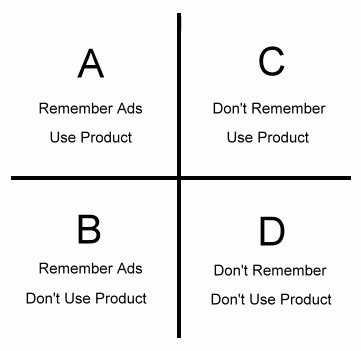
    Reeves Ad Penetration Test

    His staff phoned 1,000 people across the country at random and asked two questions:

    Are you familiar with our advertising?

    Do you use our product?

    He put the tallies into a grid much like this one.

    Please appreciate the elegant simplicity of this test.

    Some People Will Remember Your Ads

    The left side is made up of people who are familiar with your ads.

    As a percentage of the total, these people represent your MARKET PENETRATION. The higher your Market Penetration, the better your advertising is working. The lower your score, the greater potential for increased sales with a good advertising campaign.

    The top side is made up of people who buy what you have to sell.

    If ten percent of the unpenetrated group buys your product, and twenty percent of the penetrated group buys, you may subtract the first group from the second to get what Rosser Reeves called the “Usage Pull” of your advertising. Today it’s better known as the CONVERSION FACTOR.

    Sometimes, No Exposure is Better

    Thankfully, we don’t see it often, but it is possible to have a negative Conversion Factor. This is evidence that your advertising is actually harming sales. Should you find yourself in this situation, STOP YOUR ADVERTISING IMMEDIATELY and get help.

    Reeves techniques are nearly half a century old, but they still work exceptionally well. If you can find a copy, Reality In Advertising deserves a place in your marketing library.  Consider it a guidebook to go fishing for customers.

    Your Guide,
    Chuck McKay

    Marketing consultant Chuck McKayYour Fishing for Customers guide, Chuck McKay, gets people to buy more of what you sell.

    Have questions about whether your advertising is drawing customers?  Drop Chuck a note at ChuckMcKay@ChuckMcKayOnLine.com.  Or call him at 304-208-7654.

  • Trends and Cycles and Advertising In Them

    Trends and Cycles and Advertising In Them

    Trend graph.
    Trend graph.

    Originally published August 12, 2008.

    Some trends are cyclical. Some are obvious. Sometimes both. Most are also predictable.

    Are all trends cyclical? Hardly.

    In the 90s, as growing demand and sophisticated technology converged to create the Internet, providing service to local subscribers was a great growth business. Look at the incredible growth of AOL, Compuserve, and hundreds of local ISPs throughout the country.

    Today, however, Internet service is a commodity. There’s no hope of a repeat of the dramatic growth curve of the last two decades.

    Trend, yes. No cycle.

    But the housing boom of the last few years? That was an obvious trend, with an equally obvious cyclical behavior. Equity growth can’t continue at double digit rates indefinitely. By the time cab drivers and school teachers are buying second homes as investment properties, the boom is about over.

    Trend? Definitely. Cycle? Equally definite.

    We’ve seen this cycle before, haven’t we?

    We’ve seen what happens after a real estate crash. We all remember 1992.

    In each phase of each cycle, some businesses will benefit, and others will be damaged. Real estate brokers and mortgage lenders did very well during the real estate boom. They won’t be doing well in the immediate future. Bankruptcy attorneys and payday loan companies will, however.

    While the housing bubble was rising, anyone hanging out a shingle got business. Advertising? That was a totally unnecessary expense.

    Now that the bubble has burst, how many brokers have left the industry? How many have laid off their staff, and are again operating out of their homes?

    Suppose you had been the one.

    The one real estate broker in town who had realized that markets don’t go up forever. Suppose that you’d started building your image as a problem solver, as the company who can get it done, back when times were good. Who would stressed sellers turn to today to help them get their overpriced homes off the market?

    The time to build image, to create Top-Of-Mind-Awareness, is before someone needs your services.

    When times are good, people may choose you because of your reputation. They may choose you as a result of your advertising. But, sometimes, you may simply be the beneficiary of so many people in the market that you’re tripping over them.

    That was a fair description of the recent real estate market in this country. It’s about to be the description of the state of personal finance, too.

    Trend? Yup. Cyclical? Obviously. Predictable? You tell me.

    And, much like real estate brokering, and mortgage lending in the early years of this decade, do you suspect a dramatic increase in the number of bankruptcy attorneys and payday loan companies?

    Yes. It’s a safe bet (but probably a poor metaphor, huh?)

    So, what’s ahead for bankruptcy attorneys and payday loan companies? A year or so of so much business they’ll trip over it. Followed by lean times when the “market correction” has played out.

    What’s my advice?

    Don’t depend on your Yellow Pages ads.

    Oh, they’re working well right now. By the time someone is in trouble and needs your services, they’ll open the directory and search for any headline that promises them relief from their particular pain. When people open the Yellow Pages they’ve already decided to buy. But since they have no familiarity with you, and no preference for anyone, it’s a crap shoot whom they’ll buy from.

    When the onslaught of people in financial trouble diminishes (as all trends do), you’re going to have to start competing with other bankruptcy attorneys or payday loan companies for the small amount of business that’s left. You’re going to need an image in people’s minds if you expect them to pick you. You can’t build image in a directory listing.

    Start now in other media.

    Give compelling reasons that people who need your services should choose you. Start now when cash is flowing and investments in your future are less painful. Start now, because it takes time to influence the way people think, and you’ll need that time when you’re fishing for customers.

    Your Guide,
    Chuck McKay

    Marketing consultant Chuck McKayYour Fishing for Customers guide, Chuck McKay, gets people to buy more of what you sell.

    Got questions about how economic trends affect advertising? Drop Chuck a note atChuckMcKay@ChuckMcKayOnLine.com. Or call him at 304-523-0163.


  • Advertising Observations From My Hotel Room

    Advertising Observations From My Hotel Room

    Originally published February 10, 2006
    Some people when they visit a new community look for the typical “touristy” kinds of things. Others wonder if there’s a casino nearby. I study the local ads.

    This week I’ve traveled through four major southern cities. As you might expect, I have some advertising observations to share.

    Example Number One:
    Earlier this week I dropped in to visit a radio station because I’m a friend of the program director and morning disc jockey.

    While we were catching up, he played an ad for me that had a strong character espousing the client. The character was hammering away the copy points in a way that was nearly impossible to ignore.

    The client wants it re-done with a “regular announcer.”

    I told him that it was too bad that the client was intent on making the ad less attention getting and less memorable.

    Observation:
    When clients insist on making an ad sound like or look like an ad (ie. “professional”) they are effectively insisting that their ad be just like all the others.

    Estimates are that Americans ignore nearly 3,500 advertising impressions a day. Shouldn’t we be working to make our ads less like everyone elses?

    And please note that I’m not suggesting being different for the sake of difference. As the great jazz bassist and composer Charlie Mingus said “Anybody can play weird; that’s easy. What’s hard is to be as simple as Bach. Making the complicated simple, awesomely simple, that’s creativity.”

    Example Number Two:
    Ads that have attorneys screaming, “I’ll FIGHT for YOU. I’ll get you the money you deserve for your pain and suffering.” are probably running in most markets across the country. Does the same guy produce them all? They all appear to have the same script.

    Observation:
    This is transactional marketing taken to an extreme.

    Sobering thought: these ads must be producing results for the lawyers to keep running them in prime time.

    Example Number Three:
    You can’t build a positive image by piggybacking on someone else’s slogan. In a single community over the last thirty days I’ve witnessed “Got Insurance?” “Got Real Estate?” “Got Teeth?”

    Observation:
    Honestly, what do you think of these variations on “Got Milk?”

    Are you driven to do business with them?

    Do you get the feeling that these various businesses are able to solve your problems?

    Or do you suspect that they have nothing to offer, and are trying to cash in on someone else’s notoriety?

    Example Number Four:
    Why do the graphic artists who compose yellow pages ads insist on putting the client’s logo as the headline? I have the Memphis Bell South yellow pages open in front of me as I write this. I’m looking under landscaping.

    Here are the headlines.

    Bob Hollandsworth Landscape
    Complete Lawn & Landscaping Service
    Designscapes By D
    Growth Spurts Landscape And Irrigation
    Landscape Creations, Inc.
    Naturescapes
    Paradise Allscapes
    Tee Time Landscape
    Total Yards Landscaping

    Yes, I’m aware that these are the names of the businesses. That’s the point.

    Observation:
    It appears each of these companies is proud of their name. Unfortunately, as a shopper, I want to know what they can do for me. I’ll fix ‘em for making me do all the work. I’ll ignore ‘em.

    Now, among all of these easily-forgettable ads are two that hint at the ability to help me.

    When Skies Are Blue, We Rain – Blue Skies Irrigation

    From Concept To Completion, Your One-Source Solution For A Beautiful Landscape – Pugh’s Landscaping.

    Better, but I still have to think about them in order to see the advantage to me, the buyer.

    Therefore, the winner is clearly:

    Give Your Yard An Exciting New Look – Germantown Landscape Company


    At last, a clear promise of benefit. I now know what’s in it for me.

    Take a peek at your yellow pages ads. If the headline is your company’s name, you’re wasting money.

    Final Example And Observation:
    You probably shouldn’t assume that everyone knows how to find your store. “The oldest, ugliest building on Tanner Road” doesn’t mean anything to anyone who doesn’t know which section of Tanner Road to look in to find your store.

    Cleverness like this can actually cost you business. If you make shoppers solve a puzzle in order to respond to your ads, they’ll take the easy way out and file you permanently under “ignore,” which doesn’t work well when you’re fishing for customers.

    Your Guide,
    Chuck McKay

    ” href=”http://v69qtgw4rkz.c.updraftclone.com/wp-content/uploads/2006/01/Chuck.jpg”>Marketing consultant Chuck McKayYour Fishing for Customers guide, Chuck McKay, gets people to buy more of what you sell.

    Got questions about making your ads stand out and get noticed? Drop Chuck a note at ChuckMcKay@ChuckMcKayOnLine.com. Or call him at 304-523-0163.


  • A Priest, A Rabbi, And A Minister Walk Into A Bar

    A Priest, A Rabbi, And A Minister Walk Into A Bar

    Originally published December 2, 2005

    Most people are convinced that advertising is easy. Most believe that they could do a better job than the ads which inundate them daily. Perhaps they could.

    Some of them become advertising salespeople. Sadly, they are predictable. Their first predictable bright idea is to write ads using sex appeal. Their second predictable idea is usually to write ads using humor.

    So, the typical rookie radio or television salesperson staples a typical newspaper ad to a typical Broadcast Production Order form, checks the box to indicate “Spec spot” (that is, to be produced under the speculation that the customer may buy it), and under instructions to the copywriter writes “Make it funny.”

    Make it funny?

    MAKE IT FUNNY?

    Attach an eighth page listing of all the tire sizes on sale at Bob’s Tire Barn to the affor-mentioned Broadcast Production Order form, and tell the copywriter to MAKE IT FUNNY?

    “A priest, a rabbi, and a minister walk into a bar…”

    What’s the last thing the joke teller does before he starts this story? He looks to the left, and then to the right to make sure he’s not about to be overheard. What’s funny to some people is likely to be offensive to a significant number of others.

    And yet, advertisers and account executives keep telling ad writers to be funny, and ad writers keep trying to be.

    In radio or television the producer can direct the talent to inject “tones of voice” in order to cue people that something other than serious will follow. Those amusement signals are nearly impossible to do in newspapers or magazines.

    Fortunately, funny in print isn’t attempted as often as in other media. Unfortunately, about one ad in ten attempts it anyway. You’ll usually see the humor in the headline. That prevents the first line of copy from expanding and elaborating on the attention-getting headline.

    Oops.

    People can see funny faster than they can hear it, which is why we’re likely to see sight gags used in television. The major problem is the generic nature of gags. They seldom have any relevance to the product being advertised. Sight gags are bad advertising. They lead to the reason advertisers are perpetually tearing their hair out: people remembering the gag but unable to remember the product or the advertiser.

    Oops.

    Where television tends to be gag oriented, radio tends to be joke oriented, and like gags, jokes are seldom relevant. There’s no association between the set up or the punch line of the joke and the message the seller wants desperately to plant in the mind of the listener.

    The joke draws attention to itself. It draws attention away from the advertiser’s product.

    The funnier it is, the sooner it will irritate on repetition, (which assumes that it was ever funny in the first place). That’s why people say “Stop me if you’ve heard this one…”

    No joke is universally funny.

    A sizable percentage of the population won’t be amused. Trust me, the words “childish” and “stupid” come up frequently when real people critique “humorous” ads.

    Real people get confused by messages that aren’t expressed simply. Real people get offended by things that may not strike them as particularly funny. Even professional comedians tell jokes that they consider hilarious while the audience sits silently on their hands. Real people become annoyed at someone who tries to be funny, and fails.

    Oops.

    There’s a difference between humor which appeals to men, and that which appeals to women. International advertising agency J. Walter Thompson interviewed pairs of female friends in eight countries and concluded that male humor is based on competition and impressing people around them. Women use jokes to achieve intimacy and to make people feel at ease. Men prefer gags with a punch line. Women laugh at stories that relate to their everyday lives.

    Diana Coulson, director of strategic planning at J. Walter Thompson, Paris, said:

    “The key thing that emerged was that women’s main source of humor is from the everyday, the little issues, stuff they observe and that happens to them. They can find humor in a household chore, or something silly that somebody says to them at work. Men use humor in a much more competitive way. Men want to be funny to show off and to get people to admire them. It’s all about scoring points, whereas with women humor is much more a way of creating an attachment, bonding and getting intimacy with people. They are instinctively enhancing their relationships.”

    Humm. So men and women find different things funny? Who’d have thought?

    Humor can backfire. According to marketing consultant Martin Wales:

    “One laser eye surgery company was using humor in its ads, you can see them if you get redirected here. The competition capitalized on it by suggesting that there’s nothing funny about eye surgery.”

    In most major cities sizable portions of the people who live there come from other countries. Humor frequently doesn’t translate from one sub-culture to another. Instead of being funny these ads are confusing. They’re frequently offensive. Worse yet, no matter how much attention they draw, these ads seldom sell enough product. Following the “Yo Quiero Taco Bell” campaign, William J. McEwen, Author of Married to the Brand wrote in the Gallup Management Journal:

    “In a recent move that surprised relatively few industry analysts, Taco Bell announced that it was firing the advertising agency responsible for its award-winning TV commercials of the past few years. According to the company, the advertising that had built strong recognition as well as profitable merchandising opportunities for the Taco Bell Chihuahua was apparently unable to move product sales. Taco Bell sales have been reportedly flat — a situation clearly unacceptable to its management and to its stockholders..”

    Then there’s humor’s short shelf-life. You’re going to have to replace funny ads much more frequently because of the burn out factor.

    But you know the biggest reason jokes and gags fail? Their primary job is to persuade someone to purchase something from the company paying for the ad. And as we already mentioned, any attempt at communication that draws attention away from the core message is beyond stupid. When it’s your money being wasted, it’s criminal.

    The father of modern copywriting, Claude Hopkins, understood the purpose of advertising very well. In 1923 Hopkins explained:

    “Don’t lessen respect for your self or your article by any attempt at frivolity. People do not patronize a clown. There are two things about which men should not joke. One is business, one is home.”

    John Caples, author of Tested Advertising Methods, observed:

    “The two most influential books in the world have no humor in them: the Bible and the Sears Catalog!”

    Jay Conrad Levinson, author of the Guerilla Marketing series of business books said:

    “Marketing is not a stage for humor. If you use humor in your marketing, people will recall your funny joke, but not your compelling offer. If you use humor, your campaign will be funny the first and maybe the second time. After that, the humor will be grating and will hinder the very concept that makes marketing successful – repetition.”

    But, with a contrary opinion comes David Ogilvy.

    “I think this was true in Hopkins day, and I have reason to believe that it remained true until recently, but the latest wave of factor-analysis reveals that humor can now sell. This came as a great relief to me; I had always hated myself for rejecting the funny commercials submitted for my approval.

    “But I must warn you that very, very few writers can write funny commercials which ARE funny. Unless you are one of the few, don’t try.”

    Four famous advertising men with interesting, and slightly contradictory opinions. Are there facts? Surprisingly, considering how many multiple tens of millions of dollars are spent on humorous advertising, there’s precious little research done on it. At the least, every ad using humor should be tested against a serious ad to see which pulls better response.

    One such study was published in Journalism Quarterly in 1989. Bob T.W. Wu, Kenneth E. Crocker, and Martha Rogers did in a test of print ads for facial tissue and for athletic shoes. They found no difference in appeal or persuasiveness, but found “the attitude toward the ad” was higher for the humorous version than for the serious one.

    Did you catch that? People found the product no more appealing. They were not persuaded to switch brands. The only reported that they found the AD more entertaining.

    Our objective is not to entertain, it’s to sell.

    Can humor sell your product?

    Sometimes.

    Maybe.

    Most businesses should not use humor in their advertising. On the other hand, I willingly admit humor can be used quite effectively to sell product. Not jokes, but humor. A joke is only funny the first time. Humor is appreciated every time a listener hears it.

    A humorous touch can engage, and involve, the prospective customer. An ad that shows the advertiser’s sense of humor (or charm, or personality, or playfulness, or likability) frequently resonates in the hearts and minds of the public. When that happens, advertising gains credibility, and sales usually trend significantly up.

    The major problem is that at any given time there are only, what? Maybe a dozen people who can make humor work? Humorous ads are difficult to write well. It’s even harder for that well-written script to survive the treatment of producers, directors, and actors.

    What about your product, and the way it connects with the self-image of the consumer. High involvement products tend to have a longer purchase cycle. Prospective customers are more likely to search for hard facts. They won’t find those facts in a humorous ad. Unknown, expensive, or potentially embarrassing products won’t sell well with humor, either.

    Fun advertising has a much easier job selling snack foods, beers, sodas, cigarettes, movies, and music than it does in selling high ticket items. Fun advertising tends to work best with inexpensive disposable products that are themselves “fun.”

    Should you use humor in your advertising?

    Probably not. You’ll likely do far better when you stop trying to entertain and focus on offering benefits and spelling out value. (Note: I’m trying hard to talk you out of it).

    However, if you insist, here are some things that might mitigate the damage.

    • No sight gags. No jokes. Use humor to be friendly, rather than funny. When humor is subtle it’s usually more effective and suffers from less burnout than something more overt.
    • Use humor to attract customers, and make sure it doesn’t distract from the product. Use humor to reinforce and support your basic premise. Make it relevant to the product you’re selling.
    • Before you attempt humor, be sure you know your customers. Research if it’s available, personal observation always.
    • Do not use humor to attempt to deceive your customer. Humor intensifies people’s reactions. When they find you’ve not been truthful, you can expect outright hostility.
    • Don’t over-analyze humor. It’s either funny or it’s not. The best humor comes from the edge, where it can easily be offensive.
    • At the same time, don’t rush your first idea into the marketplace. Sleep on it.
    • Be thought provoking. Engage your customers’ imaginations. Let your customer experience “getting it.”
    • Be careful not to let prospective customers see themselves as the butt of your joke. Vonage’s “People do stupid things” campaign wouldn’t work as “You do stupid things.”
    • Use humor about situations, not people. Whoever they are and wherever they come from, people will usually identify with a situation.

    And above all, never lose sight of your purpose in advertising. Your purpose isn’t entertainment. Your purpose is to sell the product. Will humor motivate people to buy? Then do it. If it won’t, then don’t use it when you’re fishing for customers.

    Your Guide,
    Chuck McKay

    Marketing consultant Chuck McKayYour Fishing for Customers guide, Chuck McKay, gets people to buy more of what you sell.

    Got questions about writing ad copy, with or without humor? Call Chuck at 304-523-0163. Or “E” him at ChuckMcKay@ChuckMcKayOnLine.com.