Author: Chuck McKay

  • Politics, Religion, and Advertising

    Two years ago I got a different cell phone, with a new number. I had trouble remembering it until my wife pointed out that it’s composed of the month and year that I turned twelve, the year I graduated high school, and the year I was born. Since then, I’ve never forgotten it.

    This is an excellent example of how memory works. In order for any new information to stick when it hits our minds, we associate the new with something we already know. All successful memorization is associative.

    So is all decision making, which is an important point for advertisers. Each person’s opinion is built upon what she’s already accepted as fact, and can retrieve from memory.

    Sometimes she will accept new information and come to a new conclusion, which appears to contradict the earlier opinion. It doesn’t. The old opinion was based on the old information. The new opinion is based on additional information that complements the old.

    And when she is presented with new information that contradicts the old? She refuses to accept it. This does not compute. It must be a lie. As marketing guru Al Ries said in his recent Advertising Age article, The Sad And Unnecessary Decline Of Saturn:

    When you believe in something, what you generally do when faced with facts that seem to contradict your beliefs is to fault the execution, not the strategy.

    Conventional wisdom dies hard. You can defend any strategy by pointing out flaws in its execution.

    In other words, I choose not to believe what you’re telling me.

    This is the primary reason it becomes pointless to argue politics, religion, or new advertising campaigns.

    As advertising practitioners, the key point is: people refuse to accept any new information that contradicts their existing beliefs. Those beliefs become a big filter for new ideas.

    We call this big filter the Personal Experience Factor. When the new advertising campaign didn’t work, did the ad fail because people don’t know about Mr. Advertiser? Or because they do?

    Every contact Miss Customer has with Mr. Advertiser builds her Personal Experience Factor. Every new bit of information is filtered through that Personal Experience Factor. A lot of new information never makes it thorough the filter.

    Mr. Advertiser makes claim of great customer service. Miss Customer hears claim, remembers her last visit to Mr. Advertiser’s business, and thinks bull stuff.

    From that point on, not only will Mr. Advertiser’s claims fall on the deaf ears of Miss Customer, but she may well start sharing with her friends her personal experiences at the hands of Mr. Advertiser.

    When I worked at a News/Talk radio station in Columbia, South Carolina, we had a staff of about 30, pretty much evenly divided between the genders. In the space of a few short months through three major news stories I saw first-hand how perception of the news was affected by people’s previous experiences.

    • The Clarence Thomas confirmation hearings had opinions divided according to gender. Without exception men believed him, women believed her.
    • Lorena Bobbit’s trial, and her subsequent acquittal, had all of the women in our office standing and cheering. Our female news director shouted “There IS justice.”
    • The O.J. Simpson verdict split the bias along racial lines. Whites believed him guilty. Blacks believed him to have been set up.

    We all saw the same evidence. We came to different conclusions. Why? We all drew from different Personal Experiences as we weighed the evidence and made our conclusions.

    When new evidence contradicts your Personal Experience, then the evidence must be a lie. When it reinforces your Personal Experience, it’s likely true.

    Most women have had experiences with unwanted sexual advances. It’s easier for women to draw upon those experiences and say “That’s happened to me, just the way she described it. Most men have had, shall we say, more limited experiences in these areas. It’s harder for them to say “Could be true, because they’ve never shared that particular experience.

    A great many black Americans have had the experience of being stopped for “driving while black,” or know someone who has. It’s not out of their realm of experience to imagine someone being profiled.

    Most whites have never experienced the police automatically assuming them to be suspects. It’s harder for them to imagine the police pulling anyone over to ask what they’re doing in this neighborhood.

    What experiences has your customer had in dealing with you? Should it surprise you that her perceptions are not yours?

    Does she listen to you brag about your incredible selection while finding you don’t have anything in her size?

    Does she drive all the way across town for your advertised special to find that limited to quantity in stock means you only had three at this price?

    Does she hear all about your commitment to customer service while listing to the recorded on hold message as she waits 22 minutes for someone to help solve her problem?

    Is your advertising failing because Miss Customer doesn’t know about you, Mr. Advertiser, or because she does?

    One thing for sure, she won’t change her opinions about you until she starts having different personal experiences.


    People not only won’t accept that which contradicts what they already believe, but they will also find reinforcement all around them for things they do choose to believe.

    Here’s a quick non-scientific poll you can conduct among your friends.

    First question: Who’s responsible for the mess in New Orleans?

    Second question: How did you feel about this President before the hurricane?

    Here’s my prediction: People who were fans of Mr. Bush prior to the advent of Hurricane Katrina will blame local authorities. They will be angry that New Orleans’ Mayor and Louisiana’s Governor have both criticized the President.

    Those who were not fans of Mr. Bush before the disaster will use the apparent disorganization on a lack of planning at the Federal Level, and on the general ineptness of the Bush Administration. None of them will change their minds as more facts become available.
  • What Do Consumers Call It?

    The Internet is a wonderful marketing laboratory. You can come up with an idea at lunch, implement it this afternoon, and look over the results tomorrow morning. But this is not an article about web-based marketing.

    It’s an article about using information.

    The great thing about collecting customer preferences from the Internet is how quickly you can apply them to your off-line marketing.

    Search words, for example.

    Your customers, or potential customers, already have a name for what you do. Its up to you to find out the names they’ve given to your stuff, your services, your procedures.

    Use those names. Making people change their vocabluary only frustrates them.

    When customers have to try to remember your name for what you do, instead of just calling it by the name that comes to mind, they won’t order it. Which terms do they use when they want what you’re selling?

    Hardees restaurants used to have a pretty good ham and cheese sandwich. Customers called it a ham and cheese. Hardees insisted that it be called a “Yumbo.” Had Hardees called it a ham and cheese you’d likely still be seeing it on the menu. (There was also the added embarrasment of having to publicly proclaim “I’d like fries with my Yumbo,” but I digress).

    Sometime back a radio program director explained that her format, Adult Album Alternative, was going to be the next big ratings winner. I told her she didn’t have a prayer. Somewhat taken aback, she said “Well, our numbers are small now, but our listeners LOVE us. Our time spent listening is already the best in the market.”

    It doesn’t matter. Country radio listeners will tell you they listen to country music. Jazz listeners will proclaim they listen to jazz. Reggae listeners know they’re listening to reggae.

    Then there are your listeners,” I said. “What do they call the music on your radio station? You can safely bet that whatever they call their music, they don’t call it Adult Album Alternative.”

    When they can’t name it, they won’t recommend it. People can’t rave about your radio station, or your store, or your service, if they don’t know what to call it while they’re raving.

    You’ve been describing your business in your own terms. Your ads are producing a return on your advertising investment. You’re doing OK, so far.

    Humm. Is just “OK” enough?

    Imagine how customers would respond if you spoke to them in their own terms. How much more could you sell if your ads managed to resonate in the minds and hearts of your customers?

    It doesn’t matter if you have a web site or not. The words customers use to describe what they’re looking for on the web are the very words they use when they’re looking in real life. They’re the words you should use in your radio scripts, in your newspaper layouts, in your Yellow Pages listings.

    What do customers call what you do? Why aren’t you using those descriptions in your off-line advertising?

    Perhaps a coffee break spent Googling keywords would be time well invested.

    Do you know what your customers call what you do?

    Do you dare to not find out?

  • One Easily Remembered Point

    One Easily Remembered Point

    Dentist

    One of the things that too many small businesses do when they advertise is to try to pack the ad with everything that could possibly be of interest to any potential customer.

    After all, advertising is too expensive to waste any opportunity to sell everything to anyone.

    That’s logical, isn’t it?

    None the less, it’s guaranteed to be bad advertising.

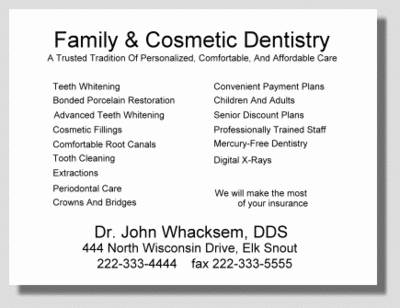
    Look at this Yellow Pages Ad

    It could easily be a radio ad, or television ad. The style isn’t at all different, merely the details of the execution.

    Dentistry Ad
    Dentistry Ad

    And as a Yellow Pages ad, listed with all competitors under “Dentists,” Dr. Whacksem is likely to get a few calls from this ad. He will, however, always suspect that his ad isn’t very efficient. It doesn’t draw enough business for what he’s paying. He’ll blame the medium. “My radio rep told me that Yellow Pages don’t work. She was right.”

    She’s wrong. So’s the doctor.

    The medium isn’t the problem, the message is the problem.

    What’s the message? Ah. There’s our problem.

    What is his message?  That he works on kids, and their parents, and older people, too? That he will accept insurance payments or make a payment plan? That he does fillings, and teeth whitening, and root canals, and extractions? That he does crowns and bridges and bonded porcelain? That he uses x-rays? That his staff is professionally trained? That he’s “mercury-free,” (whatever that means)?

    What is Dr. Whacksem’s message? I’ve counted at least fifteen, and that doesn’t even count him telling you how to get in touch.

    Without scrolling back up, how many can you remember? Humm. And that was only two paragraphs ago, after I drew your attention to it.

    Nobody will remember a list.

    Listing your services, or your products, is bad advertising.

    Instead of getting more information to more people, you’ll accomplish exactly the opposite. The message becomes part of a blur in the minds of the people who are already being clobbered by hundreds of other ads every day.

    This ad doesn’t say anything “salient,” anything a potential customer can relate to. Without that salience, it doesn’t stand out. It doesn’t get remembered. To maximize your impact, you need to give this ad salience.

    You need to make one simple, easily remembered point to one particular group of people.

    Some small business people get it right away. Many do not. Frankly, most do not.

    You’re telling me NOT to tell people that my dental office works on children, and adults, and old people. You want me not to tell people we do root canals, and teeth whitening, and x-rays, and takes most insurances? That’s crazy. What if someone needs a crown, and they don’t see that in my ad?”

    What if someone needs a crown, and you didn’t manage to get their attention in the first place? How many people do you believe actually read your list of services?

    Whatever the size of your business, your advertising will have a bigger impact if you limit your ads to one simple easy to remember message.

    Consider this ad from one of our first dentist’s competitors:

    Better Dentistry Ad
    Better Dentistry Ad

    First, notice the headline – “good news for high fear dental patients.” How many people are afraid to even be examined by a dentist? And even those who aren’t afraid will appreciate the promise of “Soft Touch.” Everyone will appreciate that their comfort is this dentist’s first concern.

    Notice, too, that the ad doesn’t list all of basic services. Truthfully, though, doesn’t every dentist do fillings? Root canals? Cleaning? Doesn’t every dentist use x-rays?

    Do we even notice that these things are missing? Do we care?

    No, we don’t.

    What do we remember?

    Instead, we remember that Soft Touch Dentistry doesn’t want us to hurt, or to be afraid.

    The second ad makes much more impact, doesn’t it?

    OK, but what happens when someone who’s not afraid of the dentist hits the Yellow Pages? Which ad is she drawn to?

    Care to speculate?

    Of course it’s the second one. Whether she needs a cleaning, a root canal, or a crown, our dental prospect is still not likely to even notice the first ad, and will react positively to the second. The second ad, the highly-focused single message ad, is the one our dental prospect will read. She’s also more likely to phone for an appointment.

    So, by narrowing the focus to a single point, we actually broaden the appeal of the ad. Wow.

    Then, there’s cost.

    And there’s something odd happening here. With all of its additional impact, the second ad takes only about 60% of the space that it’s competitor does. Soft Touch Dentistry makes a much bigger impact with a substantially smaller ad. Double wow. How much money will this save Soft Touch over the year? Better yet, how many more impressions can Soft Touch Dentistry purchase with the same budget?

    OK, one last thought: the Advertising Performance Equation (APE) represents the relationship between your message, the frequency of that message delivery to an audience, the customers’ experience with you, your market potential, and resultant sales.

    All other factors being equal, and without going into the math, making your ad twice as memorable will double the percentage of your advertising driven sales.

    And we like to double the catch when we’re fishing for customers.

    Your Guide,
    Chuck McKay

    Marketing consultant Chuck McKayYour Fishing for Customers guide, Chuck McKay, gets people to buy more of what you sell.
    Got questions about helping people to remember your advertising? Drop Chuck a note at ChuckMcKay@ChuckMcKayOnLine.com. Or call him at 304-208-7654.


  • One Quick Question

    Today I’m not offering perspective. Today I’m asking for your help. Today I want to know the one marketing question no one has ever answered to your satisfaction.

    Would you take the few seconds it takes to ask the question?

    Click here. And thank you.

  • Recipe For Customer Churn

    Over the years I’ve stopped doing business with quite a number of companies. Sometimes it was because my needs changed. More often it was because I was tired of being ignored.

    It always amazes me how hard most companies will work to acquire a new customer, and how little they’ll do to keep him.

    So, let’s take a test, shall we?

    Why Customers Leave My Business

    In each blank, please write the percentage of your former customers who left because of:

    1 _____ Price.
    2 _____ Customer needs changed.
    3 _____ Customer service.
    4 _____ Quality.
    5 _____ Convenience.
    6 _____ Functionality.
    7 _____ Other.

    Go ahead. Take your time. Since there can be multiple reasons, don’t worry about making the totals add up to 100%.

    Finished? Shall we compare your results to those of 369 other companies surveyed by Right Now Technologies*, as reported in a recent white paper?

    48%Price.
    35%Customer needs changed.
    21%Customer Service.
    17%Quality.
    17%Other.
    15%Convenience.
    14%Functionality.

    Do your answers look anything like these?

    Then you’re in deep trouble.

    Because while you’re reacting to a perceived price issue, or assuming that customers don’t need you any more, the customers have their own reason for not doing business with you. And their reasons don’t look anything like yours.

    Here’s what 300 customers said in that same survey:

    73%Customer service.
    31%Quality.
    25%Price.
    15%Functionality.
    15%Other.
    09%Convenience.
    08%Customer Needs Changed.

    When businesses think that 21% of lost customers are are the result of poor customer service, but 71% of the lost customers cite poor customer service as the reason they stopped buying from the business, we have a recipe for some serious customer churn.

    Have you followed up on your lost customers?

    Do you know why they stopped doing business with you?

    Do you even know whom they are?

  • What’s Your Story?

    When we talk about building your brand we always project into the future, and what your brand will become.

    Customers need time to buy, and use, and make your product part of their lives. It takes time for one generation to introduce your product to the next generation. It takes time to develop your company’s heritage. That heritage will then become a major part of your brand.

    Heritage implies tradition, and a traditional way of life. Heritage includes history, but also status, class, and character. Heritage has value to this generation, and to future generations. Heritage grows in shared experiences and common history.

    Brands share their heritage in the form of meaningful, memorable, and relevant brand stories.

    People love good stories.

    Our cultural heritage is built around stories. Our great art involves stories. Our politics revolve around stories.

    Today, with more entertainment choices available than any time in history, people still choose to be entertained by great stories of other human beings. Side note: the huge impact of reality programming just goes to show that today’s taste in gossip – or should I say storytelling – tends to run toward unvarnished “truth.”

    Ah. Truth. Truth is subjective, isn’t it? During the last election which story got more traction? The story being told about John Kerry’s military service in Cambodia? Or the story being told about George Bush’s military service in Alabama? Which was the truth? Was either? Both?

    People love a good story.

    Do you need a story? If you’re determined to develop a brand, you do.

    Good brand stories involve the user, and do so on an emotional basis. Your brand story must not be about the product.

    A name by itself, although it may have recognition, isn’t a brand. Your brand must be more than a name. Your brand will become the sum of the values, the beliefs, and the actions of your company. Your brand story will be tempered by the experiences of customers in dealing with your company.

    Good brand stories capture both the essence of a brand, and its desires for the future. Your brand story will tell the truth about your company. Maybe it won’t be today’s truth. Maybe it will be a truth that your company aspires to.

    Disney’s brand story involves the past, present, and future. The past is portrayed as the ideal community with clean streets where no one is ever threatened. It’s present is safe, secure, and happy. In Disney’s future you’ll never grow old, get sick, or die.

    Oprah’s brand story is that of American women’s best friend. Her show is made up of the back-and-forth conversation with emphasis on self-revealing intimacies that is the basis of female friendship.

    McDonald’s brand story is one of families having fun together. A family outing to McDonald’s becomes a celebration. The food is secondary.

    Your brand story must be consistent with everything your company does. Terrible things happen when the story you tell is contradicted by your actions. For instance, here is a different version of a brand story. You’ve no doubt seen it in your e-mail.

    “When you forward this e-mail to friends, Microsoft can and will track it (if you are a Microsoft Windows user) for a two week time period. For every person that you forward this e-mail to, Microsoft will pay you $245.00, for every person that you sent it to that forwards it on, Microsoft will pay you $243.00 and for every third person that receives it, you will be paid $241.00 Within two weeks, Microsoft will contact you for your address and send you a cheque.”

    Putting aside for a moment the realization that there are always going to be people who WANT to believe in fairies, in getting rich quickly, and in outrageous claims, why does this particular fraud continue to show up in our in-boxes? Perhaps it’s because many of us resent Microsoft.

    Microsoft’s brand story is one of a rich company ruthlessly annihilating any and all competitors to maintain a monopoly.

    Which leads to one more critical part of the equation: you get to write your brand story, but it won’t spread without the enthusiastic help of the ultimate users of whatever it is you sell. Brand stories originate with your company, but they belong to your customers. Once you’ve put your story into the marketplace, its’ no longer under your control.

    We started this discussion by addressing folk heritage. The common stories of our heritage are what identify us as a people. The common stories of our heritage live in our minds, but even more deeply in our hearts. Brand stories become a major part of our common heritage.

    When a motion picture, or a vacation destination, or an automobile, or a celebrity, or even a cleaning product becomes successfully attached to a powerful brand story, it enters our minds through our hearts to become imbedded in our memories. That’s when it becomes a brand.

    Share This Page With A Friend

  • Media’s Dirty Little Secret

    I’m constantly amazed by all of the media reps from all of the different media outlets that can help your advertising to “reach the right people.”

    Why am I amazed?

    Because they all reach the same people.

    Don’t believe me? Start with radio – there’s more information available, and the radio reps are eager to share it.

    Ask ‘em for exclusive cume figures. (Cume is the cumulative total of different people who tune in to the station each week. Exclusive cumes are people who don’t listen to any other radio station).

    You’ll find, as I have, that the exclusive percentage is usually around 3% – 4%.

    Occasionally you’ll find a truly unique format, like Christian, or Classical, or Korean. In these situations you may find exclusive cumes as high as 15%. But as rare as those formats are, exclusivity is even more rare.

    Television? TV is harder to demonstrate, since people tend to watch programs instead of stations. However, that fact alone should make my case. No television station ever has an exclusive audience.

    Newspapers? Not them either.

    And not outdoor, or cable, or point of purchase, or “specialty” advertising (like calendars or pens or Rubic’s Cubes with your name on ‘em).

    Nope. Absolutely no medium, absolutely no media outlet, has an exclusive hold on the right people.

    With only minor variations, everyone is reaching the same audience. According to Wizard of Ads research, approximately 70% of all of the radio stations in America, for instance, are suitable for advertising whatever you offer.

    And yet, we keep listening to the “We’ve got the right people” pitch. We want to believe it. We want to believe that just a simple minor modification to what we’re already doing will make us incredibly successful. “We have a great offer. We just need to reach the right people.”

    So we let the media reps perpetuate this nonsense.

    We should hold them accountable for consultation on improving the impact of our messages.

    Instead, we let them convince us that folks who read their newspaper, or watch their TV station, or listen to their radio station, or view their outdoor ads are the right people.

    And they’re wrong.

    No need to fuss at ‘em. Most are just repeating what they’ve been told. But they are wrong, none the less.

    They don’t have a lock on the right people. They share the right people with every other media outlet in town.

    Please don’t misunderstand. I’m not saying that it doesn’t matter where you place your ads. It does matter.

    But not for the reason you’ve grown accustomed to hearing.

    It matters because one exposure to an ad almost never leads to a sale. Regardless of the medium you choose, your ad needs to be repeated a number of times each week to make acceptable impact.

    The correct media outlets are those that allow you enough exposures while staying within your budget. In other words: the less expensive choices.

    They may well be the smallest media outlets in the market.

    Can you reach enough people this way? You tell me.

    How many additional sales each week do you need to reach your goal? Ten? Fifty? If you get the same response as direct mail and most internet sites, about two percent of the audience will purchase.

    So for ten additional sales, you need to reach an audience of only 500. Is there a newspaper that doesn’t reach 500 people? A radio station? A billboard? A cable tv system?

    For fifty more sales you’ll need an audience of only 2,500 – assuming that your offer interests them. It pretty much always costs less to reach 2,500 potential customers twenty times, than to reach 50,000 once. And as we said, very few things will sell on the strength of a single exposure to your ad.

    Face it. Ninety-eight percent of the people in any audience have minimal interest in what you’re selling. How do you reach the two percent who are interested?

    You write better ads. Then you put those ads into an efficient media buy.

    You write ads that appeal to the right people.

    But that’s a subject for next time.


    Send This Page To A Friend

  • Bad Seduction

    Bad Seduction

    I just read some advertising suggestions on an Internet marketing site that are beyond annoying. They are flat-out bad advice.

    They illustrate a complete lack of understanding of the whole persuasion process.

    First, small business owners are told that advertising often has a cumulative effect, so ad-driven sales may not be immediate. Then, they’re told how to measure and track the immediate response of their advertising.

    Reading past that little dichotomy, some of the suggestions included:

    · Use magazine response cards. Remember to code the cards if you use multiple publications.

    · Use a coupon in your newspaper ads. Code the coupons so that you can tell which publication generates the most sales.

    · Put a line in your radio scripts to “Mention this ad and get a 10% discount.”

    · Ask all new customers how they heard about your business.

    Make no mistake. These are all bad suggestions. Very bad. In addition to being very poor persuasion, each of these strategies assumes that your prospective customers are paying very close attention to your ads.

    Trust me, customers don’t.

    Good Advertising is Seduction

    Pretend with me for a minute that all advertising is an attempt to get a “date” with your prospect.

    How do these recommendations hold up under that scenario?

    Would you, for instance, send a response card to anyone you could possibly be interested in dating, which says “If you’d like to learn more about me, fill out your name, address, and your specific areas of interest in me, and apply your own postage to return it to me?

    No, I didn’t think you would.

    The advice contained in these recommendations also suffers from major misunderstandings in the motivations of customers.

    Coupons Assume That You Have Nothing to Offer but a Better Price

    Think about the implications of that for a moment. It suggests that after you’ve spent the money to advertise your discounted (and minimally profitable) price, that the customer has no reason to ever come back to do business with you again. Or at least, until you drop your price again.

    Mention this ad? In three decades of mass media experience, I’ve never heard of a single person saying “I heard your ad. Give me the discount.” Smart radio stations will never allow this on their air. Does that mean people don’t respond to advertising? No, it doesn’t mean that at all. It means that they won’t embarrass themselves by parroting your line. Not surprising, is it? Most people won’t admit that advertising affects them in any way.

    Ask new customers where they heard about you?

    Customers Don’t Know Where They Heard About You

    Oh, they’ll try to give you an answer. Really though, your advertising isn’t important enough for them to remember exactly what they learned about you, let alone the source of that information. But because they’ll want to be helpful, they will guess. They’ll usually guess wrong.

    There are two major problems with any of these “track your response” strategies.

    · They provide bad information. Bad information is worse than none at all. It gives you a distorted view of reality. Which leads to the second problem:

    · You’ll be tempted to make decisions based on this bad information. You will frequently make the wrong decisions.

    Consider this, instead. Send the object of your affection an “I love you” message.

    Does it matter whether your “I love you” comes in a telegram, an e-mail, a card, or over the phone? Or is the expression of love the most important consideration?

    Does it matter whether your ad message is delivered in the newspaper, over the radio, on cable TV, or by direct mail? Or is the message the critical part?

    Your advertising will improve by orders of magnitude when you spend less time attempting to find the most effective medium, and more time searching for the most effective message. Consider the message to be the bait you use when you’re fishing for customers.

    Your Guide,
    Chuck McKay

    Marketing consultant Chuck McKayYour Fishing for Customers guide, Chuck McKay, gets people to buy more of what you sell.
    Got questions about tracking your advertising? Drop Chuck a note at ChuckMcKay@ChuckMcKayOnLine.com. Or call him at 760-813-5474.

  • Reading Comprehension At 70 MPH

    Ben Franklin is reported to have once written “I apologize for the length of this letter. I didn’t have time to write a short one.”

    I chose Ben’s quote for our on-going discussion of advertising to draw attention to a basic truism: it takes more skill to craft a six word outdoor message than it does to write a 180 word radio commercial, or a quarter-page newspaper ad.

    Why six words? Because in order to see those words one usually glances at the “board” while doing 45 miles per hour down a city street (simultaneously watching for traffic) or while tooling down the highway at 70 mph. This requires the message to be short, simple, and easily comprehended.

    Perhaps six words are too restricting. Maybe eight words will work. Maybe eleven. But if you’re using eleven words, they’d better be short words. And short and simple, by themselves, aren’t enough. The key is to make those few words attention-getting, and memorable. This is where 99% of the outdoor advertising examples you and I see just don’t cut it. (Remind me sometime to rant about visual clichés).

    According to the Institute of Outdoor Advertising, outdoor has the ability to “generate awareness, create interest, and sell your product/service.” That was what IOA’s VP of Research, Cathy Hodges, told me in a letter 20 years ago. (Yes, I am an information pack rat. Yes, I really do still have the material she graciously sent May 2, 1985).

    In fact, the research indicates that with a 50 showing, over a four week schedule, you’ll reach nearly 80% of the adults in your market more than 13 times. There’s no doubt that outdoor advertising is the most cost-effective way to reach large numbers of people.

    Major national advertisers can use a short statement to reinforce the message they’re sending over other forms of mass media. We’ve all seen McDonalds, or Budweiser, or Ford extend the impact of their television with outdoor as a “reminder,” to build frequency.

    Other national advertisers market image, and don’t make a direct promise: Marlboro, Black Velvet, Chanel No. 5, or Coors Lite. Sometimes a strong outdoor showing is the only medium necessary to promote that image and build awareness.

    And on a local level, other media sometimes provide the best examples of how to effectively use outdoor. “Burt Smith, Accuweather, Channel Six at Ten,” for example.

    But for most local advertisers, outdoor isn’t a good choice.

    It’s that six-to-eleven-word practical limitation.

    More words mean less readership. Fewer words make it much harder to craft a strong message. Writing effective copy for billboards requires incredible skill.

    Today, however, we shall not dwell on the negative. Let me instead share with you of several gems that I saw as I drove North on I-35 from Wizard of Ads ® Headquarters South of Austin to my home West of Fort Worth.

    I saw hundreds of boards on this four and a half hour trip. Sadly, there are only six examples worth remembering.

    Those that I don’t remember? Several dozen real estate developments, all with pretty houses and such memorable messages as “Pinecrest, from the $180’s.” Car dealers bragging that they “will not be undersold.” Indistinguishable restaurant after indistinguishable restaurant after indistinguishable restaurant.

    But six that did stand out are excellent. Let’s look at them, shall we?

    First, my favorite use of outdoor – to give directions. Oh, you can add the promise of a benefit? So much the better.

    I appreciated this board for the touch of subtlety in it’s implied promise. Additionally, the Best Western logo was wrapped around the globe. Obviously, Best Western is everywhere. Excellent imagery:


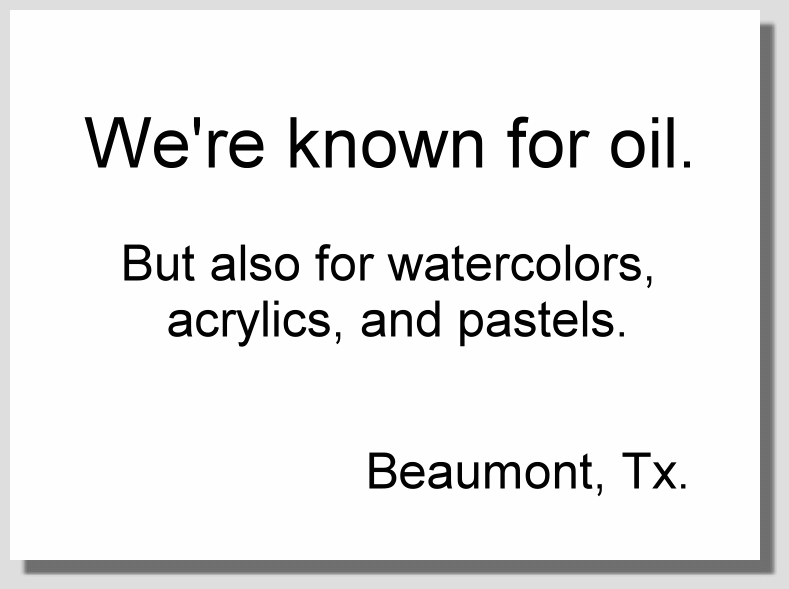
    Somewhere in Beaumont, Texas, a writer in the Visitor’s Bureau deserves a raise. Over a photo of the sun setting on the water:

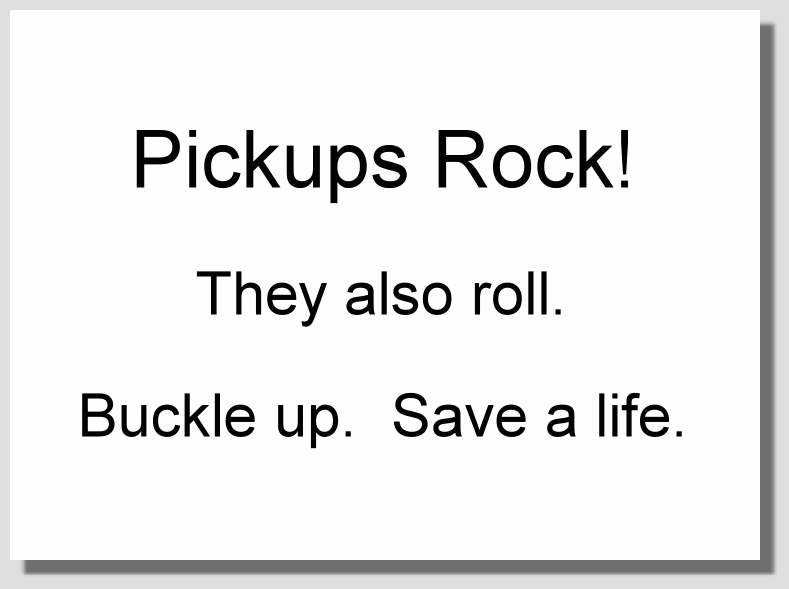
    Some of the best radio and television ads are public service announcements. That’s not surprising. Effective advertising involves emotions. Most writers admit that the easiest ads involve issues about which people are already emotional.

    Here’s the outdoor version of a public service announcement. Next to a graphic of an upside-down truck it said:

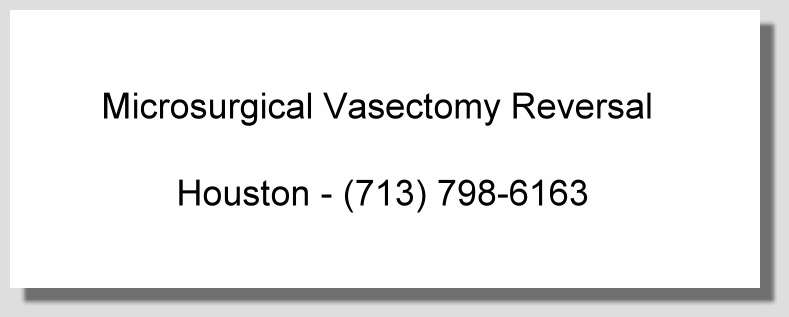
    Appreciate this next one for it’s simplicity. This board has been posted on major thoroughfares throughout the South for the last decade. Apparently gentlemen from Atlanta to El Paso have proven to be willing to travel to Houston for the procedure:

    This is too good an idea to not use locally. Chris Gloede, in his Rants On Modern Marketing blog suggests that with the proliferation of cell phones, a billboard is a great place to post a number to call for special offers or more information. It’s an idea worth stealing. Be sure to send Chris a “Thank you” note.

    And my final example, this board combines a strong implied benefit, with an excellent name, all wrapped up with a direction. As a bonus, the name (Bush’s Quick Chicken) and the implied benefit (three lane drive through) both promise the same thing… that I only have to pull off the road for a minute. Brilliant use of the medium. This board is my favorite of the whole trip:

    Considering outdoor? The cost of exposure isn’t the most important question. A much more important question is “Can I make an elegantly simple presentation of my business in only a few words?

    Well, can you?

    Send This Page To A Friend

  • Wishin’ Don’t Make It So

    Advertising can not fix a broken business. Oh, you might draw potential customers the first time through advertising, but from that point on it’s pretty much that customer’s Personal Experience Factor that determines whether she’ll be back, or not.

    Advertising can’t correct your company’s problems, either. As my dear, sweet, saintly old grandmother, Fanny McKay, used to say: “Wishin’ don’t make it so, and neither do massive amounts of gross ratings points.”

    Today brought to conclusion a 26 week test that further proves this point.

    Here are the facts:

    • The advertiser is a gentleman who came out of retirement to operate a small service business.
    • He truly is a craftsman.
    • He doesn’t intend to work many hours. He’s open from 9:30 am to 2:00 pm, and never open on weekends.
    • He didn’t spend much to buy the business, possibly because of its location.
    • He has a horrid location.
    • We wrote good ads, and explained that the odd hours were the price you paid for the excellent quality of his work at his price, which is much lower than anyone would expect.
    • The ads were voiced by a well-known and loved local personality.
    • The client received over 400 exposures per month on a local radio station, equally rotated through all of the station’s dayparts.

    And at the conclusion of six months, and well over 2,400 ads being played to this station’s audience, the advertiser had no improvement in business. None. Nada. Zilch.

    Should we be surprised? That a service business in a bad location with hours that most customers couldn’t keep, didn’t see those people changing their lives to do business on his terms?

    Send This Page To A Friend


    Ever been to one of Roy H. Williams free public seminars? People who have attended use such terms as “life-changing experience.” The next one takes place at Wizard Academy on August 4.

    I promise that you’ll never look at the world quite the same way again.