Author: Chuck McKay

  • Advertising and Air Conditioner Sales

    Advertising and Air Conditioner Sales

    Air Conditioner
    Window AC Unit

    Bear with me as we set up the facts of this story.

    This story is true. It actually happened. The people and the company involved are very real, but shall not be named. If they must have a name, call them . . . oh, let’s call them Little Brother Bob’s Hardware.

    L.B.B.’s Hardware has several stores in southern states. Each summer they stock, and sell, window air conditioners.

    The company had tradionally offered an incentive program for superior sales performance when it came to air conditioners. Each month’s quota was set at 110% of the sales from the same month a year ago. If any store outsold its quota of air conditioners, there would be a bonus of $25 per each additional unit sold over quota. The bonus money would be pooled, and the store’s manager could distribute to employees according to their contribution.

    The Advertising Started

    They bought ads in local newspapers. They passed out flyers in the stores. They mailed those flyers to the regular customers of each store.

    First month: the store in our little tale sold 16 units over quota, and earned a bonus pool of $400 for the manager to distribute to assistant managers and salespeople.

    Second month: 20 units over quota. $500 bonus.

    Enter the Contractor

    In the first week of the third month a local builder came in to the store carrying one of the flyers.

    He explained that he had just been awarded a contract to remodel a local hotel. He wanted to purchase 200 identical window air conditioners, and wanted to know how quickly he could arrange delivery of such a large number of units.

    The manager called L.B.B.’s Hardware’s home office.

    Home Office Reaction

    The home office took over the sale and dealt directly with the customer.

    Within 48 hours a new bonus program had been implemented. Effective immediately, the bonus potential was capped at $500 per month.

    In three years since the new bonus program has been in effect, Little Brother Bob’s Hardware has never again exceeded quota. At least, not this store.

    Most of us see a cause and effect relationship in this example.

    Do you have a bonus program for your salespeople? Is the program working with, or working against your advertising? How do you know? A strong repellent can cancel a great bait when you’re fishing for customers.

    Your Guide,
    Chuck McKay

    Your Fishing for Customers guide, Chuck McKay, gets people to buy more of what you sell.

    Got questions about staff incentives that will reinforce your advertising?  Drop Chuck a note to start a conversation at ChuckMcKay@FishingforCustomers.com. Or call him at 317-207-0028.

  • Four Media Predictions, part 3 of 3

    In the last two posts I’ve made some observations of My Network TV, the new News Corporation television network, and of MySpace.com, the News Corporation internet portal.

    News Corporation, as you know, is the Rupert Murdoch media conglomerate. That conglomerate exists because Murdoch has a history of recognizing opportunities. While the other networks are slugging it out in a zero sum game for the same viewers, for instance, he’s established sports programming distribution into China.

    Marketing consultants shouldn’t make predictions of what’s to come. If we’re wrong it blows our credibility.

    Then again, when we’re right, it tends to show that we do know what we’re talking about.

    Hummm.

    Let’s tie my observations in parts one and two of this series into some projections, shall we?

    First, younger viewers are spending more time online. And thanks to broadband (which gets faster and cheaper every year), it won’t be long before they turn to the web for longer form programming. I predict that News Corporation will develop programming content that will easily transfer from My Network to MySpace to multiple other new-media platforms.

    Second, as MySpace continues to develop, among members of the emerging generation it will become more influential than MTV.

    Third, I predict that as MySpace grows in influence among younger web users, Yahoo, AOL, and MSN will be negatively impacted.

    And finally, earlier this year Fox used MySpace to promote the Fox TV comedy Free Ride. Without buying ads, they managed to work viral marketing to launch the show.

    Watch for more. I predict this will become a textbook example of integrating content and using new media to recruit viewers for traditional media.

    One last observation:

    As of mid May, My Network TV already had 141 affiliates. Their combined reach is 89.9 million households, which equates to 81.6% of the U.S.

    Its still waaaaay to early to recommend My Network TV and it’s programming.

    But shouldn’t we all be watching closely on September 5 to see what happens after they launch?


  • From the Department of Redundancy Department – part 2 of 3

    Anyone who has been the parent of a third, fourth, or fifth grader already knows the truth: it takes a lot of repetition for long-term memory to be affected.

    In most school districts students start learning the multiplication tables in the 3rd grade. How much is three times four? Right, twelve. And three times four? Good. How much is three times four? And three times four is…..?

    In the fourth grade? Again, how much is three times four?

    And in the fifth grade? Yep. Multiplication tables again.

    Why? Because it takes a lot of repetition to affect long-term memory.

    Of course, marketers know this too. Winning marketers know that it costs the same amount to reach 100% of the people 10% of the time, as it does to reach 10% of the people 100% of the time. The first strategy will fail. The second will succeed, provided, of course, that the message is salient.

    McKay’s advice: when forced to choose between reach (total circulation) and frequency, always choose frequency. Frequency sells.

    Why? Because it takes a lot of repetition . . .

    My favorite frequency media include outdoor, radio, and direct mail.

    It’s tough to get frequency in television. Or at least it has been.

    People listen to radio stations, but they watch tv programs. Viewers have no loyalty to a particular television station. In the minds of viewers, television stations are similar to their electric service or their telephones. They’re only aware of the provider when the service is interrupted. When this show is over, the viewers will choose another show. Maybe on this station. Maybe not.

    Historically, in television the only way to insure that a particular audience is exposed to an ad an average of three times is to buy three ads within the same program.

    But My Network TV is about to change the rules. Their first season will exclusively be made up of two telenovelas – drama which is scheduled daily.

    So, you don’t like much of what’s on tv these days? Too much reality programming? You like a solid tv drama but the networks have taken away The West Wing, there’s only one episode left of Commander In Chief, and they’ve killed off your favorite characters on ER?

    Hummm. Maybe you’ll be curious about My Network TV’s Desire or Secret Obsessions. And if you like either, you’ll be tuning in night after night after night… Monday through Friday, with a weekly summary show on Saturday (in case you missed an episode this week).

    I’m thinking that three or four weeks into either show, we’ll all know who’s watching. We can also predict that they’ll be around until the end of the show’s 13-week run. And, I see this as an opportunity to build frequency on television.

    Don’t misunderstand, I’m not endorsing My Network TV. It’s too new a concept, and way too many great ideas were stillborn in the marketplace. Plus, we have no idea yet how many people will be watching either program.

    But I will be watching closely September 5 when the new network launches.

    Will you?


  • Television and the Short Novel – part 1 of 3

    Normally, I don’t get excited about the announcement of new programming, or of new programming sources. And don’t get me wrong, I’m not excited now, either.

    But I am intrigued with Fox’s new My Network TV, which will launch September 5 of this year.

    When UPN (owned by CBS) and the WB (owned by Time Warner) announced they would merge to form the CW this fall, it left all ten of Rupert Murdock’s News Corporation stations in major markets facing a future with no programming.

    News Corporation also owns the Fox network, who quickly announced the formation of My Network TV.

    A year ago News Corporation purchased MySpace dot com, a web destination that reportedly has eighty-five million users. So far, MySpace is known as a young people’s social networking site as well as a good vehicle for selling new music.

    So, it’s really no surprise that My Network TV is going to be targeted to the eighteen-to-thirty-four crowd. However, it appears to me that My Network TV is targeted to an even narrower (and faster growing) demographic: the eighteen-to-thirty-four Hispanic market.

    Across the US Hispanics represent just over 10% of all households. But in the cities that make up My Network’s initial affiliates Hispanics account for over a third of all homes.

    In markets like Southern California, nearly half of the Hispanic residents are under 25. And all across America the vast majority of younger Hispanics are bilingual.

    In many of those markets, the local Spanish language TV stations lead the market in ratings, and identify themselves as “Nuestro Canal” or “Tu Canal” (Our Channel or Your Channel).

    The new network is called My Network. Hummm. You be the judge.

    Let’s look at the programming.

    My Network will broadcast only twelve hours per week. There will be two serialized hour-long dramas for the first season called “Desire” and “Secret Obsessions.” New episodes will air every weeknight, with a weekly recap on Saturday.

    Each story will run for 13 weeks, and be replaced with another telenovela (Spanish for Short Novel). Univision and other Spanish language broadcasters have found this format to be a hit with their viewers. With the popularity of such television drama as Lost, Gray’s Anatomy, and Desperate Housewives, don’t be surprised if the English speaking market warms up to the telenovela format as well.

    Other shows in the works include a fake psychologist who falls in love with a patient; a reality show searching for top models; a contest show with prizes for trivia knowledge; the story of a pilot and an heiress who survive a plane crash; and a Fox-developed investigative crime series.

    Yup. I’m intrigued by My Network TV, because it appears to target young English-speaking Hispanics.

    And, just as Spanish words have become part of mainstream America, just as Mexican dishes have become regular American fare, the telenovela will become a staple of younger Americans, too.


  • Waiting For Your Cat

    I was first exposed to Persuasion Architecture TM in a Wizard Academy class taught by Bryan and Jeffrey Eisenberg. From my hotel that evening I phoned my son, the retailer.

    Think about it, Chad,” I said, “you identify the personalities of your customers, and then you anticipate what they’ll want to know, or to do, in order to do business with you.

    “How much more money could you make if you could be planning ahead to give your customers exactly the shopping experience they want? What would happen to your word of mouth if they all left knowing with certainty that you understood them?

    We brainstormed the possibilities for well over the next hour.

    You, Dear Reader, now have the advantage.

    You don’t have to travel all the way to Wizard Academy, near Austin, Texas on those rare occasions that the Eisenbergs have been available to teach that class. (Although if you ever get the chance, believe me, you won’t want to pass it up).

    No, you can simply pick up a copy of their new book, Waiting For Your Cat To Bark: Persuading Customers When They Ignore Marketing, for only $19.99 (or $14.39 if you’re a member at BN.com; $12.99 at Amazon.com).

    As Jeffrey says in his introduction, “We explain the principles and framework … for tying all the communications your company makes into a coherent persuasive system.”

    He goes on to explain that chapters one through six explain how and why marketing has permanently changed. Why customers respond differently than they used to (chapters seven through thirteen). That chapters fourteen through twenty-two address anticipating what your customers require, and how Persuasion Architecture TM bridges the marketer / customer gap in chapters twenty-three through twenty eight. And finally, how you can start implementing Persuasion Architecture TM in your business.

    Bryan Eisenberg and Jeffrey Eisenberg, with Lisa Davis have written one of the best business books of this decade in Waiting For Your Cat To Bark.

    If you deal with customers, and you’ve noticed that they don’t react as they used to, you need to understand Persuasion Architecture TM.

    If you haven’t yet noticed, you definitely need to understand Persuasion Architecture TM.


  • Differentiate Or Die*

    As the American continent was settled, pioneers took with them the things they couldn’t do without. Those things they could do without, they did without. This provided an opportunity for the first peddlers.

    A peddler would load up a Conestoga wagon with anvils and thimbles; frying pans and print fabrics; hammers and saws; gunpowder and fishhooks and filleting knives; coffee and sugar and salt. He’d then pull his rig up in the center of the new community and start banging a drum to get the attention of the pioneers. (This is the origin of the nearly obsolite term “drummer” to mean traveling salesman).

    Since there was an existing demand for nearly everything the pioneers had left behind, these early peddlers could sell nearly everything in their wagons, quickly, at a profit.

    As distribution improved, the general store became the more permanent variant of the Yankee peddler, the drummer, the traveling salesman. The outgrowth of the general store was the department store.

    The one constant was demand. Demand for nearly everything. Until distribution became cheap and easy, goods would continue to be in short supply. When a manufacturer could find a peddler, or a store, or a department store to stock his goods, the market would find, and purchase, those goods.

    But that hasn’t been the case in quite some time, has it?

    Distribution is no longer an issue. Now, we have choices. Limitless choices. With the maturation of the Internet, shoppers literally have the world available at their fingertips.

    This amazing proliferation of choices is a result of, well, choice. Choice forces more choice through the process of division.

    Take a single item, or service, say dining. Originally there were inns or roadhouses. Places where a traveler could buy a meal, a libation, or a night’s lodging. Then the process of division set in to create categories.

    Roadhouses divided into hotels and restaurants. Hotels divided into hotels, motels, campgrounds, and RV parks. Restaurants divided into fine dining, family restaurants, and fast food.

    Fast food became Mexican, Italian, Chinese, and burgers.

    The marketing of burgers has split into restaurants appealing to children (McDonalds Happy Meal and playgrounds), to adults (Have it your way at Burger King), to people with big appetites (Hardees and the Monster Thickburger), to people looking for value (The $6 burger for only $3.95 at Carl’s Jr.).

    The burger wars have even spilled out of fast food and over to TGI Fridays and their Meyer Natural Angus (TM) Hamburger – targeted at people willing to pay extra for quality.

    How long can this division process go on? As long as more suppliers want to get into the game.

    In fact, it must go on.

    Each division in turn becomes a separate category, which invites more division. Each division offers the consumer more choices. If we’re to convince shoppers to choose our products (or services) when they could choose literally anybody’s, we must differentiate our products (or services) from all of the others.

    This is contrary to what most people consider common sense. It appears logical that if McDonalds has the biggest percentage of hamburger sales, that taking a couple of percentage points from McDonalds could make a small company rich. We’ll just do what McDonalds does. Unfortunately, without differentiation, those percentage points simply aren’t available.

    As a consumer in the mood for a burger, would you choose a quarter pounder with cheese from McDonalds, or a comparable sandwich from the new ABC Burgers – a company you’ve never heard of?

    For that matter, would you choose ABC Burgers, or Burger King? Hardees? Carl’s Jr? Rally/Checkers? Business nearly always goes to the better known company.

    That is, unless we can come up with an excellent reason for you to choose ABC Burgers.

    I promise that reason won’t be “We’re just like McDonalds.”

    It helps to get inside the consumers’ minds and understand that every decision carries the risk of being the wrong decision. Consumers minimize that risk by trusting that their previous experiences will be repeated. Indeed, companies like McDonalds, and Burger King, and Hardees go to great lengths to insure that the burger they purchase in Bismarck will taste exactly like the burger they purchase in London.

    A consumer might buy an ABC Burger instead of McDonalds quarter pounder if it were bigger, or less expensive, or was grilled over mesquite, or used three different cheeses, or was garnished with ABC’s proprietary barbecue sauce, or if they offered a money back guarantee that you’d love their burger.

    All of these reasons are examples of differences.

    In order to persuade anyone to purchase an ABC Burger, we’ll have to come up with an excellent reason to buy one. And choosing among multiple options always comes down to differentiation.

    I presume you want to persuade people to buy from you. Does your company exist among multiple competitors? Then, we’ll have to come up with an excellent reason to persuade those people.

    Choosing among multiple options always comes down to differentiation.

    What makes your company different?


    *Differentiate or Die, Survival in Our Era of Killer Competition is an excellent book on this topic by Jack Trout. I recommend it highly.
  • Can Breakeven Analysis Predict Your Coupon Success?

    Can Breakeven Analysis Predict Your Coupon Success?

    Pretend with me that you own a snow cone cart (or as they call it in the South, “shaved ice”).

    You’ve mentioned to a friend that your sales are ok, but that your business isn’t growing. She suggests that since people love a bargain that you distribute a “buy one get one free” coupon.

    Can You Predict the Impact of That Coupon?

    Yes, I believe that you can.

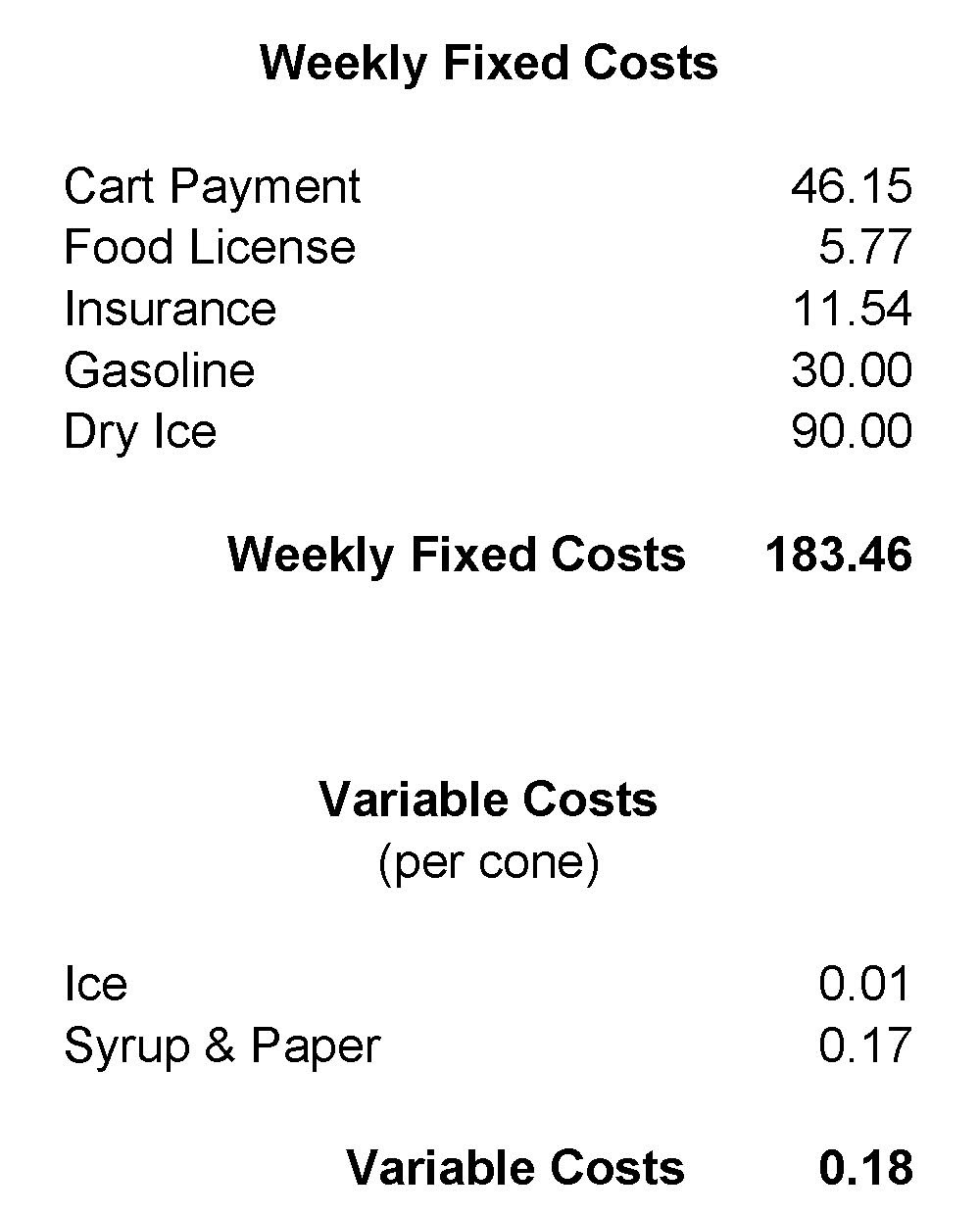
    You financed the cart and are paying $200 per month for it. You pay $300 per year for your license to sell food. Your liability insurance runs $600 per year.

    You use $15 of dry ice each day to keep your shaved ice cold. You use your car to tow the cart to the public park in which you sell your cones, and spend about $30 per week in gasoline. You use roughly $0.17 in syrup, paper cones and napkins for each snow cone served. You purchase your ice for $0.80 per bag, and use roughly 5 bags each day. (Some always melts by the end of the day and is wasted, but it’s better than being caught short).

    Oh, and you sell ‘em for $1.50 each.

    We’ll Use a Technique Called “Break Even Analysis.”

    This technique is useful in start up operations to calculate the number of sales at any particular price point to “break even.”


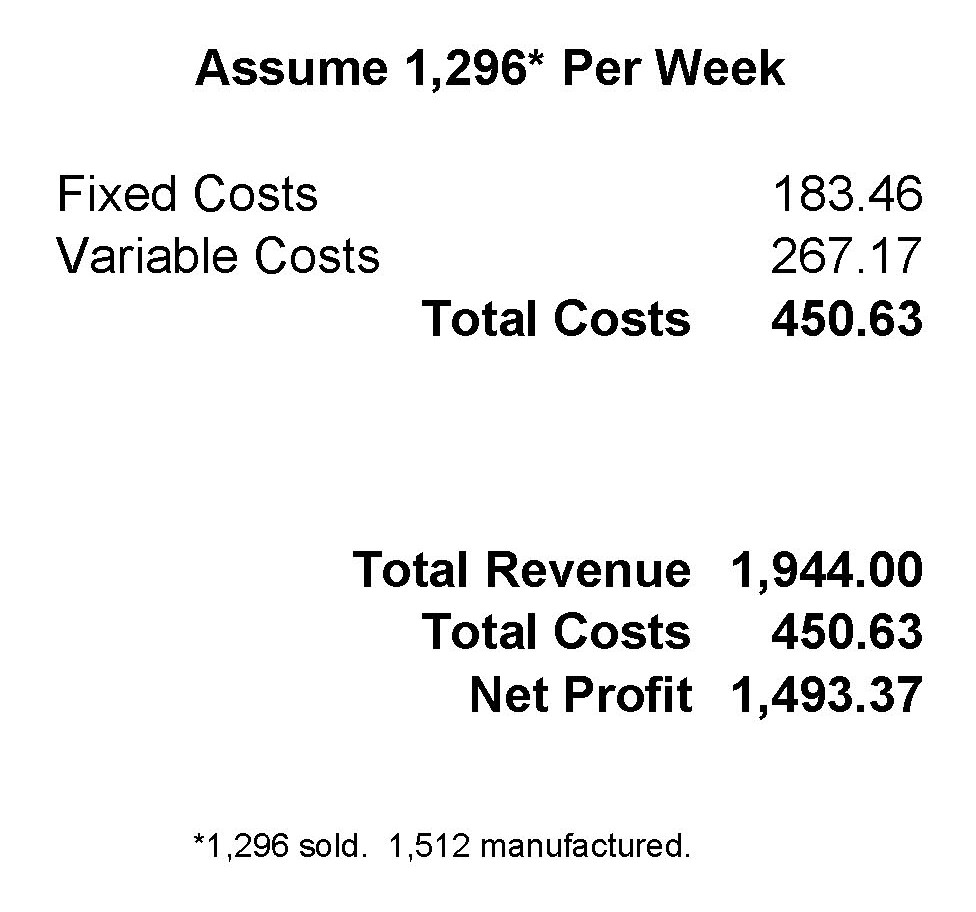
    Assuming that demand is roughly 14 cones per hour, and you are open from 10am to 10pm six days a week, what’s your weekly revenue and net profit?

    Now, what’s likely to happen when your “buy one get one” coupons are distributed and redeemed?

    People won’t drive clear across town to save $0.75. Your coupon renewal will happen within a six to ten block radius.

    Humm.

    These are already your regular customers.

    Some of Your Coupon Sales Will Cannibalize Your Regular Sales

    But then, some of the regulars who haven’t been by in a while will be reminded by the coupons. And, of course, there are always going to be people who have never bought before.

    Let’s make some assumptions, shall we?

    1) The coupons will boost your business by 6 redemptions per hour (12 cones).

    2) Three of those coupons will be renewed by your existing customers.

    In other words, your gross sales will increase from 12 to 18 per hour, but you’ll be dispensing 21 cones per hour – 210 and 252 per day, respectively.

    Now your variables will look like this:

    So, are the coupons a good idea?

    Can you apply break even analysis to your next promotion? Finding the bait with the top ROI is of major importance when you’re fishing for customers.

    Your Guide,
    Chuck McKay

    Marketing consultant Chuck McKayYour Fishing for Customers guide, Chuck McKay, gets people to buy more of what you sell.

    Got questions about couponing, or about breakeven analysis? Drop Chuck a note at ChuckMcKay@ChuckMcKayOnLine.com. Or call him at 760-813-5474.

  • How Housing Affects Your Sales

    Brace yourself. The good times are about to stop rolling.

    The real estate market has stopped expanding. Some economists are predicting the bubble will burst. Others predict a soft landing. But any way you cut it, the bubble has stopped growing.

    The inventory of houses in the hottest growth markets continues to grow. A year ago in the hot zones houses sold in less than thirty days. Today the average home in those communities stays on the market for at least six months, and the number of months is growing.

    Next step? Homeowners will decide they can’t make a seventh mortgage payment on the old place, and will start dropping price to promote a quicker sale. It won’t take long before everyone is forced to drop price.

    Then there are those interest-only loans that people used three years ago to buy more house than they could afford. These va mortgage rates today have far different rates than one could get years ago. The loans were short-term, and converted to a conventional principal plus interest loan about… well, about now. That means a much higher house payment – a payment that many of them will no longer be able to afford. In markets like San Diego and Las Vegas the repossession rate is already growing at an alarming rate.

    Why am I talking about real estate in a marketing column? Because Americans are a peculiar people. Each time we determine that we’ve improved our net worth, we spend about 10% of it.

    For the last six years, American homeowners have spent with reckless abandon as they perceived growth in their homeowner’s equity. They didn’t spend actual cash, but rather added to their credit card debt. The growth has stopped. The debt remains. Consumer optimism is about to screech to a halt.

    Soft landing? Bubble burst? Doesn’t matter. Without upward motion in real estate consumer spending is about to change abruptly.

    What will you do when consumer optimism ends?

    How are you going to attract new customers to your business when they’re afraid to spend?

    Why aren’t you doing that already?


  • Do You Have To Drop Price To Increase Sales?

    Do You Have To Drop Price To Increase Sales?

    1976 Buick Century Wagon
    1976 Buick Century Wagon

    In 1985 while living in Florida I paid $1,000 for a 1976 Buick Century Wagon.

    The wagon was a bit older than I would have selected under other circumstances, but the previous owner had the most incredibly detailed maintenance records on the vehicle. I assumed (rightly) that he must have kept the car in remarkable working condition. Besides, it was the appropriate size to ferry all of the kids to their various commitments.

    That car was one of the most dependable I’ve ever owned.

    Two years later, when I accepted a job in California, the mother of my children said “This car is now eleven years old, and I don’t think I’d like to drive it across the country. Let’s sell it and buy a different car when we get there.”

    Then she added “And I want to sell it.”

    Like a number of first time advertisers, she called the local newspaper’s classified department. Discovering that every additional word cost her more, and trying to save money, she dictated “1976 Buick Century Wagon. Must see to believe. $500. Call (904) xxx-xxxx.”

    Total cost? Fourteen dollars for ten days.

    Days passed

    More days.

    No phone calls.

    At the end of the first week, she asked “Do you think I need to drop the price? Would it sell at three hundred?

    I said “Let me see what I can do.”

    I called the paper and changed the ad to: “Perfect second car for family with children. Clean, incredibly maintained 1976 Buick Century Wagon in perfect working order. Automatic transmission, cruise control, electric adjustable seats, electric windows, electric rear window, electric retractable antenna, air, AM/FM casette, new tires, good upholstery, headliner and carpet. Comfortably seats nine. Everything works. $1,000. By appointment at (904) xxx-xxxx.”

    Total cost? $37 for the week.

    We got exactly three calls the day the ad hit.

    One buyer asked to come see the car immediately, and brought cash. He counted out the bills, I signed over the title, and called the paper to cancel the ad.

    Two lessons

    First, spending too little to do the job is the most expensive advertising that any of us will ever do.

    As Charles Mortimer, former Chief Executive of General Foods said at a 1963 shareholders meeting, spending too little in advertising “is like buying a ticket three-quarters of the way to Europe. You’ve spent your money but you don’t arrive.”

    Second lesson? Often, it ain’t the price. It’s the sell.

    You see, every decision carries the risk of being the wrong decision.

    As advertisers, our objective is to minimize the appearance of risk in purchasing our products or services.

    Dropping price can reduce the risk, but it can also kill profitability.

    Providing our prospective customer with enough reassurance that (s)he’s making the right decision also reduces the risk. Customers are willing to pay more when they’re sure they’re doing the right thing.

    What can you do to minimize risk?

    Can you do it without dropping price?

    Better yet, can you aggressively raise your price, and do a better job of selling? Its not enough to catch ’em. You have to make ’em profitable when you’re fishing for customers.

    Your Guide,
    Chuck McKay

    Marketing consultant Chuck McKayYour Fishing for Customers guide, Chuck McKay, gets people to buy more of what you sell.
    Got questions about writing seducing headlines and emotional appeals? Call Chuck at 304-523-0163, or write ChuckMcKay@ChuckMcKayOnLine.com.


  • Will You Deliver By Friday?

    Robbie,” I said, “will you deliver the artwork by Friday?” Robbie looked at me and said “Well, I’ll try.”

    So, you’re not going to make a Friday delivery,” I asked? Robbie said “I told you, I’ll try.”

    But that wasn’t the question, was it?” I pointed out. “The question was, ‘Will you deliver the artwork by Friday.’ I’m not asking for effort. I’m asking for commitment. You have refused to make the commitment. I’m interpreting your answer as ‘No.’”

    As you might imagine, Robbie doesn’t get any of my business.

    Are you a supplier of goods or services? Do you deliver when you say you will? Is your word a binding commitment?

    It’s just you and me, here. You can be honest.

    Your customers don’t care about the difficulties that have popped up in your life, or your business. They don’t want to know about unplanned urgent distractions. They don’t want to know that your suppliers are backordered. They just want you to deliver on time.

    My partner, Roy Williams, often asks “Why do customers not come to your store? Is it because they don’t know about you? Is it because they do know about you?”

    My friend and former boss, Rick Dames, says: “It’s so simple. Just do what you say you’re going to do.”

    It IS simple. Not necessarily easy, but simple.

    Is your word a binding commitment?

    If your answer is “Yes,” consider making that willingness to commit part of your marketing strategy.

    But if your answer is “No,” understand that advertising won’t help your business.

    Oh, advertising may get you some new short-term customers. But when you disappoint them, the collective negative word of mouth is going to outweigh any positive impressions left by your advertising.

    So, what’s it going to be?

    Is your word a binding commitment?

    Will you deliver by Friday?