Author: Chuck McKay

  • Four Stories – Two Outcomes – One Moral

    It’s been said, perhaps too often, that nothing happens until someone sells something.

    Then again, maybe it hasn’t been said enough.

    Example #1 – The concert.

    A not-for-profit agency decided to promote a concert as a fundraiser for their organization. They paid the deposit on a minor-league baseball stadium in which to hold the event.

    They contacted a great number of family-friendly performing artists, asking them to perform gratis, to benefit the good works of the organization. Several artists indicated interest, but were unable to immediately commit, citing the need to clear their schedules.

    The not-for-profit agency was advised to find sponsors for the event, in order to be able to pay for printing, advertising, security, and legitimate out-of-pocket expenses. They determined that they’d have an easier time acquiring sponsorship if they waited until the acts had all confirmed.

    Things went along smoothly, until time to start paying miscellaneous expenses.

    The not-for-profit group kicked into panic selling mode. Prospective sponsors, feeling the desperation, quite naturally distanced themselves. The family-friendly acts stared asking why no agreements were being put into final form.

    The not-for-profit ran out of time, forfeited the deposit on the venue, as well as their credibility with the artists, the venue, and the community.

    Example #2 – The study tool.

    A husband and wife sold the business they’d built over the last decade for enough money to last the rest of their lives. They signed a non-compete agreement, which prevented them from creating a new business in the same industry.

    They attempted to retire. They failed at it.

    Feeling the need to do something, they looked for an opportunity in a new industry. The No Child Left Behind Act of 2001 had become the law of the land, and someone mentioned the need for additional study material. How much study material? Enough to provide tutoring for every class taught in all 13 years of public education.

    They formed a company to produce self-tutoring study guides. They hired several school teachers to write the individual learning modules.

    Our entrepreneurs determined that there would be less pirating of their soon-to-be copyrighted materials, if the study guides were only accessible on-line. They hired two software coders to make the materials interactive.

    When they were finished composing, debugging, and making the product user friendly, everyone admitted that they’d created an incredible product. By their estimate, they sunk half a million dollars into this project.

    Completely prepared, they started contacting school districts. None of those districts made appointments for demonstrations. Seems those school districts had already contracted to use another company’s product, even though it was still in the early stages of development and wouldn’t be available for another year.

    Example #3 – The radio show.

    A real estate broker, wanting to enhance his reputation in the community as a credible problem solver, contacted the local talk radio station to purchase an hour of time each week.

    Then, as the host of a new call-in show, he sold ads within his program to a mortgage broker, a plumber, a landscaper, and a building contractor. By the time the first program aired, his broadcast had turned from an expense to a new profit center for his brokerage.

    Example #4 – The headhunter.

    While looking through the help wanted ads, an unemployed salesperson noticed a large number of positions available in a specific narrow field.

    On a whim he phoned a few, represented himself as a headhunter who worked in that field, and asked about the range of compensation. He also asked about the employers’ willingness to pay a fee for his services. When enough of them agreed, he offered to send over an agreement.

    Then he started phoning companies who employed workers in that field. When he got them on the phone, he told them he had employers lined up who were paying well for people with their particular skills. Did they know of anyone who would be interested in interviewing?

    A quick trip to a quick printer 48 hours after reading the first want-ads, and our new headhunter had business cards, letterhead, confidentiality agreements, and contracts to act as agent. He also had several interviews set up for his professional clients to meet with his employer clients, and a company operating in the black within his first 30 days in business.

    Finally, the moral.

    Sell the concept first. Get commitment, then create the service.

    Not only does this guarantee a market for the services you’ll deliver, but it also allows you to get your new customer(s) involved in the development of those deliverables. (Which is another way to keep them committed to you, by the way).

    There is nothing more important to the success of any new venture than the acquisition of customers.

    Without a customer you don’t have a business. You have a hobby.


  • The Psychology of Pricing


    The following stories are true. The author personally witnessed each as it unfolded. There is a commonality, which will become obvious.

    1. A young man spends $400 on a new set of tires for his car, and then promptly totals the car. He pulls the new tires from the car and displays them in his front yard with a sign that says “New tires, $10 each.” No one even stops to look at them. After two days he changes the sign to read $5 each.”

    2. A convenience store operator decides to get rid of two cases of cans of an off-brand fuel additive which haven’t sold at the recommended $1.67 per can. He puts the individual cans in a basket near check-out marked “Twenty-five cents each.” No one buys even a single can.

    3. A music store has a collection of posters for guitarists and keyboard players which explain chord theory. They’re left over from last year’s inventory, and aren’t selling at the imprinted price of $5.95 each. Much like the convenience store owner, the music store owner displays the posters near check out. He prices them at fifty cents each. They don’t sell, and the owner is now considering dropping the price to twenty-five cents just to get them out of his inventory.

    Interestingly, the solution is the same in each case.

    That solution?

    Raise the price.

    The young man changes his sign to read “New tires, $50 each.”

    The convenience store operator marks the cans “Cleans fuel injectors like nothing else. $4.95 per can.”

    The music store tags the posters at $5.95, and adds a small sign to the effect that the poster is a valuable reference for any recording studio.

    The results?

    The tires sold. The fuel additive sold out. The posters sold out.

    Consider it from the perspective of the potential buyer. There’s a psychology of pricing in which the old saying “You get what you pay for” is the lens through which the buyer views the world. Consciously or unconsciously, the vendor conveys the value of his product through its price. If the price is ridiculously low, the goods must be of low worth. But displaying them proudly, at a premium price, conveys value, too.

    Everyone appreciates a bargain. No one wants to buy junk.

    Would you have any interest in $5.00 tires?

    Why would you even consider putting a twenty-five cent additive you’ve never heard of in your car’s fuel tank?

    Would you even glance twice at a piece of “art” that costs only a quarter?

    You don’t want to sell junk, do you?

    What’s in your inventory that you need to move? Can you price it aggressively, and move it to a high-profile location?

    Drop a note and let us know how pricing effects the way you fish for customers.

    Your Guide,
    Chuck McKay

    Marketing consultant Chuck McKayYour Fishing for Customers guide, Chuck McKay, gets people to buy more of what you sell.

    Got questions about articulating your value, and making sure people know it? Drop Chuck a note at ChuckMcKay@ChuckMcKayOnLine.com. Or call him at 304-208-7654.


  • Making News

    Please note the following story.

    The Queen invites Kate to Christmas at Sandringham

    By KATIE NICHOLL, Mail on Sunday Last updated at 20:54pm on 25th November 2006

    She has already been granted a rare private audience with the Queen, and now Prince William’s girlfriend has been honoured with an invitation to Sandringham for the Royal Family’s Christmas lunch.

    It is the first time an unmarried partner has been invited to the festivities at the Norfolk estate, and it clearly indicates how close Kate Middleton has become to the Royal Family.

    However, the 24-year-old has not yet accepted the prestigious invitation, as she struggles to find a compromise if she misses her own family’s traditional Christmas get-together.


    We can speculate that somewhere a PR person typed a press release and sent it to the Daily Mail.

    What’s the news angle? That someone outside the Royal Family has been invited to Christmas lunch.

    Why is that news?

    Bluntly? Because the press release says it is.

    And the addition of the personal conflict – a young girl trying to decide whether to have spend the holiday with her own family, or the family of her boyfriend – only adds to the appearance of news. (And a photo couldn’t hurt).

    There’s a great benefit to publicity. It’s reported by the news department, rather than the advertising department. To the reading (or listening, or viewing) audience news has much more credibility.

    What have you done that may be newsworthy? Did you explain your industry to a class of 4th graders? Donated in every blood drive for the last 8 years? Discovered your great grandmother’s teddy bear in a trunk in the attic?

    Have you considered releasing the story to the media?

    Here’s another thing to consider: many smaller newspapers don’t have a large staff of reporters, and are begging for local news content. If you send the story already written in newspaper style (aka the inverted pyramid), there’s a good chance your story will be picked up as is. The chance improves with a good black and white photo.

    Clip the story, run a few photocopies, and add them to your press kit.

    Your company does have a publicity/press kit, doesn’t it? If so, a human interest story is a great addition. If not, it’s a great start.

    Got a story? Will you make an effort to find or create one?

    What’s holding you back?


  • Jesse, Rae Anne, and Chuck – A Customer Service Story

    There’s a story of a Boy Scout arriving fifteen minutes late for a Troop meeting because he helped an old lady cross the street. When his Patrol Leader pointed out that crossing the street shouldn’t have taken a quarter of an hour, the Scout explained it took so long because the lady didn’t want to go.

    Do you do that?

    Do you decide for the customer what service should consist of? Do you deliver it regardless of whether she perceives any value in your actions? Are you frequently surprised to learn that service is not a quality your company is known for?

    Perhaps you’re crossing the street with old ladies who don’t wish to cross.

    Better customer service starts with “What can I do to help?” Truly savvy customers understand this and take the initiative, asking “Will you help me?

    It was October of 1985. Jesse, Ray Anne, and I had not that long before been co-workers at an Orlando radio station. Now, oddly enough, we were all working for separate advertising agencies in Orlando. Each of our respective employers was a small fish in the Central Florida advertising pond, and each of us wore several hats in the completion of our duties.

    As colleagues often do, the three of us met for lunch at a small Vietnamese restaurant. (“Try the spring rolls, they’re incredible”).

    While I tried my best to look skilled at eating rice with chopsticks, Jesse and Ray Anne started comparing notes on the rates various media sources charged their respective clients. Then they started bragging about their own negotiation skills.

    How much are you paying for K-92? That’s outrageous! I never pay them a dime over $57.

    After listening for a while, I finally said “You two seem to think beating up a media rep for a couple of dollars per spot is going to help your clients. How much did you accomplish? You saved the client, what? $170 over the course of the month? Pfffttttt.

    Ray Anne looked at me and said “Chuck, you know how competitive the advertising business is. How else can we demonstrate that we’re working on the client’s behalf?

    I said. “I go into meetings with the media reps and say ‘Here’s what I’m trying to accomplish for my client. I’m not here to try to grind down the cost per point. I’m asking what you might be able to do to help my client reach his goals.’

    Does that work for you?” asked Jesse.

    You’d be amazed at how often the sales department calls in the programming or editorial or production or promotion department and creates an extra splash for my client. I pay that $170 each month that you manage not to, and my client easily gets thousands of dollars in additional exposure.

    Additional exposure. Do you suppose that’s a street your client would like some help in crossing?

    I doubt seriously that our 1985 lunchtime conversation changed the way media is purchased in Orlando. But what I find amazing is that these sorts of discussions between buyers and sellers don’t happen naturally in the course of doing business.

    You’ve heard it said that more than half the time customers don’t make their purchasing decisions on price at all. (There’s hard data to prove that, by the way). But even when price isn’t the primary consideration, value always is.

    Does your customer see any value in your customer service? Does she actually want to cross the street?

    If you normally react to competition by cutting rate, perhaps you have an opportunity for both you and the customer to leave the negotiation thrilled at the outcome if instead you ask “How can I help?


  • More Words About Pictures

    More Words About Pictures

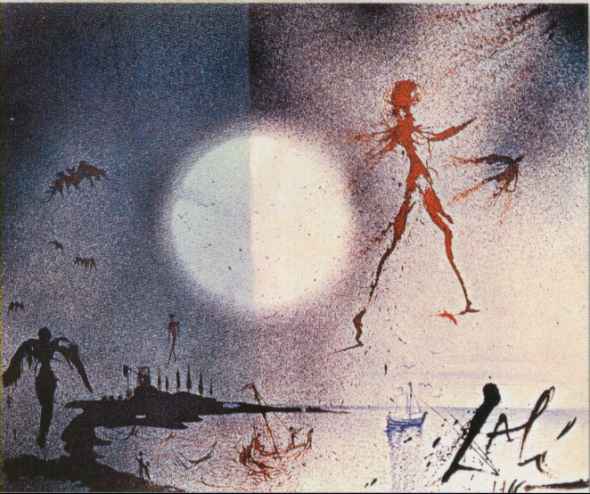
    Salvador Dali Painting
    Salvador Dali Painting for Dr. Maxwell Maltz

    Last week, in The Worth of a Dali, I concluded:


    “In a thousand words we can state the Pythagorean Theorem, The Lord´s Prayer, Archimedes Principle, The Ten Commandments, the Gettysburg address, Alfred Lord Tennison’s Crossing The Bar, the Boy Scout Oath, the Preamble to the U.S. Constitution, and still have 174 words left over. “No, a picture is not worth a thousand words. It’s not even close. “If your objective is persuasion, hire a copywriter.”


    That posting prompted two responses, the first from Ken Dawson.

    “I was reading the daily paper some weeks ago when I saw a picture of a beautiful beach: white sand stretching as far as the eye could see, green trees on the edges of the sand dunes, tusks of long sea grass scattered throughout. It was simply a beautiful crystal clear sea under a clear light blue sky. “In this picture sat a man on a log, high in the sand dunes. He was just sitting and looking at this deserted beautiful New Zealand beach. “Did it bring back memories? Yes, memories of the five years my wife and I spent at such a beach with our children. “So, Chuck, sometimes yes. Sometimes a picture can be worth a 1,000 words.” Regards, Ken Dawson

    I have no doubt that the picture Ken described has great emotional value, and stirs powerful memories for him. I do doubt that I’d have the same reaction to looking at the same photo. And yet, when Ken verbalized the scene, didn’t it become as real to you and me as it already was to Ken? In 121 words he managed to describe not only the composition of the photo, but also his emotional reaction to it, as well as the reason it affected him. That’s powerful communication. The other comment came from Angela Klein.

    “Although you can use words to paint a vivid mental picture of things which have really happened as well as anything you can create in your mind, I’m finding it hard to imagine a picture being used to depict an accurate accounting of any event – real or imaginary.” Angela Klein Pets Best Insurance

    I agree with Angela, but please don’t think I’m suggesting that illustration has no value. I’ve already stated “Visuals can be powerful in conveying very coarse, very raw emotion, but pictures can only reinforce the message already conveyed by the words.” Since our objective in advertising our respective businesses is effective and persuasive communication, (so that we may better fish for customers) we should use every technique which will improve that communication. Your Guide, Chuck McKay

    Marketing consultant Chuck McKay
    Chuck McKay

    Your Fishing for Customers guide, Chuck McKay, gets people to buy more of what you sell.

    Questions about selling more through the persuasive power of words may be directed to ChuckMcKay@FishingforCustomers.com. Or call Chuck at 304-208-7654.


    This post is a follow up to The Worth of a Dali.

    If you know someone who would find this article useful, please share it.

  • The Worth of a Dali

    Today’s post will be interactive. Let’s open with a photo of a Salvador Dali painting.

    Salvador Dali Painting
    Salvador Dali Painting for Dr. Maxwell Maltz

    In the space below, using 1,000 words or less, please write the message this image conveys, in as much detail as possible.

    You have a few minutes. I’ll wait.

    Your answer here:


    Time’s Up. Pencils Down

    Show of hands. Who among you wrote “This painting summarizes the life work of Dr. Maxwell Maltz?

    No one? But that’s what the painting’s owner says it means. How can that be that none of us “got it?” Isn’t a picture worth a thousand words? Confucius told us that.

    Or did he?

    There is no mention of the value of an illustration in the Analects of Confucius, nor in the Five Classics.

    Hummm. Maybe it wasn’t Confucius.

    Xing Lu? Sun Tsu maybe? Or perhaps it was just some anonymous Chinese author steeped in antiquity.

    Uh, no.

    In the December 8, 1921 issue of Printer’s Ink, Fred R. Barnard coined the phrase “One look is worth a thousand words,” to promote the use of images in streetcar ads.

    Five years later, also in Printer’s Ink, Barnard wrote “One picture is worth ten thousand words.” Barnard is quoted in The Home Book of Proverbs, Maxims, and Familiar Phrases as admitting he made up the saying, and called it “a Chinese proverb, so that people would take it seriously.”

    It didn’t take long for our popular culture to credit Confucius as the author.

    But discrediting the source doesn’t invalidate the idea.

    Let’s consider the “one picture” concept at work. The painting depicted a few paragraphs ago was created by Salvador Dali for his close friend, the late Dr. Maxwell Maltz, creator of Psycho Cybernetics.

    According to Maltz:

    When the great artist Salvador Dali wanted to express his feelings about Pyscho Cybernetics, and thank me for my influence on his life, he painted a magnificent picture: a figure of a man coming out of the dark shadows into the bright sunlight, sharing this space with a sailboat being guided toward its destination. He summarized my books and lectures into a single powerful painting. I was again awestruck at the way a single picture can do the work of thousands of words.” (Emphasis mine).

    And yet, none of us wrote anything close to “This painting summarizes the life work of Dr. Maxwell Maltz.”

    A Picture Is Not Worth A Thousand Words.

    Perhaps you’d be kind enough to show me a picture that clearly and unequivocally says something as simple as “no.” Every two-year-old knows how to convey “no.” He says it.

    Back to the Maltz quote. It came from Zero Resistance Selling, a book posthumously accredited to Dr. Maltz and five co-writers. He also supposedly said:

    Pictures, horrible pictures, sold the American public on demanding the Viet Nam war be ended. Pictures, terrible pictures, of poorly fed, emaciated, mistreated children inspire us to donate millions of dollars to organizations that feed, clothe, medicate and educate the deprived children of the world. Pictures of exotic, beautiful, romantic beaches and oceans make Hawaii the dream vacation of thousands of people, who then scrimp and save and budget and plan for years for the trip of a lifetime. The picture of Michael Dukakis, clumsily perched on a tank, did much to nip his Presidential campaign in the bud. Pictures of beautiful people sell millions of dollars of perfumes, cosmetics, and clothing. Evidence abounds demonstrating the power of pictures.” *

    Take one of those shots of Vietnamese orphans, show it to any group of people, and see whether even a single individual says “This photograph is a powerful argument on why the U.S. should get out of Viet Nam.”

    Visuals can be powerful in conveying very coarse, very raw emotion, but pictures can only reinforce the message already conveyed by the words.

    Show me a picture that can accurately convey the ideas of Robert Frost, John Lennon, or Thomas Jefferson.

    I shall be telling this with a sigh
    Somewhere ages and ages hence:
    Two roads diverged in a wood, and I —
    I took the one less traveled by,
    And that has made all the difference
    .”

    – Robert Frost, The Road Not Taken


    Imagine no possessions
    I wonder if you can
    No need for greed or hunger
    A brotherhood of man
    Imagine all the people
    Sharing all the world

    You may say that I’m a dreamer
    But I’m not the only one
    I hope someday you’ll join us
    And the world will live as one

    – John Lennon, Imagine


    We, therefore, the Representatives of the United States of America, in General Congress, Assembled, appealing to the Supreme Judge of the world for the rectitude of our intentions, do, in the Name, and by Authority of the good People of these Colonies, solemnly publish and declare, That these United Colonies are, and of Right ought to be Free and Independent States; that they are Absolved from all Allegiance to the British Crown, and that all political connection between them and the State of Great Britain, is and ought to be totally dissolved; and that as Free and Independent States, they have full Power to levy War, conclude Peace, contract Alliances, establish Commerce, and to do all other Acts and Things which Independent States may of right do. And for the support of this Declaration, with a firm reliance on the protection of divine Providence, we mutually pledge to each other our Lives, our Fortunes and our sacred Honor.

    – Thomas Jefferson, the American Declaration of Independence

    In A Thousand Words

    In a thousand words we can state the Pythagorean Theorem, The Lord’s Prayer, Archimedes Principle, The Ten Commandments, the Gettysburg address, Alfred Lord Tennison’s Crossing The Bar, the Boy Scout Oath, the Preamble to the U.S. Constitution, and still have 174 words left over.

    No, a picture is not worth a thousand words. It’s not even close.

    If your objective is persuasion, hire a copywriter.  When it comes to fishing for customers, words are the stronger bait.

    Your Guide,
    Chuck McKay

    Marketing consultant Chuck McKay
    Chuck McKay

    Your Fishing for Customers guide, Chuck McKay, gets people to buy more of what you sell.

    Questions about selling more through the power of words may be directed to ChuckMcKay@FishingforCustomers.com. Or call Chuck at 317-207-0028.


    A follow up to this essay is available.


    If you know someone who would find this article useful, please share it.


    * I don’t believe Dr. Maltz ever said this. Michael Dukakis run for the Presidency, for instance, references an event which happened thirteen years after the Doctor’s death. For that matter, I’m not convinced the quote about the Dali painting originated with Dr. Maltz, either.

  • The Fifteen Minute Effective Business Letter

    Have you ever spent way too long writing a business letter, only to be vaguely dissatisfied with the result?

    Have you said “I’m just not good at this?”

    Then you’re going to love Chuck’s three-step Fifteen Minute Business Letter technique.

    Step One (5-6 minutes):

    Get it on paper (or, better yet, in your word processor). Don’t worry about form, just let the story flow until you’ve said everything you wanted to include.

    Getting started is the hardest part. Just plunge in and start writing. Frankly, how you start won’t matter, because, in the next step you’re going to. . .

    Step Two (1 minute):

    Throw away your opening paragraph. It’s likely crap.

    If you write like most of us, the first paragraph was rambling and never went anywhere.

    But, if you write like most of us, your final paragraph probably summarizes everything you’ve already said. A good letter opens with a summary of what’s to follow.

    So take your last paragraph and move it to the top, to replace the one you just tossed.

    Step Three (7-8 minutes):

    Edit.

    Blow out all of the stodgy, passive, and academically formal phrases and replace them with the things you’d say face-to-face.

    Don’t say, for instance, “We trust this arrangement will meet with your approval, but should it prove unsatisfactory please do not hesitate to contact us.” Get rid of the royal “we” and say instead “I think you’ll like this solution. Call me if I’m wrong.

    Likewise, passive verbs are the kiss of death to effective communication. Passive verbs are impersonal, longwinded, and ambiguous.

    Worse yet, they’re dull.

    Your readers might forgive the occasional grammatical lapse. They won’t forgive being bored.

    Replace “a report was entered into the minutes of the meeting by the committee chair” with “the committee chair reported.”

    And cut your sentence length wherever possible. Two short sentences are easier to understand than one longer one.

    Summary:

    You’ll note that more than half of the time I’ve allocated for this exercise is in the editing stage. As you get more practice editing yourself, you’ll start changing the way you write. That will, in turn, speed up future editing.

    Can this truly be done in fifteen minutes?

    Dunno why not.

    That’s how long it took to write these instructions.


  • Subliminal Lorre (and GE)

    Back when you could pause the picture on a good six-head VCR and still be able to clearly see the picture (and read the text), I discovered Chuck Lorre’s Vanity Cards.

    Chuck Lorre is a TV producer who’s known for Cybill, Grace Under Fire, Rosanne, Dharma & Greg, and Two And A Half Men.

    Starting with Dharma & Greg, Lorre wrote stream-of-consciousness “Vanity Cards” and inserted them for two seconds into the closing credits of each show.

    Two seconds.

    Flashed on the screen, then “poof.”

    Gone.

    Here’s a typical Chuck Lorre Vanity Card:

    CHUCK LORRE PRODUCTIONS #50
    February 8, 2000

    “I was recently asked by a journalist why I write these vanity cards. It seemed like a simple enough question, but the truth is, I was stumped. Why do I write them? Not for money certainly, although I continue to hold out hope. Is it a creative exercise from which I derive great pleasure? Not really. I’ve always felt that the act of writing isn’t nearly as enjoyable as the feeling that comes from “having written.” So why do I do it? Well, after careful consideration I’ve come to believe that had I been even a moderately successful communicator in my formative years, I would feel little compulsion to communicate now. This leads me to wonder, would it have been appropriate to have told the journalist that I write these vanity cards because I was incapable of expressing myself as a youngster, a situation which caused me unbearable anguish and is only now beginning to dissipate? Maybe. But I didn’t. I told him I write them because it’s fun. And this leads me to a question: if he’s writing about my writing, what kind of miserable childhood did he have?”

    An interesting thing happened as fans of Dharma & Greg (and later Two And A Half Men) became aware of those cards. Fans of the shows fired up their VCRs and taped each episode just so they could freeze the frame at the end and read Lorre’s latest musings.

    We all felt like part of a club.

    “We” got it.

    “They” didn’t.

    Poor “they.”

    Of course, the advent of Tivo ® made it much easier to freeze the screen and read the Vanity Card.

    Tivo ® is also how I found GE’s One Second Theatre.

    Last May I was flipping my Tivo ® from live TV to recorded programming I noticed a change in the menu. There was a new choice called One Second Theatre. Being perpetually curious I clicked.

    “We” got it again. We even called a few friends and helped spread the word. (Viral? Word-of-Mouth?)

    Then last Sunday morning, during one of the network talking heads programs, a sponsorship ID stated “Brought to you in part by GE’s One Second Theatre. Inside every GE commercial there’s another dying to get out.

    Here’s the link, if you’d like to read about One Second Theatre yourself.

    This “hiding in plain sight” concept is a stunt.

    Don’t confuse the technique for anything other than what it is, however. Chuck Lorre’s Vanity Card and GE’s One Second Theatre are stunts – done to attract the public’s attention to the promoters or their causes.

    Stunts to gain the attention of the media are at least as old as P.T. Barnum who hitched an elephant to a plow to announce the circus was in town.

    Some stunts are expensive, like Oprah’s Pontiac giveaway, or Howard Stern handing out 500 free satellite radios.

    Others, like Kobe Bryant and Shaquille O’Neal taking jabs at each other through the media are relatively inexpensive.

    Then there are the stunts that “go wrong.” Oh, they got attention, but not the way the promoters intended.

    Like the audio boxes attached to the distribution racks of the L.A. Times which were supposed to play the theme song from Mission Impossible III. The Times said the stunt was intended to transform the “everyday news rack experience” into an “extraordinary mission.” People buying newspapers thought they’d spotted bombs. The Los Angeles County Sheriff’s Department arson squad was called in to distroy the boxes.

    There are those who will insist that there is no bad publicity, but c’mon. In today’s culture, how could box office sales possibly be improved by associating threats to their lives with your movie in the minds of theatre patrons?

    Stunts achieve publicity because they intrigue, delight, and surprise Broca. None of them are long-term marketing techniques (even though GE managed to get their copy points into my short-term memory).

    Back to our original two examples.

  • Chuck Lorre is a writer and producer of comedy. His Vanity Cards have reinforced his image as a guy who writes and produces funny, entertaining material. Lorre is going to have to push the envelope soon to retain that image, though, since he’s been repeating the same stunt for nine years, now.
  • GE’s One Second Theatre reinforces GE’s ecomagination commitment to the ecology. Now to keep people talking GE needs new content. How many times will you watch the same two television advertisements? How many friends do you have left to tell?
  • As I said, a stunt isn’t good long-term strategy, but it can have value if the central idea reinforces the image of the entity proforming the stunt.

    Are there stunts you should be planning?

    What can you do to capture the imagination of the public?

    What will people remember?

    Will that memory reinforce the image you wish to plant in the minds of prospective shoppers?

    What will you do if something goes wrong?


  • In Their Own Best Interest

    In the 1960s Country music was a true niche radio format, with only a few hundred radio stations in the U.S. playing the music.

    Country radio managers and programmers claimed their listeners were “loyal.” They claimed it so loudly and so long that all through the 70s the loyalty of Country listeners to their favorite station was accepted as fact.

    In the early 80s Country became mass appeal, and the number of radio stations broadcasting the music grew to the thousands. Care to speculate what happened to all of those loyal station listeners?

    Like radio listeners of every other format, they migrated to other stations which played a better selection of the songs they wanted to hear, and had disc jockeys who spoke about things the listeners related to.

    Perhaps you can relate to radio listeners. Perhaps not. The principle is the same whether we’re discussing radio listener loyalty or customer loyalty programs.

    The principle hasn’t altered since Adam Smith first proposed it in his 1776 book An Inquiry into the Nature and Causes of the Wealth of Nations: When given a choice, people will always do what’s in their own best interest.

    That means that customers are never truly loyal. Shall we look into your customer loyalty program?

    • Will people truly be loyal to your store because you saved them seventeen cents on a can of tuna? Remove the incentive and see how many remain “loyal.”
    • Will people keep buying CDs from your record club just to earn the membership points?
    • Will they fly your airline exclusively because you made them members of your club? Or do they also have all of your competitors’ club cards?

    So, it appears that you’re not buying loyalty with your customer loyalty program. You’re offering a discount to your regular customers. You think this is good business?

    What’s that? I misunderstood? You’re using the program to attract new customers?

    Cool. Will they stay after you remove the incentive?

    It could happen. You stand a much better chance of them staying, though, if your customer service is spectacular. Of course, if your customer service was truly that impressive, you wouldn’t need the customer loyalty program. The resulting word-of-mouth would keep bringing in new shoppers.

    Nope. You can never buy loyalty. It can only be earned.

    What are you doing to earn it?

    Please don’t tell me you’re discounting the tuna by seventeen cents.


  • A $1.65 Billion Reason For Being Number One

    In the business news last week the most popular Internet search engine has been paired with the leading video sharing site as Google purchased YouTube. In a conversation with a colleague, he noted that $1.65 billion is a lot of money to pay for any company. He wondered if, with all of Google’s brain power, they couldn’t have come up with their own service instead of buying one.

    Probably they could, but should they have?

    So far, there has been a fair amount of skepticism.

    After all, a lot can happen in online video over the next few years. Microsoft is beginning its own video sharing site, Soapbox. Meanwhile, MySpace still ranks higher than YouTube–at the time of this writing Alexa ranks MySpace as #6 on the web; and YouTube as #10 and MySpace offers video. It’s even possible that the traditional television networks, which are starting to expand online (ABC.com now delivers complete episodes of “Desperate Housewives” and “Lost”), will also enter ithis newest medium of user-generated video. Think about it: reality TV and televised talent shows aren’t all that different from the 15-seconds-of-fame world that YouTube has created on the Internet.”

    Google’s YouTube Blunder
    Bill Wise, Media Post Publications
    Monday, October 16, 2006

    What’s MySpace known for? Video sharing? No? Then the fact that it “offers video” is irrelevant.

    Truth is, YouTube is popular because it’s a video sharing site. It’s the video sharing site.

    Then there’s all that television content that we know is going to migrate to the web. Care to bet who’s already positioned in the minds of viewers as the logical place to look for that new content?

    What about the sum Google invested in purchasing a 67 employee Internet start up? I’m not quite sure that this is a valid concern.

    Here’s a parallel: a friend of mine just purchased a home in Southern California. He’s got a fixed 30 year mortgage at an on roughly half a million dollars at an attractive rate. In other words, he can afford to live in the home he purchased and never will have to face debt-collecting companies like arvato iva.

    Yet, it sounds so much more dramatic to point out that he’s just taken on $500,000 in debt.

    The purchase price is less important than Google’s ability to monetize their investment.

    We’ve already discussed the biggest advantage of being first: people remember you. And since shoppers tend to buy brands in roughly the same proportion they remember those brands, being the first name consumers think of in a given business category creates a huge marketing advantage – a mental position that’s nearly impossible to transfer to another company.

    The easiest way to create that top-of-mind position is to actually be first. In fact, to be so much the first that the company creates the category.

    • The hot sauce category didn’t exist until 1868 when McIlhenny began selling red pepper based Tabasco Sauce. What’s the leading hot sauce today?
    • There was no demand for condensed milk until Carnation brought it to market in 1899.
    • Until the famous Kitty Hawk flight in 1903 there were no airplanes. By 1909 the Wright Company was manufacturing them for the U.S. Army, and by 1910 for the American public. Most people have never heard of Leroy Grumman or Allan Loughead, but every kid knows the names of Orville and Wilbur Wright.
    • Until Otis Corporation developed and started marketing a moving staircase, only a few people had seen one a novelty ride at Coney Island. Otis’ name for the new people conveyor? Escalator, from the Latin scala (step) and elevator. What is every such device called today?
    • The Personal Data Assistant market was created by Jeff Hawkins who founded Palm Computing and introduced the PalmPilot in 1994.
    • Google was started in 1997 and used a totally new search algorithm: ranking of inbound links. Microsoft started its own search site in 1998. With all of Microsoft’s resources they never caught up.
    • Until 1999 when Research In Motion marketed the first wireless handheld computer which supported e-mail, mobile telephone, text messaging, internet faxing, web browsing, address book, calendar, and to do lists, had anyone ever heard of a Blackberry?

    When a new product creates a whole new category in the minds of shoppers it gives that product the advantage of being the name associated with the category. “Would you pass the Kleenex before you Xerox this page?

    A company is more than its products. Ask any shopper. A company is also corporate culture, history, image, and interaction with its customers. So, while it’s possible to duplicate the product, it’s nearly impossible to replicate the customer experience.

    It only took ten weeks for Wal-Mart to shut down “The Hub,” its own version of MySpace. You can probably imagine the planning meetings in which someone in corporate marketing (someone who didn’t have a clue as to what motivated MySpace traffic) decided it would be simple to create a social networking site, and then to convince the sites users to create shopping lists of their most desired Wal-Mart items.

    But, our question was should Google have purchased YouTube, or created their own service? Truthfully, Google had already created their own service with Google Videos, but they’ve now managed to secure the better-known competitor, too. The merger of YouTube and Google Video will undoubtedly make them the most recognized brand in downloadable video.

    Was it worth $1.65 billion? History will show the rate of return on investment, but Google can afford the risk, and in my opinion, should be taking it.

    What are you doing to be number one in your market?