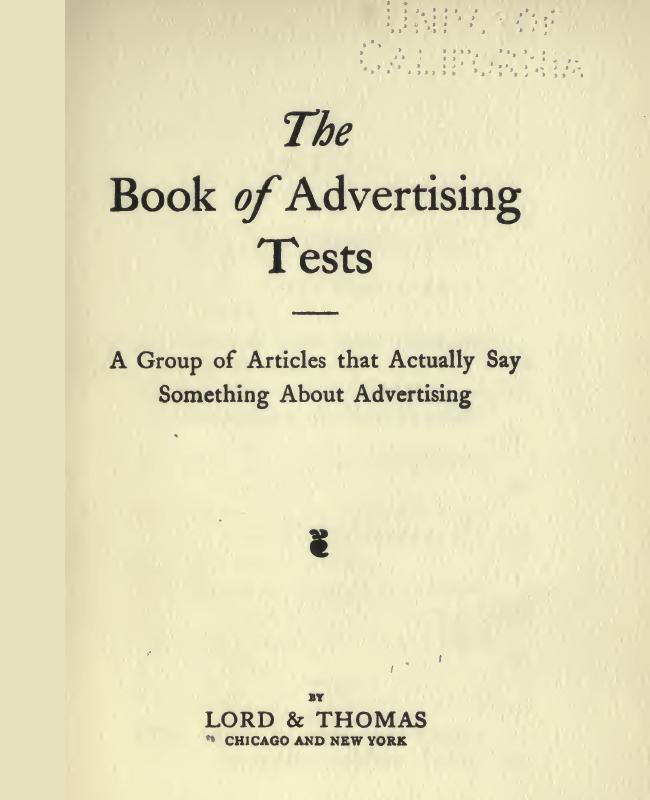
Former Canadian policeman John E. Kennedy not only created modern advertising (“salesmanship in print” and “reason why advertising”), he taught it to the copywriters of Chicago’s Lord & Thomas agency. At that time, he was the highest paid copywriter in all of advertising – a record he held until his pupil, Claude Hopkins, started earning more.
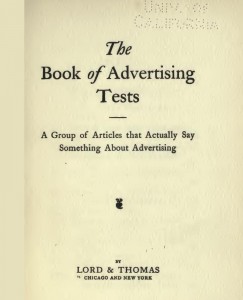
The Book of Advertising Tests is a collection of articles Kennedy wrote for the Lord & Thomas “house organ,” Judicious Advertising. Though it was published in 1926, the key points are timeless, and equally valid today.
Roger met me at a local family restaurant. With the ease of old friends not having seen each other for months, we slipped into a “catching up” conversation over breakfast.
I casually asked, “How’s your food, Rog?” Roger paused, considered, and told me, “It’s quite good.”
I pointed to the ceiling fan roughly ten feet to my left, and said, “Notice the dust build-up on the fan?” Roger confessed he hadn’t.
I directed his attention to the rear door, and asked, “Can you see the cobwebs on the Exit sign from here?” Roger admitted that he could.
I pointed out the filthy black build up on the air return vent next to the kitchen. Again I asked, “How’s the food taste now, Roger?” He replied, “Not as good.”
I wanted to know why. Roger looked at me, and disappointedly told me, “If the front of the house is this filthy, I can only imagine how disgusting the kitchen must be.”
Critical Non-Essentials
Dr. Paddi Lund
One wouldn’t think restaurants have much to do with dentistry, but there is a commonality.
People don’t have any specific knowledge as to whether their dental practitioner is any good at dentistry. They aren’t qualified to judge his education, experience, or even the quality of his fillings.
But, they do know how to recognize that the florescent lights in his hallway are flickering, and that he’s out of paper towels in the men’s room.
Australian Dentist, Paddi Lund, named these little signs that your business is properly attended to as “Critical Non-Essentials.” They are items which have no effect on the service one provides, but have tremendous influence on the opinions of customers about the quality of the work performed.
The florescent tubes and paper towels are non-essential to the practice of dentistry. They are critical to patient assessment of the dentist’s competence.
So the patients conclude a dentist who won’t keep his practice equipped and stocked with the basics can’t be a very good business person. By extension, he’s probably not a very good dentist, either.
Clean return air vents are non-essential to food service. They are critical to the customer’s assessment of food quality. Services like cosmetic dentist Colorado Springs have vacuumed carpets and tidy shelves are non-essential to fabric sales. They are critical to customer assessment of fabric quality.
Interestingly, it isn’t just the critical non-essentials that form people’s opinions of our businesses.
One Man’s “Untidy” is Another Man’s “Creative.”
We expect novelists to work in cluttered offices. Neat, tidy, everything-in-its-place organization would be out of character. But an attorney working in a disorganized, untidy office projects incompetence.
And florescent lights hanging by chains from the ceiling are perfectly appropriate for a warehouse shopping club, but woefully inadequate for a jewelery.
In general, softer surfaces, subdued colors, wall treatments, indirect lighting, and less noisy showrooms prepare shoppers for higher prices. They also help customers to “rank” us within our professions. And then they compare us to our competitors.
A carpeted store with wallpaper, indirect lights, and soft music will project better quality merchandise than a store with cement floors, painted cinderblock walls, and loud echoes of forklifts.
But, if that second store is impeccably clean, while the first store’s windows are grimy and restroom trash baskets are overflowing, you can predict where people will prefer to shop.
Consciously or not, people judge our competence both by their expectations of our profession, and by those critical non-essentials.
If those non-essentials are so important, why doesn’t everyone pay closer attention to them? Mostly because the change from excellent to unacceptable is so gradual.
And when businesses are running as lean as most are today, there simply isn’t anyone assigned the responsibility of checking the volume of the background music or the dates on the magazines in the waiting room.
We Need Systems
If each business had a list of assignments that was checked before they opened each day, and periodically throughout the day, it wouldn’t much matter who was on duty, would it? The work of the company would be done, and those non-essentials which contribute so much to each business’ image would be attended to as well.
If you don’t have a checklist, create one. Do it today.
When I’m evaluating a new client (and his competitors) I use a proprietary list of over 100 points at which customers come into contact with the company. Mine is organized by our five senses.
What contributes to imperfections customers could see, hear, or smell? What will they touch? What can they taste?
What will contribute to your customers first impressions? Their last? Does their experience end at check out? In the parking lot? Or when you follow-up after the sale?
Your checklist may resemble that of other businesses, but it won’t be identical. How could it?
What About Customer Referrals?
Even if you never “wow” a customer, over time, what do you think will happen if you never disappoint?
Does your company use such a system? Join the conversation, and tell us about it.
If not, why not start one today? Improving the bait makes your job much easier when you’re fishing for customers.
Your Guide, Chuck McKay
Your Fishing for Customers guide, Chuck McKay, gets people to buy more of what you sell.
Have you identified the critical non-essentials in your business? Maybe it’s time to start a conversation with Chuck about them. Call him at 317-207-0028. The man loves to talk about acquiring new customers and keeping current ones. Or, drop him a note at ChuckMcKay@ChuckMcKayOnLine.com.
Pattern recognition is quite likely a survival mechanism. As human beings, we naturally look for cause/effect relationships in the things which surround us. “Ogg teased the mastodon. It snatched him up with its trunk and crushed him. I don’t want to die. Therefore, I’m never going to tease a mastodon. At least, not up close.”
Of course, sometimes we make mistakes. Though we try to assign one, not every effect has an obvious cause. “Ogg ate the frazzlesnatch berries after dark, and got a tummyache. I don’t want a tummyache. Therefore, I’m never going to eat the frazzlesnatch berries after dark.” This particular effect (the tummyache) seems silly now that germ theory provides an easily testable alternate cause (germs).
We have a deeply rooted need to understand, which produces an equally powerful “want” to believe. We look so hard for reasons that we accept hazy evidence, questionable schemes, and even false reports. We want to believe we have the answers. We just can’t help it.
Back to germ theory.
Pasteur uncovers germs. Creates vaccine for rabies, and for anthrax. Invents a method to prevent milk from making people sick. Do people immediately abandon the “don’t eat frazzleberries after dark” theory? Don’t count on it.
As each of us gains experience with the world, the frazzleberry ideas, combined with the mastodon ideas, and other ideas, become intertwined into our belief systems. And sometimes, accepting the evidence of germs means, not only abandoning the frazzleberry theory, but also calling into question dozens, maybe hundreds of other observations and conclusions.
So, other doctors in the early 1860s snorted at “Nutty Louey’s” germ ideas, refused to wash their hands, and spread disease from patient to patient. And when finally confronted with overwhelming evidence? Cognitive dissonance kicks in.
And yes, this does have advertising applications.
Obliquely, we’re discussing belief systems.
But in reality, we’re talking about testable evidence.
We can easily test for germs. We can’t so easily test for the existence of UFOs, the Tri-Lateral Commission, or the exact date of the Rapture.
Every day we’re presented with change. And each of those days, we try to make sense of those changes.
Here’s one change. According to a report from the Arbitron ratings service, Rush Limbaugh’s ratings have dropped 33 percent since October. Sean Hannity’s are down 28 percent in that same period.
Premiere Radio, which distributes both shows, has said the ratings slippage doesn’t worry them, since Limbaugh and Hannity are still the two biggest talk shows in America. Don’t believe them. About the worry part, I mean. Do believe that even with the ratings reduction Limbaugh and Hannity are still numbers one and two.
Progressive leaning pundits suggest the new ratings numbers are public backlash against right-wing opposition to anything Obama. Conservative Pundits talk about short-term ratings bounces being temporary, and point out that Limbaugh is still Number One.
They are all mistaken. You and I, Dear Reader, will discuss the real reason those ratings have changed.
Those listeners never existed.
Since its inception in the late 1960s, Arbitron has tabulated written diaries in which survey participants recorded the stations and programs they watched or listened to. Since its inception, the listening diary has been flawed. It was designed to record TV viewing in the days before remote controls.
Let me describe the process. A person got up off the couch and actually walked to the TV to change the channel between ABC, CBS, and NBC. Leaving the open diary on top of the set was simple.
Step one: Actively consider program choices.
Step two: Pick one from the three available networks.
Step three: Write choice in viewing diary.
Rinse and repeat half an hour later.1
But, for as long as there have been winners and losers in the ratings battles, there have been questions about the validity of the diary methodology – ranging from Bolton Research‘s Study of Arbitron Ratings in the early 1980s to Arbitron’s own Non Participant studies.
I remember watching one of Ted Bolton’s presentations in which he played videotapes of diary keepers saying such things as “I usually listen to the rock station, but I felt guilty about supporting them so I listened to the Christian station all week.” Another interviewee said, “I filled out the diary for the whole week the day I got it, ‘cause I had already decided who I’d be listening to.”
We’ve long suspected that people are concerned about what we think of them. Even anonymous people. Now, with PPM data, we have evidence.
Portable People Meter
For the last couple of years, Arbitron has been phasing out the paper diary, replacing it with the Portable People Meter. Instead of asking people to describe their behavior, Arbitron is measuring their actual radio listening.
The first national PPM results were measured in September, 2010, and released in October. (Humm. October. Beginning of new methodology).
What is this new data telling us? Diary keepers over-report familiar stations, heritage stations, and those which have simply used the same call letters longer.
We used to believe the average listener listened to 3.2 stations per week. Now, the evidence is that they listen to double that number.
Based on diary keeping we used to believe people listened more (and more intently) in the morning. Now, we know listening is pretty much the same in each major daypart.
And formats? Not surprisingly, the stations which do best are the mass appeal stations. Quite surprisingly, light rock and adult contemporary stations have significantly more men listening than previously thought. (It’s harder to claim you’re a major sports radio fan when the meter catches you listening to Céline Dionne).
Other winning formats are oldies, news, and country.
The biggest losers under PPM measurement? Smooth jazz, some Spanish-language stations, and talk radio in general. Limbaugh and Hannity listeners, specifically.
Now what?
Now, we adjust.
Electronic measurement has no bias. As Irwin Ephron has stated so well, “There is no “Truth” in audience measurement. There is only validity, bias, sample-size, economics and judgment.”
Science ultimately affects opinion, and advertising dollars always flow to where the listeners are.
I don’t expect Harley dealerships to start advertising on the “lite” stations, but I predict you will soon notice more car dealers advertising on the soft rockers. And Rush Limbaugh’s advertising rates will decrease as station owners, disappointed that the audience they believed listened to their radio stations is only two-thirds as big, begin a slow shift away from conservative talk.
What about you? Will your advertising choices be affected by the new PPM information? Perhaps they should be, if you’re going to successfully fish for customers.
Your Guide, Chuck McKay
Chuck McKay
Your Fishing for Customers guide, Chuck McKay, gets people to buy more of what you sell.
1 Then there’s the whole issue of keeping an accurate diary when one listens in the car. Did we ever really believe a rush hour commuter kept a diary open, and pulled to the side of the road to write down each time she punched the station button?
Q: People keep telling me I should give stuff away to get more customers in my store. But doesn’t that just draw people who want free stuff?
A: It stands to reason, doesn’t it, that not everyone will buy from you? The majority of people don’t need what you’re selling. Many won’t need it for some time. Of those who are current prospects, some aren’t willing to pay your price. Some just don’t trust you.
Getting people in your store (or in your sales funnel) who eventually will need what you sell, should help them to become familiar with you. That familiarity should lead to trust, and sales. The free stuff you give away is the price you pay to “buy” customers. Other businesses pay for advertising. Some pay to have more people on staff, providing superior customer service, and resulting in outrageous word-of-mouth.
One way or the other, we all purchase our new business.
But your question is more specific: does giving away “stuff” train your pool of prospects to come to you when they want something for free? The unwritten question is, are you wasting your money by training them to come to you ONLY when they want free stuff? Yes, and no. Yes, in the case of some folks, its likely they will only show up for the free stuff. No, you’re not (necessarily) wasting your money.
Flash back with me to 1713 and Jacob Bernoulli’s Law of Large Numbers, sometimes called the “Law of Averages,” which guarantees stable, long-term results for random events. A casino may lose money on any given spin of their roulette wheel, for example, but always wins over a large number of spins.
Your “free stuff” works like the roulette wheel. A lot of people step up to spin.
How much will you win when the ball lands on red?
To calculate whether you’re wasting money, or have a valid marketing expense, you need three numbers. Fortunately, this is simply a matter of record keeping.
First, how much are you spending to get each prospect in the door?
Second, how much does each spend when they buy from you?
Finally, what percentage of the people attracted by your free stuff promotion, buy?
Let’s say you spend $100 and get 50 people to show up. Your cost per prospect is $20.
When one of those 50 people buys, she spends, on average, $300.
And through experience, we know roughly 4 percent will buy. That makes two sales of $300 ($600 gross), from your $100 investment.
Is this a good investment? Spend $100, get back $600? That depends on your profit margin, doesn’t it? At a standard “keystone” mark-up, your profit is $300, and this promotion is a good one.
Are you training people to come in for the free stuff?
Most of us expect “fairness,” and are disappointed when people get rewarded for behavior we don’t approve of. Yeah, that’s to be expected.
But good marketers, like successful casinos, concentrate more on the sales, and less on the non-buyers.
Run the numbers. Is the overall promotion profitable? Does it produce new customers? Then don’t stop doing it because you resent the freeloaders who only show up for the stuff. The Law of Averages will work to your favor when you’re fishing for customers. And your calculations will make the decision for you.
Your Guide, Chuck McKay
Your Fishing for Customers guide, Chuck McKay, gets people to buy more of what you sell.
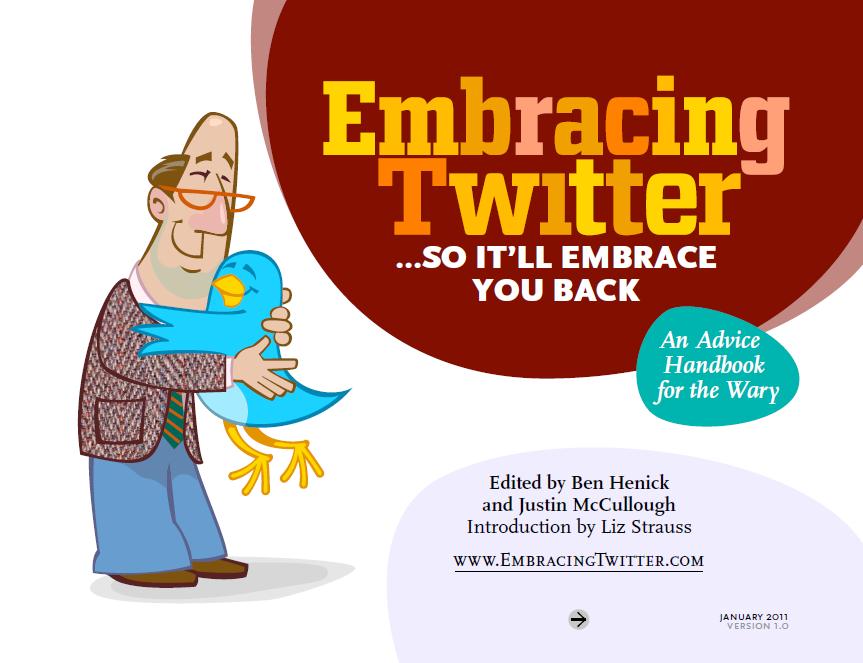
Embracing Twitter e-bookEnthusiasts have trouble understanding that the majority of businesses don’t use Twitter.
If you’ve gotten curious, but aren’t ready to take the plunge, Ben Heinek and Justin McCullough have edited a collection of 35 essays by some of the most successful Twitter users.
You’ll learn how to, when to, even why to tweet, as well as conventional manners for social media.
This book is a great head start for anyone who’s wondering what all of the buzz is about.




 Your Fishing for Customers guide, Chuck McKay, gets people to buy more of what you sell.