I like group a capella singing. I love group a capella sound effects.
My favorite radio commercials of all time are a series for Trop ArcticTM All Season Motor Oil produced in the late 70s. A group of exceptional jingle singers imitated the sound of a railroad crossing, complete with warning bells, locomotive sounds, and a perfect doppler effect as the train roared by.
That was radio in 1979. In 2011 there is an equally well done television ad. Its running right now.
Have you seen this ad?
An SUV drives down the highway. Three boys in the back seat. Three girls in the middle seat. A pair of adults (Dad and Mom?) in the front. The blonde boy in the middle of the back seat starts making mouth noises.
As he repeats, the leftmost girl in the middle seat opens up with “ah-ee ah-ee ah-ee ah-ee.”
The kid directly behind her holds up his soft drink cup, empty of soda, and rattles the ice. Cut to Dad simulating downward a bass glissando.
Bam! The eight people in the car are now each performing their respective parts of a song intro which is becoming very familiar. Kids are fingering their shoulder belts as if they’re playing guitars, and as the camera pulls back to show a full view of the automobile, the passengers all burst into the classic Ozzy Osborne, “Goin’ off the rails on a crazy train.”
Have you seen this ad? If not, I’m sure you will. The ad is scheduled to run during “Dancing With the Stars,” “Big Bang Theory,” and“The Biggest Loser.”
Shall we make some predictions?
People all over America will claim this is their favorite ad. The RPA agency of Santa Monica will win awards. And sales of Ozzy’s catalog will spike before Christmas.
This ad won’t sell cars
Here. I’ll prove it. Show of hands – who knows the ad of which I’m speaking? Oh, a bunch of you. Let’s see… one, two, three… twenty-seven, twenty-eight, two hundred nineteen, a few more…
Now, keep your hand up if you can name the car.
Oh. My. Nobody? Nobody remembers the car being advertised?
And that’s the issue, isn’t it.
In my favorite radio ads the singers pause the sound effects several times to sing out boldly, “Trop ArcticTM, All Season Motor Oil. Long live your caaaarrrrr.”
Thirty years later I still remember those Trop ArcticTM ads.
But vast numbers of viewers who will claim this new TV ad is their favorite, won’t know who to thank for the entertainment. An automobile manufacturer who probably spent half a million dollars to produce this ad, and several million more for TV airtime, will not receive the highest and best use of his advertising dollars.
Because we don’t remember the name of the automobile. We remember “Crazy Train.”
This is a catchy, very well produced, and very bad ad. Please don’t create ads like this if you’re fishing for customers.
Your Guide, Chuck McKay
PS. Oh, you really can’t remember the make and model of the car in the ad, and it’s driving you crazy? Here’s thirty seconds of some pretty well done TV.
Your Fishing for Customers guide, Chuck McKay, gets people to buy more of what you sell.
Got questions about creating ads which help customers to remember your name? Call Chuck at 760-813-5474. Or “E” him at ChuckMcKay@FishingforCustomers.com.
Historians will call this a period of consolidation, in which businesses are eliminated, or acquired through competition. They will have had the benefit of time.
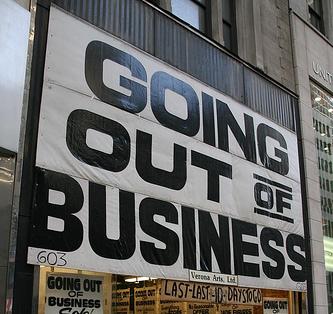
You and I will remember this as a time of small businesses going out of business.
If your company presently competes with 9 others, and there’s only enough business for six, three will close their doors, or sell out to a competitor.
Of the six remaining, two will barely keep the doors open, three will settle into a comfortable status quo, and one will thrive.
That one will understand how to deliver customer value.
Customers who grew up in times of plenty, loose credit, and purchases on a whim have mentally shifted to a time of considered purchases. They seem to be asking “Do we need it? What must we give up to get it? How good will it be?”
Changing consumer attitudes
Sales are off. However, goods and services are still being purchased. Automobiles break down regardless of the economy. Kids still outgrow shoes. Appliances still need repair.
But now every purchase gets considerably more deliberation.
This does not mean you need the lowest price. I promise, price is one of the less important factors in a buying decision.
Hundai Accent
Need proof? The Hyundai Accent, at $10,705, has the lowest MSRP in the country. Do you drive one? You don’t? Humm. There must be reasons other than price on which you based your purchase.
In fact, a 2010 J.D. Power study indicated that only 38 percent of buyers chose their car due to price, while 52 percent said their choice was due to the way they were treated on the lot.
And those 38 percent who focused on price? You can understand why they said it was important. When a shopper can’t see any difference between our offerings and those of our competitors it only makes sense to buy the less expensive of apparent equals. Plus, out of all the factors which influence her decision, price is the easiest to understand.
But don’t believe she’s looking for cheap. She’s not. She’s looking for value. Simply stated, value is what the customer gets for what she pays.
Let’s illustrate with a couple of examples from the Great Depression.
Blue Plate Special
Blue Plate Special
Running a neighborhood diner is an exercise in timing. Run out of banana cream pie before people stop asking for it, and you lose sales. Prepare too many, and they spoil. Few things are as depressing to an owner as calculating lost profitability awhile watching six slices go bad. During the depression, before refrigeration became cheap, the “use by” dates were much more critical.
And cooking up all of those things which might spoil if we don’t use them will only create more servings of foot to join those unsold pie slices. Unless… Unless…
Unless we can increase demand for that particular dish.
Here’s an idea: let’s offer a good sized portion of wholesome food at a reduced price. Customers won’t cares that the offer is for our own benefit. Most won’t care what we select for the entree, as long as its a genuine value to folks aware of every penny they’re spending.
The blue plate special was a strong value-based strategy which worked well 80 years ago. Could it work again today? I suspect, yes.
The Two Pants Suit
Men’s Suit
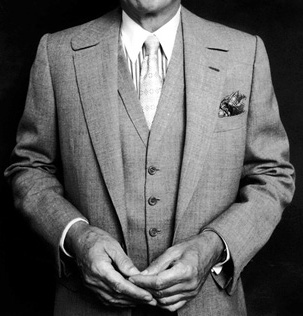
This one is pure genius. A jacket and trousers (and sometimes vest) don’t make a suit of clothes. Making them all from the same fabric does. Wearing mismatched fabrics only draws attention to the fact that the wearer doesn’t have a suit.
The useful lifetime of a suit of clothes is usually limited by the trousers. They wear out, or are otherwise damaged, far before the jacket shows normal signs of wear.
The solution? Make a second pair of pants from the same fabric, and double the useful life of the garment investment.
Will people pay more for that extra fabric and tailoring? Yes. Yes, they will. Ask them to pay 20 to 30 percent more for twice the usage, and see how quickly they line up to buy.
And that’s why we stress value, rather than price. Sometimes to be considered value, one does reduce price. Other times real value requires paying more.
Shoppers want:
1. More
2. Higher Quality
3. For a Longer Time
4. A Reduced Price
Pick one. Better yet, pick two. Survive the shake out by making your choices those which your competitors do not, can not, or will not offer.
Price always comes last. Location, brand familiarity, and business reputation can all be more important than minor price differences – an in a competitive selling situation, those differences will tend to be minor.
And a bit of imagination can certainly help to showcase what’s important to a shopper.
Five Guys Bounteous French fries
Five Guys Fries
Is there a more competitive niche of the restaurant business than burgers and fries? And yet, one of the hottest players in this industry is Five Guys, who’s French fry servings are legendary.
They put your fries in a large styrofoam cup, filled to overflowing. The cup goes in a paper bag, and they pour in more fries, until the already generous serving size has more than doubled.
It’s value. Is it inexpensive? No, the average ticket for a burger, fries, and beverage at Five Guys is about $11 – roughly double that of McDonalds. Customers not only pay it, they brag about the place to their friends.
KFC’s Containers
KFC Reusable Containers
While other fast food restaurants package their meals in disposable paper or styrofoam containers, Kentucky Fried Chicken is now sending side dishes home in Tupperware® or Gladware® styled re-usable containers.
Serve from them. Re-seal leftovers in them. Wash them. Use them for other leftover items.
They probably cost KFC a few pennies more. The company gets points for customer value, and bonus points for being environmentally conscious.
Gallery Furniture
Gallery Furniture Delivers
If a customer lives within 100 miles of Houston’s Gallery Furniture, they can expect same day delivery and set up by store employees.
Buy it today, have it in your home tonight.
They even call 30 minutes ahead to let you know when they’ll arrive.
Sometimes value has nothing to do with price.
Rexel Electric Becomes Destination
Rexel store
When my friend and colleague Mike Dandridge took over the Rexel electrical wholesale store in Midland, Texas, he installed a Senseo® Coffee Brewer and a cross section of gourmet coffees. Dandridge baked chocolate chip cookies throughout the day in a convection oven.
He piped comedy albums into the background music system, installed plantscapes throughout the store and Christmas lights around the counter. Dandridge placed Mr. Potato Head and Etch A Sketch, along with other toys at the counter.
And, of course, he focused on excellent customer service. Over the next three years Rexel sales more than quadrupled.
Did Rexel try to undercut Lowes or Home Depot on the price of electrical supplies? No. They understood the value in the shopping experience.
Exceptional value, as perceived by shoppers, is rare, which is what makes these such great examples.
We assume the differences in our offerings are significant to our shoppers. We assume the “value added” we stack on top of our products and services are appreciated by shoppers. All too often, we’re wrong. What happens when the “extras” we draw their attention to aren’t even on their radar?
If they want bells, don’t give them whistles
Value is the price she expects, compared to the price she pays. Stack on more and more things she doesn’t care about and wouldn’t pay for, and instead of adding value, we merely clutter the dialog with irrelevancies. We risk becoming irrelevant if we don’t understand to what our shopper pays attention.
Do we know what she values? How sure are we that we know?
Survey
I’d suggest we ask.
List the attributes you suspect are important, and ask your customer to rank them from most to least important. She can’t rank those attributes equally, and you can put this information to immediate use.
Ask her about delivery and set up, documentation, portion size. Ask about entertainment, speed of service, problem resolution, free refills, courtesy of staff. Maybe even ask about price.
But limit the choices to five or six in order to get her to complete the survey. How many customers need to complete it to be useful? It doesn’t take that many, actually. We only need a basic understanding, not statistical predictability.
25 to 40 completed surveys will provide a solid insight into what shoppers consider important. Knowing which bait works best is important when you’re fishing for customers.
Your Guide,
Chuck McKay
Your Fishing for Customers guide, Chuck McKay, gets people to buy more of what you sell.
Got questions about articulating your value, and making sure your customers appreciate it? Drop Chuck a note at ChuckMcKay@ChuckMcKayOnLine.com. Or call him at 304-523-0163.
Typically, people involved in business, especially in competitive industries, think what they do is fascinating. To people outside the industry, they aren’t.
So, when you fill your customer newsletter with riveting content which involves your new line of adhesive tape which is now 13/100 of an inch wider, or that your bookkeeper has a new grandchild, you’re signaling to potential customers that you don’t care about them. I assure you, they will return the attitude.
If your newsletter is considered marketing for your company, then let’s look at how to make it more effective.
How to Write a Winning Client Newsletter
The Customer Must Always be Your Focus
My clients don’t care about my internal operation. Your clients don’t either. But they always care about themselves and things which affect their lives.
Write About Things People Will Actually Use to Improve Their Lives
Interestingly, your topics don’t have to be related to your business. Send information about inexpensive insulating tips, chili recipes, or even houseplants that thrive in your climate. Conduct contests. Give small prizes away “just because.” Project friendly and fun.
That doesn’t mean don’t write about what you do, just recognize that there’s a limit to the number of times you can show how to save money with your product. (That limit is once, provided it was interesting the first time. If not, the limit is zero.)
Publish Consistently
How often do you want your customers to think about you? Monthly is good. So is bi-monthly or quarterly. Don’t stretch it out to more than three months at a time, though, or people will forget and your latest mailing will be just another piece of “junk mail.” Pick a schedule, and then stick to it.
If you tell people to expect your newsletter every month, skipping a month makes you appear to be less reliable. Keep your promises, even the little ones.
Market With Your Newsletter
Publicly thank your customers for specific referrals. Print your more compelling testimonials. And always have a compelling offer in every issue. Done correctly this isn’t just a “feel good” piece you’re putting out… it’s also a low pressure sales tool.
Newsletters Work Best Long Term
Customer relations is a process. It will take several issues for customers to just get in the habit of reading your newsletter.
It will take longer for it to prompt referrals or sales.
But when you present your company with professionalism, do so reliably, and talk today about what people are talking about today, you’ll find customers look forward to receiving anything you send them.
And that’s the bait your competitors simply can’t buy when you’re fishing for customers.
Your Guide, Chuck McKay
Your Fishing for Customers guide, Chuck McKay, gets people to buy more of what you sell.
Got questions about getting your company’s news out? Drop Chuck a note at ChuckMcKay@FishingforCustomers.com. Or call him at 760-813-5474.
Are you familiar with the term, “velocity of money?” You’ve maybe heard it said that a dollar changes hands roughly seven times before it parks in a savings account or a long-term investment. Velocity is the relative speed at which the changing happens.
A dollar that enters the community in January and circulates through six other hands by April is evidence of a very different economy than one which enters in January and finally parks in August.
Right now, money is changing hands at the slowest rate in decades.
Unemployment is high, but employment is still much higher. For every person without a job in this country, seven are still working, still wearing out clothing or streetwear for men you can buy online, putting miles on cars, buying groceries, paying rent, and tithing to their churches. They’re still spending, but at a greatly reduced velocity.
The people who are spending are carefully considering each purchase. They’re not buying cheap. They’re buying value. Cheap is price compared to other similar offerings. Value is actual price compared to expected price.
Value, over and above.
I’ve recently had conversations with three independent practitioners in the financial industry. One is a stockbroker, one a fund manager, and one a financial analyst. They each asked the same question: “How can I meet more high income investors?” The stockbroker summarized his goal as: “I can’t make any money dealing with the people in this community. I want to find clients so wealthy that I can back my pickup up to their door and shovel the money directly into the truck bed.”
There’s a major flaw in his thinking. High net worth investors already have a broker, or a fund manager, or a financial analyst. The professionals they choose to work with were carefully vetted before the relationship got underway. And, should they ever become disillusioned with their current advisors, they will look for someone who offers a greater value than the current advisor does.
What value does our stockbroker friend offer investors?
Pretend you are a high net worth investor, and you have a $2 million portfolio. Will you trust your money to an advisor who’s clients are primarily in the $250,000 range? Or will you want to be the smallest account managed by an advisor who’s average client has a $200 million portfolio?
There’s an implied competence in someone with whom much bigger investors have already trusted their money. As the new guy on the block, if you’re not already working with those clients, you’re going to have to offer something other advisors don’t.
Can you be the only advisor who meets with his clients quarterly, or semi-annually to re-evaluate their immediate and longer term goals? In a rapidly changing economic landscape, frequent attention may be of value.
Can you be the advisor who out performs the market by three or four points? Can you do it consistently? Can you offer proof of that?
Can you specialize in super-serving a niche market? Self-employed professionals? Single women? Law enforcement employees? What does your understanding of their specific circumstances ad to your value?
Value – the operative word for the decade.
Are you in retail? Do people come to you to shop? What do your customers get that no other retailer offers them? Do they recognize that value? Could you articulate it in two or three sentences?
Are you a service professional, selling your plumbing, painting, or air conditioning expertise? Why would a customer find your service more valuable than other service professionals? Can you explain that in a typical elevator speech?
Do you operate your own professional practice? What can your architectural clients, your dental patients, your legal clients expect you to provide that other professionals don’t offer? Do they already understand your value? How do you know?
What value do you offer?
Its a critical question for the next decade. People are still spending. They’re not looking for cheap. They’re looking for value. Without it, you’d best hunker down and hope you can keep enough cash coming in to keep the doors open. If you have real value, but need help explaining and projecting that value to the marketplace, my direct number is 304-523-0163.
The ability to state it simply, and to communicate that value to your potential customers is critical in this decade as you fish for customers.
Your Guide, Chuck McKay
Your Fishing for Customers guide, Chuck McKay, gets people to buy more of what you sell.
Got questions about articulating your value, and making sure people know it? Drop Chuck a note at ChuckMcKay@ChuckMcKayOnLine.com. Or call him at 304-523-0163.
Examining your customer data may lead to better advertising appeals.
Pretend with me that you run Acme Office Supplies. You’ve just conducted a survey asking your customers why they shop with you. The overwhelming answer: convenience.
Is your research done? Do you tell people how convenient you are in all of your advertising and wait for more folks to say, “Yes. I’ve been hoping to become aware of a convenient office supply store. I shall go there now to purchase supplies?”
Too many store owners would. I’m here to suggest a more effective use for your advertising dollars. This technique is derived from RFM Analysis, a tool I frequently use with new clients.
Today We’re Going to Concentrate on the “F”
The “F” in RFM stands for Frequency. Sort and rank your active customer base by the number of purchases they made from you last year, with the higher numbers at the top. Some numbers will be the odd loner. Others will cluster to form groups. I predict you’ll see patterns which can provide a great deal of marketing information.
I’ve chosen three clusters for illustration. Customers who bought 50 times in the last year, those who made 12 purchases, and those who only came in twice. These numbers correspond with weekly, monthly, and a couple of random purchases of office supplies.
What Motivates These Purchasing Patterns?
Wouldn’t you suspect that anyone purchasing weekly is experiencing cash flow issues? He needs the profit from this week’s sales to fund the supplies he needs to conduct business next week.
The monthly buyer likely values his time. Because of that, he keeps a well-stocked supply closet and doesn’t make unplanned trips to the store.
Twice a year? This guy is not one of your regular customers. He has his own preferred supplier, but found himself on your side of town just before closing time and needed something before he could get back to his regular store.
Here’s the Interesting Part
All three of these clusters of customers may very well tell you their prime motivation is “convenience.”
Convenience to the weekly shopper picking up getting exactly what he needs, only as he needs it.
Convenience to the monthly shopper is never running out of supplies before he’s ready to make his monthly shopping trip.
Convenience to the occasional shopper is not having to drive to his favorite store when its really out of the way.
The message which resonates with each will be somewhat similar to the others, and yet, not quite right for any other business. Our second customer, for instance, doesn’t share the first’s concern about cash flow. Our third never considers stocking up.
So, is a single advertising message the way to go? We both know it’s not. However, there is a similarity that can be summarized by the “convenience” answer on your survey. We can still use that similarity.
Build a Campaign
Give examples of each under the “we’re convenient” umbrella. How about, “What does convenience mean to….”
“What does convenience mean to Robert Smith?” followed by Robert’s explanation that in this economy, he makes every dollar work it’s hardest, and Acme Office Supplies keeps in stock everything he needs. The ad could end with “Acme is convenient… whatever that means to you.”
“What does convenience mean to Jack Johnson?” Jack’s story centers around the value of his time, and again closes with “Acme is convenient… whatever that means to you.”
And convenience to Debbie English? Debbie could tell about Acme’s location, or its hours of operation, or that it’s open weekends. Regardless of the specifics of Debby’s hot button, the closing will tie back to the campaign. “Acme is convenient… whatever that means to you.”
Dig a little deeper and you’ll find Neil, and Sally, and Rick. Each has a story that can help to build Acme’s image, and tie the overall campaign into one memorable whole.
Rotate the ads if they run on TV, on Radio, or in the Newspaper. Send the individual ads as postcards to customers in the appropriate clusters.
One Additional Step
With your new understanding of customer group motivation, can you offer inexpensive customization of your services?
Could you create an order form for Robert that let’s him check off the supplies he needs this week, or perhaps list his usual purchases but leave blanks so he can fill in the amounts? Robert could fax the order to you, and you could deliver it first thing in the morning.
Could you send someone to Jack’s office with his custom order form – one that you and he developed together to determine his optimum level of supplies? You could schedule that appointment weeks in advance, survey his stockroom, and just like you do for Robert, deliver tomorrow morning. Because of his time sensitivity, Jack would find this service exceptionally valuable.
Customize once. Re-use indefinitely. And customized bait usually works better when you’re fishing for customers.
Your Guide, Chuck McKay
Your Fishing for Customers guide, Chuck McKay, gets people to buy more of what you sell.
Got questions about uncovering strong customer motivations? Drop Chuck a note at ChuckMcKay@ChuckMcKayOnLine.com. Or call Chuck at 760-813-5474.
What happens when a person gets parched? The obvious answer is that they will automatically search for the nearest store, POS (POS stands for point of sale) or refrigerator to look for a nice beverage to quench their thirst. This is of course basic human nature as just about every person on this planet will feel this way at frequent times during the day.
Now the question here is; what happens when a business gets parched?
Thirsty For Leads
A business cannot literally get thirsty. However, it can crave for an extra number of sales leads. The main reason behind this is because these sales leads are the key to the business’ survival and its eventful growth in their industry. There are times when a business can run dry of business leads. When this happens, their growth is stunted and the flow of income will be capped.
When the business is thirsty for leads, they turn to reliable sources like a credible business sales leads provider. These sales leads providers can offer them a dependable business contact database so that their thirst can be quenched.
What Does a Database Offer?
A business database holds a list of contacts of potential clients or business prospects in a specific market. For instance, business owners can get a business database that holds sales leads that are in a particular industry, profession, or even country. Therefore, they can acquire a number of sales leads just with a drop of a hat.
Aside from this, there are a number of other benefits that the business can get from acquiring this business contact database and mailing list from a reliable provider.
Let’s Look At These Advantages
Enhancing the range of the business’ target market – For many businesses, the expansion of their market range is put into top priority. The database allows their market to be expanded as it enables the business to contact potential clients that may have escaped them in some way or another. When they achieve this great benefit, they are not in the first step into increasing their return of capital.
Acquisition of fresh sales leads – Businesses, in most industries, always needs sales leads that are fresh and targeted. These are the leads where other companies within a related industry have not yet made any kind of deal with these potential clients. Now imagine when these business contact these prospects first, the chances for procuring a closed transaction out of them will be very high.
Lower down the completion time for the marketing campaign – With the sales leads in hand; the business no longer has to search for them thus negating the first few phases of their marketing campaign. Therefore, they can immediately focus on a more important matter at hand with these leads; namely qualifying them to become respected clients of the business.
Training costs will be minimized significantly – Business owners no longer have to worry about training their staff in trying to search for the sales leads as the contact database already holds them. The business owner can then train a lesser amount of tasks for their sales representatives. As an example, they can then train their representatives to qualify more leads and turn them into quality clients for their business.
Obtain a more stress free environment – This last benefit can be seen as an added bonus to the whole package. Since these other benefits are attained with the acquisition of the business database, then business owners and their staff will eventually notice that their assigned tasks has become less of a hassle to deliver. The end result will be that the business achieves a more relaxed workspace which helps a lot in keeping the peace within the establishment.
With this business database at the business owner’s fingertips, their organization will always be full of leads and enable them to acquire these benefits and more. Outsourcing to business database providers will help your business keep going and surely your ROI will be more than what you expect.
About the Author
Alice Clark is a sales and marketing consultant specializing in business contact database management. Alice invites you to visit http://www.contactdb.com/ to learn more about business contact lists and databases.
Martha was THE media queen at a large, St. Louis based advertising agency in the late 70s. She personally placed several millions of dollars with local media.
The St. Louis radio stations, television stations, newspapers, outdoor companies all came to kneel before her throne and pay homage.
For, you see, the ad budgets she tossed to local media reps as if she was feeding scraps to her pets, could make, or break, a media rep’s sales goal.
And Larry couldn’t get in to see her.
He’d called. Left messages. Sent flowers on her birthday. Arranged madrigal singers to serenade her office during the end-of-year holidays. But, no matter what could not get Martha on the phone, or to pencil him into her appointment book.
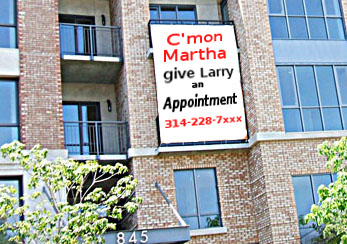
Until October of 1972, when Larry had a 15 foot banner made that said: “C’mon, Martha. Give Larry an Appointment. Call 314-228-7xxx.” He hung the banner on the building across the street, so that each time Martha looked out her third floor office window, she saw it.
Martha is an Identified Prospect
When prospects are identified, we have their contact information available. Instead of sending a letter to “occupant” and hoping someone reads it, we address that offer to a specific person.
Instead of running a 30 second TV ad to reach the whole viewership in hopes enough of those viewers might be interested, we pick up the phone, dial a particular prospect, and ask.
Presumed Prospect:
The prospect goes to her mailbox, and retrieves an envelope from Smiling Ralph’s Auto Emporium addressed to “Occupant,” or maybe “Resident.” The letter says, “Dear Neighbor, its time for Smilin’ Ralph’s Legendary Upgrade Your Ride sale, this Saturday at Smilin’ Ralph’s.”
Identified Prospect:
The prospect goes to her mailbox, and retrieves an envelope from Smilin’ Ralph’s Auto Emporium addressed to her. The letter says, “Dear (prospect’s name), your 2006 Chevy Silverado is worth $15,575 toward the purchase of a new Toyota Tundra 11 Crewmax at Smilin’ Ralph’s.”
The General Public is Too Vast
If Ralph sends letters to the general public, he’s sending them to people who don’t drive; to people who just bought a car; people who will not buy a pickup; people who will not buy any foreign-made vehicle, and people who simply can’t afford one.
The more non-buyers Ralph can remove from the Presumed Prospect list, the greater the percentage of sales which result from offers he presents to those remaining. This has the effect of driving advertising down cost per sale. All of his advertising becomes more efficient.
So, instead of sending the Occupant letter to everyone in town, Ralph uses some combination of geography, demography, and psychography to eliminate as many non-qualified prospects as is practical. Its Ralph’s goal to to spend no money to reach people who won’t buy. Its his hope a significant number of the remaining Presumed Prospects will.
We prefer to know more about our prospects, than less. We like efficiency.
Like Ralph, we look for similarities in age, income, event attendance, radio listening, magazine subscriptions, and other purchasing habits among our current Core Customers. We systematically eliminate groups of people from our Presumed Prospect listswho don’t match the profile.
Of course, the ultimate in knowing “more” is to have their names, addresses, and previous purchase information. This moves them from the Presumed Prospect list to the Identified Prospect list. Getting those people to self identify is the primary function of two-step advertising.
So, Identified Prospects Are Better?
Not better. More efficient.
C'Mon Martha Banner
Larry was willing to pay to hang a banner in Martha’s view because he knew she was a buyer. A big buyer. His risk of spending to reach a non-buyer is zero.
The cost of the banner may make it questionable as a good investment, but the sheer size of the anticipated payoff made this one worth the gamble. Of course, banners aren’t the only medium. And they are costly.
Compare the cost of Larry’s banner with the much smaller cost of a local radio ad. Ah, but radio presents another problem. To schedule that ad, Larry would have to know which stations Martha listens to, and the time she listens. He needs to know whether she is paying attention, or if she’s chosen that exact minute to return a phone call.
Odds are high Larry won’t pick the right time to schedule his ad. He’ll hedge his bet by purchasing ads on more radio stations, over greater periods of time, and for several more days. Maybe Martha will hear one of them. And unless Martha picks up the phone and calls him, Larry won’t even know when she’s heard it and he can stop paying for additional ads. Yeah, radio’s an expensive way to reach one single person.
OK. Larry could rent a billboard and put his message on it. Oh, wait a minute. Which route does Martha take to work? Does she drive, or take the bus? Will she be more likely to notice the message going to work or coming home. Larry is right back in the unenviable position of needing to buy a lot of boards, too.
And television? Larry doesn’t know which television programs she likes or which of those she’ll choose to watch at the time he’s scheduled the ad to run. Even if he did, can Larry be sure she won’t choose that commercial break as the best time to raid the ‘fridge? Come to think of it, doesn’t Martha sing in her church choir? On which night do they rehearse? Is that the night Larry chose to run his ad?
Newspaper? Which paper? Which section? What size ad? How many days? Which days? Looks like a significant budget for newspaper, should Larry choose it.
Mass Media is a Terribly Inefficient Way to Reach a Single Buyer
But, odds are Martha isn’t the only radio listener / television viewer / outdoor or newspaper reader. She’s likely one of many. How many depends on the station (or location, or circulation), and the time of day (or placement).
How many of those other people may be prospects? Ah. Good question. That sort of brings us back to the basics, and back to the concept of Presumed Prospects, doesn’t it?
As a general observation, the more we know about a shopper / potential buyer, the more it costs to expose that shopper to our message.
This concept is important. I’m going to repeat it. It always costs more to reach a highly-qualified prospect than one who’s marginally qualified, or not qualified at all.1 But, the more qualified that prospect is, the more likely she is to buy.
So, like nearly everything in advertising, the way to determine the best advertising program for your business is to try a few and compare. The cost of each ad isn’t really relevant. Divide the number of dollars resulting from advertising driven sales by the total cost of the advertising.
The Exception
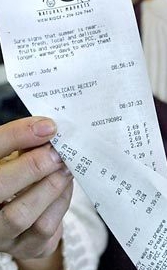
Cash Register Receipt
We know far more about existing customers than about any Presumed Prospects or Identified Prospects. Well, we should.
People who’ve already bought are most likely to do so again. Since you already know each customer’s name, her address (or e-mail address) and what she bought, you can craft an individualized offer and deliver it for the price of a stamp.2 (You do know this information, don’t you)?
There’s a grocery two blocks from my home. If 30 days goes by and they don’t record any purchases from me, coupons for the exact brands I prefer appear in my mailbox. They offer me 30 cents off six cans of Campbell’s® cream of chicken soup, and ring up a hundred dollars or so of other groceries on my next trip in.
And, our relationship is invisible to that grocery’s competitors. No one knows they sent the coupons but them, and me. And maybe my Postman, but he’s not telling.
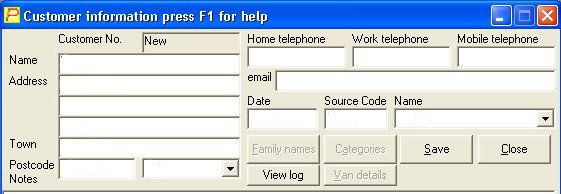
Customer Data Screen
Do you have a system to capture the pertinent customer information from each sale? You need one. You need to identify the characteristics of your Core Customers and apply those to the Presumed Prospect lists.
I promise, better database management leads to more predictable successes when you’re fishing for customers.
Your Guide, Chuck McKay
Your Fishing for Customers guide, Chuck McKay, gets people to buy more of what you sell.
Got questions about creating a customer database? Drop Chuck a note at ChuckMcKay@ChuckMcKayOnLine.com. Or call Chuck at 304-208-7654.
1. Martha and Larry are real people. I heard the story from Larry, years after he retired. After three days of her friends, colleagues, and other media reps calling to ask, “Well, are you going to give Larry the appointment?” she did. And, not surprisingly, she eventually placed a schedule.
2. When you send offers to your core customers, call it “Core Mail,” to distinguish it from Direct Mail.
Q: I keep reading that narrower focused ads are more effective, but I don’t have a very big advertising budget. I can’t afford to pass up anyone who might be interested in what I sell. Shouldn’t my ads include everyone?
A: Short answer, “no.”
Here’s why: Unless you’re a recording engineer, or perhaps a recording musician, you’re probably not interested in advertising for a new Pro-Tools plug-in. If you’re exposed to such an ad, you probably won’t even notice it. You definitely won’t remember it.
You do the same thing with all of those other products and services in which you have no interest: sumo wrestling, cheeses of the world, the position of the guy running for school board in some other district, crosspoint stitching, 18th century English poetry, building a wind-powered electrical generator, tourism guides to Toronto, and the genealogical history of your brother-in-law’s family.
What happened when you were “exposed?”
Did you consciously consider, then choose to ignore these offerings as they competed for your attention? Nope. You didn’t recognize any value to you, and stopped further consideration. Gone. Poof. No longer exists in your universe. Maybe never did.
All of those people you’ve been attempting to “woo” to your business react in much the same way. Either they are interested in your advertisement, and will allow more information to enter their “What’s In It For Me” filter, or they aren’t, and relegate your ad to “ignore” status.
Now, when it comes time to compose an ad for your business, people will not see “office supply store” and immediately think, “Hey, they probably have flash drives, too. I could go there and compare prices with the computer store.” Instead, they’ll see “office supply store” and immediately think, “I don’t need office supplies.”
You’ve already been dismissed.
Its not that people are too lazy to figure out what you’ve got for them. They made the decision to ignore what you’re saying long before such a puzzle might even occur to them.
This is why you must create your advertising from the perspective of a potential buyer. Potential buyers, by the way, don’t think of what they want in terms of “all their (blank) needs.” And as long as your ads say that, or “fast, friendly, courteous service,” you can count on being ignored.
But, what if instead, you’d created an ad that said, “We’re a modern office supply store. We recognize that in addition to paper, toner, and desk calendars, today’s office may need blank DVDs, hub adapters, and hard drive upgrades. Come visit our computer supply department, and while you’re there, pick up a 16-gig USB flash drive for only $17.95?”
Would someone who needed a flash drive react to that ad? Highly likely.
But you have more things for sale than flash drives, don’t you? A whole store full of other things. Hummm. I guess you’ll need to create other ads for those items.
There is no universal bait. You must choose the fish you wish to catch when you’re fishing for customers.
Your Guide, Chuck McKay
Chuck McKay
Your Fishing for Customers guide, Chuck McKay, gets people to buy more of what you sell.
If you have more questions about copy strategies to sell more of what you offer, Chuck welcomes your email, or call him at 304-523-0163.
Bob’s is the only hardware store in Elk Snout. Bob’s buys a weekly quarter page in the Elk Snout Gazette for $230. Bob’s grosses $6,700 per week, year round (since there are no seasons in Elk Snout).
One day, the new Gazette salesperson convinces Bob’s manager to purchase an additional $200 ad in the Graduation Issue of the paper. That week, Bob’s revenue jumps to $7,100. “Well, I guess the new kid was right,” says Bob’s manager, “we just doubled our money.”
But, as the manager adds up all of Bob’s payables, he seems to have $64 dollars less to pay the bills than he expected. How could he be short? He even had the extra profit from the extra Graduation ad.
By some odd coincidence, you operate a small factory in Elk Snout making stone trivets. You sell them to hardware stores like Bob’s. That salesperson for the Gazette must have been pretty good. He got you to buy one of those $200 ads in the Graduation Issue.
Your gross increased by the same $400. At the end of the month, after you’ve paid the trivet factory bills, you find that you have an extra $15.
You and Bob’s weren’t alone in that Graduation Issue. The injection molding company and the nightclub also purchased $200 ads, and amazingly, they too each saw sales increases of $400 that week.
But when they reconcile their payables, the nightclub seems to have picked up an extra $170, but the injection molding company comes up short $332.
What’s going on??
It’s the effect of gross margin.
Gross margin is profit divided by selling price.
Let’s look at your trivet company financials. Every trivet costs $4.50 to produce. You sell them to Bob’s, and similar stores, for $9.75. Your gross margin is $5.25 divided by $9.75, or 53.8 percent. This means that for every dollar you take in, 53.8 cents falls to the bottom line, while 46.2 cents is consumed in the production of trivets.
The injection molding company operates with a gross margin of only 17 percent, using up 83 cents of every dollar manufacturing the plastic parts which they sell for that dollar.
But over at Bob’s Hardware, each dollar of gross sales produces 34.1 cents in net profit, which means that 65.9 cents of each of Bob’s dollars gets used to purchase and stock the hardware.
And at the nightclub, forty cents worth of rum and 5 cents worth of cola costs the customer $6.00, and provides an astonishing 92.5 percent gross margin.
So, what does gross margin have to do with advertising?
It isn’t simply dollars in minus dollars out.
In Hope is Not a Strategy for Greater Return on Advertising Investment, I said, “If advertising is an investment, you should expect to see a predictable profit from that investment. Invest a dollar in advertising, get back four, or five, or six. At the very least, shouldn’t you get back a dollar ten?”
Alas. A dollar ten returned on a dollar invested will have three of our four fictitious companies losing money. You see, each company’s revenue is in gross dollars, but each ad is purchased with net dollars. When a portion of each gross dollar is eaten up in the expense of generating sales, it takes more of the remaining net dollars to do the job.
You won’t know whether your advertising is profitable until you calculate Return on Advertising Investment (ROAI), wich is the reciprocal of gross margin. If you have a 50 percent margin, your advertising must return at least double your investment. At a 20 percent margin, you’ll need five times the investment. At 5 percent margin your ROAI needs to be 20 times.
Let’s look at this in chart form.
Gross
Breaks Even
Investment
Margin
at ROAI of:
Nightclub
$1.00
92.5%
$1.08
Trivet Company
$1.00
53.8%
$1.86
Bob’s Hardware
$1.00
34.1%
$2.93
Injection Molding
$1.00
17.0%
$5.88
The last column shows the sales increases each company needs to justify each dollar that company invests in advertising.
If the nightclub gets back anything in excess of $1.08, their advertising is profitable. But, if the injection molding company doesn’t see sales increases greater than $5.88 for each dollar invested , they’d be better off not advertising at all.
Your trivet company breaks even when each dollar spent returns $1.86. Bob’s breaks even when $2.93 returns. Compared to Bob’s Hardware, you get a $1.07 advantage in every dollar you invest in advertising. But compared to the injection molding company, each dollar your trivet company invests buys $4.02 more.
What about that $200 ad in the Gazette?
The nightclub did well. Your trivet company did, too.
Gross
Breaks Even
Effect of $400
Investment
Margin
at ROAI of:
Sales Increase
Nightclub
$200.00
92.5%
$1.08
$170.00
Trivet Company
$200.00
53.8%
$1.86
$15.20
Bob’s Hardware
$200.00
34.1%
$2.93
$-63.60
Injection Molding
$200.00
17.0%
$5.88
$-132.00
OUCH! Bob’s Hardware and the injection molding company not only didn’t make a profit on their $200 advertising investment, they actually lost operating capital.
And it all has to do with Gross Margin. If you don’t know your margin, how do you know whether your ads are “working?” How do you even know how much to budget?
Most companies don’t produce only one product. They need to calculate an average gross margin by dividing total operating profit by total gross sales.
What is your company’s average gross margin? What is the ROAI you need to stay profitable?
Fishing for Customers isn’t simply being ready to “hook ’em.” Sometimes it’s knowing how much you can afford to spend on “bait,” too.
Your Guide, Chuck McKay
Your Fishing for Customers guide, Chuck McKay, gets people to buy more of what you sell.
Got questions about expressing the specific values and advantages of what you sell? Drop Chuck a note at ChuckMcKay@FishingforCustomers.com. Or call him at 760-813-5474.

 Your Fishing for Customers guide, Chuck McKay, gets people to buy more of what you sell.